Holy Cross Abbey: A Cistercian Monastery and Parish Church in Ireland
Site at a Glance
- Popularity
- High
- Country
- Ireland
- Primary era
- Medieval
- Eras represented
- Medieval
- Civilizations
- Irish, Norman
- Site type
- Religious
- Remains
- Monastery
On this page14 sections
History
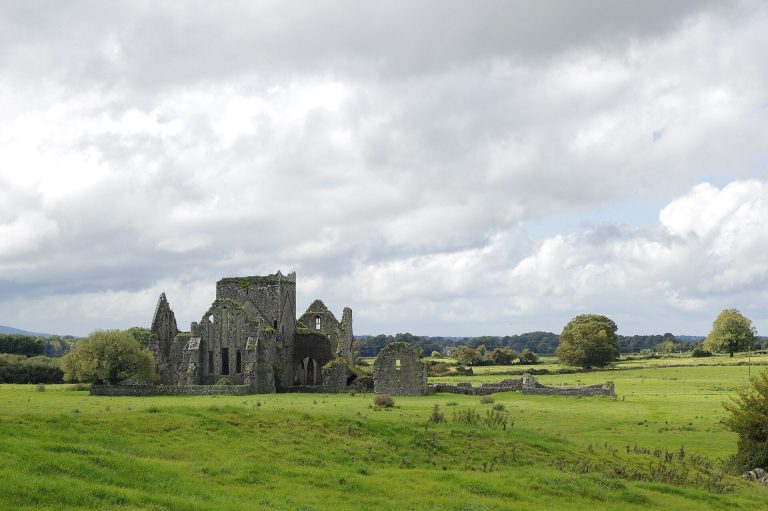
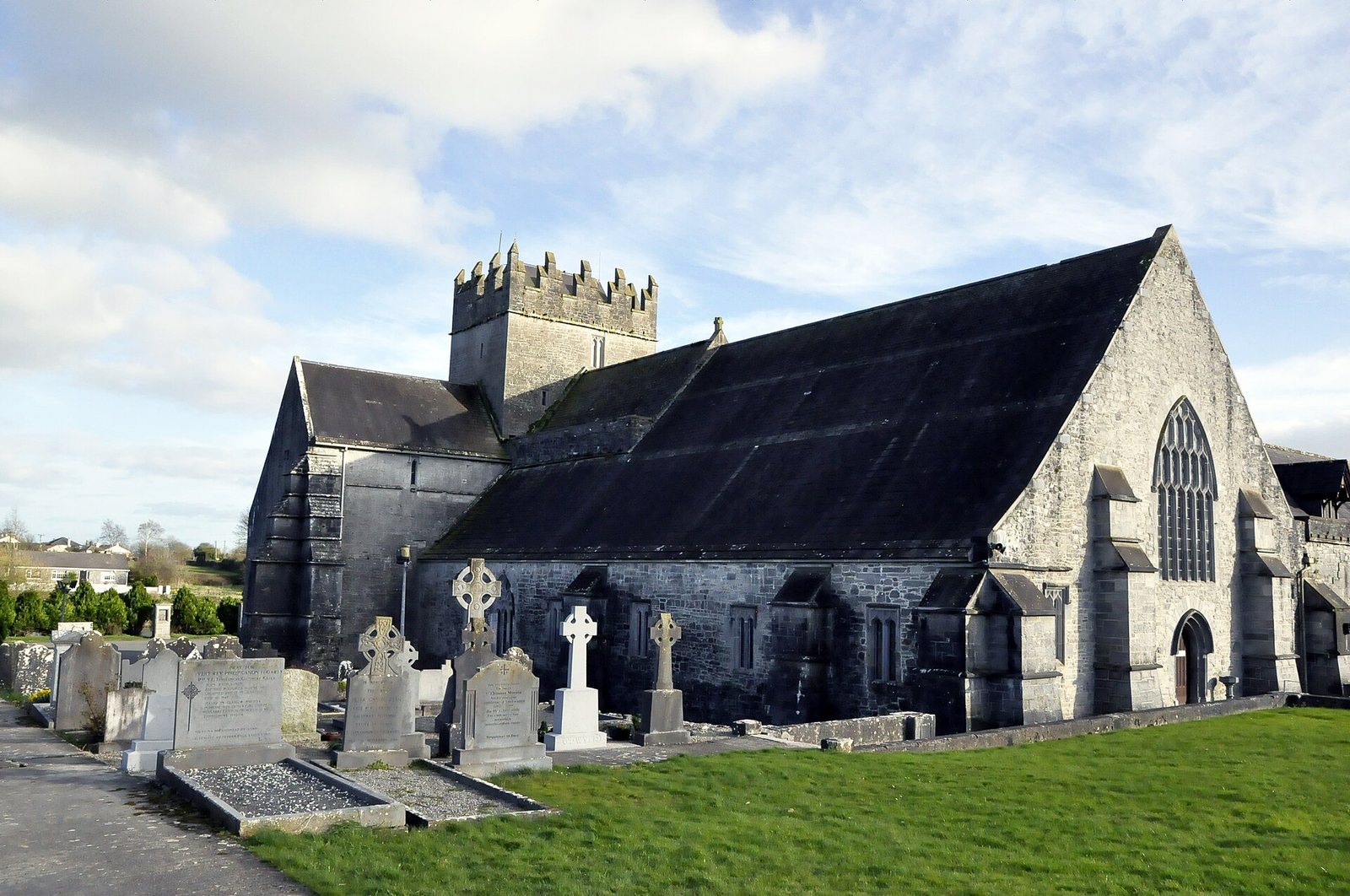
Holy Cross Abbey is a former Cistercian monastery that now serves as a Roman Catholic parish church on the western bank of the River Suir in County Tipperary, Ireland. Domnall Mór O’Brien, king of Thomond in western Munster, founded it in 1180. Its church took much of its present form through a late-Gothic rebuilding in the fifteenth century, and the abbey became a pilgrimage destination through its association with a relic of the True Cross, traditionally identified as the cross used for Jesus’ crucifixion.
Foundation and early difficulties
Holy Cross was a daughter house, a monastery founded from another community, of Monasteranenagh Abbey. It belonged to the Clairvaux branch of the Cistercian order, associated with the major French abbey of Clairvaux. It was the eleventh of 42 medieval Cistercian abbeys in Ireland and established no daughter houses. The foundation charters date to 1185–86.
The monastery’s early progress was troubled. In 1227, a Cistercian inspection considered closing it and joining its community to Abington Abbey. Stephen of Lexington, a Cistercian monk and administrator, decided that Holy Cross should continue and sent a monk from Dunbrody to strengthen the house. The intervention also opposed the Mellifont conspiracy, a revolt against Anglo-Norman practices that was advanced in the name of unity within the Cistercian order.
Pilgrimage and rebuilding
The abbey’s relic drew pilgrims for roughly three and a half centuries. Its origin is uncertain. One tradition says Pope Paschal II gave it to Murtogh O’Brien, Domnall’s father, in 1110. Another links it to Isabella of Angoulême, queen consort of King John of England and later wife of Hugh X of Lusignan. In this account, she brought the relic to Ireland around 1233 and gave it to Holy Cross in gratitude for the monks’ burial of her son Pierce.
The relic also became a focus for Catholics facing religious persecution. It was associated with Catholic resistance and, in some claims, Irish independence. In 1567, English official Sir Henry Sidney complained to Elizabeth I about the abbey’s influence. During the fifteenth century, the Earls of Ormond protected Holy Cross. James Butler, the fourth earl, gave substantial support for rebuilding, work that may have begun in 1431 and continued to the end of the century.
Dissolution and continued religious use
In 1536, Cistercian abbot John de Newry criticized the monks’ lax observance and issued nine rules addressing worship and conduct. At the dissolution of the monasteries, the abbey’s annual income was assessed at £66. This was modest by comparison with English abbeys, but above the average for Irish monasteries. Abbot Philip Purcell tried to preserve the community by turning it into a secular college, but royal officials seized its land and movable property and granted them to aristocrats.
In 1558, Thomas Butler, then the abbey’s owner, permitted monks to use its buildings on the condition that they serve the parish according to the Book of Common Prayer, the Church of England’s principal historic service book. The Catholic Archbishop of Cashel and Emly, Dermot O’Hurley, came on pilgrimage in 1583.
On 30 November 1601, Hugh Roe O’Donnell, lord of Tyrconnell, made a pilgrimage to venerate the relic during the Nine Years’ War, a major conflict in Ireland from 1594 to 1603. He then sent an expedition to Ardfert, where it recovered territory belonging to his ally Thomas Fitzmaurice, the eighteenth Baron Kerry. This was O’Donnell’s last victory before the defeat at Kinsale. The relic was last displayed publicly in 1632.
Renewal, decline, and modern use
Luke Archer became abbot in 1613 and sought to establish Holy Cross as a novitiate, a house where people prepared to take religious vows, for Irish Cistercians. Recognized as the order’s vicar general in Ireland, an official authorized to exercise delegated authority, he appointed monks to lead houses including Mellifont and Dublin. Some appointments may have been honorary rather than evidence of active communities. Under political pressure, Archer and his monks left for Kilkenny in either 1623 or 1632. Illness forced him to end his efforts in 1637; he died in 1644 and was buried at Holy Cross.
The renewal effort ended with the English conquest of Ireland under Oliver Cromwell in 1649–50. Religious life at the abbey nevertheless continued under arrangements supported by English patrons until 1740, when the last abbot, Edmund Cormack, died and its religious vocation ended. The buildings then fell into neglect for nearly a century.
The True Cross relic was thought to have disappeared by 1807. It was reportedly recovered around 1880 and returned in 1888, although another tradition places it eventually at an Ursuline convent in Cork. In 1833, the abbey’s new owner, Charles Wall, began restoration work on the nave and the choir’s eastern windows. Ownership passed to the state in 1880, when the abbey became a protected National Monument, a legally protected historic site, and was ordered preserved.
Special legislation in 1969 permitted the abbey to return to Catholic worship as an exceptional use of a National Monument. The church resumed use as a parish church that year, with alterations for this purpose carried out between 1971 and 1975. In 1969, the sacristan of St Peter’s Basilica in the Vatican supplied an authenticated relic of the True Cross, and the Jerusalem Cross, an emblem with a central cross and four smaller crosses, was restored to the abbey. Holy Cross is now a parish church in the Archdiocese of Cashel and Emly, a territorial church jurisdiction headed by an archbishop, and its stated patron is Mary, the mother of Jesus.
Remains
Church
Plan and surviving fabric
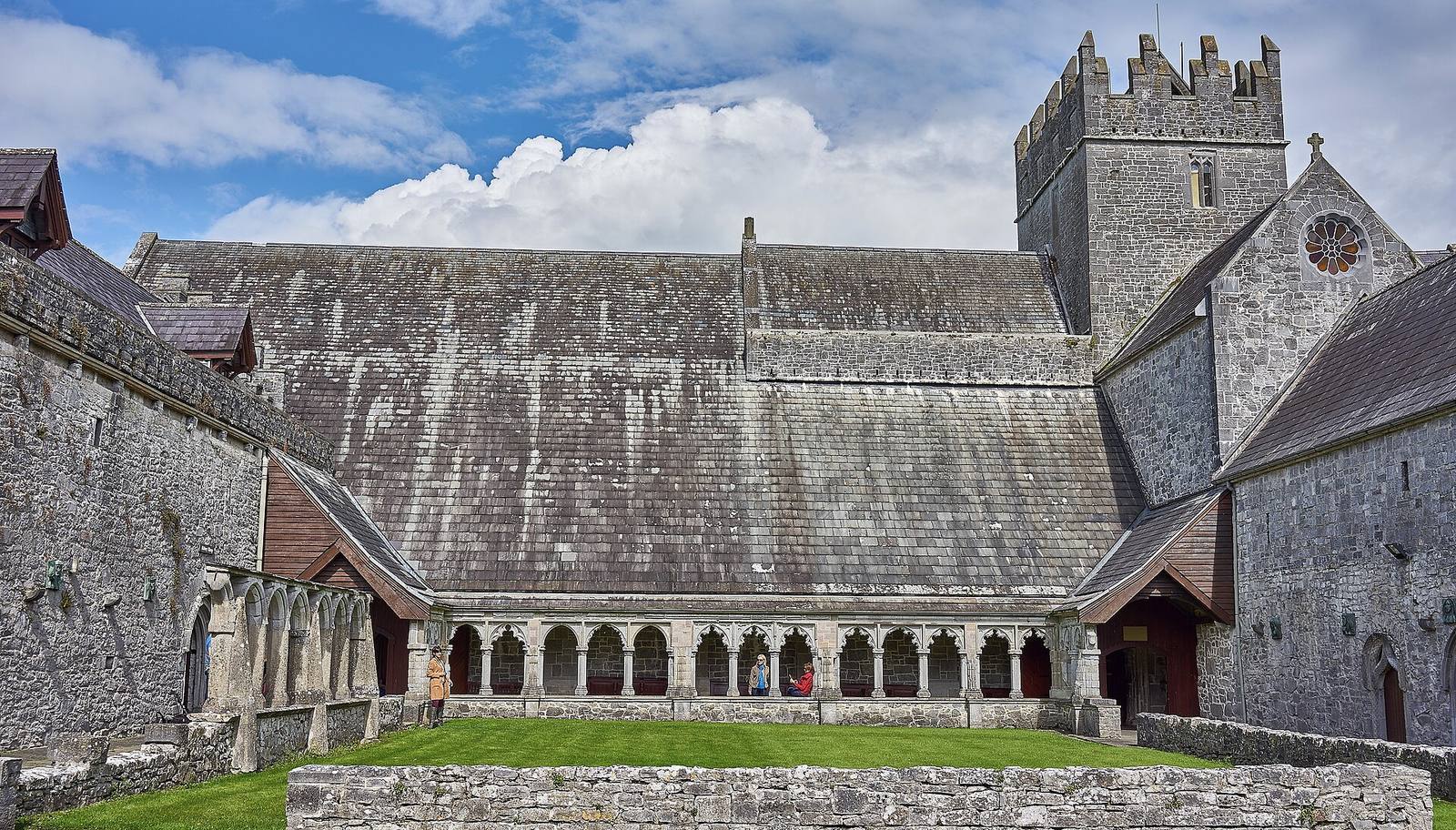
The church is oriented east and has a cross-shaped plan, shifted slightly south to fit local constraints. Its principal parts are the nave, or main body; the transept arms, which extend across it; the crossing, where those arms meet; and the choir, the area used by clergy and singers during services. The choir ends in a flat east wall. Two side chapels on each side of it open onto the transept arms. The north nave arcades and some features on the south side preserve work from the twelfth century. The church was altered and enlarged in the fourteenth century.
Crossing, choir, and chapels
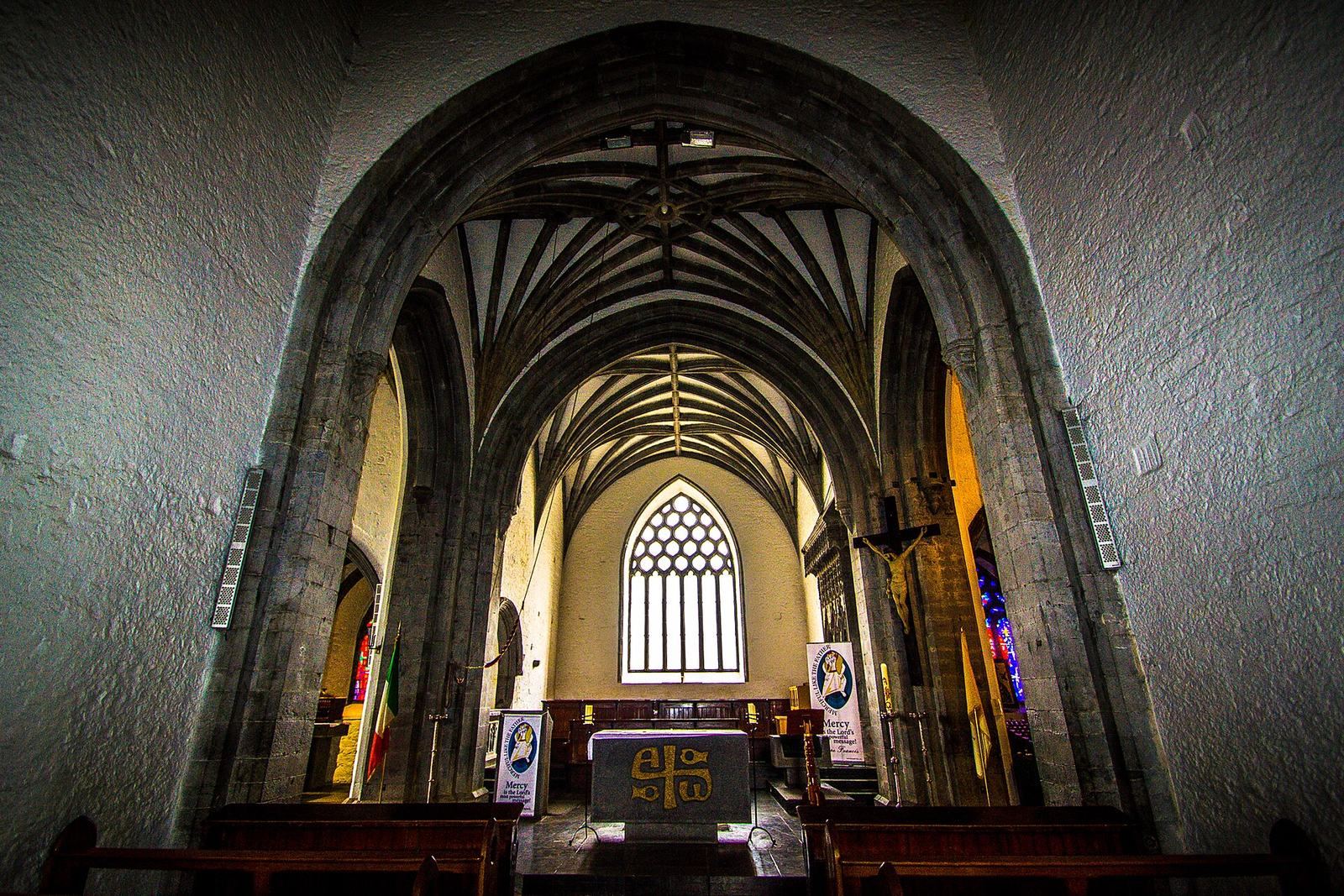
A square tower rises over the crossing. Stone vaults cover the crossing and choir, while the nave has a wooden ceiling and floor. A stairway is set in a transept. The church has notable windows at its west and east ends and in the south transept. French influence is reflected in the eastern window, the grooved roofs over the choir and side chapels, and the rib vault, a ceiling supported by intersecting stone ribs, beneath the tower. The choir’s sculptural decoration is well preserved, a condition attributed to the durability of the local limestone. The tower is believed to contain Ireland’s oldest bell.
Each transept has two chapels on its eastern side. One of the south chapels has a notable vault. Between the southern chapels, a passage has a roof supported by two twisted columns; it may have been where the relic was displayed. Faint traces of painted decoration remain in the north transept’s chapels.
Cloister and monastic ranges
The cloister stands south of the church. Its western range held the storage room and dormitory. The eastern range contains the sacristy, where items for worship were prepared, the chapter house, where the community met, and a parlour for conversation.
Tombs and sacred objects
Tomb of the Good Woman’s Son
A fourteenth-century monument in the choir is known in English as the Tomb of the Good Woman’s Son.
Tomb traditionally attributed to Isabella
Another tomb, traditionally attributed to Isabella of Angoulême, is set within a group of clergy seats beside the choir. Its openwork is patterned with foliage and displays a cross of St George and the English royal arms quartered with those of France.
Relics and cross
The parish’s relics of the True Cross and a separate gold cross were stolen on 11 October 2011 by thieves using a portable angle grinder. Garda Síochána recovered both objects a few months later. They were returned to the parish on 17 January 2012, relatively undamaged.