Palazzo Pretorio: Crema’s Municipal Palace
Site at a Glance
- Popularity
- Very Low
- Country
- Italy
- Primary era
- Early Modern
- Eras represented
- Early Modern, Modern
- Civilizations
- Italian, Venetian
- Site type
- Civic
- Remains
- Palace
On this page16 sections
History
Origins and construction
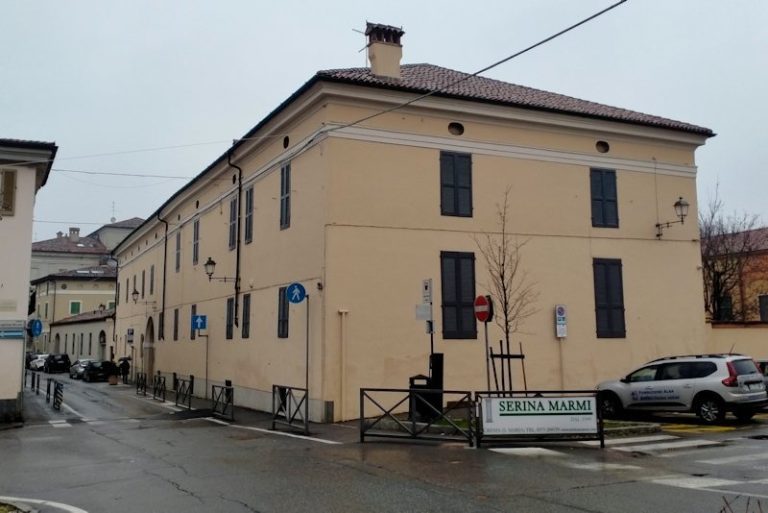
Palazzo Pretorio is a municipal palace in Crema, Italy, built in its present form from 1553 to 1555 in a sixteenth-century style. Historians and architectural evidence point to possible origins as early as 1286, but the later palace was constructed for the Municipality of Crema on the site of demolished old houses.
Under Venetian rule
During the rule of the Venetian Republic, the state governed from Venice, the palace served as the residence of Crema’s podestà, or chief magistrate. Appointed by the Venetian Senate, the city’s central governing body, the official also acted as captain and held office for sixteen months.
While the palace was under construction, Vincenzo Civerchio painted the now-lost Battle of Ombriano. It showed the Sforza, the ruling dynasty of Milan, defeated by the Italian commander Renzo da Ceri in 1514, an outcome that ended Crema’s siege. In 1633, podestà Marcantonio Falier commissioned Gian Giacomo Barbelli to paint an interior room; that work is also lost. That same year, a cord used for corporal punishment was taken from the palace and moved to the arch of the Torrazzo.
Alterations and later use
The palace was modified during the seventeenth century and more extensively in the eighteenth. On 13 April 1768, an explosion at a gunpowder-making site between Porta Ombriano and Porta Ripalta killed many people and badly damaged several buildings, including the palace. In 1801, its prisons were demolished and an underpass took their place.
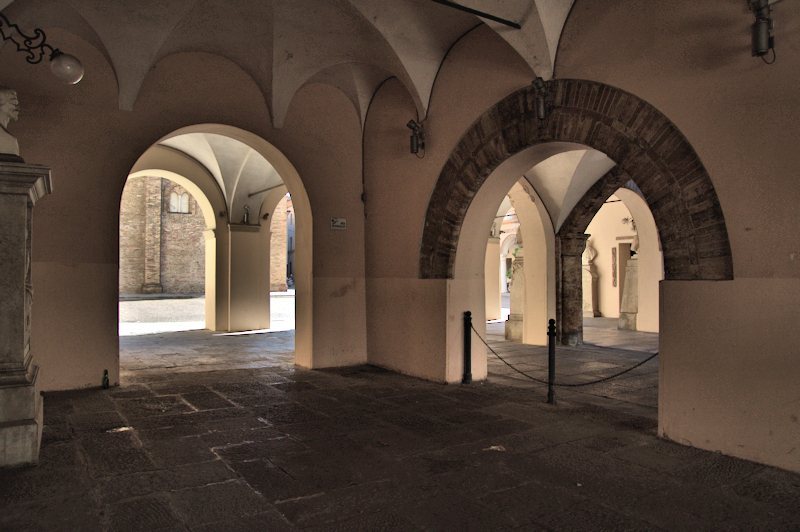
A famedio, a memorial space honoring notable people, was established beneath the portico in 1876 at the initiative of engineer Felice Francioli. It was first screened by a gate, and its location changed after the Second World War. Extensive restoration in the 1960s altered the interior and brought new uses for its rooms. Rooms beneath the portico, once used by the Guard Corps and later by the Hygiene Office, were demolished to make a third pedestrian lane. Palazzo Pretorio now houses municipal offices and serves representative functions.
Remains
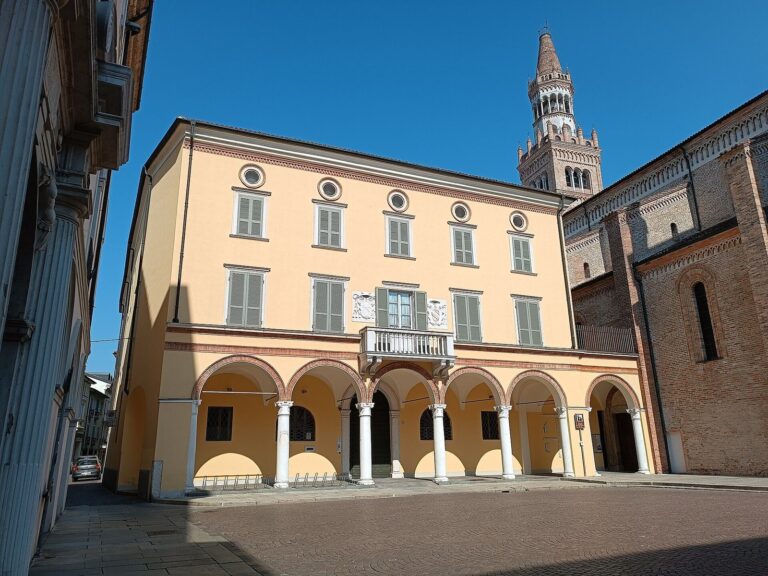
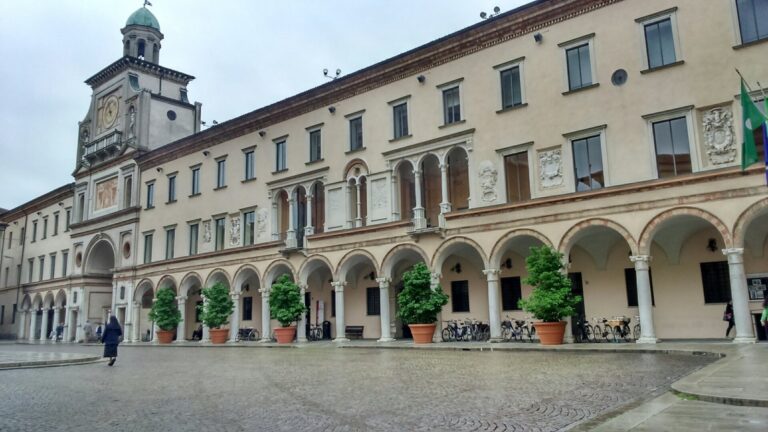
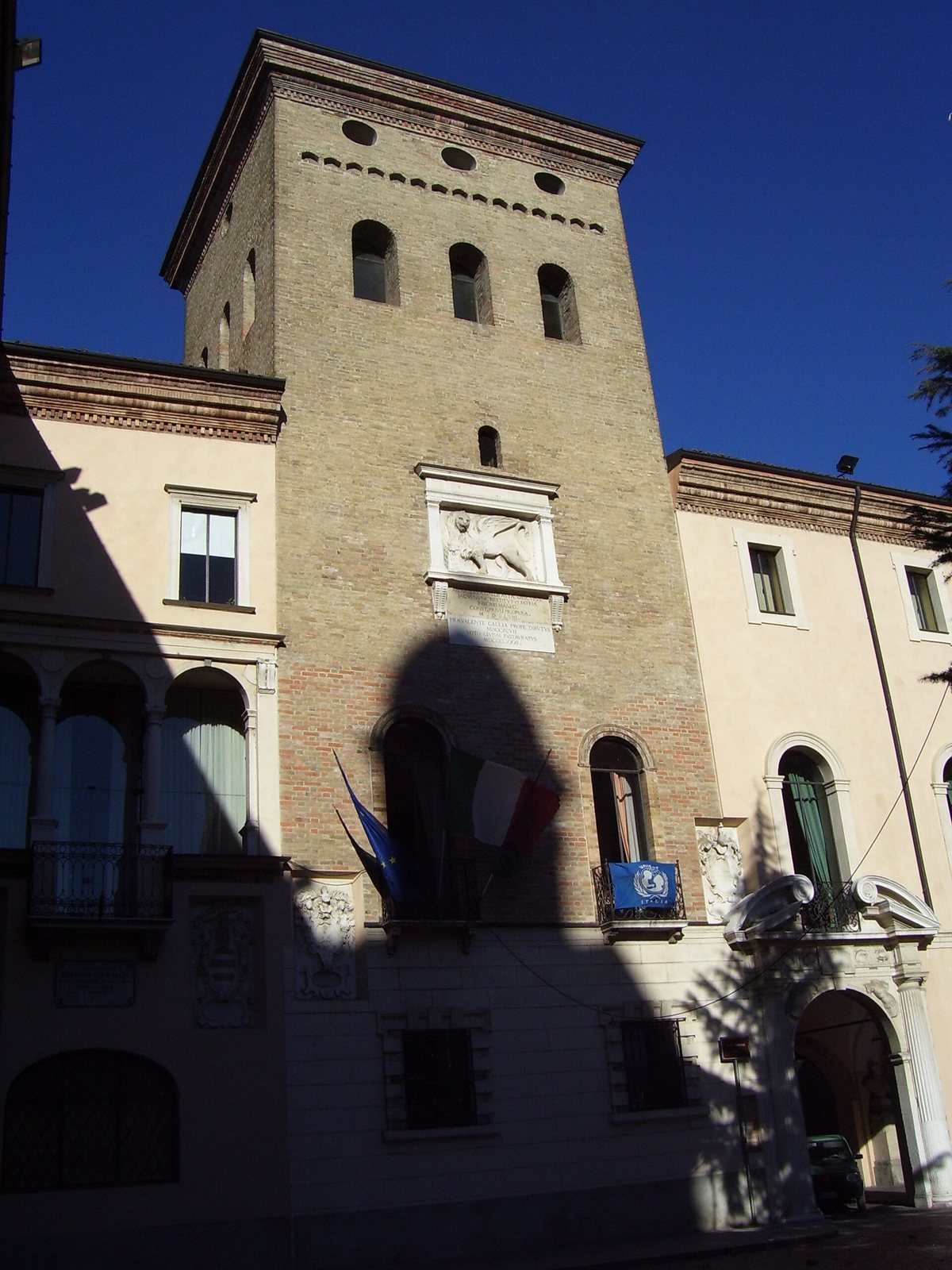
On the north side of Piazza Duomo, beside the medieval Torre Pretoria, Palazzo Pretorio combines a sixteenth-century-style façade with a monumental entrance, an upper-floor suite of rooms, and a portico. The principal staircase curves around a small cloister and courtyard, while an underpass occupies the former prison area.
Architecture and circulation
Façade and portal
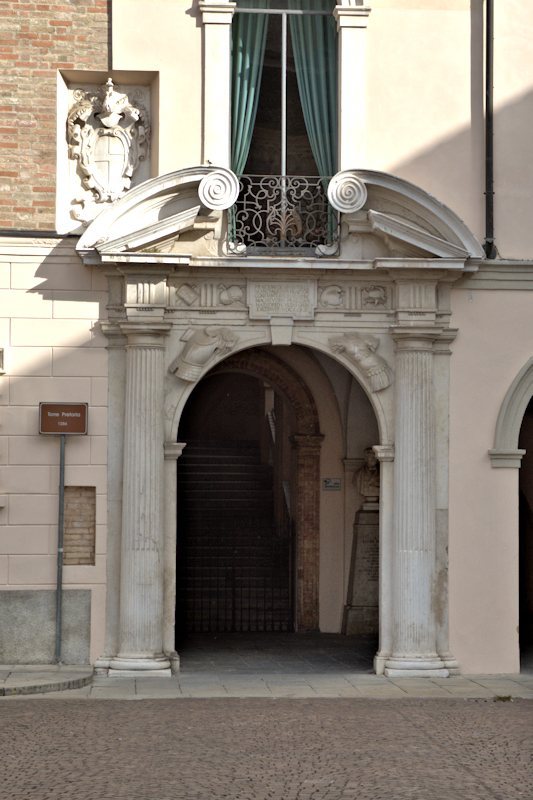
The façade faces the square and harmonizes with its surrounding buildings. Eighteenth-century work added openings on the side facing Via Frecavalli and marble elements to the arches. The monumental portal, installed in 1634, is made of Botticino marble, a decorative stone quarried near Brescia. Its classical design incorporates military symbols, and an inscription thanks Marcantonio Falier, who paid for it.
Staircase and courtyard
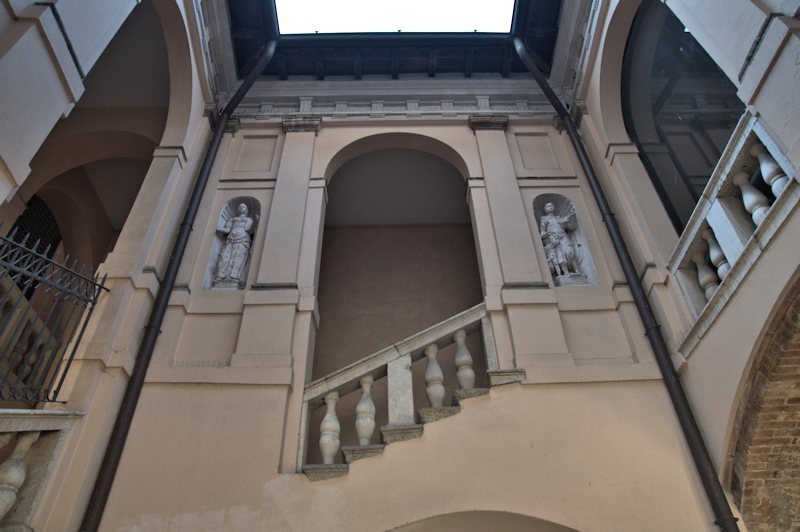
Aligned with the portal, the grand staircase once led to the Council and Moceniga halls. The latter was named for Venetian podestà Luigi Mocenigo, whose term in Crema ran from May 1590 to August 1591. Around the small cloister and courtyard, the staircase has arches, balustrades, and pilasters, shallow column-like projections from the walls, topped by terracotta capitals. A classical cornice and two faux-marble statues representing virtues complete the ensemble.
First-floor rooms
The Council Room displays ten portraits of Venetian podestà, seven attributed to Gian Giacomo Barbelli. The Reception Room has a sixteenth-century coffered ceiling, formed from recessed panels, and was once decorated with frescoes by Carlo Urbino. Those paintings are lost.
Underpass and portico
The underpass runs through the space once occupied by the prisons. The portico includes the pedestrian lane created during the 1960s restoration, when the rooms that had housed the Guard Corps and Hygiene Office were demolished.
Memorials and commemorative works
The famedio
The memorial beneath the portico contains works honoring several Crema citizens. A bust of musician and composer Stefano Pavesi, made by sculptor Micoli in 1862, stands alongside a bust of Barnabite cleric, physicist, and astronomer Giovanni Maria Cavalleri. Barnabites belong to a Catholic religious order; sculptor Corbellini made Cavalleri’s bust in 1876. Corbellini also created a memorial that year for hydraulic and cartographic engineer Carlo Donati De’ Conti.
Other memorials honor Giuseppe Benzi, musician and composer who served as chapel master, directing music, at Crema Cathedral, and lawyer Pietro Donati. The latter work, made by sculptor Barzaghi in 1887, commemorates a promoter of schools and the library who served as a deputy in the tenth, twelfth, and fourteenth legislatures of the Kingdom of Italy. A bust of notary Stefano Allocchio, made by Bassano Danielli in 1907, is also present. Historian Mario Perolini identified a bust of philanthropist Francesco Grassi, who founded a charitable institution through a bequest in 1861, as part of the memorial. It may have been lost during the 1958–62 restoration.
Works formerly on the façade
Two works by Bassano Danielli that once stood on the palace façade are now in a cloister of the Civic Museum of Crema and the Cremasco. One commemorates musician Giovanni Bottesini and is dated 1901; it is associated with a plaque from 1897. The other honors organist and composer Vincenzo Petrali and dates to 1913.
Memorial to the wars of independence
A plaque-monument in the portico commemorates Crema residents who died in the Italian wars of independence. It names Pietro Bianchessi, Francesco Cominazzi, and Giovanni Gervasoni for 1848–49; Vincenzo Cazzamalli, Pietro Mazzucchi, Vincenzo Moschini, and Quirino Tenca for 1859; Giuseppe Chiodo, Giovanni Foresti, Amilcare Spotti, and Giuseppe Zanetti for 1866; and Antonio De Capitani for 1867.
Resistance and wartime memorials
A bas-relief honors Cesare Battisti, a socialist politician and an Italian irredentist, or supporter of incorporating Italian-speaking territories outside the Kingdom of Italy into the Italian state. Another dedication, dated 1 June 1947, remembers Crema residents deported to concentration camps during the Second World War. A plaque dated 25 April 1946 commemorates those killed in the Resistance. It is associated with the National Association of Italian Partisans, an organization of resistance participants and supporters, and the National Liberation Committee, an Italian resistance organization during the war. The plaque names Angelo Alghisi, Martino Abbondio, Luigi Bestazza, Francesco Follo, Antonio Festari, Carlo Guaiarini, Livio Guarneri, Raffaele Lucini, Santo Moretti, Tommaso Morrone, Ernesto Manfredini, Renzo Pirotta, Antonio Pedrazzini, Gaetano Paganini, Cesare Rigamonti, and Linfardo Volonté.
Other portico plaques
An undated plaque associated with the Crema branch of the National Association of Workers Injured or Disabled at Work commemorates people killed at work. Another plaque honors Giovanni Valcarenghi, Lodovico Benvenuti, and Mario Perolini as founders of the Crema National Liberation Committee; it was installed for the seventieth anniversary of the Republic. A memorial to Crema residents who died because of the COVID-19 pandemic was inaugurated on 28 September 2020.