Palazzo Marazzi in Crema: A Fifteenth-Century Palace
Site at a Glance
- Popularity
- Very Low
- Country
- Italy
- Primary era
- Medieval
- Eras represented
- Medieval, Modern
- Civilizations
- Duchy of Milan
- Site type
- Domestic
- Remains
- Elite Residence
On this page16 sections
History
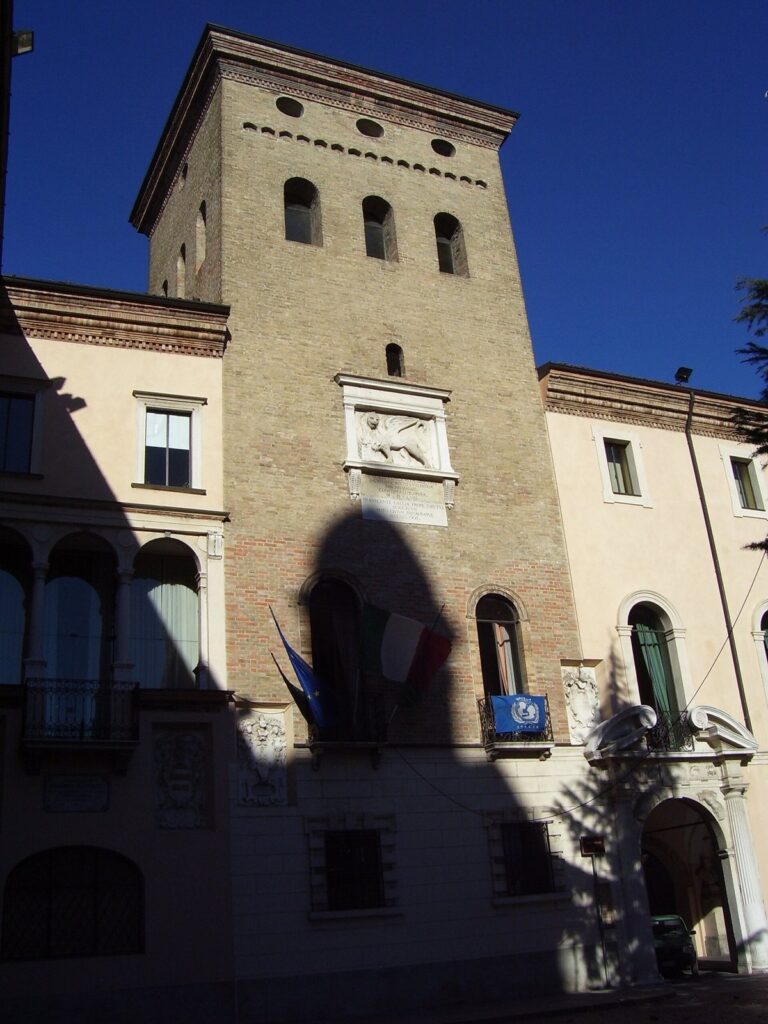
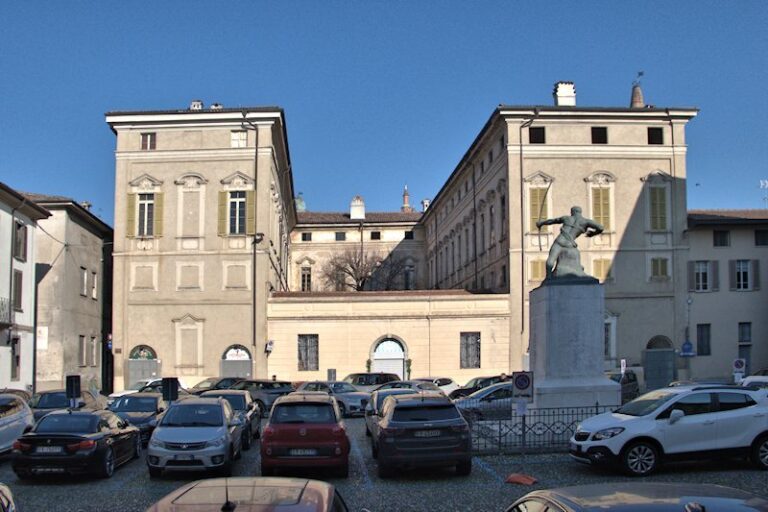
Palazzo Marazzi in Crema is a fifteenth-century palace in Italy, probably built for the Vimercati family. It was also known as Palazzo Vimercati, Palazzo Griffoni Sant’Angelo, and Palazzo Scotti, reflecting families associated with the property over time.
The Vimercati family and the Augustinian gift
The earliest certain record of the property is a will made in 1422 by Giovanni Tommaso Vimercati, drawn up by notary Vincenzo Martinengo. Vimercati left his estate to the Augustinian Hermits, a religious order following the Rule of St Augustine, so that they could establish a convent. The gift appears to have been intended as penance for wealth acquired through usury by his grandfather, Latino, and father, Giovanni.
Tax authorities confiscated the estate because they regarded its origins as illicit, but Duke Filippo Maria Visconti transferred it to the Augustinians by ducal grant. Dominican friars, members of the Order of Preachers, objected that the proposed settlement was too close to their monastery. The Augustinians therefore chose another location, in the Vicinia dei Terni, a local neighborhood district.
Griffoni Sant’Angelo and Scotti ownership
By 1526, the Griffoni Sant’Angelo family lived in the palace. They may have bought it from the Augustinians, who had been unable to take possession. In 1619, Leonarda Griffoni Sant’Angelo married Count Ferdinando Scotti, and the residence passed to the Scotti family of Piacenza. The Scottis kept it until Count Paolo died in 1774.
Ferdinando lived in the palace from about 1620. He held a seat on the Great Council, a political deliberative assembly, and served the Republic of Venice as a military officer, eventually becoming lieutenant general of cavalry.
An inn, coach service, and art collection
In 1815, the property was recorded as an inn belonging to Giacomo Gervasoni, with an entrance from Contrada di Porta Ombriano, now Via XX Settembre. Pietro Antonio Rampazzini later made it the Albergo del Pozzo Nuovo and used it as the terminus for a daily passenger service between Crema and Milan, operated with very light stagecoaches.
Vincenzo Folcioni acquired the hotel and transport business in either 1853 or 1863. His company ran two daily round trips between Milan and Crema, timed to connect with the Milan–Treviglio railway. The coach service ended after the Cremona–Treviglio railway opened. Folcioni, who died in 1883, was also an art collector. His heirs auctioned works associated with painters including Guido Reni, Guercino, Moretto, Andrea Previtali, Vincenzo Foppa, Giorgione, Callisto Piazza, and Andrea del Sarto; some had already been sold. English critic and essayist John Addington Symonds stayed at the hotel and wrote about Folcioni’s collection in Sketches in Italy, questioning some of the grand attributions.
The hotel hosted Italian general Giuseppe Garibaldi and his sons Ricciotti and Menotti on 10 April 1862. After Folcioni’s death, the property passed to the Genzini family and remained with them until 1917.
The Marazzi family and later history
In 1917, Carolina Luchini, Genzini’s widow, sold the palace to Count Fortunato Marazzi, who restored its residential use. His descendants remained its owners. Marazzi was a general, writer, and politician. He served on Crema’s municipal council from 1910 to 1920, sat in the sixteenth through twenty-fourth legislatures of the Kingdom of Italy, and became a senator on 3 October 1920.
Marazzi died in 1921. At his own expense, he promoted a monument to the fallen in Piazza Trento e Trieste, in memory of his son Ottaviano, who died on the Slovenian Karst. The street along the palace’s eastern side was named for Fortunato by a municipal council resolution of 27 July 1923; it had previously been called Canton dei Zavattini.
Remains
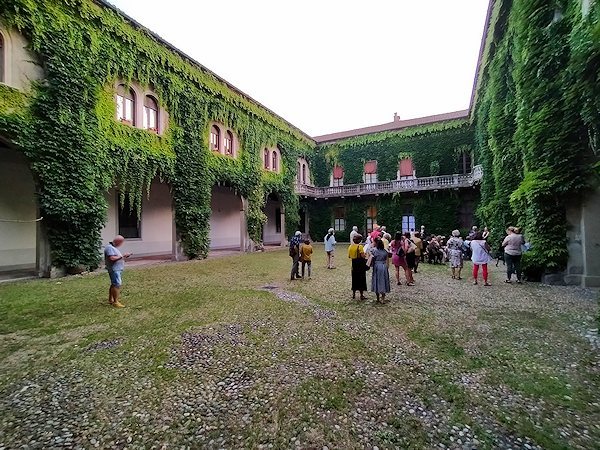
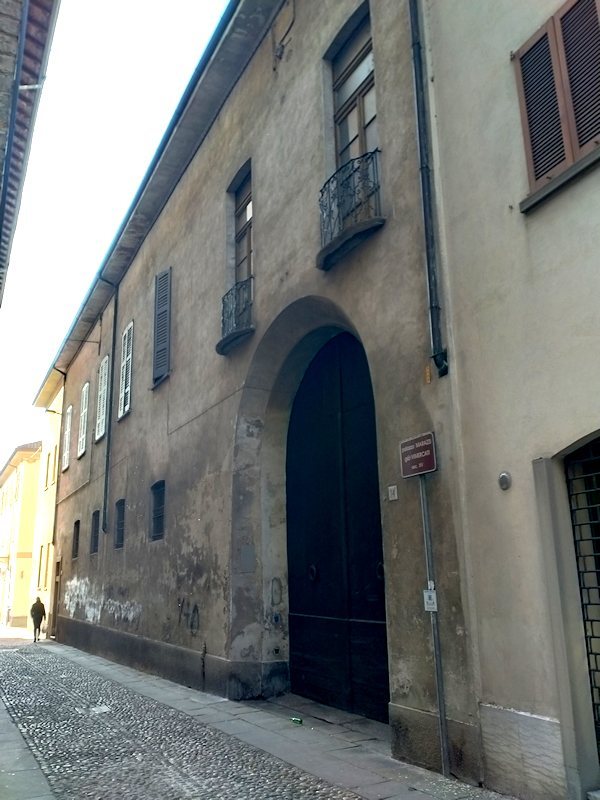
The two-storey palace has a restrained exterior and is arranged around a rectangular, cobbled courtyard. Its surviving features include an older lane approach, covered walks along the courtyard, altered upper-storey openings, and interior stairs and ceilings.
Exterior and entrance sequence
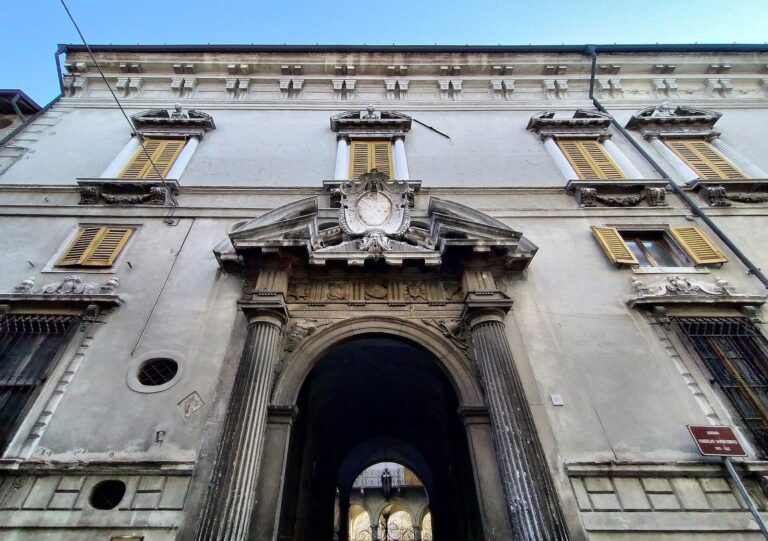
Via Marazzi elevation
The side facing Via Marazzi has plain openings without frames. Two French windows are distinguished by more elaborate wrought-iron railings. This entrance was once secondary, while the principal entrance is thought to have opened onto a lane leading to Via XX Settembre.
Former principal approach
The lane retains cobbles and wheel tracks. At its end, an exposed-brick wall has a ground-level opening, a second-level doorway with a balcony and signs that its opening was narrowed, and a third plain opening. A slight projecting molding finishes the wall above.
Courtyard and upper-storey features
Courtyard walkways
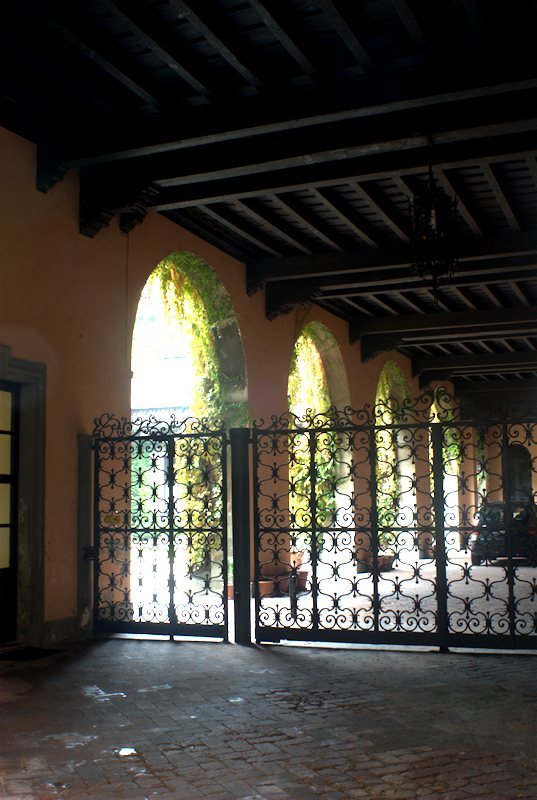
The two entrances lead into a rectangular, cobbled courtyard. Each of its long sides has a covered walkway with five round arches. The northern walkway also has a beamed ceiling, and climbing plants grow throughout the courtyard.
Windows and balcony
The first-floor windows reflect an alteration made either in the nineteenth century or the early twentieth. Openings along the long sides are slightly arched twin-light windows, with two openings within one frame; those on the short sides have horizontal lintels. A balcony runs along the western side and for a short distance along the long sides. Stone brackets support it, and its railing incorporates columns and half-columns.
Interior and commemorative features
Staircase and gallery
A staircase with two flights, a railing, and gray sandstone steps rises to the upper floor. Vincenzo Folcioni commissioned Luigi Manini to decorate the staircase, with the work completed in 1866. The stair ends in an open gallery, where a plaque commemorates Prince Umberto II’s visit to the palace on 17 May 1924. Count Mario Marazzi received the prince when he came to Crema to inaugurate a monument promoted by Fortunato Marazzi.
Ceilings
Some rooms retain ceilings dating to the fifteenth century. One has small wooden panels characteristic of ceilings from that period.
Fortunato Marazzi bust
A bust of Fortunato Marazzi stands at the beginning of Via Lucini. Sculptor Enrico Girbafranti made it, and it was unveiled in 1922. Its inscription recalls that on 8 August 1916, with authorization from Italian general Luigi Cappello, Marazzi led the Sixth Corps in an advance along the Isonzo’s left bank. After two hours of fighting, he retook Gorizia from Austrian occupation.