Kronstadt Fortress: Russia’s Coastal Defense System
Site at a Glance
- Popularity
- High
- Country
- Russia
- Primary era
- Modern
- Eras represented
- Early Modern, Modern
- Civilizations
- Russian
- Site type
- Military
- Remains
- Fort
On this page13 sections
History
Foundation and early defenses
Kronstadt Fortress is a coastal defense system on Kotlin Island in Russia. Peter I, also known as Peter the Great, laid its foundation on 18 October 1723 and gave it the name Kronstadt. The defenses grew from sea forts begun in the early eighteenth century, which repelled Swedish squadrons in 1704 and 1705, into a major stronghold guarding maritime approaches to St Petersburg.
Merchant shipping encouraged harbor construction. After Peter received 45 Dutch and English merchant ships in June 1715, he assigned governors responsibility for harbor works. The Merchant Harbor was completed in March 1719, and Peter approved a general plan for the island and city in 1721. By April 1717, eight permanent defensive works were in place: Old Kronshlot and New Kronshlot, with 42 and 76 guns; Alexander Shants, with 43; the Sergievsky, Ivanovsky, and New artillery works, with 12, 10, and 12; the Bastion, with 52; and the Military Harbor, with 36. In 1720, the harbor defenses were fully armed with 72 guns. The fortress’s total armament comprised 358 cannons, 11 howitzers, and 19 mortars, including 257 guns assigned to guard the fairway. Its garrison had 71 officers and 2,664 enlisted personnel.
A decree issued in 1718 required commanders, including Brigadier Vasily Poroshin, to keep the sea defenses ready for action. The number of approaching ships determined how many soldiers and gunners had to be on alert: one-third for one to five ships, half for six to ten, and all for eleven to fifteen. A third of the guns were to stay loaded, with powder and ammunition prepared for use.
The first fortress fronts followed the Coehoorn system, a design approach named for Dutch military engineer Menno van Coehoorn. Under Peter II, an eighteenth-century Russian emperor who succeeded Peter I, a simpler bastion plan was proposed. Bastions are projecting sections of a fortification that allow defensive fire along its walls; this plan was associated with French engineer Sébastien Le Prestre de Vauban. After Peter I’s death, Burkhard Minich took charge of much of the construction. From 1727, as the Russian Empire’s chief director of fortifications, he gave Kronstadt particular attention. He remained in control of the works until resigning in 1740.
Stone construction, flood, and rebuilding
Experiments to replace the wooden harbor defenses with stone began in 1734, but work stopped in 1737 because masons were scarce and war with Turkey had begun. A severe storm damaged the fortifications in October 1757. Wooden repairs were estimated to cost one-twentieth as much as stonework, delaying a return to stone construction for about 25 years.
In 1784, Admiral Greig signed a plan for a Kronstadt Admiralty. Catherine II, an eighteenth-century Russian empress, ordered the Admiralty moved from St Petersburg to Kronstadt in January 1785 after reviewing the proposal. Greig’s plan shaped the city’s administrative and residential buildings, warehouses, and hospitals. Stone construction resumed, and prisoners were used to dredge the harbor.
The flood of November 1824 submerged nearly all of Kotlin Island, except for a few elevated areas outside the city. By the evening of 7 November, the defenses had been destroyed, guns swept away, and soldiers caught at their posts killed. Count Sukhtelen prepared an urgent plan for stone city defenses, and engineer-lieutenant colonel Lvov directed continuous restoration work. Most of the rebuilding was complete by summer 1826, and the city plan was approved again in 1827.
Crimean War and later expansion
During the Crimean War, the mid-nineteenth-century conflict involving Russia, Britain, and France, an Anglo-French squadron of 21 vessels operated near Kronstadt from 15 May to 15 August 1855. Its ships carried out reconnaissance and soundings beyond the range of the fortress guns. On 27 May, Kronstadt’s batteries fired on the squadron, which did not attack the fortress or St Petersburg; the exchanges caused little damage. On 20 July, mines exploded beneath four British steamships, disrupting a planned assault.
Military engineer E. I. Totleben designed a reconstruction carried out between 1861 and 1888. Further works strengthened the defenses from the 1880s and 1890s, with renewed effort in the early twentieth century. By then Kronstadt was regarded as one of Europe’s strongest coastal fortresses. Its military system included the central defenses on Kotlin, sea forts between the island and the Finnish and Oranienbaum shores, and forward batteries and fortifications on both shores. Fort Krasnaya Gorka, Seraya Loshad Battery, and Fort Ino were built between 1909 and 1914 to protect the sea approaches.
The garrison’s units changed repeatedly. In 1809, its artillery included Artillery Company No. 1 and half of Company No. 2. The companies were consolidated in 1908 into the Kronstadt Fortress Artillery Brigade, with a first regiment of 12 companies and a second of eight. Before dedicated fortress infantry regiments were established, line battalions provided the infantry defense. The first and second battalions formed a regiment in 1863, then became three separate battalions in 1874. They entered the reserve in 1878 and were later restored as fortress battalions. Two fortress infantry regiments formed in 1906 were disbanded in 1910; three more were formed in 1916. An engineering team was established in 1862 and a fortress mine company in 1877.
Wartime use and disarmament
Artillery at Fort Totleben took part in the Soviet-Finnish War of 1939–1940 during the Soviet advance on the Karelian Isthmus. In the Second World War, Kronstadt’s fortifications protected the sea approaches to Leningrad. Their guns targeted enemy artillery and supported the defense of the Oranienbaum bridgehead, a secured area held for military operations.
The fortress was abolished and its defenses disarmed between 1957 and 1960. Various organizations later used its structures without consistent control, while the sea forts were abandoned and gradually deteriorated. Kronstadt’s defensive installations form part of the UNESCO-listed Historic Centre of Saint Petersburg and Related Groups of Monuments, inscribed in 1990. The fortress is also protected as a federal-level cultural heritage site in Russia.
Remains
City defenses on Kotlin
The fortress occupied Kotlin Island, where the reinforced city defenses formed an irregular quadrangle. A planned wall-and-bastion enclosure extended around the west, north, and east, while harbor walls protected the southern side. The original earth embankment was made from soil dug by hand on the mainland. Walls, gun positions, barracks, and towers were added to the defensive works, and canals and docks within the city served cargo movement.
City perimeter and harbor works
On the landward side, a wall, towers, and an escarpment, a steep defensive face, protected the city. The sea defenses included breakwaters with gun platforms. Prince Menshikov Battery guarded the entrances to the Middle and Merchant harbors. Other recorded features include an earth rampart, defensive ditch, northeastern tower, guardhouse on Leningradskaya Street, and protective dam. Defensive works also extend along Zosimov Street.
Western and northern defensive lines
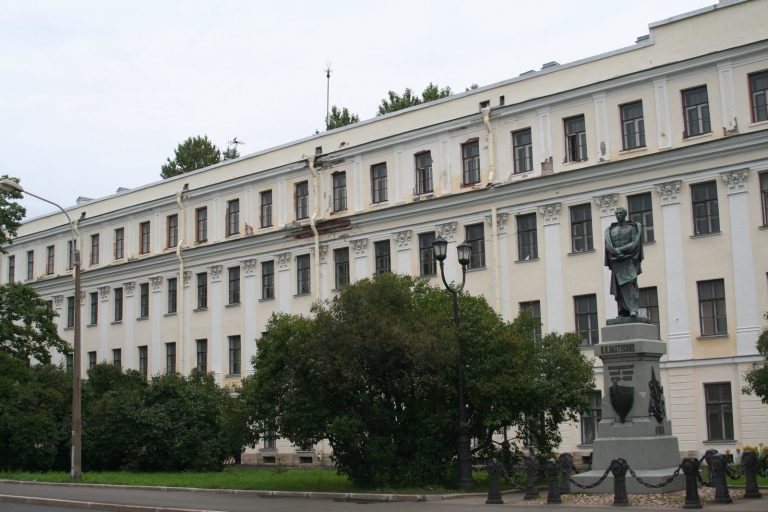
The western line included the 1st Western Barracks, also called the Citadel Barracks, built in 1826–1828 and rebuilt in 1903–1906. The 2nd Western Barracks, also known as the Kronstadt Barracks, was built in 1826–1829 and rebuilt during the same later period. Both included stone half-towers, and their walls partly took the place of the escarpment wall. The Kronverksky Canal ran in front of the line, with barriers controlling water at its northern and southern ends.
On the north, the fortress wall reached six metres in height and had three single-tier half-towers and four two-storey defensive barracks along its rear. A four-metre earth rampart separated the wall from the Gulf. Northern defensive barracks were built at different times between 1831 and 1871, and some had half-towers; recorded structures include Barracks Nos. 1–5 and Northern Half-Towers Nos. 1–3. Eastern Defensive Barracks formed the eastern defense. After reconstruction, the barracks could accommodate as many as 30,000 people. Later work raised the western barracks and the third and fifth northern barracks.
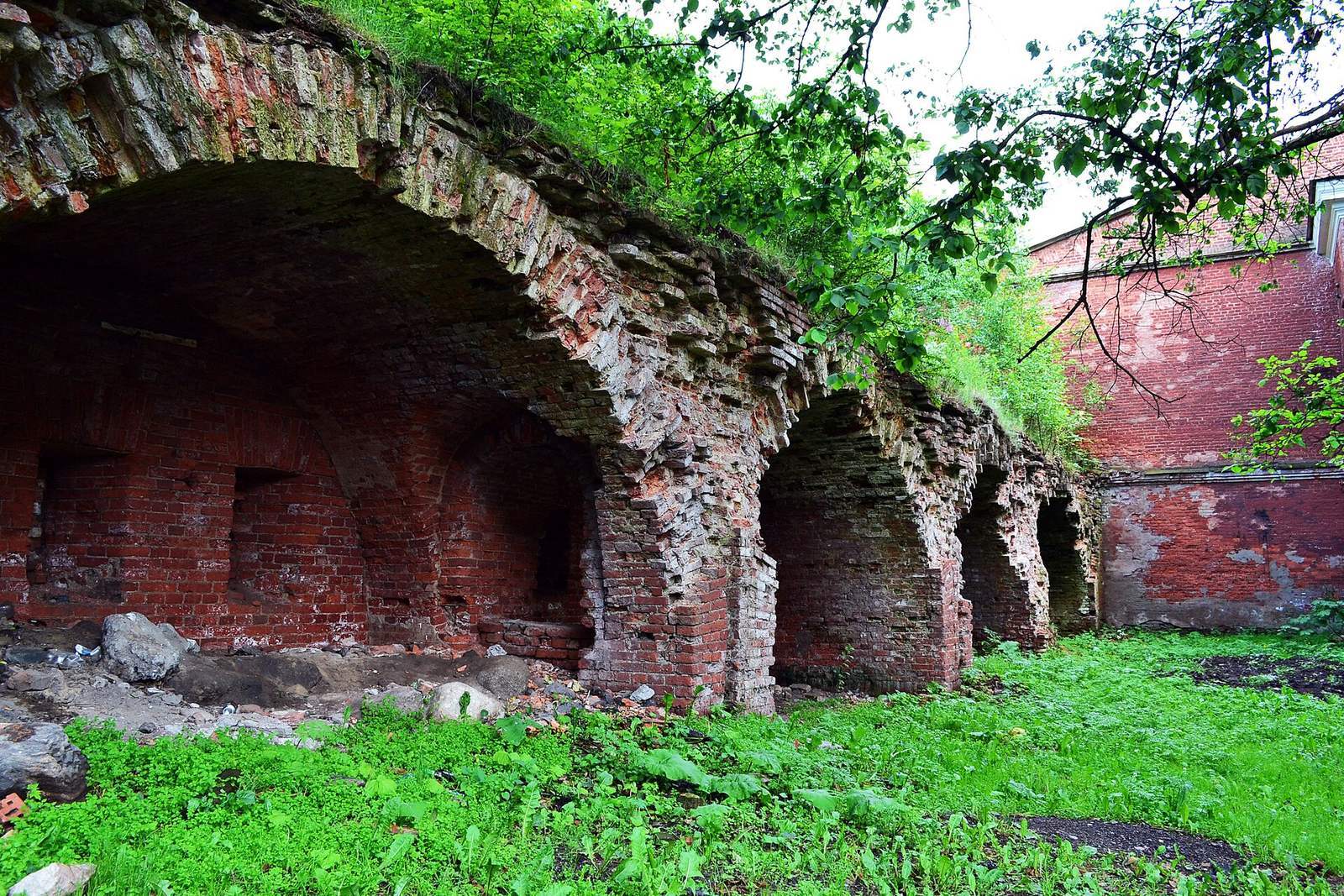
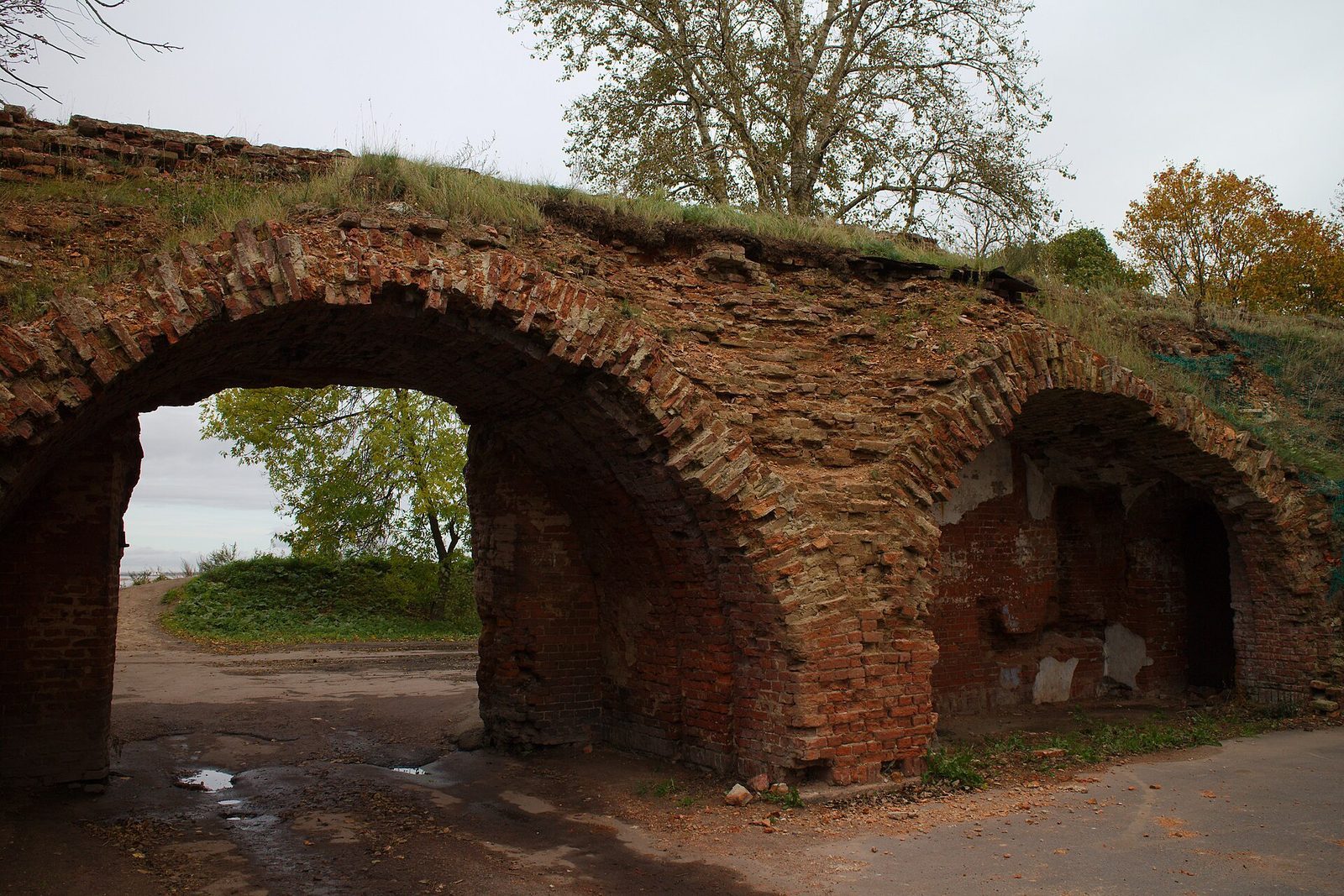
The Northern Rampart survives in good condition. It runs through central Kronstadt along Vosstaniya Street and continues in part along Zosimov Street to Kronstadt Gate; a number of barracks also remain. Vosstaniya Street was laid out in the nineteenth century along the existing fortress, which had recently been rebuilt.
Western Kotlin mortar batteries
The western part of Kotlin contains a group of mortar batteries, positions for guns that fire shells on high trajectories. Mortar Battery No. 1, built in 1893–1902, has rangefinder pavilions, small structures for measuring distances to targets. Demidov Battery and the Southern Mortar Battery were built in 1902–1905, while Mortar Battery No. 2 dates to 1902–1906. Demidov Battery includes a casemate, a protected space within a fortification, for a kerosene engine, as well as a rangefinder pavilion. It commemorates Major General P. G. Demidov, commander of the Kronstadt garrison in 1854–1855.
Sea forts and detached works
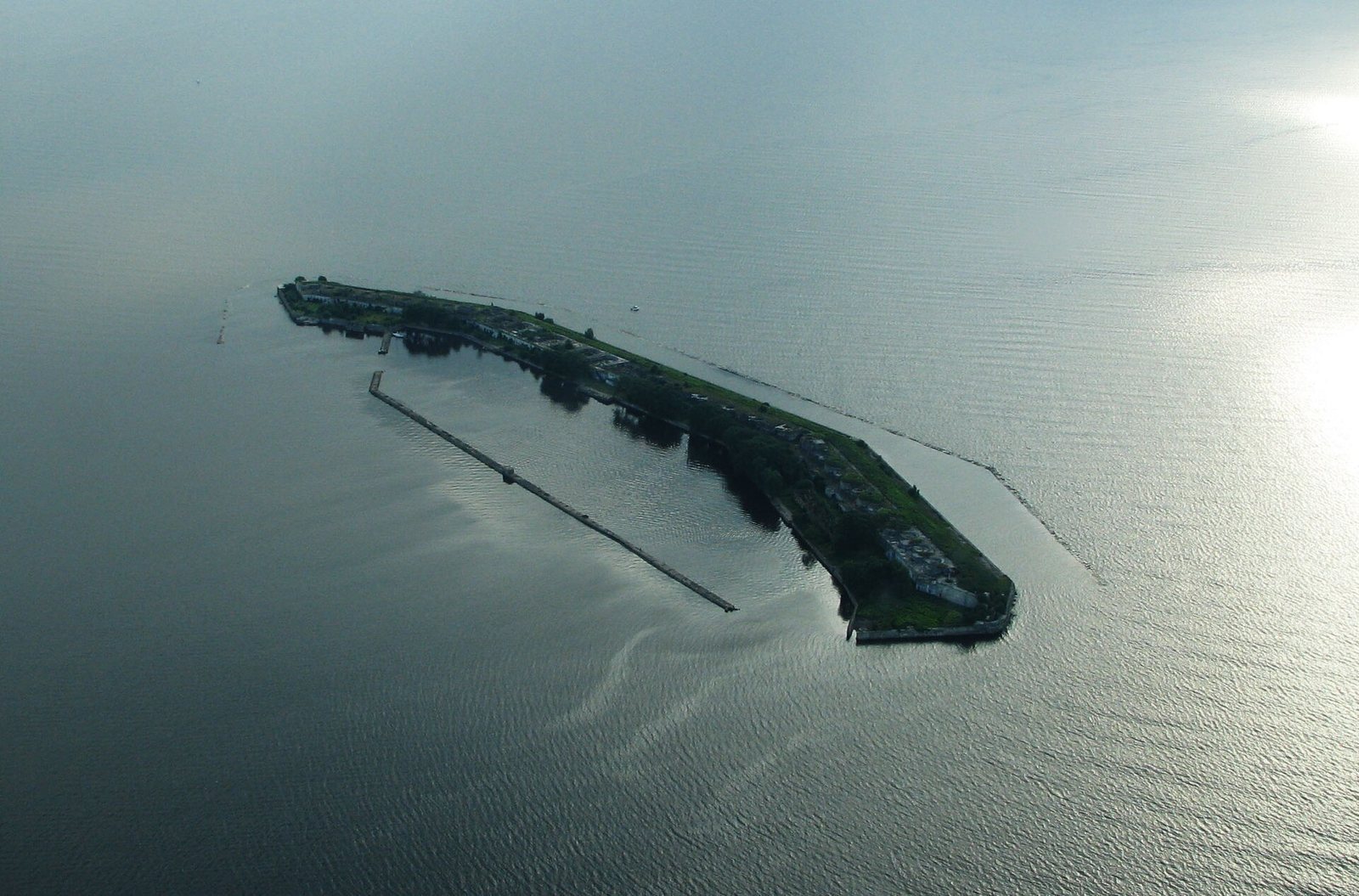
The wider sea-fort chain comprised 19 fortifications on artificial islands. These works guarded shipping channels and approaches around Kotlin, complementing the city defenses and batteries on shore.
Southern channel forts and harbor works
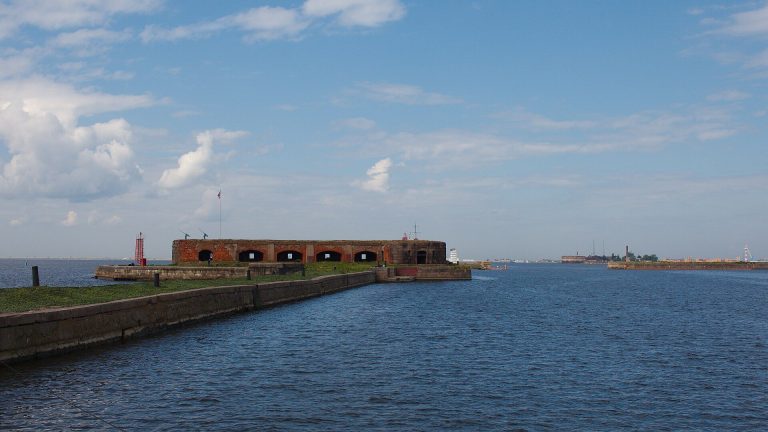
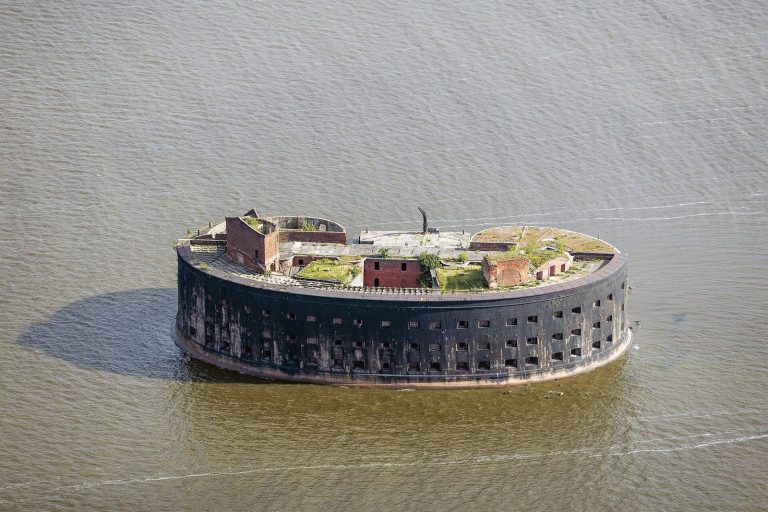
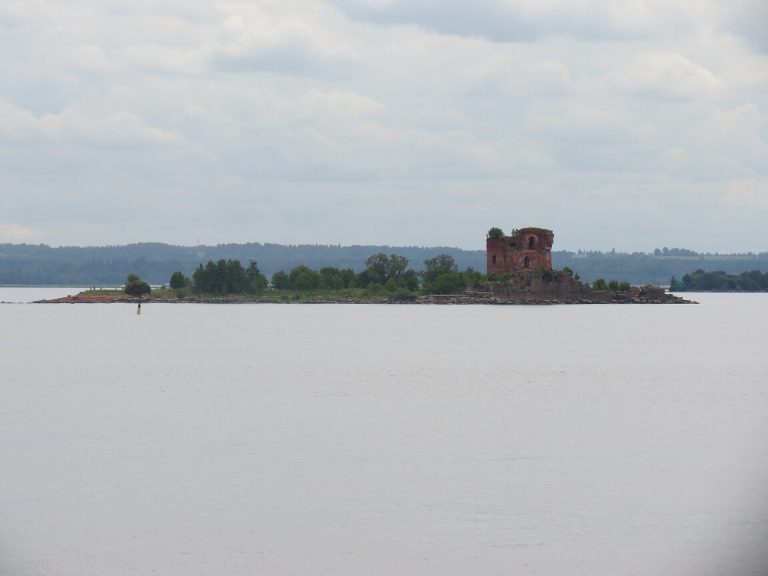
Kronshlot was founded in May 1704 on a stone-filled, wooden-frame caisson, a structure used for underwater construction, to guard the main southern shipping channel. Fort Peter I lies in the middle of the southern roadstead as an early companion to Kronshlot. Fort Alexander I is an oval, three-tier granite structure built in the 1840s. In the late nineteenth and early twentieth centuries it was used as a laboratory for plague research. Fort Konstantin, one of the largest southern defenses, has been partly restored.
West of the Kronverk stood the Den and Litke lunettes, detached fieldworks with two projecting faces. Den Lunette commemorates military engineer General I. I. Den. Litke Lunette, near the former torpedo-boat base, takes its name from navigator and hydrographer F. P. Litke.
Northern fairway forts
Fort Totleben and Fort Obruchev are large artillery works built in the early twentieth century to protect the northern fairway. Their position extended the sea defenses beyond the island’s central fortifications.