Church of the Visitation in Wola Gułowska: A Carmelite Pilgrimage Church
Site at a Glance
- Popularity
- Medium
- Country
- Poland
- Primary era
- Early Modern
- Eras represented
- Early Modern, Modern
- Civilizations
- Polish–Lithuanian Commonwealth, Russian
- Site type
- Religious
- Remains
- Monastery
On this page15 sections
History
The Church of the Visitation in Wola Gułowska, Poland, is a Baroque church whose present complex probably began soon after the Carmelites formally established their convent there in 1659. Bishop Jan Kanty Lenczowski consecrated the church in 1782. The monastery became a centre of Marian pilgrimage, focused on the revered image of Mary of Gułów.
From chapel to Carmelite convent
Hieronim Rusiecki founded a parish church at Adamów in 1545 and built a chapel at Wola Gułowska three years later as its subsidiary. Local tradition says that the Virgin Mary appeared to Barbara, a deeply religious woman, and asked the landowner to build a chapel dedicated to her.
On 25 October 1633, Ludwik Krasiński of Krasne arrived with his brothers Stanisław and Mikołaj and probably three Carmelites, a Roman Catholic religious order. Ludwik founded a monastery there. The convent is first mentioned in 1635, and the order’s provincial chapter approved its final endowments in 1642. Ludwik’s son Stanisław later supported the community and left it 20,000 złotys in his 1658 will.
The community endured violence during the Cossack and Swedish wars. Father Ługowski and Brother Cyryl Masłek were murdered. Tatars tortured Father Konrad Sierpowski, the convent’s representative for Gułów and Lublin, and killed Father Samuel Napierski and the cleric Władysław Kamieński. The Carmelites also disputed lost tithes with the parish priest of Adamów.
On 26 September 1659, Bishop Andrzej Trzebicki formally established the convent, which then had six priests and three brothers. Father Brokard Pastwiński became its first prior, the local superior. The community grew with support from the Krasiński and Stoiński families and from Eufrozyna Firlejówna, Szymon Rusiecki, Anna Zwolińska, Marianna Lasocka, Teresa Pieniążkowa, Michał Krasowski, Henryk Firlej, Piotr Rozwadowski, Jan Kuropatnicki, Eleonora Ludwika Rzewuska and Ludwik Żebrowski. Mikołaj and Adam Stoiński also served as priors. In 1661, the provincial chapter directed the convent to help support Carmelite communities in Lublin and Warsaw.
Building, learning and Marian devotion
Construction of the present church and monastery probably began soon after the convent’s formal establishment. The church and Chapel of the Passion had been built by 1704, although work continued. The church took its dedication from the earlier chapel, and a rectory was built in 1864.
The convent developed teaching and scholarship alongside religious life. It had a novitiate by 1667, a period of formation for people preparing to enter the order, and its library held 86 books in 1681. Professor Bernard Małkiewicz established a philosophy course in 1687. Father Cyryl Rudnicki, a bachelor of philosophy, taught moral philosophy and became a professor in 1688.
During the reign of Augustus III, king of Poland and grand duke of Lithuania, the community moved from the Carmelites’ Lesser Poland province to their Greater Poland province. It joined the Warsaw province in 1824. Wola Gułowska became a popular pilgrimage destination, promoting devotion to Mary as Mother of God. Father Marek Jandołowicz, a spiritual leader of the Bar Confederation, an armed movement opposing Russian influence in the Polish-Lithuanian Commonwealth, helped advance this devotion. The Carmelites also provided religious care to Eastern Christians in communion with Rome, despite the risk of reprisals by Russian authorities.
The community expanded its educational work in the nineteenth century. A novitiate was established again in 1828 and 1843; a grammar and rhetoric course began in 1833, followed by courses in dogmatic theology and preaching in 1845. These institutions closed in 1864. Devotion to the image was associated with offerings and claims of miracles. Surviving votive tablets include a round one given by the wife of the voivode of Czernichów, one from 1831 commemorating a life saved when horses bolted, and one donated by Petronela Wittichowa in 1835. In 1892, Father Alojzy Fridrich described the healing of Anna Łoginow, the daughter of an Orthodox guard, as miraculous.
Uprisings, suppression and parish life
During the November Uprising, the Polish insurrection against Russian rule in 1830-31, the army staff, including General Antoni Jankowski, was based at the monastery. In the January Uprising, the 1863-64 insurrection against Russian rule, Father Anastazy Jadochowski served as head of Baranowicze. Russian authorities arrested him and prior Father Fortunat Jajko in 1864 and sentenced them to penal servitude. Jadochowski died in Vologda in 1876.
After the uprising, Russian authorities suppressed monasteries in the Kingdom of Poland, allowing only designated communities where religious could spend the rest of their lives. The Gułów community was assigned to the monastery at Obory. Bishop Beniamin Szymański obtained permission for Father Ludwik Cierpisz to remain at Wola Gułowska as rector and custodian of the revered image. Szymański also pursued the creation of a parish, established on 11 April 1869. Roman Branik became its first parish priest, followed by Franciszek Parafiński.
In 1905, Russian authorities ordered the Polish eagle above the main altar to be painted over. It was instead covered with white paper and ceremonially revealed after 1918. Following Poland’s recovery of independence, Bishop Henryk Przeździecki reversed the Russian-era decision and restored the Carmelites to the monastery by decree on 14 January 1924. The buildings were returned on 27 April. Father Rajmund Goląka became the first prior and parish priest, followed by Father Gabriel Wielgus.
War damage and the modern community
Repairs followed in 1856, and the Carmelites renovated the church between 1924 and 1930. Further work in 1934-35 included roof repairs and plastering inside and out. In September 1939, during the German campaign and the Battle of Kock, the church and monastery sustained severe damage. Feliks Kardasz regarded the rescue of a family from a burning shelter during the battle as miraculous.
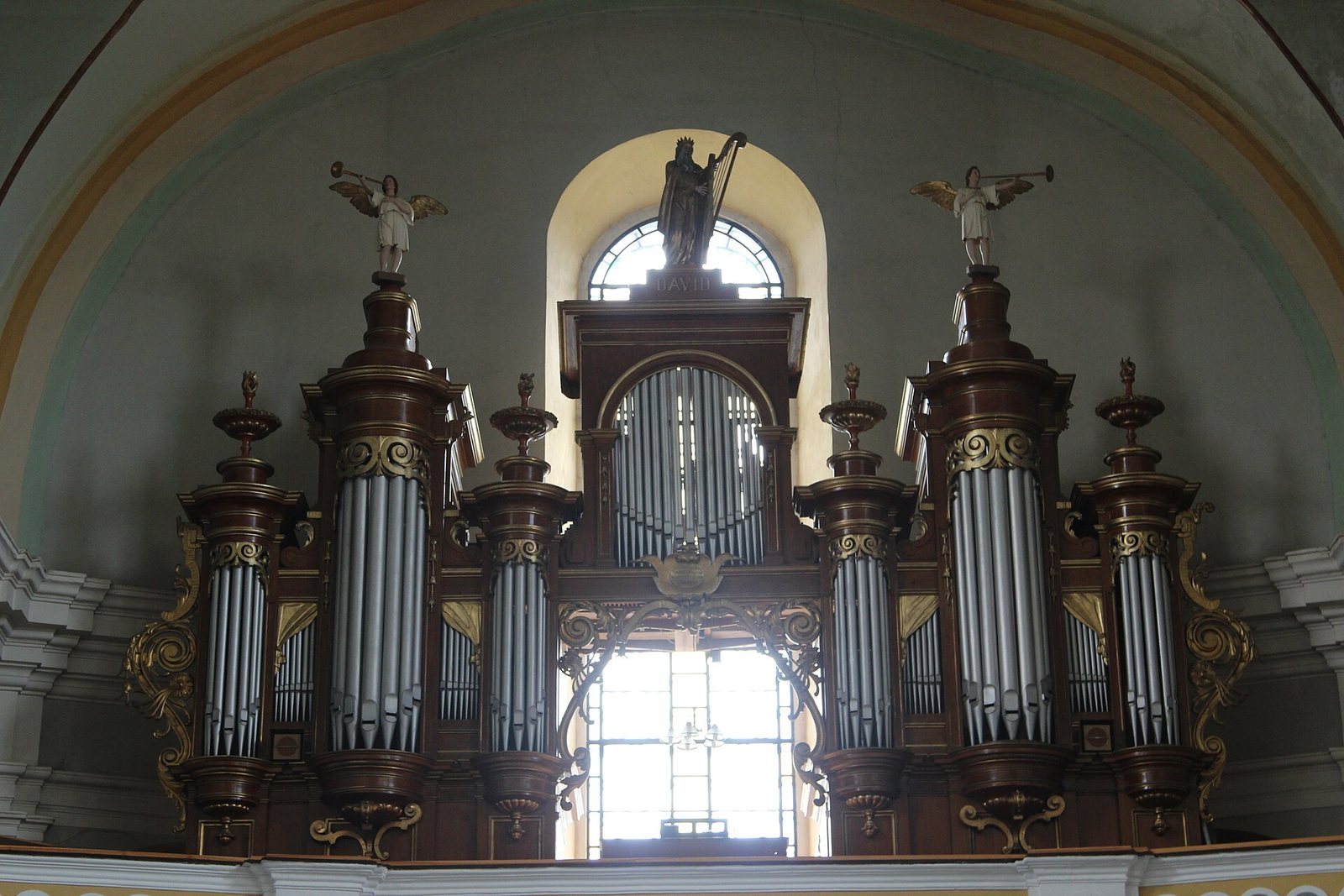
Reconstruction began after the German occupation ended. In 1952, workers restored the altars, organ and pulpit. That August, a hurricane brought the top of the right tower down onto the roof; the damage was repaired and both towers renovated in 1953. A major renovation before the image’s coronation in 1982 included painted decoration in the Chapel of the Passion and renewed gilding on the altars and pulpit. A proposal to paint the entire church was not approved by the heritage conservator.
The monastery continued operating during the German occupation. The Gestapo arrested Father Gierszewski, and Father Apolinary Roman died during a typhus epidemic. In the 1980s, the parish had about 4,500 members and was served by two priests and one brother. At noon on 5 September 1982, the image was ceremonially crowned. Those attending included Primate Józef Glemp, Archbishops Bronisław Dąbrowski and Henryk Gulbinowicz, Carmelite superior general Benitius Egberink and Pauline superior general Józef Płatek, along with other bishops. The gathering was the largest in Wola Gułowska’s history.
Remains
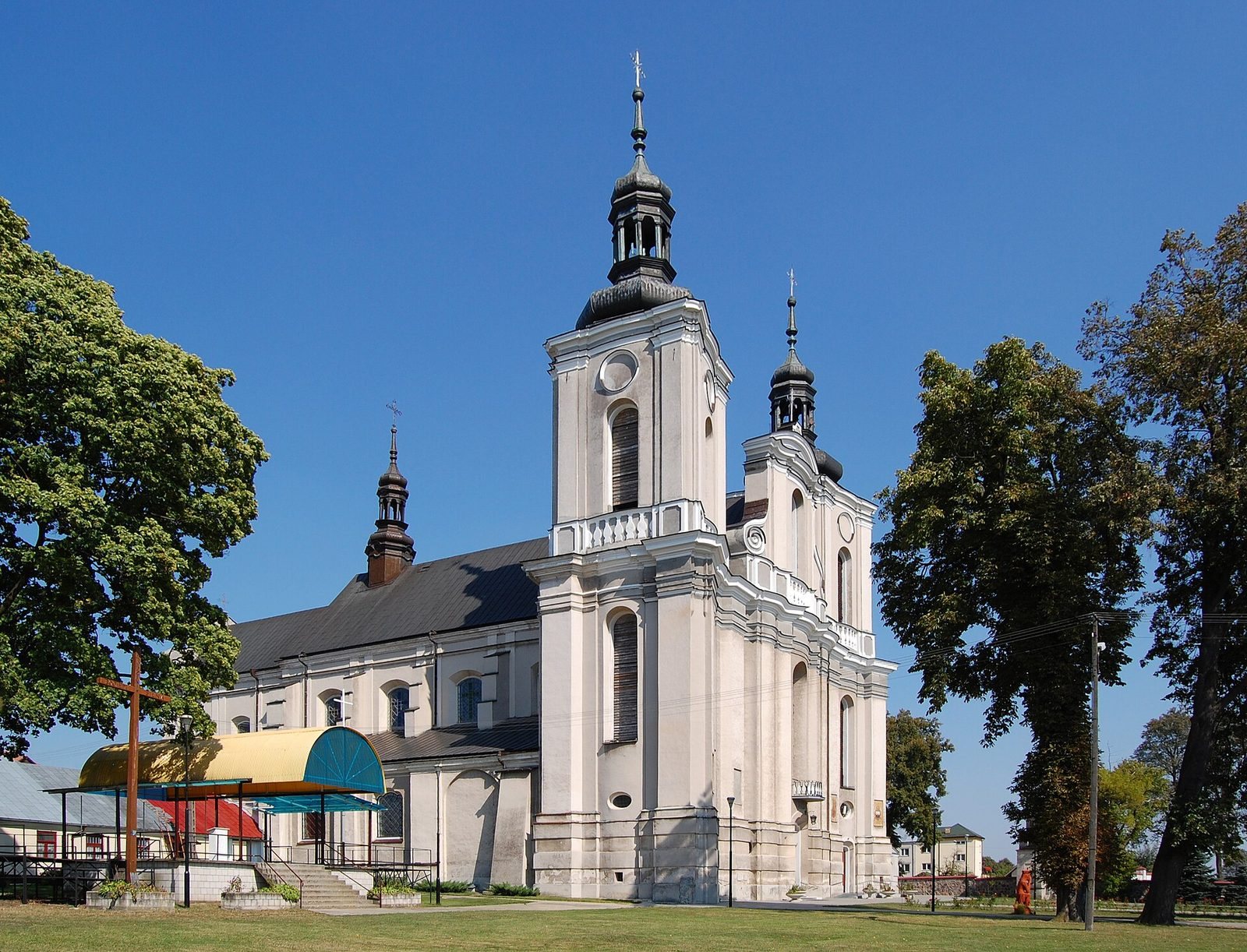
The complex is centred on a brick, three-aisled Baroque church, arranged on an east-west axis with a central nave flanked by aisles. The monastery stands on its north side, while an enclosed churchyard extends in front of and west of the buildings. The church measures 65 metres long, 30 metres wide and 15 metres high, with a floor area of 1,206 square metres and a volume of 26,532 cubic metres.
Church exterior and grounds
Church and façade
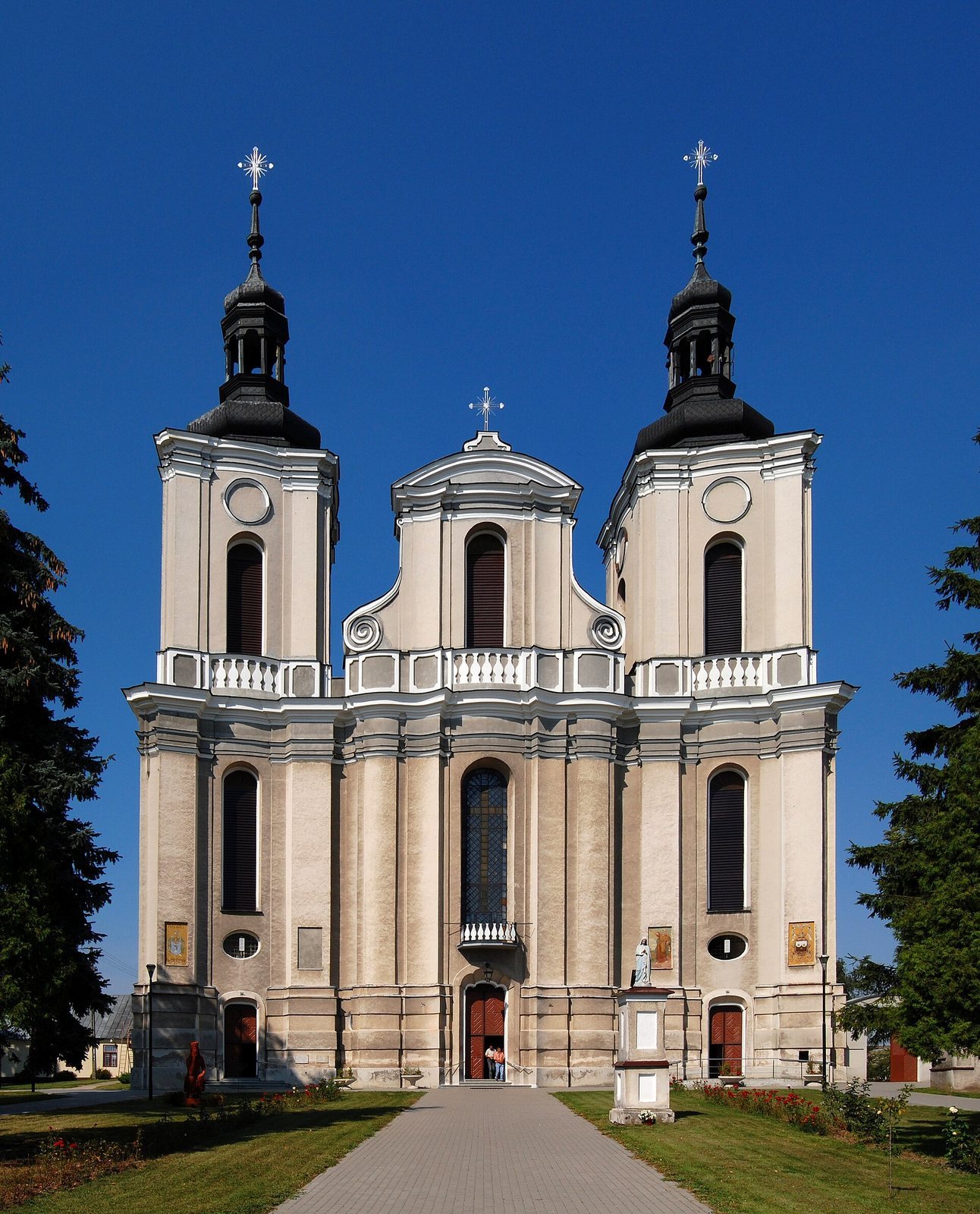
The church has two towers and a three-part western façade with a strongly sculpted profile. Its entrance is set into the base and has a shallow, curved basket-handle arch. Between the towers, a window holds a postwar stained-glass panel. The side walls are simply decorated, with buttresses in several places. The façade, with its strong vertical emphasis, dates to around 1780, while the church and sacristy are seventeenth-century structures. Its design draws on the Church of Our Lady of Einsiedeln and forms used by Bernard Meretyn in Lviv, especially at St George’s Cathedral, a church of Eastern Christians in communion with Rome. The designer is unknown; Jan Ciołkoszewicz, a priest and architect, is a possible author. The towers and façade rise above the village’s mostly one-storey buildings and the surrounding flat landscape.
Monastery, churchyard and belfries
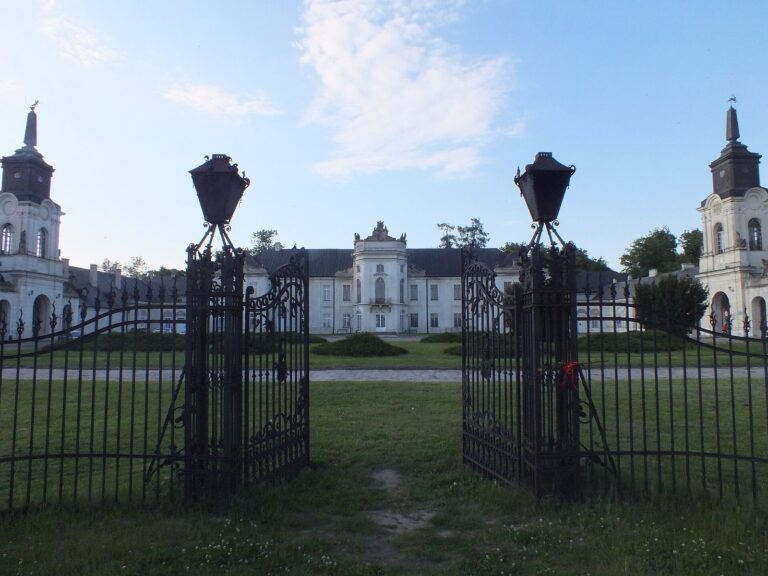
A two-storey monastery building stands north of the church. An openwork fence and a three-bay gate enclose the churchyard in front of and west of the complex. Former farm buildings and gardens lay north and east of the convent buildings. A modern mortuary with a cemetery belfry occupies the churchyard’s southeast corner. The replacement bells installed in 1958 hang in a separate, screen-like belfry; German forces had taken the earlier bells in 1941.
Interior architecture
Nave and sanctuary
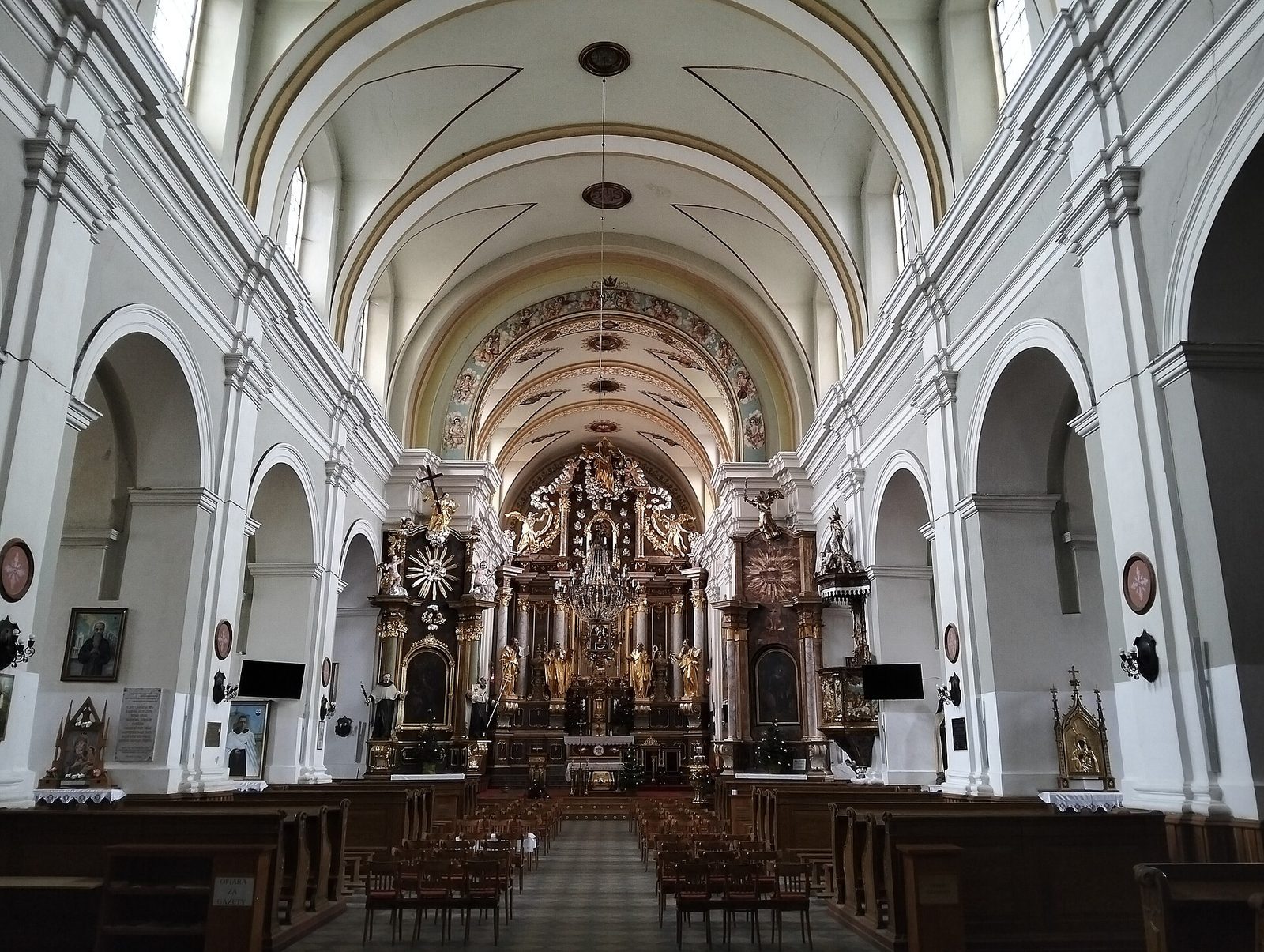
The main nave has five bays, or interior subdivisions, and the sanctuary has three. Both are covered by barrel vaults, continuous curved ceilings, with crescent-shaped sections called lunettes. The sanctuary is narrower than the nave, ends in a straight wall and is separated from it by a chancel arch. Paired shallow, column-like pilasters divide the walls of the nave and sanctuary. Eight windows occupy the nave’s vault lunettes, while six flatter-arched windows light the sanctuary.
The side aisles are about one-third lower than the nave and have cross vaults formed by intersecting curved ceilings. Four pairs of semicircular arches separate them from the nave. On the sanctuary’s north side, a rectangular annex contains the sacristy to the east and the Chapel of Christ Crucified to the west. A covered stairway beside the south wall descends to the crypts, underground chambers beneath the church. A small well is located below the altar of St John Nepomuk.
Altars, pulpit and Marian image
Main altar ensemble
The late-Baroque altar group comprises the main altar and two side altars, painted to resemble marble and richly finished with silvering and gilding. The revered image of the Virgin Mary occupies the main altar. Below it is a painting of Mary giving a scapular, a devotional garment or pair of cloth bands, to St Simon Stock, a Carmelite saint associated with the tradition. Sculptures of saints accompany the composition, with God the Father and the Holy Spirit above.
Side altars and pulpit
The side altars depict St Anthony and Elijah and include sculptures of Saints Cyril, Telesphorus and Albert, as well as an angel. Other altars in the side aisles are dedicated to St John Nepomuk, St Elizabeth of Hungary and the Transfiguration, the last now referred to as the altar of the Kleeberg soldiers. The Passion altar is in the Chapel of the Passion. The Rococo pulpit, in an elaborate decorative style, probably dates to the second half of the eighteenth century. The church’s furnishings remained incomplete amid Poland’s difficult circumstances at the end of that century.
Image of Mary of Gułów
The image is of the Hodegetria type, showing the Virgin Mary with the Christ Child, and measures 122 by 85 centimetres. It is painted in oil tempera on a linden panel. Mary holds the full-length child on her left arm. She wears a dark-red gown edged in gold and a blue-grey veil; her left shoulder is bare, and her head inclines slightly towards the child. The child wears a beige-yellow garment and sits on her arm, with his feet resting on her cloak. Conservation in 1969 revealed later repainting over the image while its original colours remained. Gunfire during the 1939 fighting pierced the halo above Mary’s head and her right hand.