Santissima Annunziata: The Nunziatella Church in Sicily
Site at a Glance
- Popularity
- Low
- Country
- Italy
- Primary era
- Medieval
- Eras represented
- Classical, Medieval
- Civilizations
- Byzantine, Kingdom of Sicily
- Site type
- Religious
- Remains
- Church
On this page18 sections
History
The Santissima Annunziata, also known as the Nunziatella, is a Catholic church in Nunziata, a hamlet of Mascali in Sicily, Italy. Its medieval building has a twelfth-century phase, and an adjacent early Christian basilica preserves evidence of religious activity before the priory period. The church belongs to the Diocese of Acireale, a territory overseen by a bishop.
Early Christian and regional setting
The wider Nunziata area has a long history of settlement. The region was inhabited in prehistoric times, while burial grounds indicate a Hellenistic presence, from the era after Alexander the Great’s conquests and before Roman rule in the eastern Mediterranean. Mosaic finds point to Roman influence. Burial practices and kiln remains reflect Byzantine settlement, associated with the medieval Eastern Roman Empire.
The early Christian basilica beside the church shows that the complex’s religious history predates its priory phase. Its roof collapsed during the ninth century. After the earthquake of 1169, which affected much of eastern Sicily, the basilica’s masonry structures also fell.
The medieval church and religious communities
The earliest described phase of the church dates to the twelfth century. A later enlargement, after the mid-thirteenth century, has been inferred from wall paintings that may include Saint Francis of Assisi, whom Pope Gregory IX canonized. The church may have acquired its tower-like form when the bishop of Catania lost possession of holdings in this area northeast of Mount Etna. From the seventeenth century, the church’s setting in the former County of Mascali, between Catania and Messina, was part of a dispute over the two dioceses’ endowed church offices and associated property.
Burials at the church were aligned with the building, with the individuals’ heads toward the apse. The remains were female and belonged to people aged between eight and forty. They may have been members of a small medieval women’s religious community associated with the Nunziatella. In the basilica, excavators found four skeletons, three female and one male, belonging to people aged between seven and forty. Their burials date to 1210–1410. The predominance of women has prompted the hypothesis that a mixed religious community, including officiating clergy, was present at Nunziata during the thirteenth and fourteenth centuries.
Rediscovery and restoration
After lava buried the city of Mascali in 1928, Italian art historian Enzo Maganuco inspected the church’s apse paintings in 1939. He saw a small painted panel concealed beneath plaster and interpreted it as a Byzantine image of Christ among the Doctors. Work to rediscover the complex began on 10 April 1984. In 1985, removal of the plaster revealed a larger painted composition.
The first restoration campaign ended in 1988. It included roof repairs, removal of late nineteenth-century decoration and interior plaster, excavation inside and outside the church, preparation of the paintings, and structural consolidation. A restoration campaign on the church’s north side, begun in October 2012 and completed in 2013, brought the remains of the early Christian basilica to light.
Remains
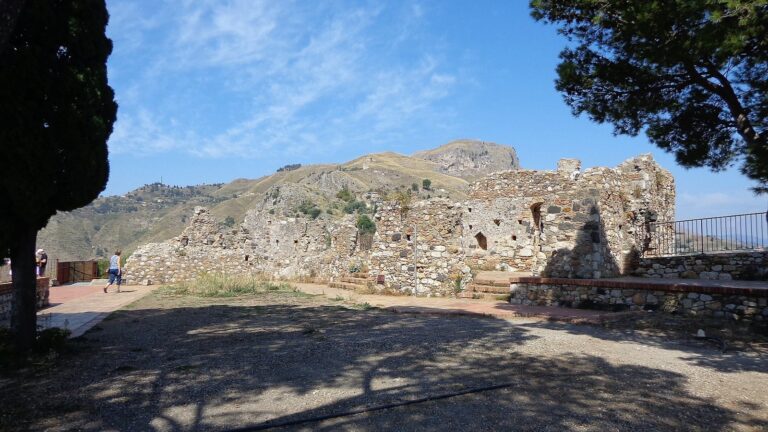
The complex brings together the single-nave Nunziatella and the remains of a three-aisled basilica set parallel to it. The church has a west-facing apse, while the basilica lies about two metres away in the courtyard to the north.
The Nunziatella
Plan and exterior
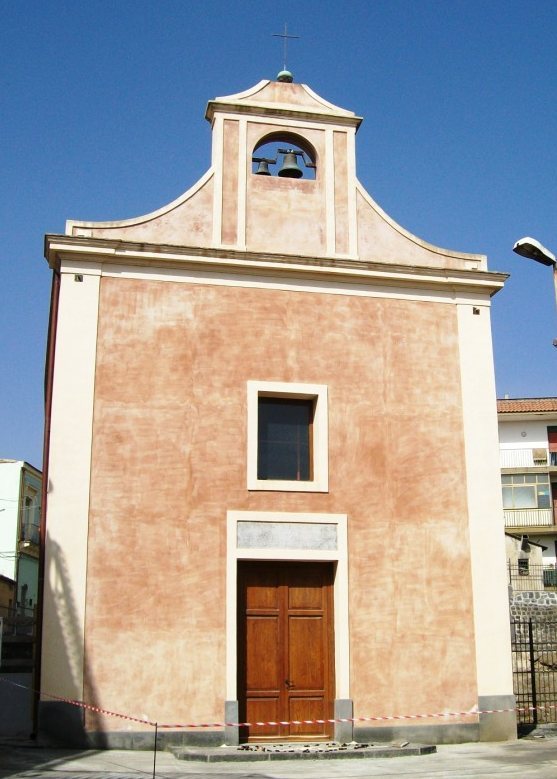
The church’s main façade has an entrance, a window above it, and a bell gable, a wall structure with openings for bells. Two scroll-shaped forms connect to the gable. An inscription above the door quotes Luke 1:38: “Behold the handmaid of the Lord; be it done unto me according to your word.” Each side wall has three upper windows and a separate entrance. The northern entrance has a round arch and opens toward the courtyard containing the basilica remains; the southern side faces the road.
Earlier footprint and wall construction
In its earliest described form, the church reached only to the level of the present side windows and was about half as deep, with roughly half the current nave length. Four niches beside the main entrance appear to predate the seventeenth-century phase and may have framed a short forecourt before an earlier church. The walls also preserve differences in construction: near the entrance they contain smaller, roughly shaped stones, terracotta pieces, and abundant lime; toward the apse they use larger stones, some squared, with terracotta fragments and harder lime mortar. Two vertical lines of larger stones on the exterior may mark former building corners.
Apse-side construction and floors
On the interior walls near the apse, vertical recesses spaced about two metres apart mark the positions of timber uprights roughly 20 by 20 centimetres. In places, terracotta fragments remain packed behind the plaster. The side walls rest on an older terracotta-and-mortar floor rather than on regular foundations, and part of an arch survives on the left near the apse. Two narrow, high openings in the upper north wall suggest access by a staircase. Stone paving in the eastern half of the nave covers another older floor made with crushed terracotta and mortar.
Painted decoration
Christ in the apse
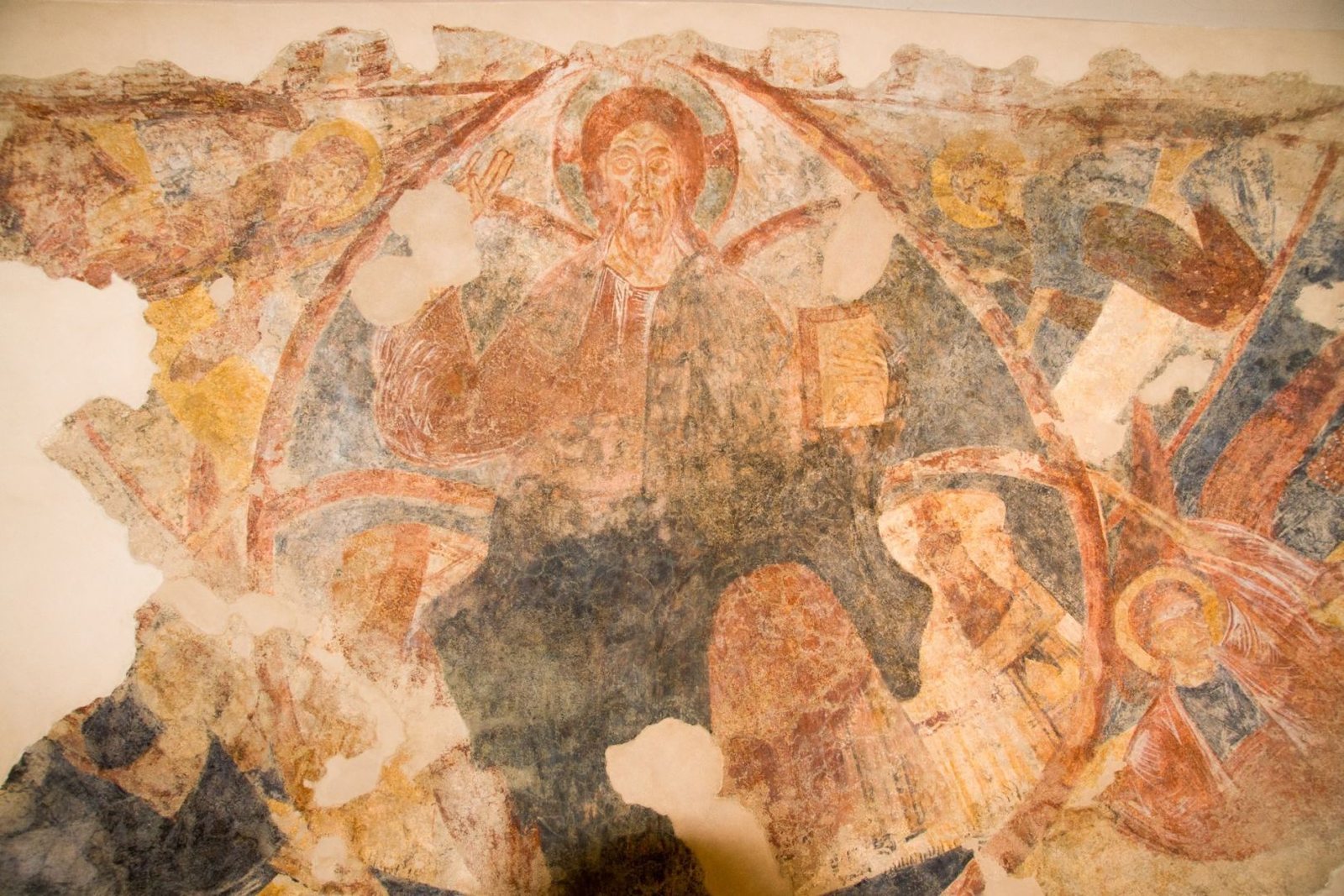
In the semi-dome above the apse, Christ Pantocrator, an image of Christ as ruler of all, sits on a throne within a mandorla, an almond-shaped frame around a sacred figure. A cross-shaped halo surrounds his head. He holds a book in his left hand and blesses with his right, with thumb and ring finger joined. Four haloed angels support the frame: two appear horizontally and two kneel. The angels’ garments alternate between blue and red, then red and blue; Christ wears a blue tunic and red mantle. The angels’ halos are yellow, while Christ’s is green, perhaps because its original blue pigment changed. Restoration also revealed the throne cushions and Christ’s feet resting on the frame.
Other figures and painted details
On the left side of the church, a sequence of isolated, full-length saints includes a figure that may represent Francis of Assisi. Brown traces appear to show the saint’s feet and clothing. At the left edge of the apse is the head of another haloed saint; on the right, Mary and the Child appear on the apse wall. The Child blesses and wears a cross-shaped halo. The small panel first noticed by Maganuco measures 341 by 228 millimetres and shows a youthful Christ with two locks of hair falling beside his ears.
Color and symbolism
The paintings’ colors and gestures carry religious meaning. The mandorla and Christ’s blessing gesture express the joining of his divine and human natures. The angels’ alternating garment colors evoke chi, one of the two Greek letters in the chi-rho, a Christian monogram. Christ’s blue tunic and red mantle represent unblemished humanity and ardent divinity. A dry-applied layer of white lead, a lead-based pigment, highlights the garments. The composition’s color arrangement has also been compared with Piero della Francesca’s Madonna del Parto.
Early Christian basilica
Layout and surviving masonry
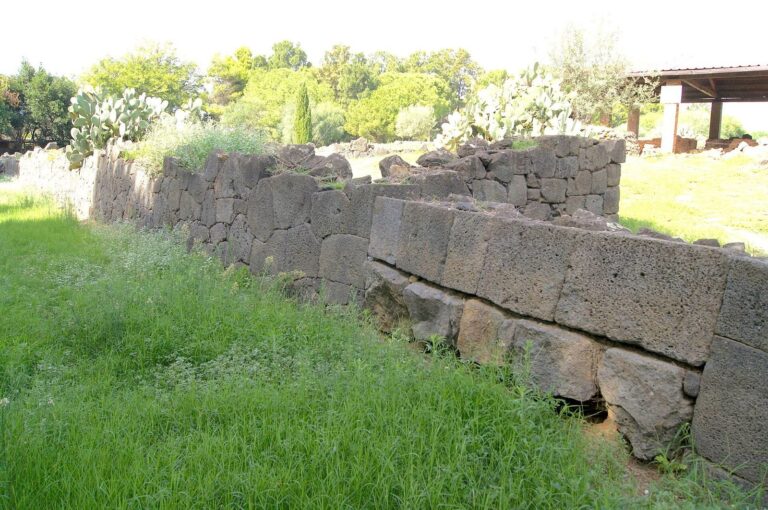
The basilica was built between the late fifth and sixth centuries. Its long axis runs east to west, with the apse at the western end. Three aisles lead toward a central apse enclosed by a rectangular wall. The remains rise to a maximum height of about 2.70 metres. The apse area and the northern wall closing the right aisle survive, while the southern perimeter wall is almost entirely destroyed.
Upper mosaic at the raised sanctuary
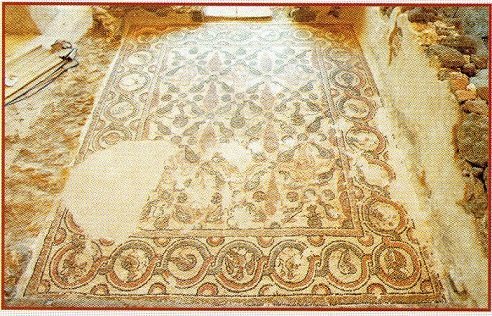
A multicolored floor mosaic in the raised sanctuary area, or bema, forms a square about 2.45 metres on each side. Three pairs of figures sit in horizontal tiers around a central feature that is no longer identifiable and may have been a font. Two peacocks with multicolored tails occupy the upper tier, paired clusters of acanthus leaves the middle, and two brown fawns the lower. Slender branches and red flowers appear against a white ground. A braided, multicolored wave pattern frames the image. A burial pit dug through the floor damaged part of the composition. The mosaic dates to around the late fifth or early sixth century.
Lower mosaic beside the aisles
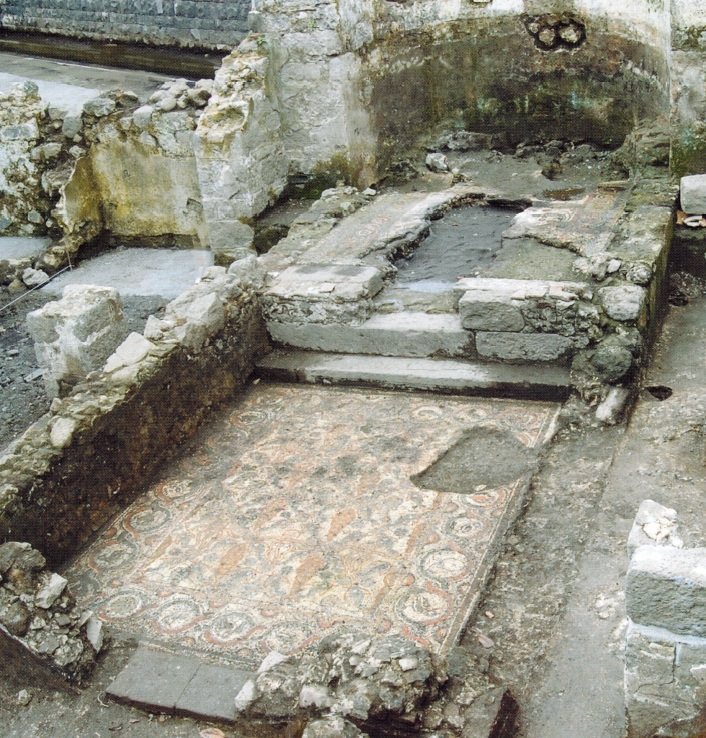
A second mosaic, almost entirely preserved, lies beneath the first at the level of the side aisles. It measures about 2.95 by 2.40 metres. Steps to the raised sanctuary bound it on the west, and a doorway probably opened on the east. Its small mosaic pieces are about one centimetre square, compared with 1.2 to 1.8 centimetres in the upper floor. Fish, octopuses, cuttlefish, and shells repeat across a geometric sea scene. Interlocking large red and gray circles, edged in black and white, form the border; birds inside the circles face inward. This mosaic also dates to around the late fifth or early sixth century.
Enclosure and excavated finds
An enclosure in the church area measured about six metres square. Its walls were approximately 40 centimetres thick and survived to about 60 centimetres high. Excavation in the basilica yielded ceramic fragments from vessels, cups, and cooking pots, along with polished stones, Greek and Byzantine bronze coins, and other bronze and silver objects.