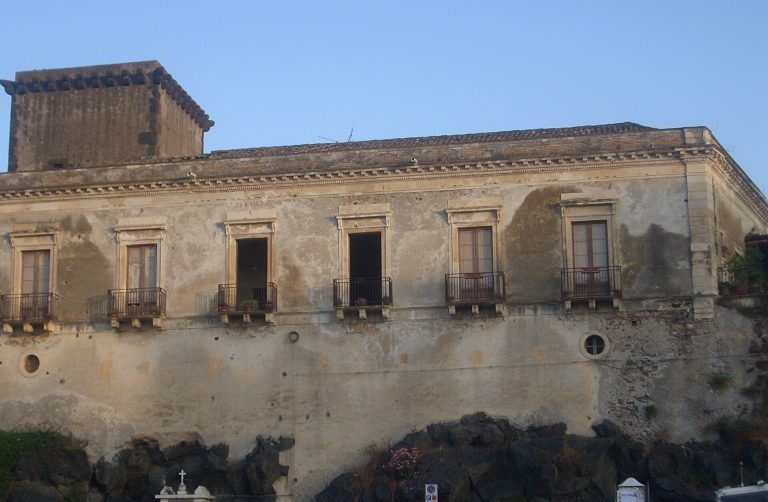
Castello di Mola: A Hilltop Fortress in Castelmola, Sicily


Site at a Glance
- Rating
- 4.6
- Popularity
- Medium
- Country
- Italy
- Primary era
- Medieval
- Eras represented
- Classical, Medieval, Early Modern
- Civilizations
- Byzantine, Kingdom of Sicily, Norman, Roman, Spanish
- Site type
- Military
- Remains
- Castle
On this page9 sections
History
Castello di Mola, now called Castello di Castelmola, is a ruined hilltop fortress in Castelmola, Italy. Its earliest construction is generally placed in the Roman period, although a primitive fortification at Mola was already associated with the conflict between Taormina and the armies of Dionysius, tyrant of Syracuse, in 390–389 BC. The fortress dominated the irregularly planned castrum Molae, a fortified settlement on the hill above Taormina.
Roman and Byzantine Foundations
The fortification was rebuilt during the Byzantine period, when Sicily formed part of the eastern Roman Empire. A ninth-century Greek-Byzantine inscription, formerly set on a marble plaque on the facade of the town cathedral, states that the castle was built under Constantine, patrikios and strategos of Sicily. These titles identified him as a high-ranking Byzantine official and military commander. The rock and its fortifications probably served as Taormina’s second acropolis during the Saracen sieges of 902–962.
Norman Conquest and the Upper Settlement
After the Emirate of Sicily was dissolved, Roger I of Sicily conquered Taormina following a seven-month siege in 1078. He then built a new castle called Mola and erected the church of the Santissima Annunziata near the settlement as a thanksgiving offering to the Madonna. In relation to Taormina, the two inhabited areas were distinguished as the castrum superius, or upper fortified settlement, and the castrum inferius, or lower settlement.
The castle was entrusted to nobles loyal to the kings of Sicily. It initially supported the Swabian rulers against the Angevin usurpers and remained loyal to the Hohenstaufen dynasty, the Swabian ruling house of the Kingdom of Sicily. In 1282, during the Sicilian Vespers, the revolt against Angevin rule, Mola rebelled against the Angevins and supported the Aragonese dynasty, which intervened in the struggle for control of Sicily.
Medieval Fortress and Prison
During the fourteenth century, under Frederick III of Sicily and later his son Peter II, the castle was enclosed by defensive walls and made inaccessible. It served as a fortress and prison, while also supporting the defense of nearby Taormina. Michele da Piazza described the Castle of Mola as an ancient foundation in 1353, and Pietro Forni held the office of castellan of Mola in 1419.
Spanish Rule and Early Modern Wars
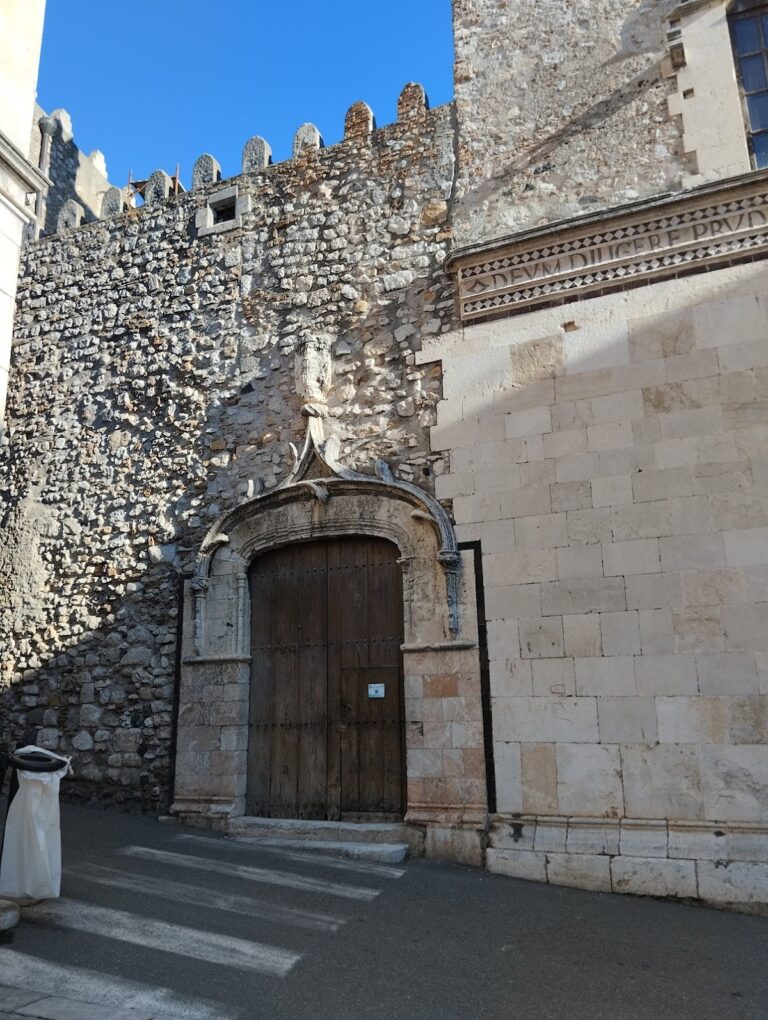
An emblem above the entrance arch bears the inscription “Faithful Castle to His Majesty, year 1578.” The reference is to Philip II of Spain, who was also king of Sicily. In 1637, Taormina administered the castle and its territory civilly. On 17 November of that year, for reasons connected with the Royal Treasury, the territory was removed from Taormina’s jurisdiction and sold as a marquisate, a territorial lordship governed by a marquis.
The stronghold was later drawn into the anti-Spanish revolts of 1673–1678, a period of serious and repeated clashes between French contingents and Spanish troops. From 1718 to 1720, the fortress and its territory served as bases for Austro-Piedmontese armies fighting Spanish forces commanded by the viceroy Jean François de Bette III, Marquis of Lede. During the War of the Quadruple Alliance, Spain opposed a coalition of Britain, France, Austria, and the Dutch Republic. Coalition troops resisted a Spanish siege before surrendering the base. The Battle of Francavilla formed part of this wider struggle for control of the Mediterranean, and Spain’s defeat opened a brief Austrian period in Sicily.
Bourbon and Contemporary Phases
Under the House of Bourbon, the lordship was raised to a principality belonging to the Villadicani family. In 1744, Alvaro Villadicane Marullo e Castelli held the titles of Marquis of Condagusta, Prince of Mola, and baron of three fiefs. Giovambattista Villadicane is also associated with this phase.
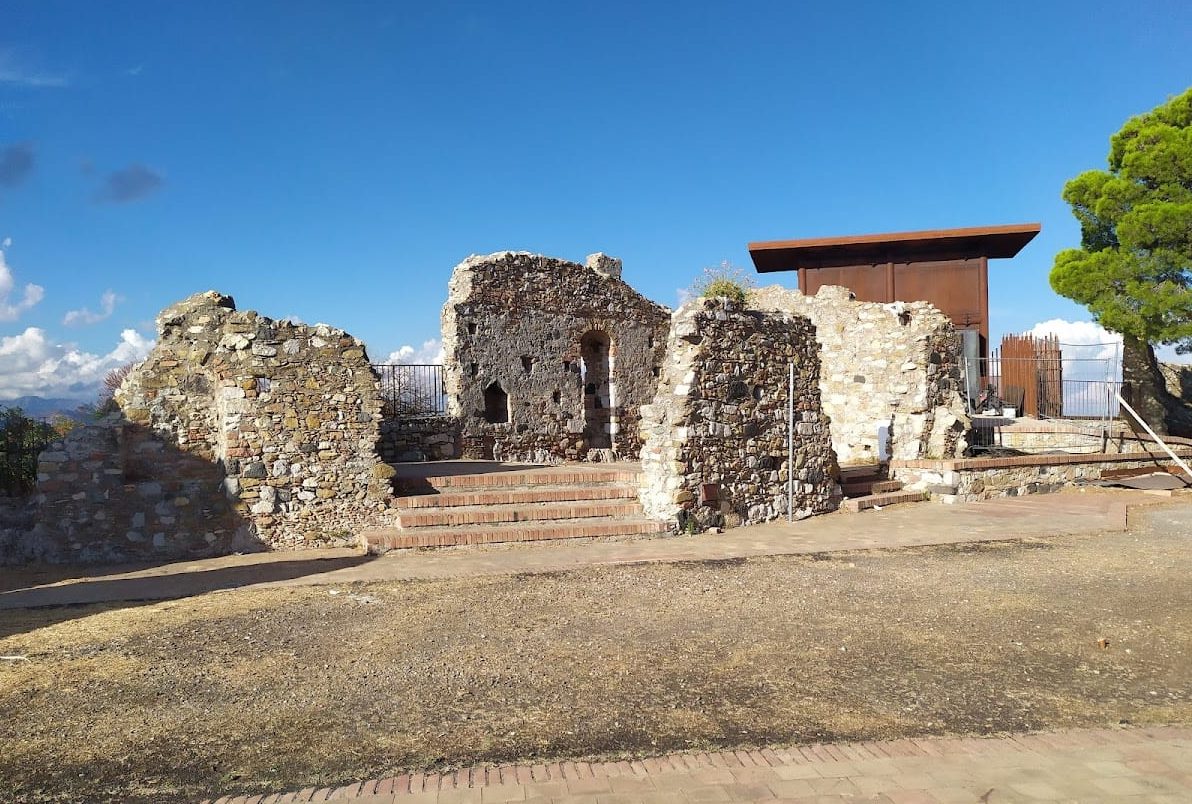
In the contemporary period, some rooms have housed the Museum of the Sicilian Middle Ages, and the castle has also been used for demonstrations of medieval falconry. The castle is designated Italian national heritage.
Remains
Hilltop Defensive Layout
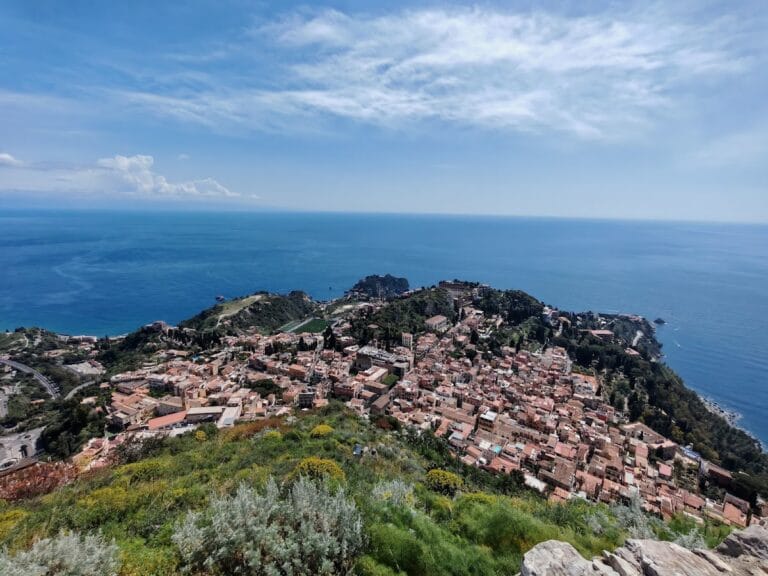
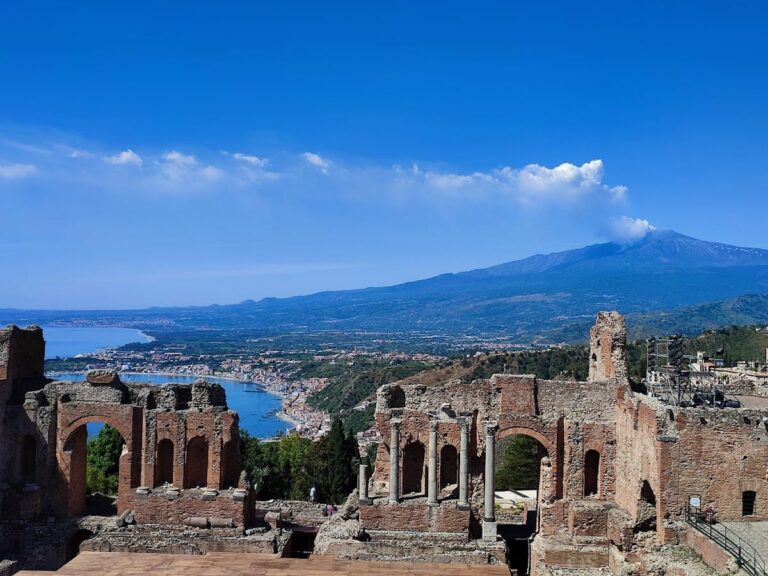
Castello di Mola survives as a ruined fortification on a hilltop at Castelmola. Together with the nearby rock of Taormina, it formed part of the Peloritani defensive chain, a network that also included the castles of Castiglione, Francavilla, Tripi, Montalbano, Castroreale, Santa Lucia, Milazzo, and Ficarra. Its elevated position extends across the Ionian coast, toward the Calabrian coast and the Strait of Messina to the north, and toward Mount Etna on the southern horizon.
The earliest described plan was irregular and dominated the fortified settlement known as the castrum Molae. Fourteenth-century defensive walls later enclosed the fortress and made access difficult. The fortification and the rock were associated with Taormina’s upper defensive settlement, while the lower inhabited area was distinguished as the castrum inferius. The nearby church of the Santissima Annunziata belonged to the settlement established beside the castle.
Entrance and Surviving Fabric
The entrance incorporates an arch topped by the emblem dated 1578 and referring to Philip II of Spain. This surviving feature connects the visible gateway with the period when the castle formed part of the Spanish possessions in Sicily. The present structure remains in a ruined condition, preserving the hilltop fortification, its defensive enclosure, and the surviving relationships between the castle, the upper settlement, and the surrounding landscape.