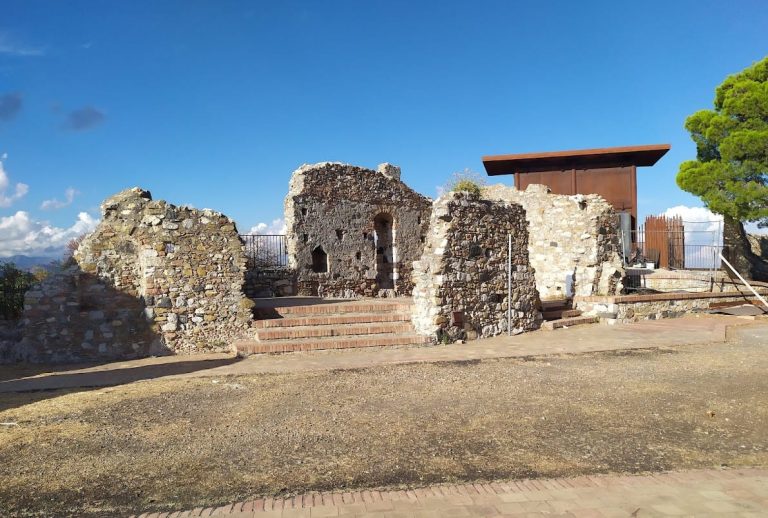
Schisò Castle: A Fortified Coastal Residence in Italy
Site at a Glance
- Rating
- 4.2
- Popularity
- Low
- Country
- Italy
- Primary era
- Early Modern
- Eras represented
- Medieval, Early Modern, Modern
- Civilizations
- Italian, Kingdom of Sicily, Norman, Spanish
- Site type
- Military
- Remains
- Castle
On this page10 sections
History
Schisò Castle is a fortified coastal residence in Italy, located at Giardini Naxos on Cape Schisò. Its original construction dates to the transition between the thirteenth and fourteenth centuries, while the building’s present form largely reflects a sixteenth-century rebuilding. Overlooking the Bay of Giardini Naxos, it combined residential functions with the surveillance of the surrounding coast.
Norman-period religious and agricultural setting
During the Norman period, the era of Norman rule in Sicily from the eleventh to the twelfth century, the agricultural settlement at Schisò included a small church dedicated to Saint Pantaleon. Local farmers and fishermen used the church before newer places of worship were established. It belonged to the dependency of Santa Maria di Gala monastery.
In 1104–1105, the regent Adelasia del Vasto granted Santa Maria di Gala to Basilian monks of the Greek rite. These monks belonged to Eastern Christian communities that followed the rule associated with Saint Basil. The monastery’s property, rights, and concessions were later reconfirmed by her son Roger II of Sicily, the Norman king, including fishing rights in waters along the Taormina coast.
Sixteenth-century rebuilding and coastal defense
The castle was rebuilt in the sixteenth century, when an observation tower was added to survey Cape Schisò and the coastal zone. The tower monitored the bay toward Cape Taormina to the north and the Gulf of Riposto to the south. This defensive work responded to raids on coastal fishing settlements by Barbary pirates led by Khayr al-Din Barbarossa, a Turkish corsair and naval commander associated with Ottoman-era operations across the Mediterranean.
Sixteenth-century Schisò also supported sugarcane processing. The installation included equipment for refining and distilling cane products. Sugarcane had been introduced into Sicily by the Arabs, cultivated during the Norman period, and expanded under Spanish rule, making its processing an important part of the settlement’s economic activity.
Owners and later history
Don Cesare Statella, a nobleman, jurist, municipal official, and reformer of Catania, was the castle’s first recorded owner, in 1582. In 1705, ownership passed to the aristocratic De Spuches family, Marquises of Schisò and Gaggi and members of the ducal house of Santo Stefano and princely house of Galati. Later owners included Giovanni Conti, a wealthy citizen of Messina, and the Lombardo Alonço family. During the twentieth century, the castle passed to the Paladino family, which remains its owner.
A renovation in the late nineteenth century altered the building’s façade by adding balconies. In the contemporary period, the castle became uninhabited and fell into abandonment. Sicilian regional authorities subsequently included it within the archaeological park complex of Giardini Naxos, together with the archaeological area and museum, as part of a planned gradual recovery of the historic building.
The name Schisò
The place-name Schisò has been connected with the Arabic name Al Qusus and with the earlier name Naxos, the ancient Greek settlement whose name survives in Giardini Naxos. Proposed intermediate forms include Nascsòs, Naschisòs, Quisòs, and Schisòs. The historian Michele Amari argued that the Arabic form Qusus might result from a mistaken reading of Nasus, or Naxos. The writer Pietro Rizzo stated that the place-name was pronounced Quisò during the Norman period.
Remains
Rocky setting and overall layout
Schisò Castle stands on a small rocky elevation formed by a prehistoric lava flow above the Bay of Giardini Naxos. The complex joins fortified and residential uses. Its noble residential section faces the waterfront, while the former church of Saint Pantaleon is incorporated into the fortified buildings. The arrangement brings together the coastal residence, defensive structures, religious space, and the installations associated with sugar processing.
Defensive structures
The sixteenth-century rebuilding included a military observation tower intended to survey the cape and the adjoining coastal waters. Two of the original cylindrical lookout towers survive, and they delimit the castle’s inner courtyard. These towers form the principal surviving elements of the castle’s earlier defensive arrangement.
Residential and religious buildings
The noble residential section occupies the waterfront-facing part of the complex. The Saint Pantaleon church, once used by local farmers and fishermen, remains incorporated within the fortified structure rather than standing as a separate building. The late-nineteenth-century renovation added balconies along the façade, giving the residential frontage its later architectural layer.
Sugar-processing installation
The castle complex contained equipment for refining and distilling products made from sugarcane. These installations preserve the connection between the fortified residence and the agricultural economy of sixteenth-century Schisò, when cane cultivation and processing formed part of the settlement’s activities.
Nearby sites