Palazzo dell’Arte dei Giudici e Notai: Florence’s Medieval Guild Palace
Site at a Glance
- Popularity
- Medium
- Country
- Italy
- Primary era
- Medieval
- Eras represented
- Classical, Medieval, Modern
- Civilizations
- Grand Duchy of Tuscany, Holy Roman Empire, Italian, Republic of Florence, Roman
- Site type
- Civic
- Remains
- Palace
On this page12 sections
History
Palazzo dell’Arte dei Giudici e Notai is a medieval palace in Florence, Italy. Its construction is most specifically placed in the first half of the fourteenth century, although proposed dates range from the thirteenth to the fourteenth century. The building became the headquarters of Florence’s guild of judges and notaries, the Arte dei Giudici e Notai.
Construction and guild use
Dating proposals connect the palace either with the formation of the guilds in 1282 or with construction during the following century. By the fifteenth century, the palace served as the guild’s headquarters and as the residence of its Proconsolo, a senior official. That officeholder’s title also became associated with the building and the nearby street, Via del Proconsolo. Around the middle of the fifteenth century, the poet Domenico di Giovanni da Corella described visiting the Proconsolo’s audience hall and seeing images of celebrated men, including poets crowned with laurels.
A civic cycle of poets and public figures
Under the guild consul Domenico Silvestri, a poet and friend of the Florentine humanist and chancellor Coluccio Salutati, the guild commissioned paintings for its great hall. In 1366, Jacopo di Cione was engaged to paint its walls and vaults. This proposed date has been questioned because Boccaccio, the youngest poet represented, died in 1375. In 1406, Ambrogio di Baldese was commissioned to add the Roman poet Claudian, then believed to have been Florentine, and the recently deceased Salutati. Andrea del Castagno received a commission in 1444 to portray Leonardo Bruni in the first room. Piero Pollaiolo later painted Poggio Bracciolini and Giannozzo Manetti, but those works have been lost.
The Florentine writers’ portraits formed part of a wider civic project associated with Salutati. As chancellor from 1375 to 1406, he had commissioned a cycle of poets, commanders, and civic heroes for the Palazzo Vecchio, presenting Florence as a “new Rome.” That larger cycle has disappeared, while the more modest programme in the guild palace survives as an important witness to the idea. Art historian Maria Monica Donato identified its portraits of Dante and Boccaccio as the earliest documented depictions of those poets.
Ownership, alteration, and rediscovery
In 1498 the guild leased part of the palace to the Pandolfini family. It sold the property in 1581 to Filippo Giunti, a Florentine printer and publisher whose family’s bookshop stood across the street. By 1832 the palace belonged to the Landini family. Architect Giuseppe Martelli then carried out a major transformation, following earlier alterations that had already changed the building. The work substantially erased its medieval architectural character.
In 1878, the Florentine notary Costantino Puccianti, who had established his office in the palace, added an inscription and terracotta coats of arms to commemorate the guild. A monumental entrance on Via dei Pandolfini was probably created around the same period. Traces of the old paintings came to light in 1882. Between 1933 and 1935, authorities uncovered further surviving frescoes while the audience hall was being used as a textile shop; its shelving had stood against the painted walls. A later owner carried out additional focused restoration and presentation of the paintings. The palace is privately owned and used for restaurant activity.
Remains
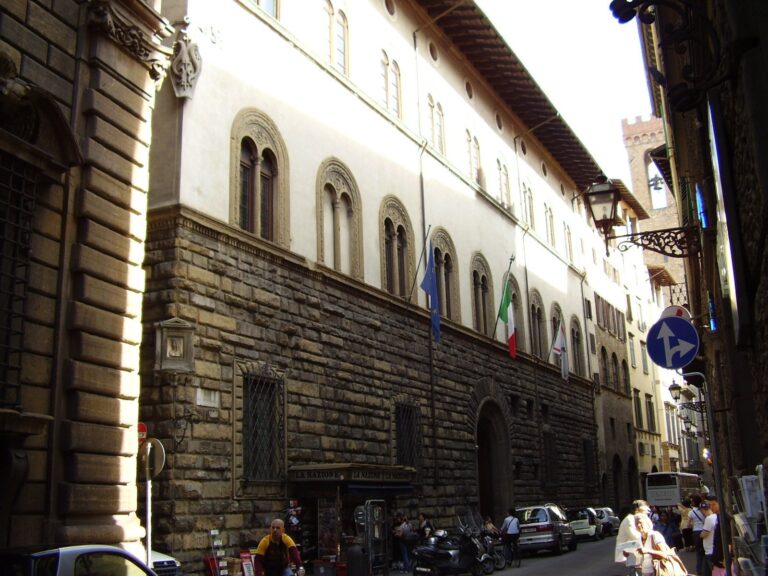
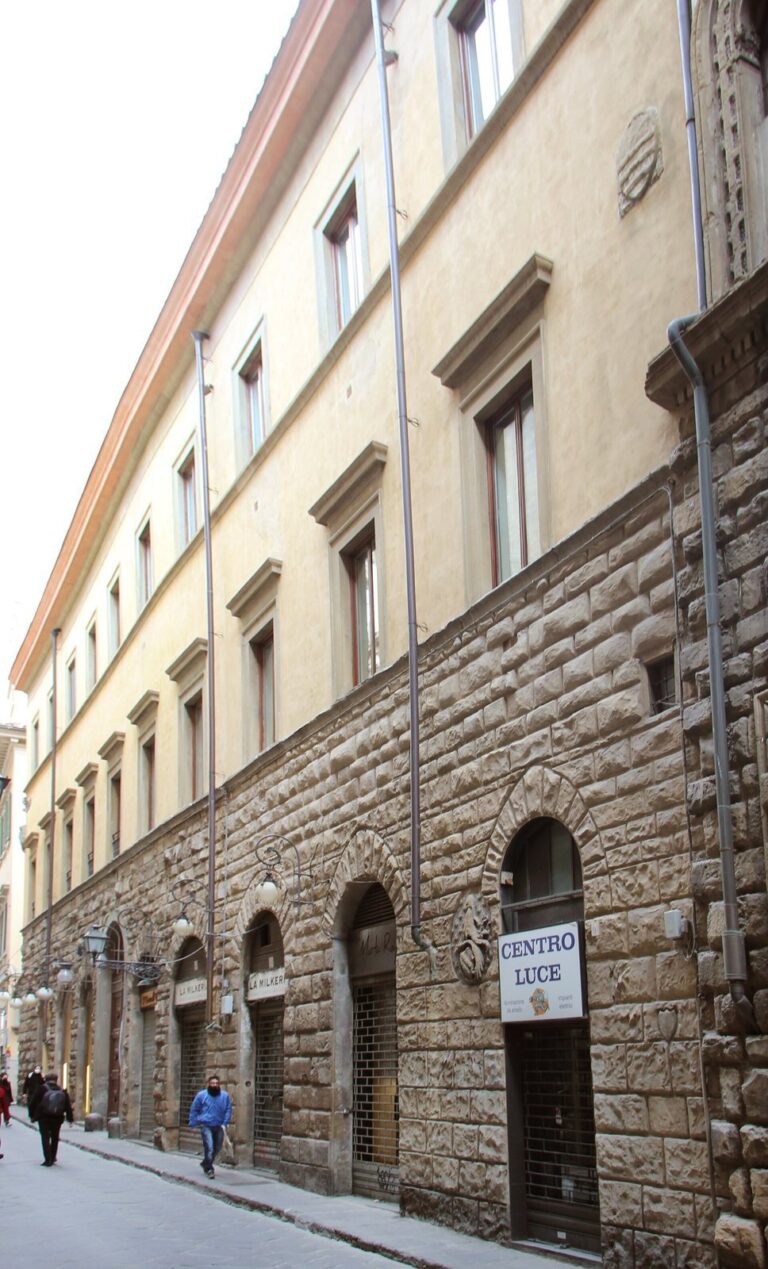
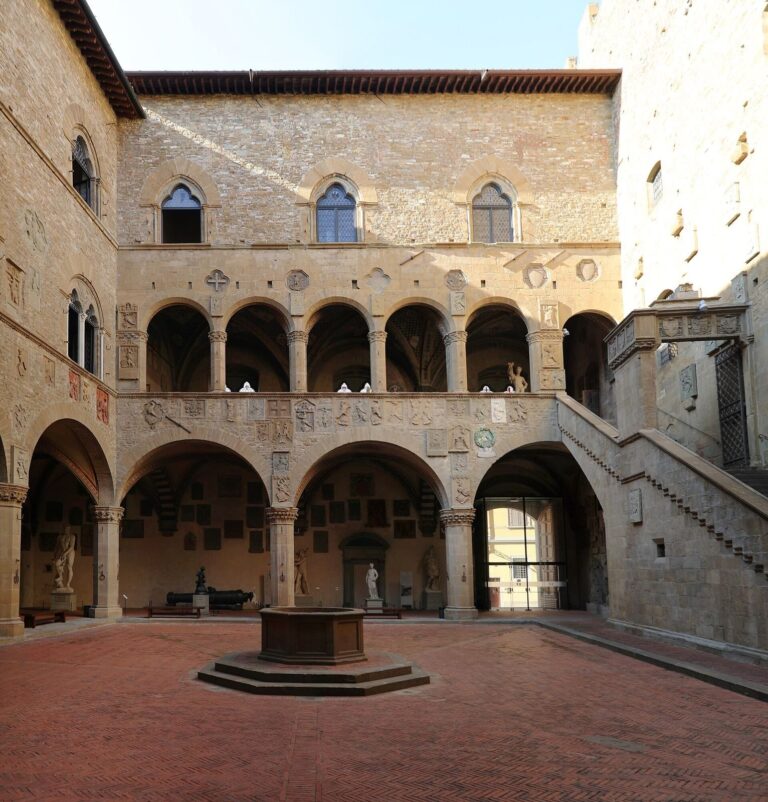
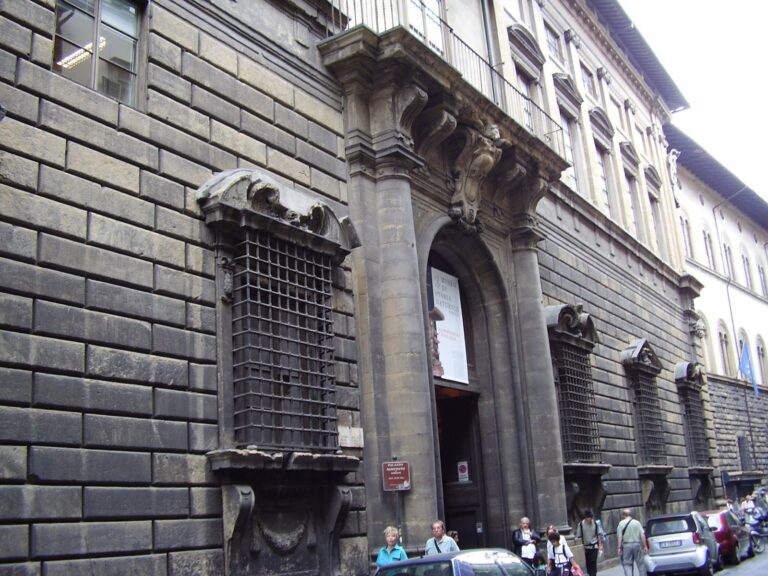
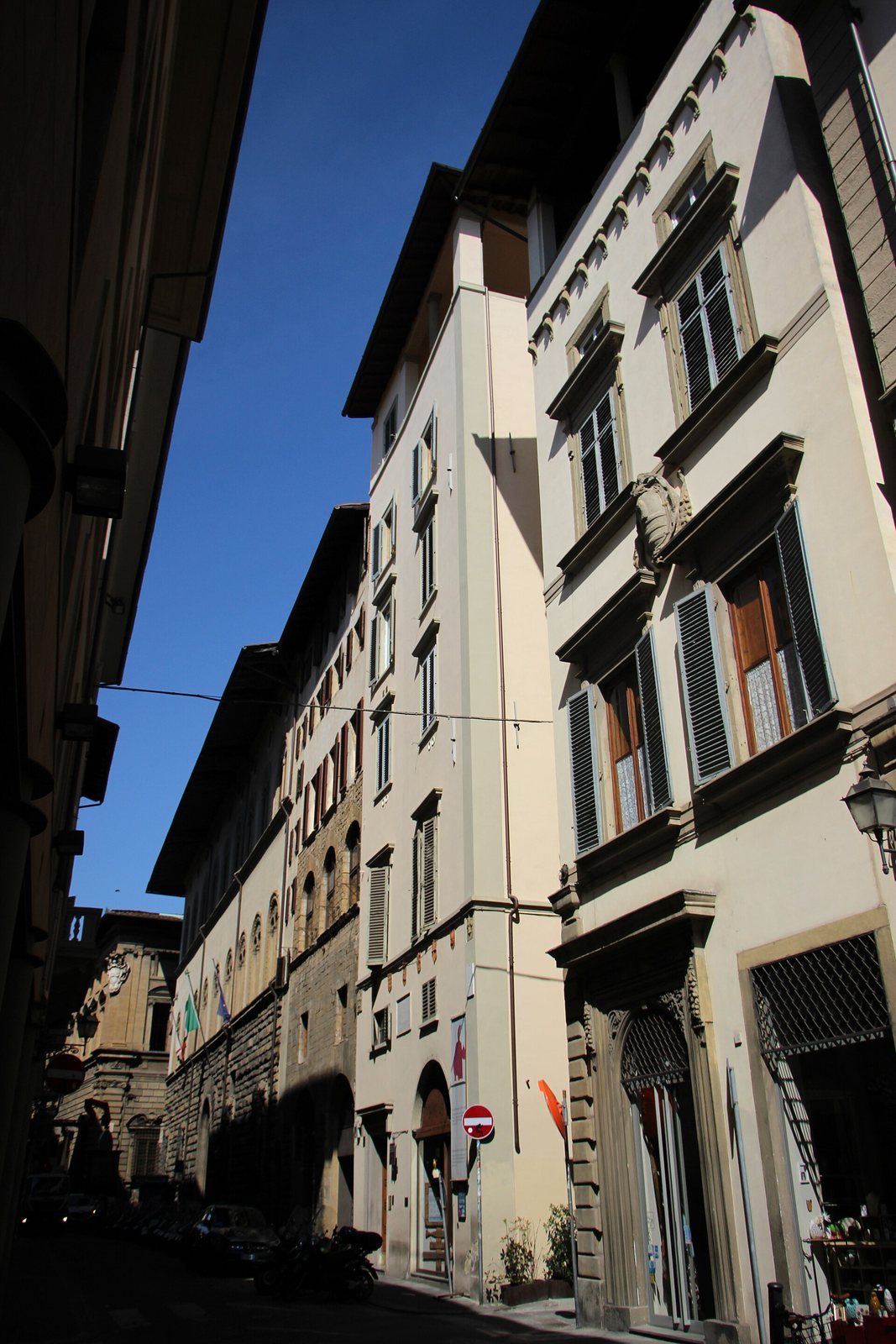
The palace stands on Via del Proconsolo and also fronts Via dei Pandolfini. Alterations have left it with the relatively plain appearance of a town palace. An eleventh-century tower was incorporated into the building. Its original entrance on Via dei Pandolfini is now blocked, while the separate monumental entrance at number 34 on that street was probably added in the late nineteenth century.
Exterior and commemorative emblems
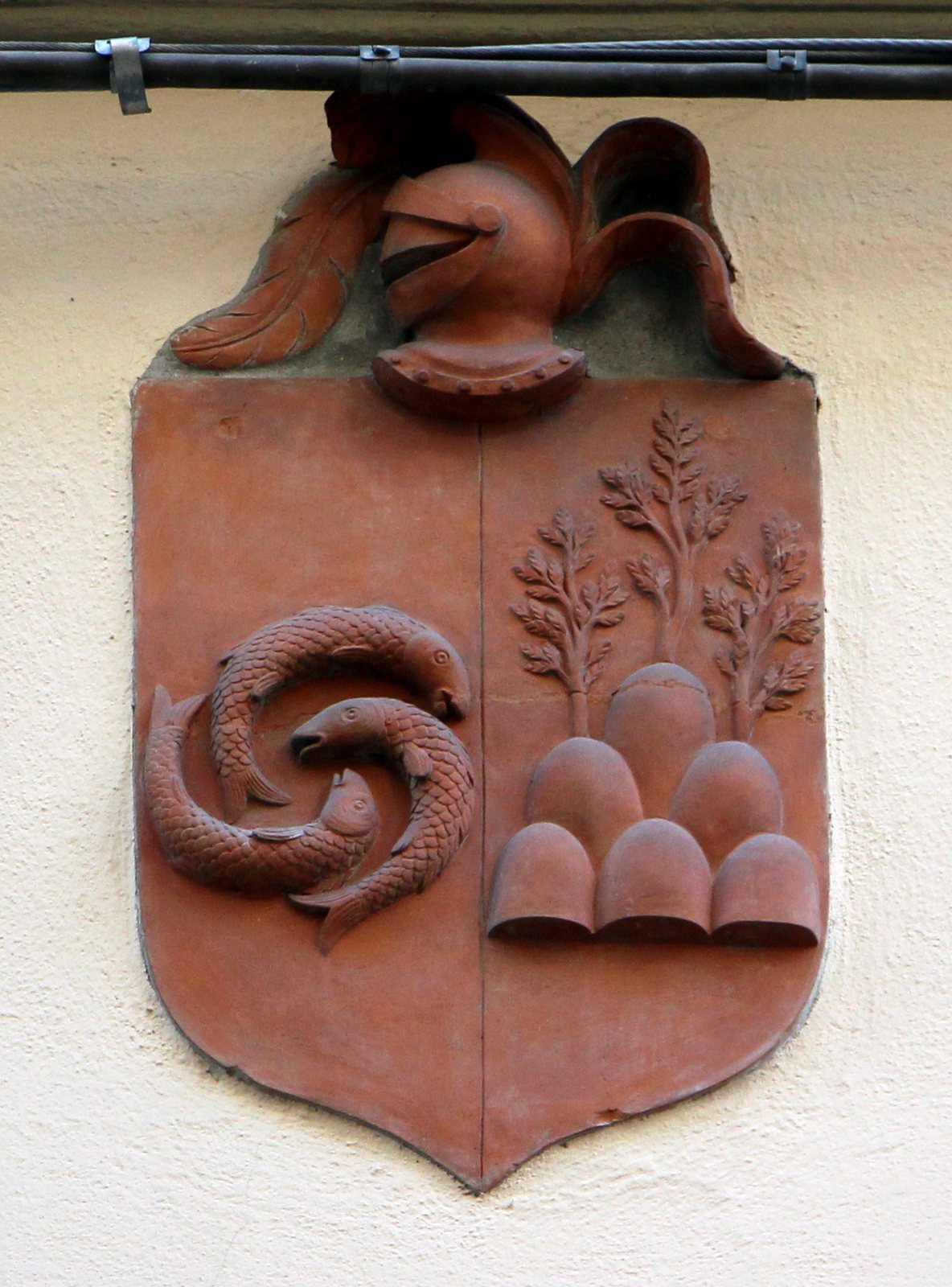
The facade carries terracotta Landini family arms showing three fish biting one another by the tails. Stone lilies crowned with eight-pointed stars also appear on the facade, probably referring to the guild. Puccianti’s commemorative terracotta arms combine the city lily and the guild’s eight-pointed star with the cross of the People and the Guelph eagle, an emblem associated with a medieval Italian political faction.
The former audience hall and its paintings
The ground-floor audience hall is the former great hall of the guild. Its damaged frescoes have received restoration that has improved their presentation. The surviving cycle includes portraits, civic emblems, allegorical figures, and religious imagery.
The poets’ lunette
A lunette, a semicircular painted field, contains Dante and Boccaccio. Of two other figures identified as Petrarch and Zanobi da Strada, only the legs remain; their busts and faces are lost. The depiction of Dante differs from the sharp, aquiline-nosed image familiar from later Renaissance representations and Gustave Doré’s illustrations of the Divine Comedy. It has been compared with a portrait in the Bargello chapel painted a few years earlier.
The vault and civic emblems
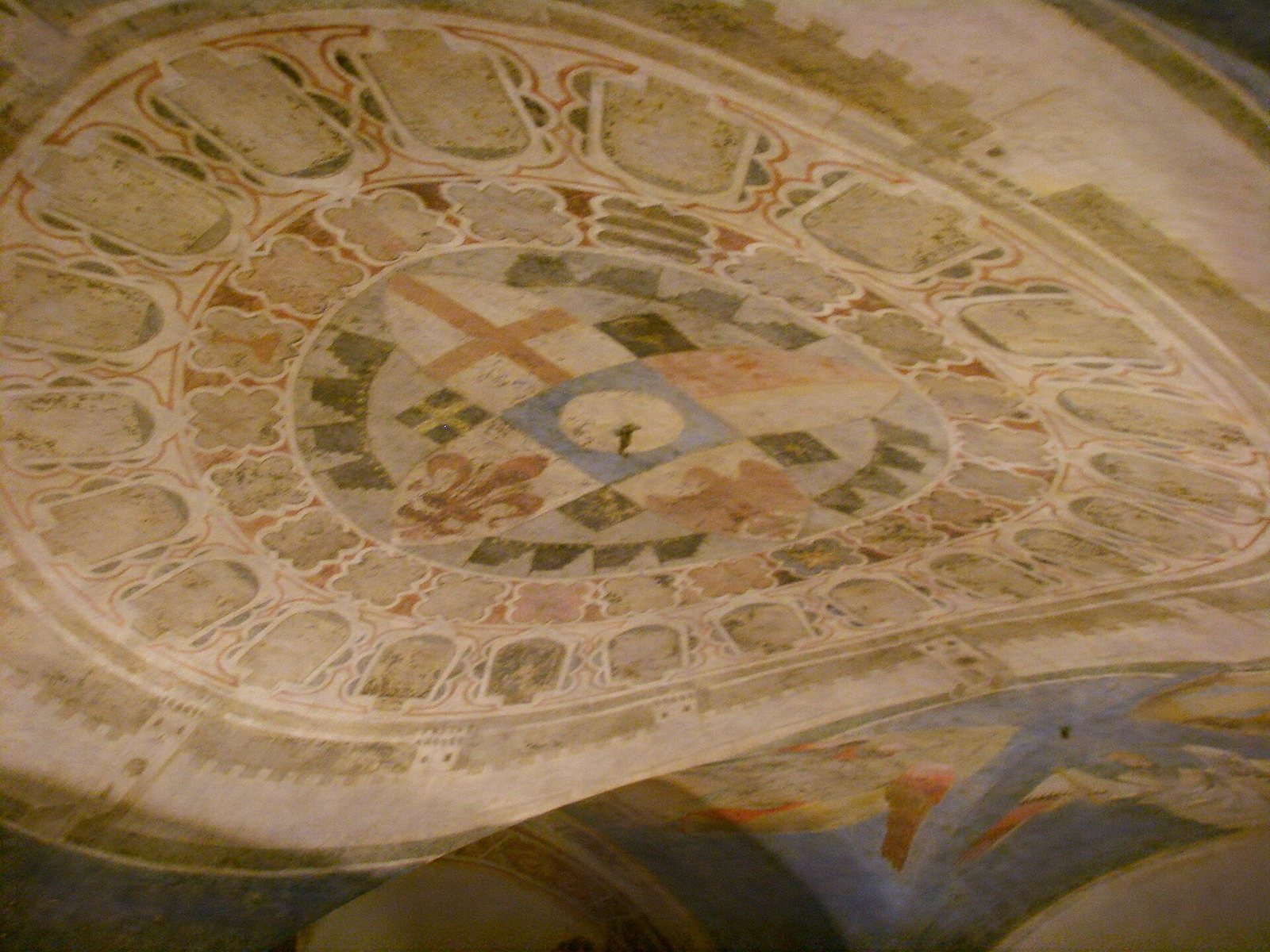
At the vault’s center, a comparatively well-preserved image represents Florence through a circle of city walls associated with Arnolfo di Cambio. Within it, coats of arms radiate outward from the Commune’s emblem, representing the city government. The sequence includes the Florentine lily, the Guelph eagle, the cross, the city’s quarters, and the insignia of twenty-one guilds. The circle also evokes the harmony and perfection of a “new Jerusalem,” an ideal city drawn from biblical tradition.
Other sections of the vaulted ceiling show the virtues of Justice, Fortitude, Prudence, and Temperance, along with an unidentified bearded figure.
Other painted fields
Three more deteriorated lunettes preserve different scenes: one shows a saint with five figures, another personifications of Dialectic and Rhetoric, and a third the remains of four heads. Other figures in these paintings cannot be identified.
Archaeological remains below the palace
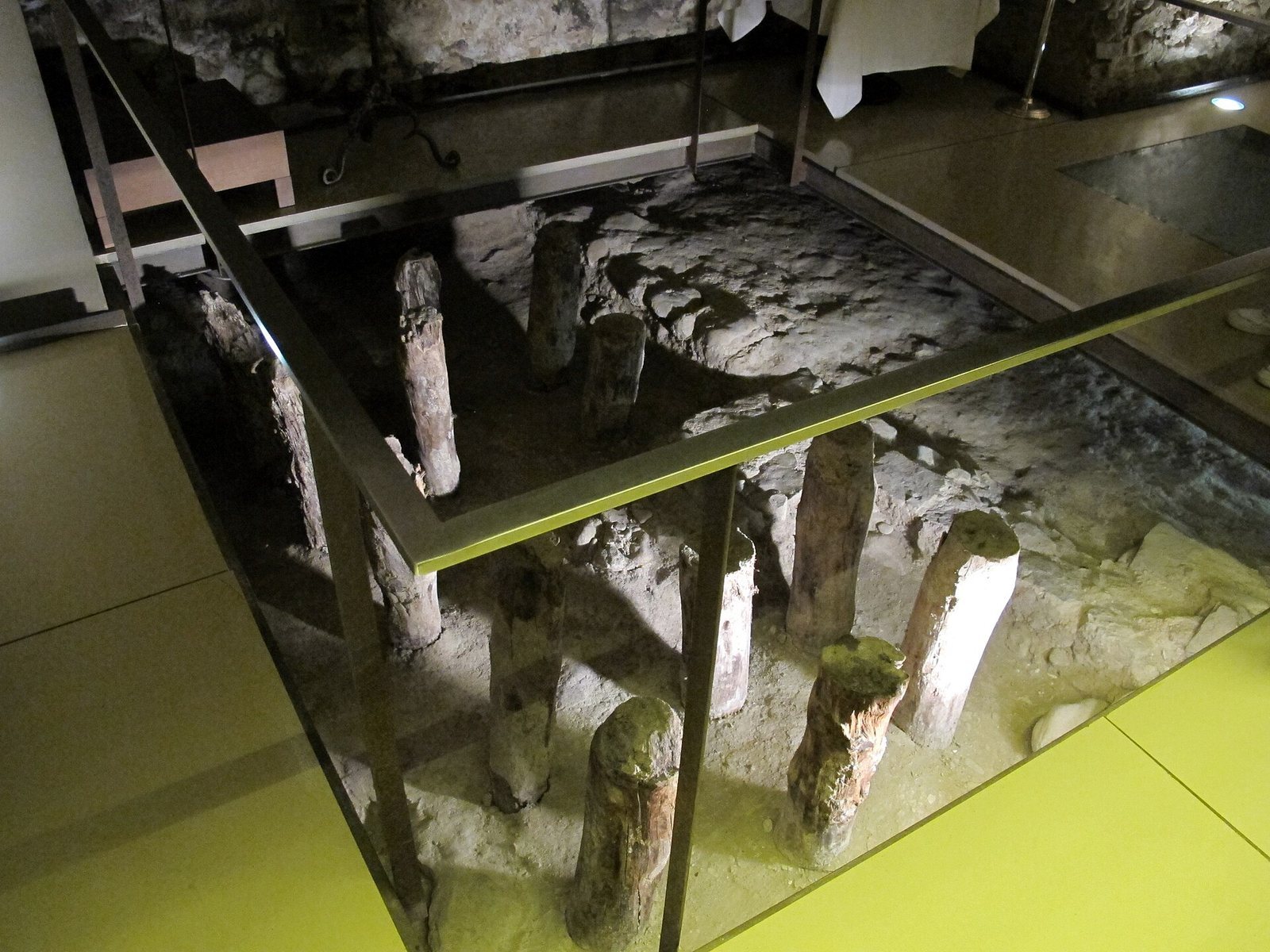
Excavations beneath the building have revealed traces of Roman Florentia and foundations belonging to buildings from the early Middle Ages through about the ninth century. Wooden piles driven into the ground are thought to relate to a fullonica, a Roman workshop for cleaning and finishing cloth, and to vats used to dye wool.
The chapel altarpiece
Jacopo di Cione’s Crucifixion Altarpiece, originally made for a chapel in the palace, is now held by the National Gallery in London.