Montechiaro Castle: A Medieval Fortified Stronghold in Italy
Site at a Glance
- Popularity
- Medium
- Country
- Italy
- Primary era
- Medieval
- Eras represented
- Medieval, Early Modern
- Civilizations
- Unclassified
- Site type
- Military
- Remains
- Castle
On this page12 sections
History
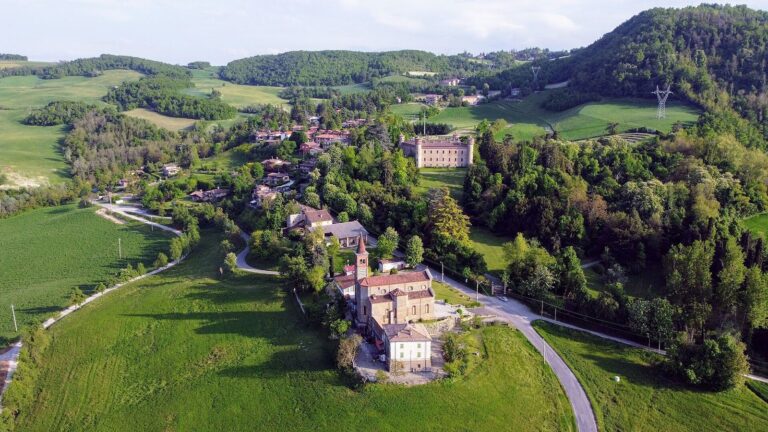
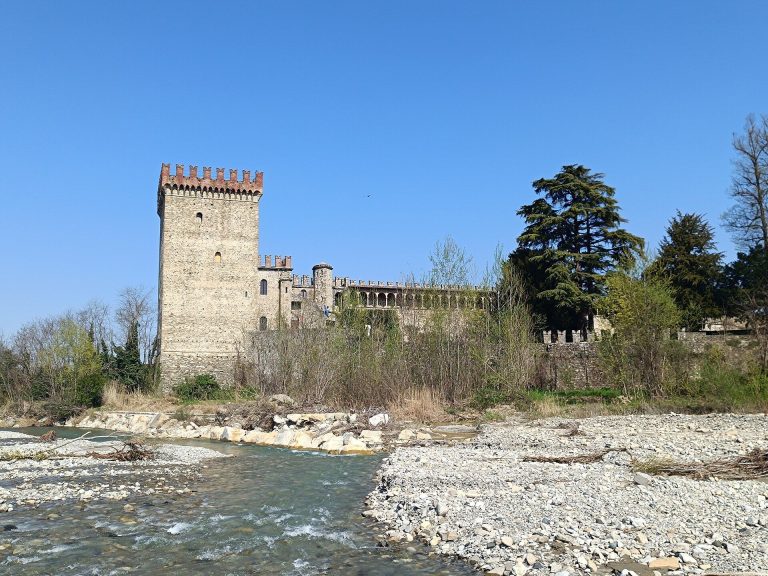
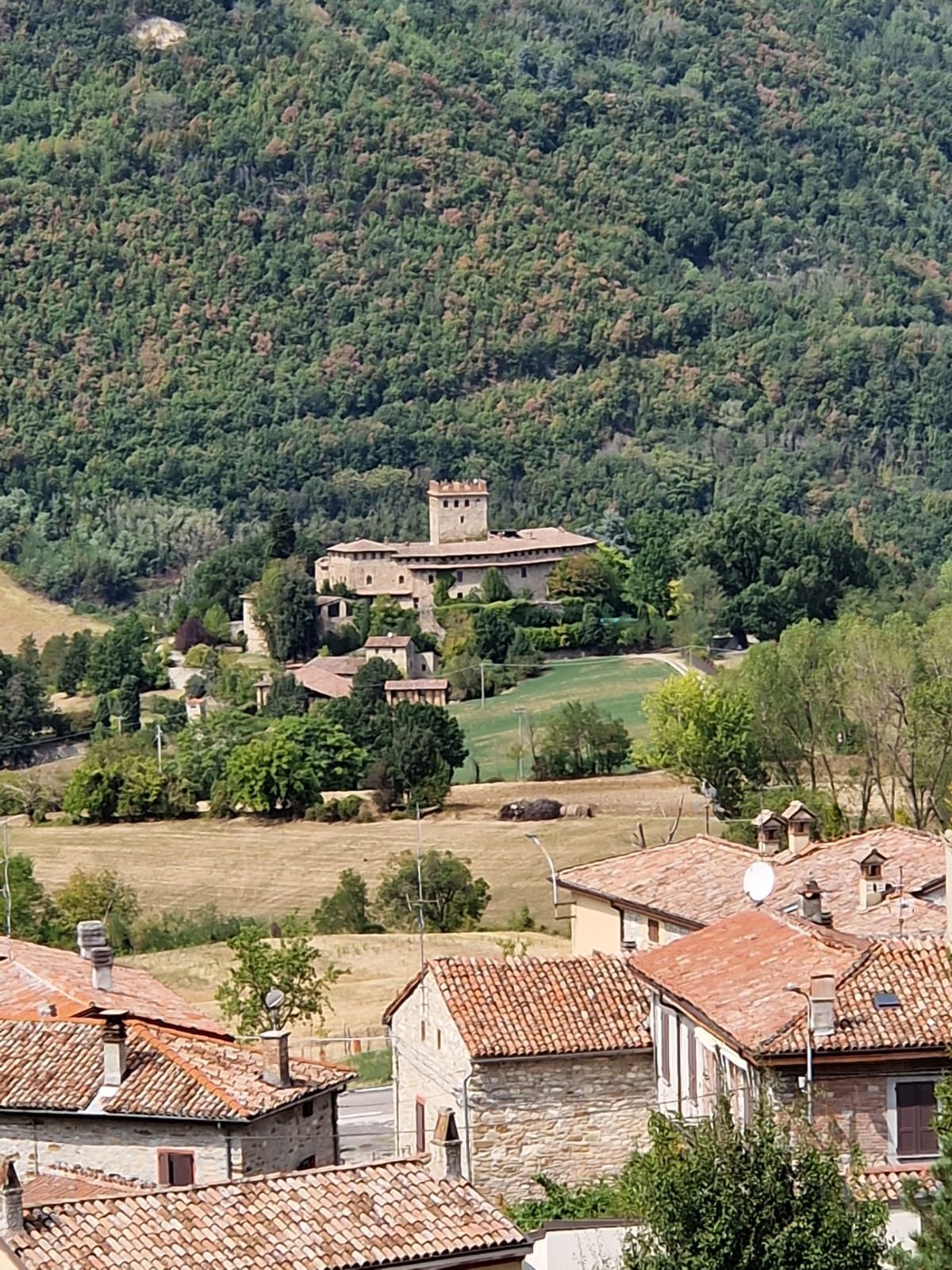
Montechiaro Castle is a restored fortified complex in Italy, overlooking the lower Trebbia valley. The Malaspina family probably built it around the middle of the 12th century as a strongpoint on the way toward the Po plain. Its stylistic features are associated with craftsmen from Lunigiana, the historic region spanning parts of present-day Tuscany and Liguria, where the Malaspina held substantial power.
Malaspina stronghold and early conflicts
The medieval Piacenza Annals refer to the castle as Castrum Raglii, a name linked with nearby Rallio. The Malaspina retained the stronghold until the end of the 12th century. Positioned above the valley, it formed part of a defensive quadrilateral with the castles of Statto and Rivalta on the opposite bank and the now-vanished castle at Rivergaro farther downstream. Together, these positions controlled the road from Piacenza to Genoa, connecting the Po plain with the Ligurian Sea.
In 1234, citizens of Piacenza destroyed the castle after nobles who had fled the city took shelter there. Uberto Pallavicino, Cremona’s chief civic magistrate, occupied it in 1251 with support from Ghibelline forces. The Ghibellines were a faction in medieval Italian politics that backed the authority of the Holy Roman Emperor. In 1312 the castle again served as a refuge for Ghibelline nobles, and an assault led by Galluccio Fulgosio failed the following year.
Anguissola ownership and medieval sieges
On 7 July 1324, the Quattrocchi family transferred the castle to the Anguissola. Fulgosio forces tried unsuccessfully to seize it in 1374, when it was held by Riccardo Anguissola. Some attackers were captured and condemned to death. The families’ dispute over the castle was later resolved through a marriage, and in 1377 Lancillotto Anguissola transferred it to Giovanni Anguissola.
In 1385, opponents of Gian Galeazzo Visconti, ruler of Milan, captured the castle despite its defense by Annibale Anguissola. In 1462, Onofrio Anguissola took refuge there after rebelling against Francesco Sforza, Duke of Milan, and being defeated near Grazzano Visconti. His brother Gian Galeazzo betrayed him to gain the duke’s favor, allowing the duke’s troops to capture him. After Gian Galeazzo Anguissola’s death, the property was divided among his two illegitimate sons and his brothers Filippo Maria and Antonio, of the Anguissola branch of Podenzano.
Later owners and changing uses
In 1635, bandits from Bobbio took the largely undefended castle, where only women and children remained. Their occupation lasted a day. A militia from Villò, led by Count Girolamo Anguissola and Count Pier Maria Zanardi Landi di Veano, drove them out the next day.
The Anguissola held the property until 1652, when Gerolamo III Anguissola sold the castle, then in poor condition, to the Genoese knight Bernardo Morando for 197,800 lire, 1 soldo, and 11 denari. Bernardo’s son Gian Francesco inherited it in 1656, restored it, and adapted it for contemporary use. When Gian Francesco died without male heirs in 1662, Morando Morandi inherited the castle and its feudal estate, which he held for 44 years.
During Morando Morandi’s tenure, a bridge was built across the Trebbia near the castle; it collapsed in the early 18th century. The exploitation of local petroleum deposits also began during this period, following earlier interest from Morando’s brother. Around 1770, the castle was remodeled as an aristocratic residence.
After Count Luigi Morando died in 1841, the family estates passed to the five daughters of his sister Teresa, who had married Marquis Antonino Casati Rollieri. The castle went to Luigia Casati, wife of Count Pavesi of Pontremoli. When she died without direct heirs, it passed to her cousin Antonino Giovanni Casati. In the 20th century, after Marquis Giovanni Casati’s death, his wife Imelde Anguissola Scotti left the castle by will to her nephew, Professor Ranieri Gagnoni Schippisi. The Gattegno family acquired it in 1990, followed by major restoration work. The castle is designated Italian national heritage.
Remains
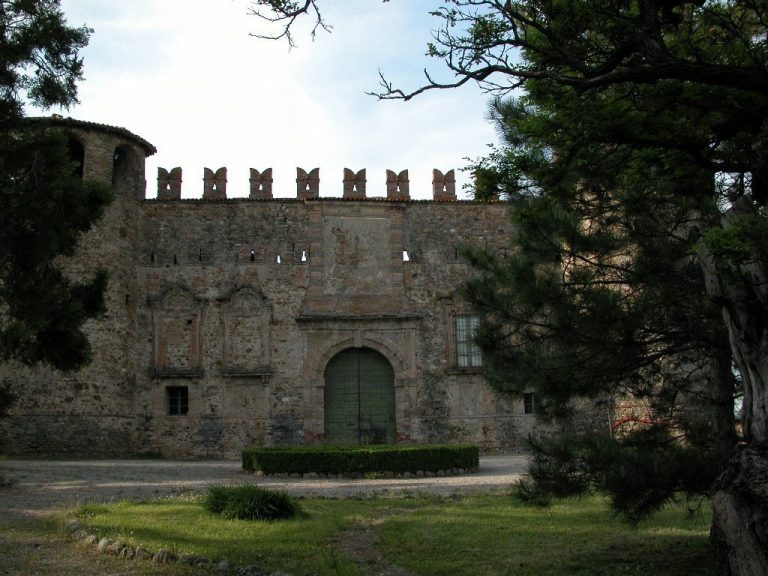
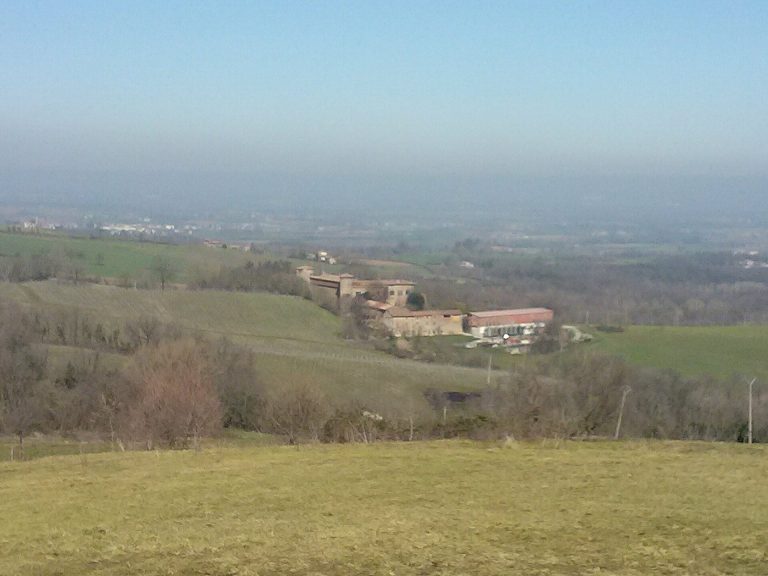
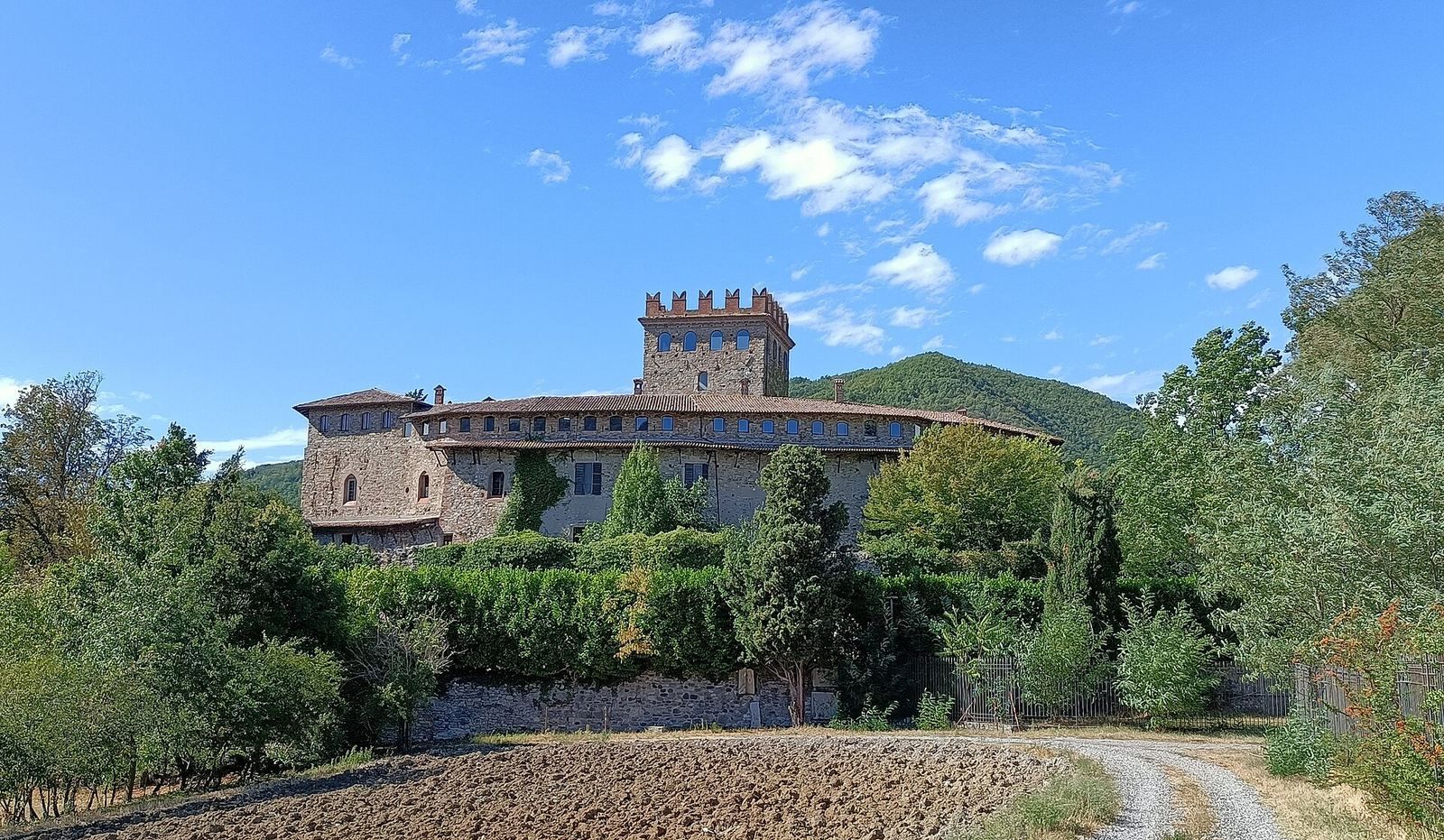
Set on the first hills of the Ligurian Apennines, the castle overlooks the lower Trebbia valley. Its rubble-stone buildings form a spur castle, a fortification built on a projecting ridge, adapted to the hilltop terrain. Three wall circuits enclose the complex, with the principal tower at the center of the courtyard and later residential buildings attached to the innermost wall.
Defensive circuits and central tower
Wall circuits
The first defensive wall is an irregular hexagon about 15 metres high, with a passage along its top. Outside it stands an elliptical second circuit, entered only from the southwest; the entrance originally had a drawbridge. About 30 metres farther out, a polygonal third wall follows the hillside. This outer circuit is in poorer condition than the inner two.
Central keep
The keep, the castle’s principal tower, stands in the courtyard. Its upper section has swallow-tailed battlements. A small window low on the tower has an arch cut from a single block of stone, a feature that points to a 13th-century date for the structure.
Interior buildings and underground spaces
Former lord’s residence
The former lord’s residence is attached to one face of the first wall circuit and was later converted into a storehouse. Its large hall contains tapestries bearing the Anguissola family arms. Another room, probably used as an oratory, or private prayer room, has a Renaissance fresco of the Madonna. The Renaissance was a European cultural movement that renewed interest in classical art and learning; the fresco’s artist is unknown.
Prisons
Prisons occupied the castle’s underground levels. Inscriptions and graffiti cut into their walls include a liturgical song devoted to Christ’s Resurrection.
Benvegnu relief
A sandstone sculpture in shallow relief, known as the Benvegnu, once stood beneath the castle entrance gate. Probably made in the early 14th century, it shows the owners greeting guests with a vernacular Italian welcome and assuring them of their reception. Its inscription is considered one of the earliest written examples of Italian vernacular. It resembles an inscription dated to 1330 at Vigolzone Castle, also held by the Anguissola in the Middle Ages. The Benvegnu is now kept at the Piacenza Civic Museums in Palazzo Farnese.