Kopylivskyi Park: A Historic Estate Park in Ukraine
Site at a Glance
- Popularity
- Medium
- Country
- Ukraine
- Primary era
- Modern
- Eras represented
- Modern
- Civilizations
- Russian
- Site type
- Domestic
- Remains
- Manor House
On this page13 sections
History
Kopylivskyi Park is the landscaped grounds of a historic estate in Ukraine, beside the Buchanka River. Russian railway entrepreneur Nikolai Karlovich von Meck acquired land there in 1882 and established the estate; its first manor house was completed in 1888 in a country-house form of Art Nouveau, an international style that flourished around the turn of the twentieth century. The estate combined a residence, agricultural and service buildings, and a landscaped park, and later became associated with composer Pyotr Ilyich Tchaikovsky and artists Mikhail Vrubel and Boris Kustodiev.
Before the von Meck estate
Kopyliv was first recorded as a settlement in 1392. It was later described as a tract and was again identified as a village in 1602. From 1738, property there passed among Polish noble owners, including the Kossakowski family, Joseph Dzyavialovsky, and Joseph Szymanowski. In 1840, the land was divided and sold to several buyers, among them Franz Yatskovsky, members of the Mukhanov family, Ketner, Glogowski, Rogalski, and Burzhynska.
The von Meck period
Von Meck was 25 when he bought the land. His mother, Nadezhda von Meck, considered the purchase financially premature. In a letter, she put its price at 150,000 rubles and warned that the deteriorating buildings and other needs would require substantial further spending. Despite these concerns, her son developed the estate and helped local residents form a cooperative society and establish a bank branch in the village.
Tchaikovsky visited in 1889 and 1890, staying in a room set aside for him. His letters spoke favorably of the house and its outlook and noted his interest in the dairy operation. Nadezhda, a patron of the composer, supported him financially. Vrubel and Kustodiev also stayed at the estate and received financial assistance from Nikolai von Meck. When he sold the property in 1910, more than 30 young residents left with him for Russia to work at his enterprises.
Nationalization and changing uses
After the October Revolution, the Bolshevik seizure of power in Russia in 1917, the estate was nationalized. Its house served as an agronomy school, then as a German military headquarters during the Second World War. From 1943 to 1945 it housed a Soviet military hospital, followed after the war by the central district hospital until 1954. The village secondary school used the building from 1954 to 1973. It also housed a branch of the Makariv children’s music school and the village council.
Protection and decline
The park was placed on a state-protected list as a garden-art monument in 1972, and the estate was registered as a locally significant architectural monument in 1990. In 1999, the Ukrainian government identified the building as needing comprehensive preservation and included it in a national program for the reconstruction of outstanding historical and cultural monuments, but repairs did not follow. The village council transferred ownership to the enterprise Allegri in 2004. That year, the district administration interpreted the estate’s omission from a list of protected monuments exempt from privatization as indicating that it lacked state-protected monument status.
Remains
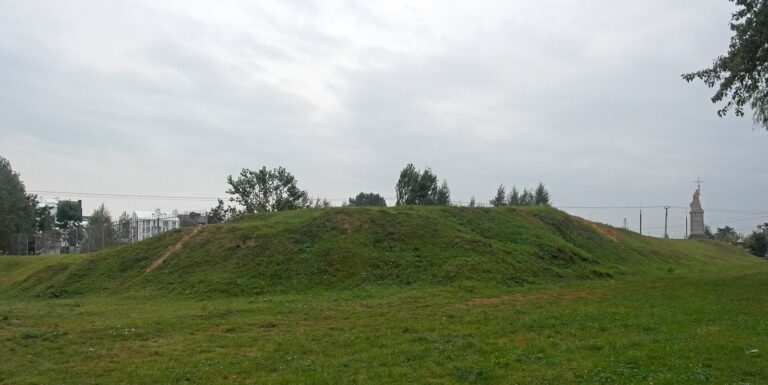
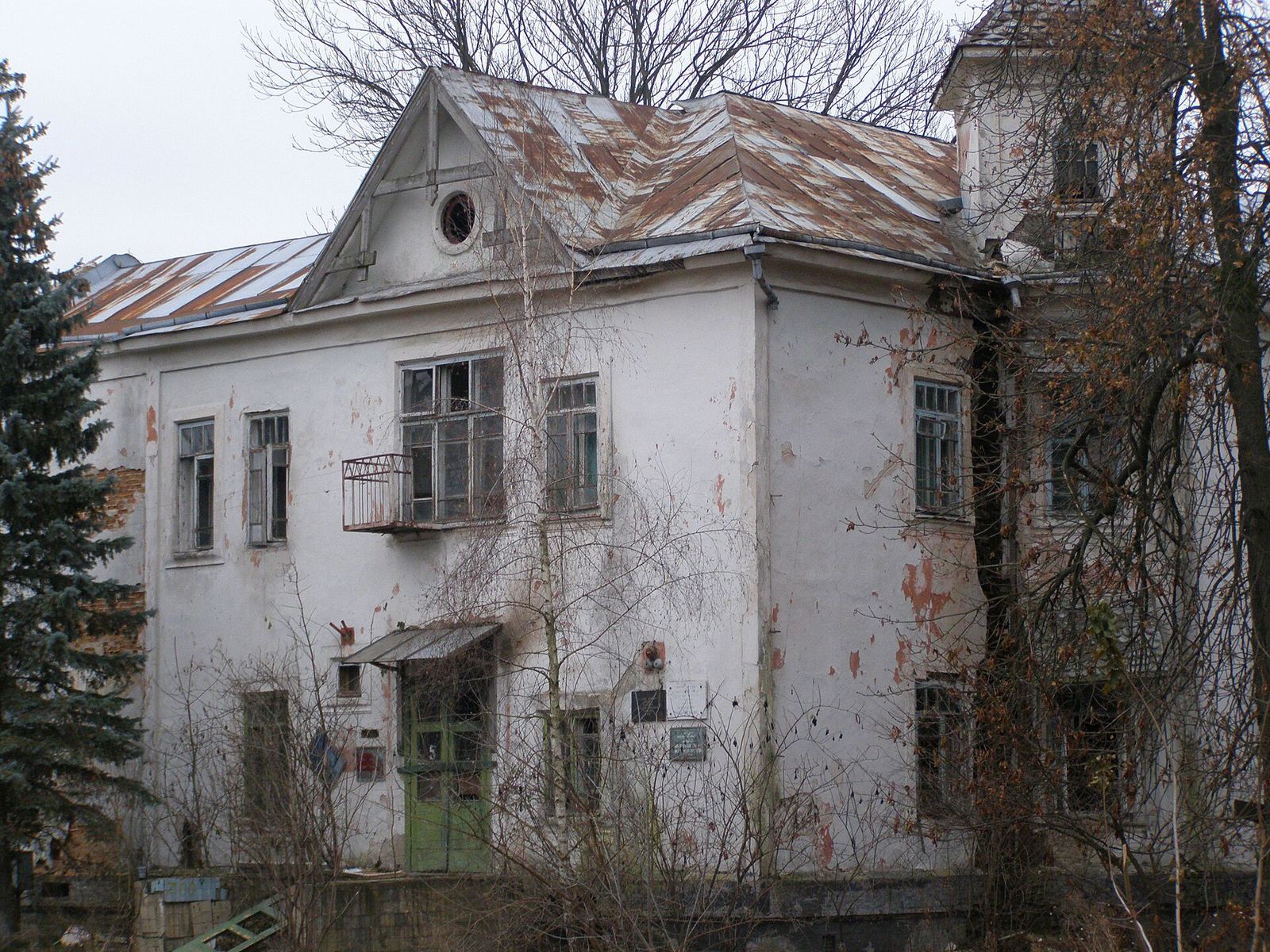
The estate occupied the Buchanka River bank and included a manor house, service and agricultural buildings, farms, and landscaped grounds. The estate is listed as covering 8 hectares, while the park is described as covering 9 hectares. Its surviving remains include the house, sections of the park landscape, a manor pond, and ruins of agricultural structures.
The manor house
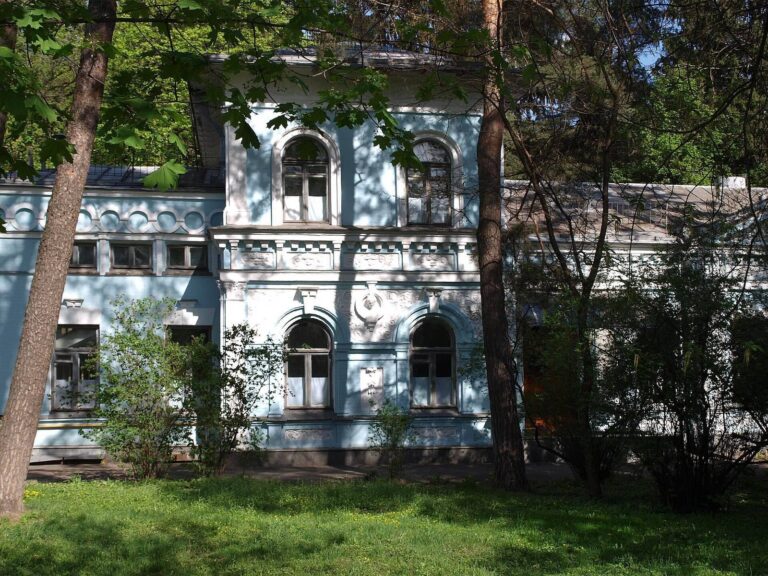
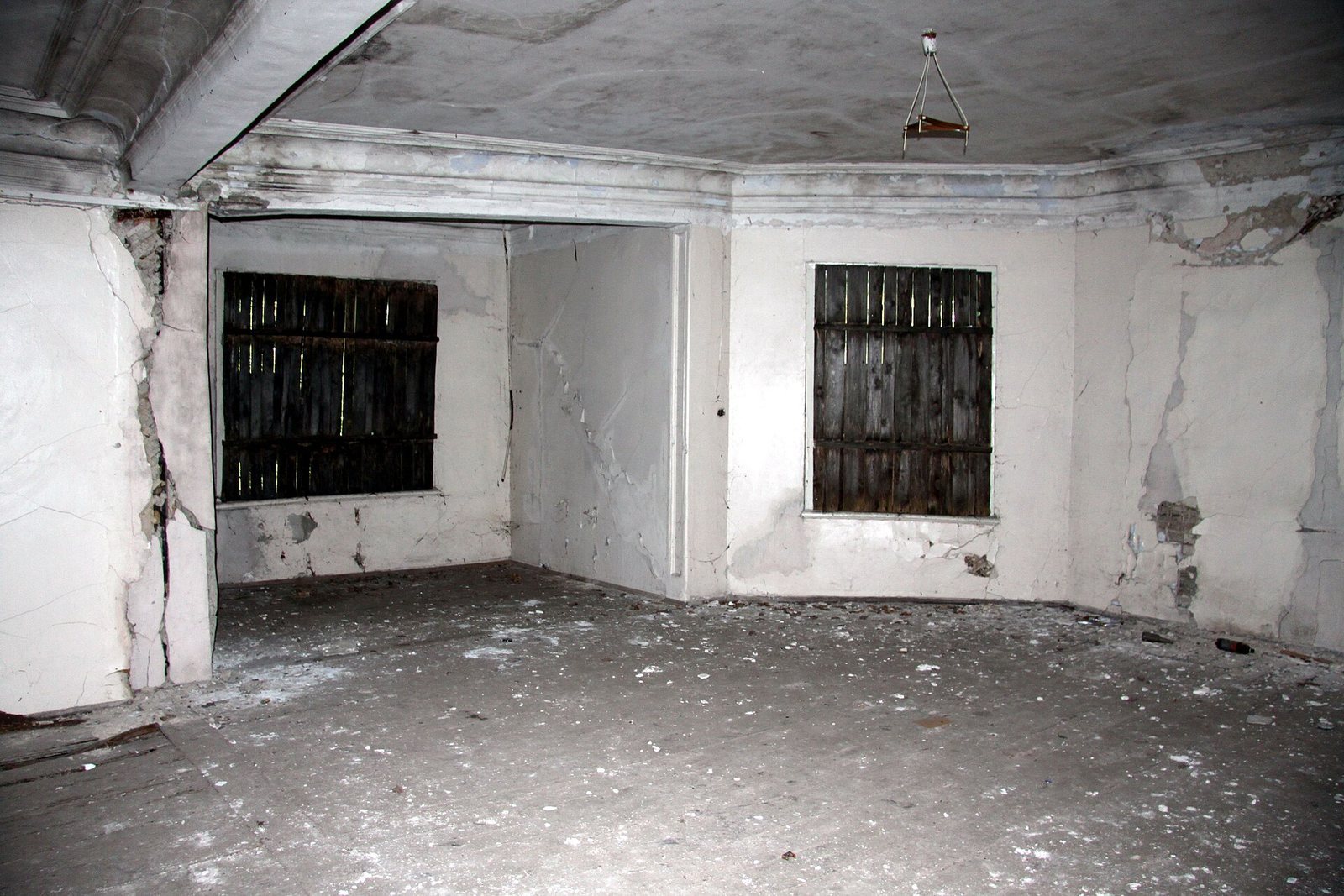
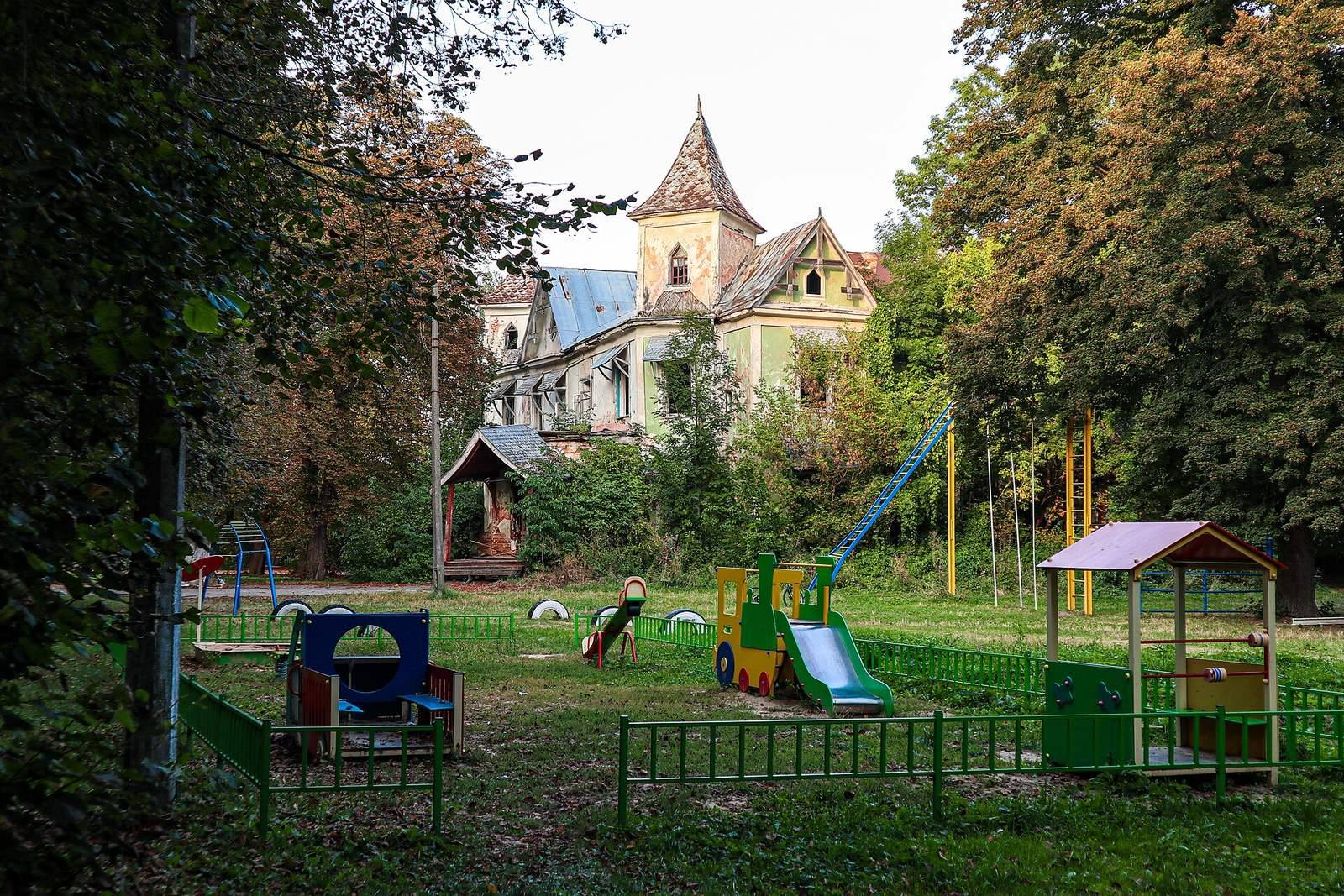
The first house, completed in 1888, was built of logs on a brick base. It had small towers, gables, bay windows, a large terrace, and an exterior staircase leading to the second floor. A fire severely damaged it in 1898, and rebuilding began around the turn of the twentieth century. The rebuilt, two-storey house had a mansard roof, whose steep lower slope creates usable attic space, a terrace with wooden ornament, and roof towers clad in metal tiles. Its design combined Russian-style features with Gothic elements. The house remains in a critical state of disrepair.
The landscaped park
Design and recreational features
The grounds were laid out in a landscape style. Their design is attributed, with uncertainty, to landscape architect Georg Friedrich Ferdinand Kufaldt or one of his pupils. Features included a riding arena, summer houses for children, a pavilion, gazebos, a fountain, an artificial pond with swans, a rose garden, and a summer theater used for musical evenings and performances. By the 1890s the park also had a children’s cottage, racecourse, and shooting range.
Plantings and surviving landscape
Spruce and linden avenues were planted during the von Meck period, with the trees transported by oxen in wooden barrels. In front of the house, spruces and ornamental shrubs bordered a lawn. Sections of the avenues, some old trees, and the ruins of a fountain survive in the park.
Roads and ponds
Poplars lined a road from the estate. Von Meck also ordered them planted along a road from the village toward the Brest-Litovsk highway, now the M06 or Zhytomyr highway, because their roots absorbed moisture and helped drain the ground. Two ponds were supplied with water from the Zdvyzh River, one for the estate and the other for local residents. The manor pond survives.
Agricultural buildings
The estate’s agricultural complex included a cowshed, dairy farm, mill, water tower, and stud farm. Ruins of the dairy farm and water tower remain.
Soviet-period features
A memorial to the Unknown Soldier was built in the park during the Soviet period, and a village stadium was constructed there in the 1960s. A wall retains an imprint of the Soviet propaganda slogan, “Ideological work is the task of the entire Party and every Communist.”