Belgorod Kievsky: A Medieval Fortified City in Ukraine
Site at a Glance
- Popularity
- High
- Country
- Ukraine
- Primary era
- Medieval
- Eras represented
- Bronze Age, Medieval
- Civilizations
- Kievan Rus
- Site type
- City
On this page20 sections
History
Belgorod Kievsky, a later historiographic name for the medieval city of Belgorod, was a fortified center near present-day Bilohorodka in Ukraine and a major stronghold of Kievan Rus, the medieval polity centered on Kyiv. Vladimir Sviatoslavich, or Vladimir I, grand prince of Kyiv, established a large fortress and settlement here in 991, although the city’s existence before that date is disputed. The fortress guarded Kyiv’s western approaches and helped extend the principality’s authority over Drevlyan lands west of the Irpin.
Early settlement and the Rus stronghold
The area had been settled by the mid-third millennium BC, when a community associated with the prehistoric Trypillia culture occupied the site. A fortified Slavic settlement followed in the second half of the first millennium AD. A chronicle entry under 980 connects Belgorod with a palace belonging to Vladimir I and says that he kept 300 concubines there.
Belgorod formed part of a wider system of fortresses defending Kyiv from steppe nomads and rival princes. Its position also helped Kyiv assert control over the Drevlians, an East Slavic people whose lands lay west of the capital. The Kyiv-to-Belz road passed through the city, linking Kyiv with Halych, Volhynia and Podolia, and continuing toward Central Europe. The nearby Irpin served as a natural defensive boundary. Belgorod grew into a political, economic and cultural center of southern Rus, and Kyiv’s princes also used it as a temporary residence.
A bishop’s seat, the center of a bishop’s authority, existed at Belgorod by 992, when the Greek bishop Nikita was associated with the city. The Primary Chronicle, a medieval history of Rus, first names a bishop of Belgorod under 1088. A chronicle tradition also recounts a siege by the Pechenegs, a steppe people who fought the Rus principalities, in 997 while Vladimir was away. Famine led the inhabitants to consider surrender, but a public assembly, or veche, chose to resist. Townspeople showed the besiegers wells containing a grain-based drink and honey, convincing them that the land could sustain the city. The Pechenegs withdrew. The episode is also associated with the first mention of a veche in Rus chronicles.
Princes, conflicts and changing rule
In 1117, Vladimir Monomakh placed his eldest son Mstislav in Belgorod; Mstislav became grand prince of Kyiv in 1125. During the twelfth century, Belgorod was the center of a small principality, usually held by a close relative or ally of the grand prince. Its succession included Sviatoslav Olgovich, Vladimir Mstislavich, Mstislav Izyaslavich, Mstislav Rostislavich the Brave, Roman Rostislavich, Rostislav Rurikovich, Gleb Sviatoslavich and Mstislav Romanovich. In 1149, Yuri Dolgoruky placed his son Boris in the city.
Belgorod was repeatedly contested in conflicts among Rus princes. Yuri Dolgoruky sought to seize it in 1151, and the city endured sieges in 1158 and 1161. In these struggles, Mstislav Izyaslavich prevailed over Iziaslav Davydovich. Rurik Rostislavich held Belgorod from 1171 and, by the late twelfth century, had established himself there. He first opposed Sviatoslav Vsevolodovich of Kyiv and later became his co-ruler. Rurik also undertook a major building program in the city.
Destruction and later settlement
Mongol forces destroyed Belgorod in 1240, after which the city declined. Settlement later resumed in a limited part of the former citadel, and during the Lithuanian period the site gradually developed into a village. A fortress there is recorded from the fourteenth century as a western outpost of Kyiv. In 1474, the Venetian envoy Ambrogio Contarini travelled through Belgorod on the road between Zhytomyr and Kyiv. During the period of the seventeenth-century Cossack leader Bohdan Khmelnytsky, estates at Belgorod belonged to Kyiv’s Orthodox St Sophia Monastery.
Archaeology and preservation
Surveys by I. P. Khrushchov and V. B. Antonovych began in the second half of the nineteenth century. V. V. Khvoika excavated at Bilohorodka in 1909–1910, finding remains of churches, houses and ancillary buildings and beginning the study of the defenses. Broader investigations followed in the Soviet period. Systematic excavations began in 1966 under G. G. Mezentseva and E. A. Lineva, alongside work by D. I. Blifeld, B. A. Rybakov, Yu. S. Aseyev, A. N. Kirpichnikov, P. A. Rappoport and M. P. Kuchera. The hillfort and burial ground have national-level immovable-monument status, while the ramparts are recognized as monuments of national historical significance.
Remains
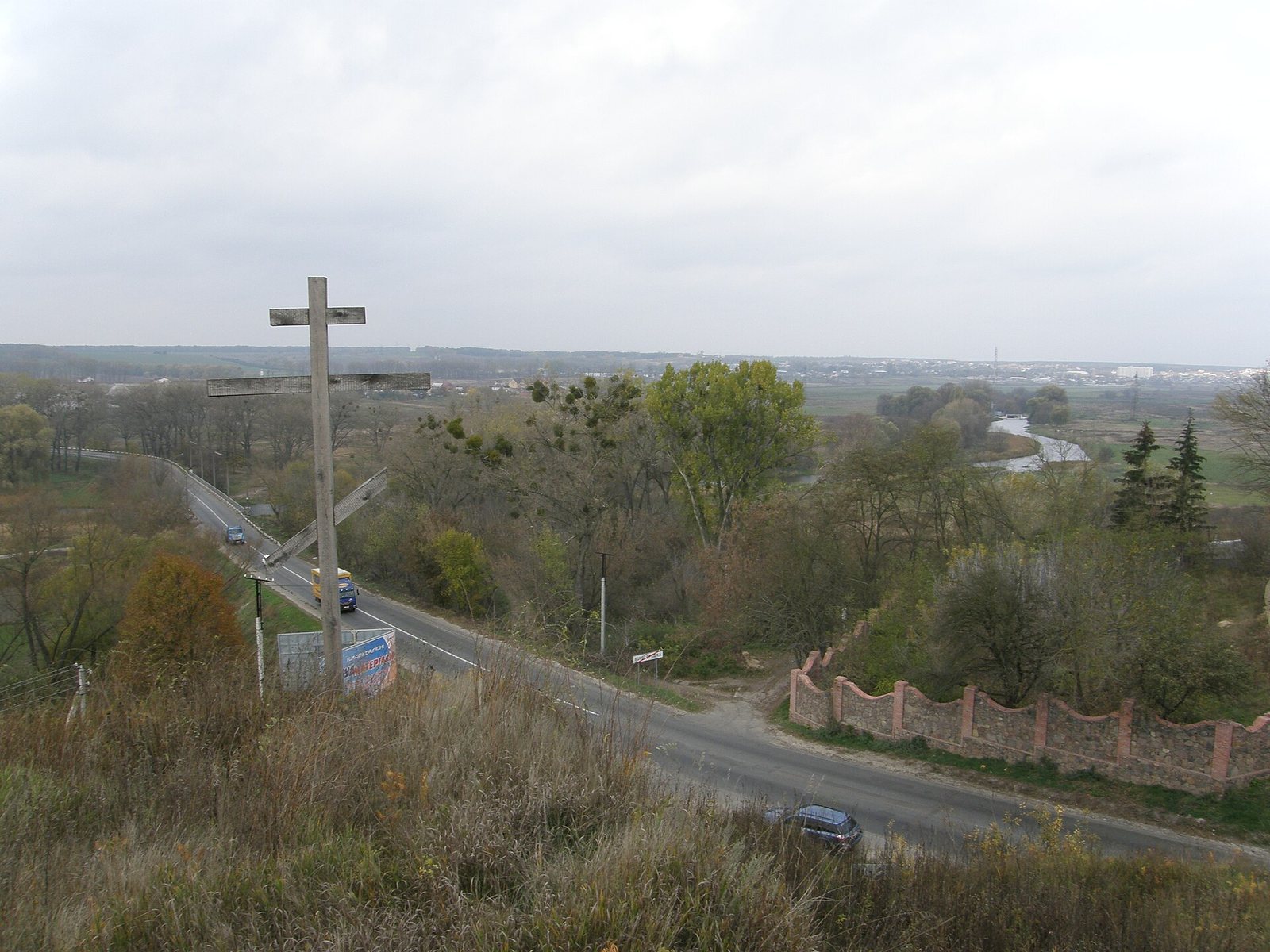
Belgorod occupied a high plateau above the marshy bank of the Irpin. Its defenses combined steep natural slopes, a ravine, earthen ramparts and ditches. The medieval city’s fortified districts included a citadel on the promontory, an outer settlement to its east and a further outer town to the north.
Plateau and early hillfort
The plateau rises as much as 50 metres above the river. Steep slopes to the west and south, together with the Irpin and a ravine, provided natural protection; ramparts and ditches strengthened the eastern and southern approaches. The early Slavic hillfort was rounded and promontory-shaped, covered 8.5 hectares, and survives partly in the southern area. Vladimir’s fortress expanded the settlement. The medieval city’s fortified area was about 100 hectares, while the wider archaeological hillfort covers 110 hectares.
Citadel and entrances
Ramparts
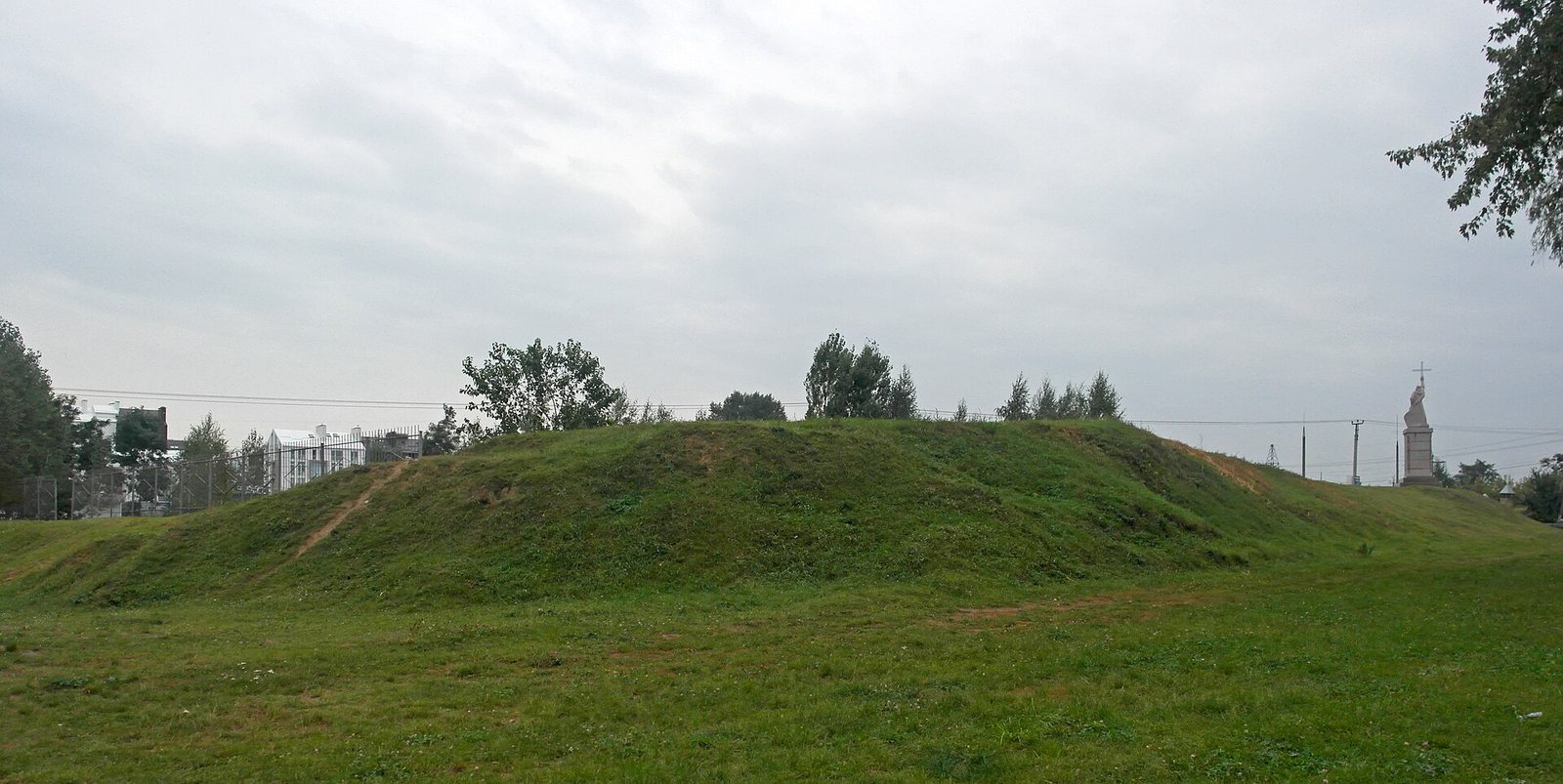
The inner citadel covered 12.5 hectares on the promontory. Earthen ramparts, reinforced with wooden structures and sun-dried earth fill, enclosed it on all four sides and extended about 1.5 kilometres in total. The best-preserved stretch is on the eastern side, where the rampart runs for 450 metres and reaches 11.5 metres in height.
Gates and streets
The principal entrance lay in the eastern rampart, which turned inward for 45 metres to form a passage about two metres wide. An entrance tower stood at each bend; excavation uncovered the right-hand wooden tower, measuring 3.75 by 2.7 metres. The southern entrance was also set between inward-curving ramparts, while another opening at the northeast corner led into the ravine. Streets linked these entrances: one ran southeast to northwest from the eastern gate toward the river, and another led north from the southern gate to meet the central street. The northeastern entrance connected with the ravine, where the main Kyiv-to-Halych road passed.
Outer districts and cemetery
The rectangular outer settlement east of the citadel covered 40 hectares. High ramparts with wooden structures and sun-dried earth fill protected its north, east and south sides, with a deep ditch beyond them. The outer town north of the citadel covered 45 hectares and was enclosed by a high earthen rampart. Beyond the outer settlement’s southern rampart lay a cemetery used from the eleventh to the thirteenth centuries, including burials of members of a princely retinue.
Churches and residences
Princely quarter and aristocratic houses
The citadel’s central area contained churches, princely and aristocratic residences, and the bishop’s court. Excavated houses from the eleventh and twelfth centuries were unusually large for their period and included two rooms. Some walls were faced with multicoloured glazed tiles.
Church of the Apostles
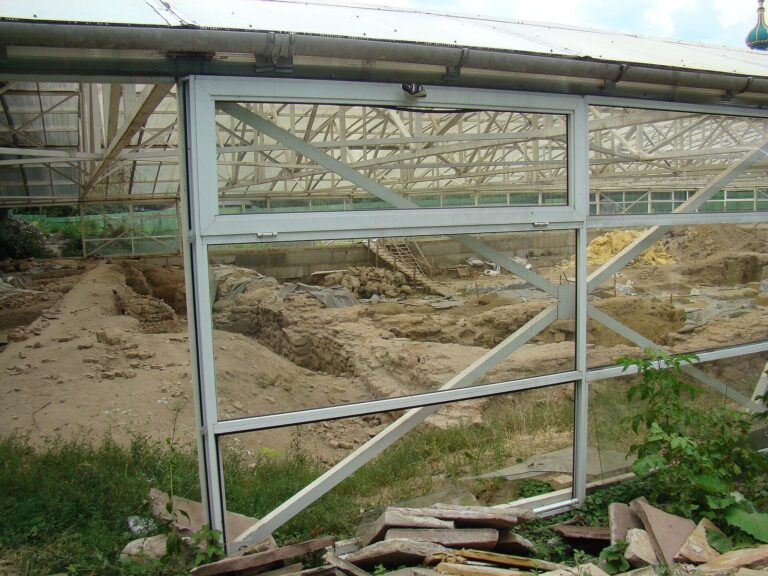
Rurik Rostislavich’s building program included a court and the Church of the Apostles, built in 1197 on the site of an earlier wooden church. The large stone church had six pillars, three lengthwise divisions inside and three apses, rounded projections at the sanctuary ends. Its floors were paved with multicoloured glazed tiles, and lead sheets covered its domes. Frescoes, paintings made on wet plaster, decorated the walls, including gold painting over plaster. Foundations, floors, wall sections and fragments of the gold painting have survived.
Smaller church
A second, smaller church had four pillars and a single apse. Its foundations have been excavated. A white-stone sarcophagus was found nearby, and Bishop Maksim was buried there in 1189.
Craft production and finds
Excavations have identified fortifications made from brick, wood and earth, as well as a pottery kiln, a bone-carving workshop, a smithy and other craft workshops. Locally made glazed tiles carried elaborate ornament. Recovered objects provide evidence of urban life between the tenth and thirteenth centuries.
Military works and memorial features
Pillboxes
Small fortified firing positions, or pillboxes, were built into the ramparts. Numbers 382 and 385 are on the outer-town ramparts, number 376 on the outer-settlement ramparts, and numbers 378–381 on those of the citadel. Positions 378, 380 and 381 are barbet-type machine-gun emplacements, a form of fixed firing position.
Monuments and markers
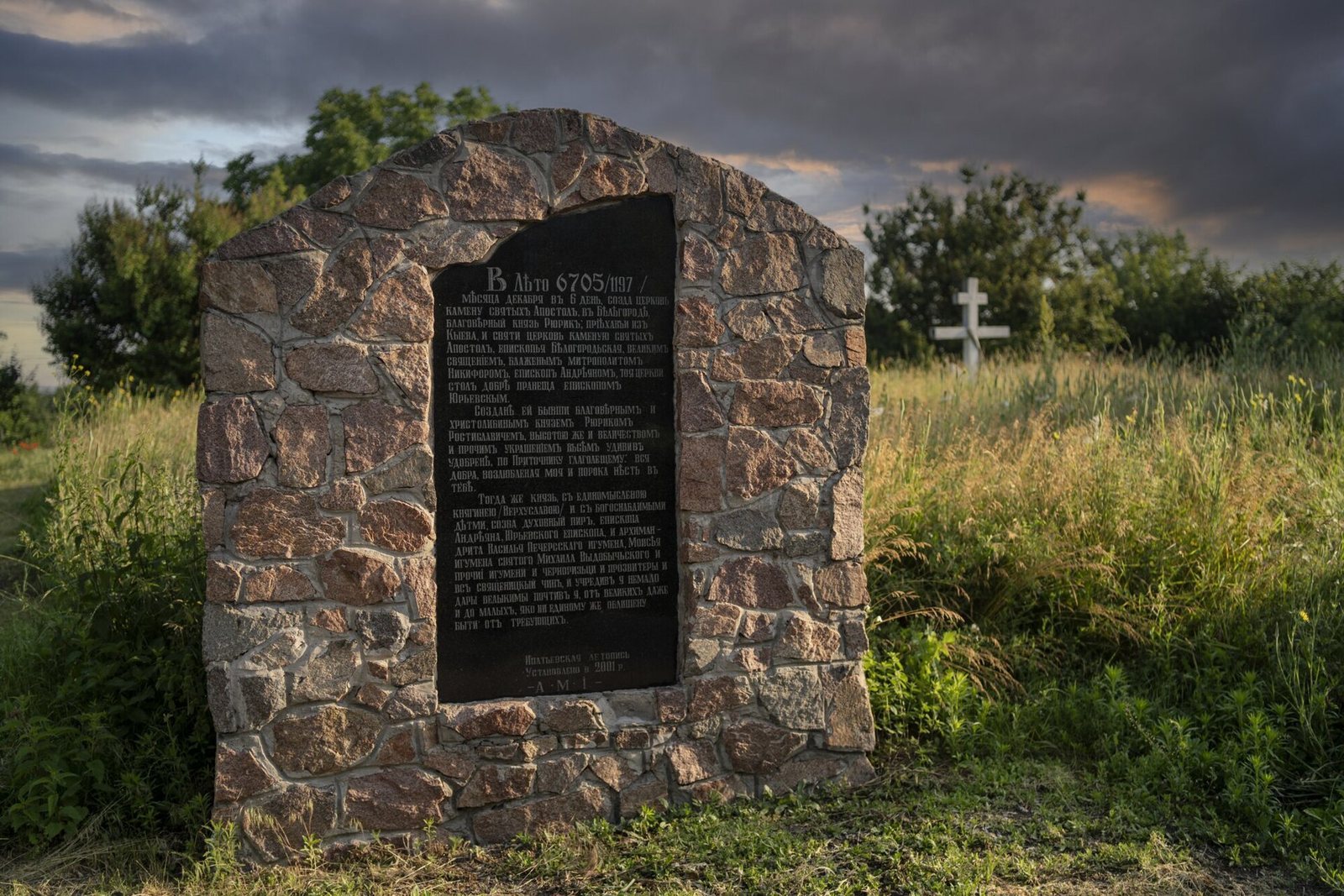
A monument to Vladimir I stands on the outer-town rampart. Other features include a memorial stone bearing an inscription, a stele describing the city’s foundation in 991, and a well identified as the chronicle well. The location of the Church of the Apostles is also marked.
Preservation
Historian A. Chlenov characterized Belgorod as the only Drevlyan fortress to survive almost intact, the only tenth-century Rus fortress preserved to that degree, and the largest surviving fortress of its period.