Zelená Hora: A Medieval Castle Converted into a Baroque Chateau
Site at a Glance
- Rating
- 3.9
- Popularity
- Low
- Country
- Czechia
- Primary era
- Early Modern
- External website
- Open
- Eras represented
- Medieval, Early Modern, Modern
- Civilizations
- Habsburg, Holy Roman Empire, Kingdom of Bohemia
- Site type
- Domestic
- Remains
- Castle
On this page16 sections
History
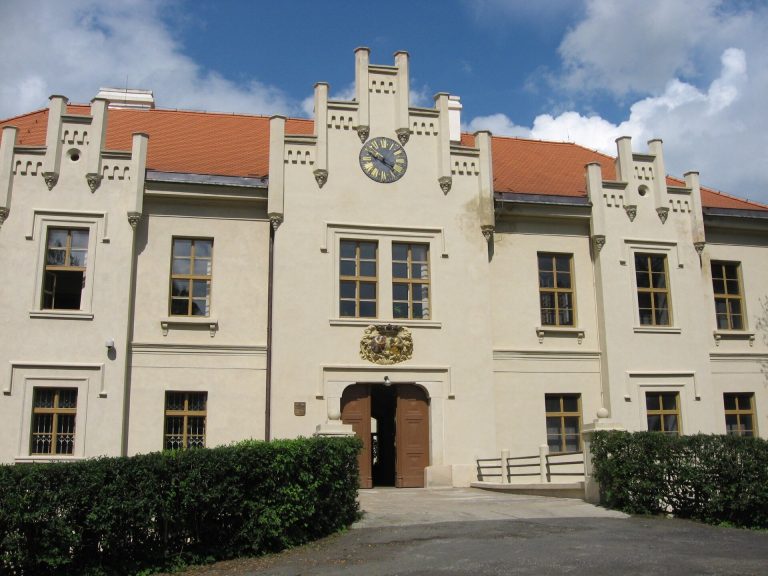
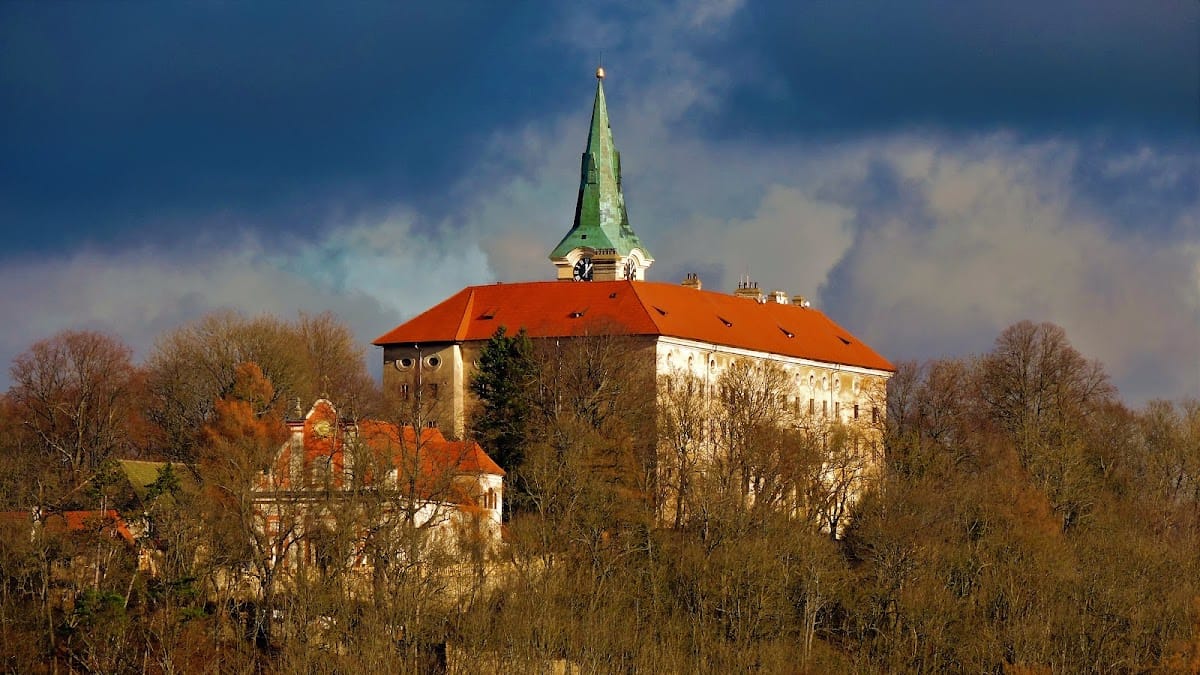
Zelená Hora is a medieval castle converted into a chateau in Czechia, on a hill about one kilometre north of Nepomuk in the municipality of Klášter. First documented in 1221, the site developed from a fortification into a Gothic castle and later acquired its present architectural character through an early Baroque rebuilding between 1670 and 1688.
Medieval origins and the Hussite period
The site appears in a 1221 exemption granted by King Ottokar I of Bohemia to the abbot of the nearby monastery. The exemption concerned labor obligations connected with the construction of the castles at Teslín, Prácheň, and Zelená Hora. The first fortification was probably a simple stronghold that soon disappeared. The hill then came into monastic possession and was probably watched from a tower.
A fortified church may have stood on the hill in the 1270s or 1280s. It may instead have been fortified in 1419, when the Hussite commander Mikuláš of Hus occupied Zelená Hora. The Hussite Wars were fifteenth-century religious and political conflicts in Bohemia linked to the reform movement inspired by Jan Hus. Mikuláš established a fortified residence on the hill and renamed it Hora Olivetská, meaning Mount of Olives.
After forces led by the Hussite commander Jan Žižka destroyed the nearby monastery, Emperor and King Sigismund transferred the monastery estates, Nepomuk, and the hill to Bohuslav of Schwanberg on 22 August 1420. The Schwanbergs soon took the fortification from Mikuláš of Hus. After inheriting the estate in 1436, Hynek Krušina of Schwanberg began constructing the castle that preceded the present chateau. The work was completed in 1454.
The Sternbergs and the Zelená Hora Alliance
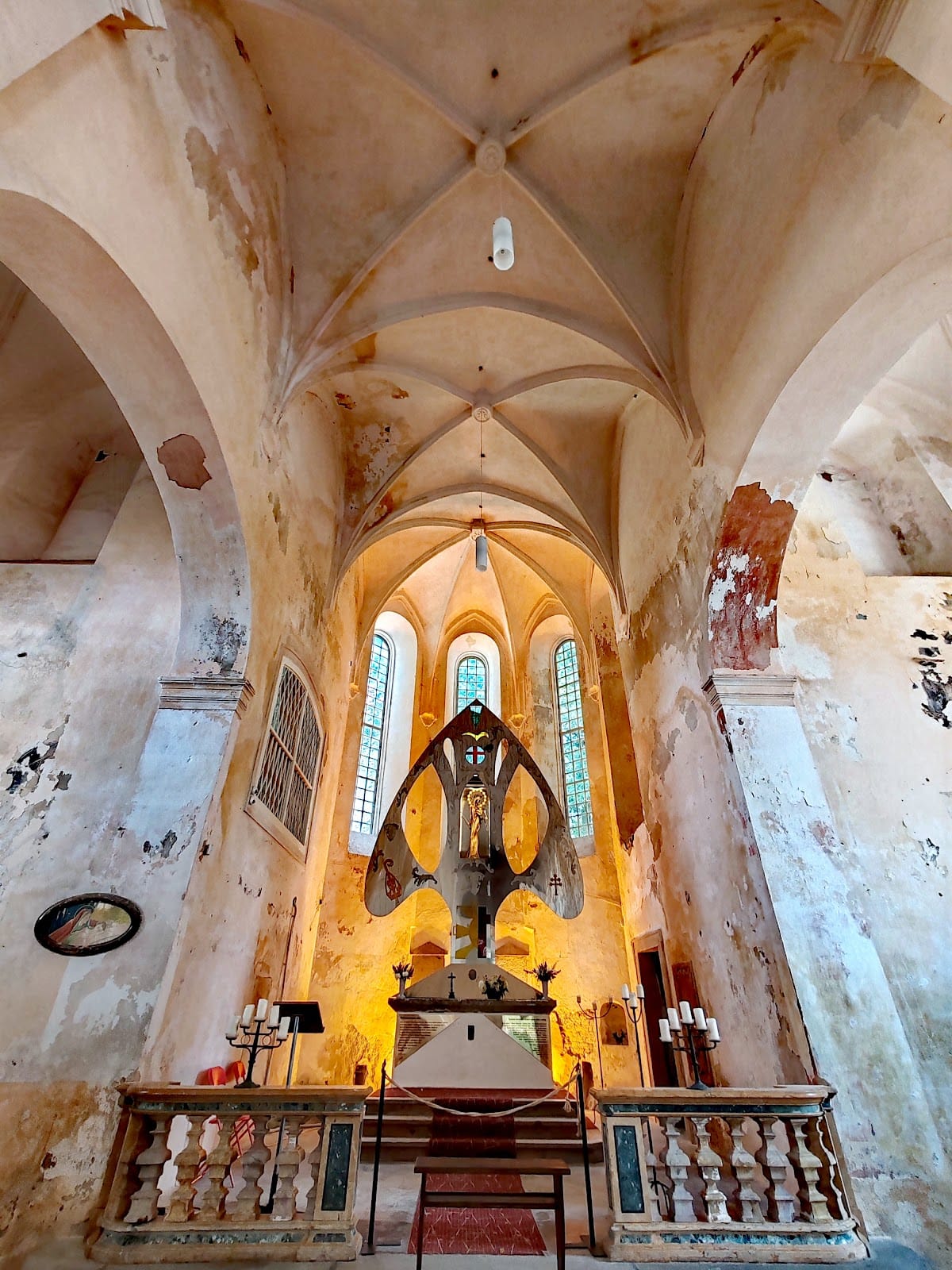
In 1449, the Bohemian coronation insignia were reportedly kept in the sacristy of the castle chapel to prevent the coronation of George of Poděbrady as king of Bohemia. The estate passed to the Sternbergs in 1464. On 28 November 1465, sixteen leading Bohemian noble families formed the Zelená Hora Alliance in the castle’s Black Hall. The alliance was a coalition of Catholic nobles opposed to George of Poděbrady, a Bohemian king associated with the Hussite religious tradition.
After Pope Paul II excommunicated George, the alliance concluded a support agreement with Emperor Frederick III in the same room on 14 April 1467. Its members then fought George’s rule for several years. Between 1476 and 1479, four Sternberg brothers held the castle jointly. It subsequently belonged to their eldest brother, Jaroslav, until his death in 1492.
Early modern ownership and transformation
Zdeněk Lev of Rožmitál acquired the castle in 1528. His heavy debts led to the confiscation of the estate in 1536, after which the Bohemian Chamber sold it to Adam of Sternberg. In 1558, Emperor Ferdinand I entered the estate as Sternberg hereditary property in the land register.
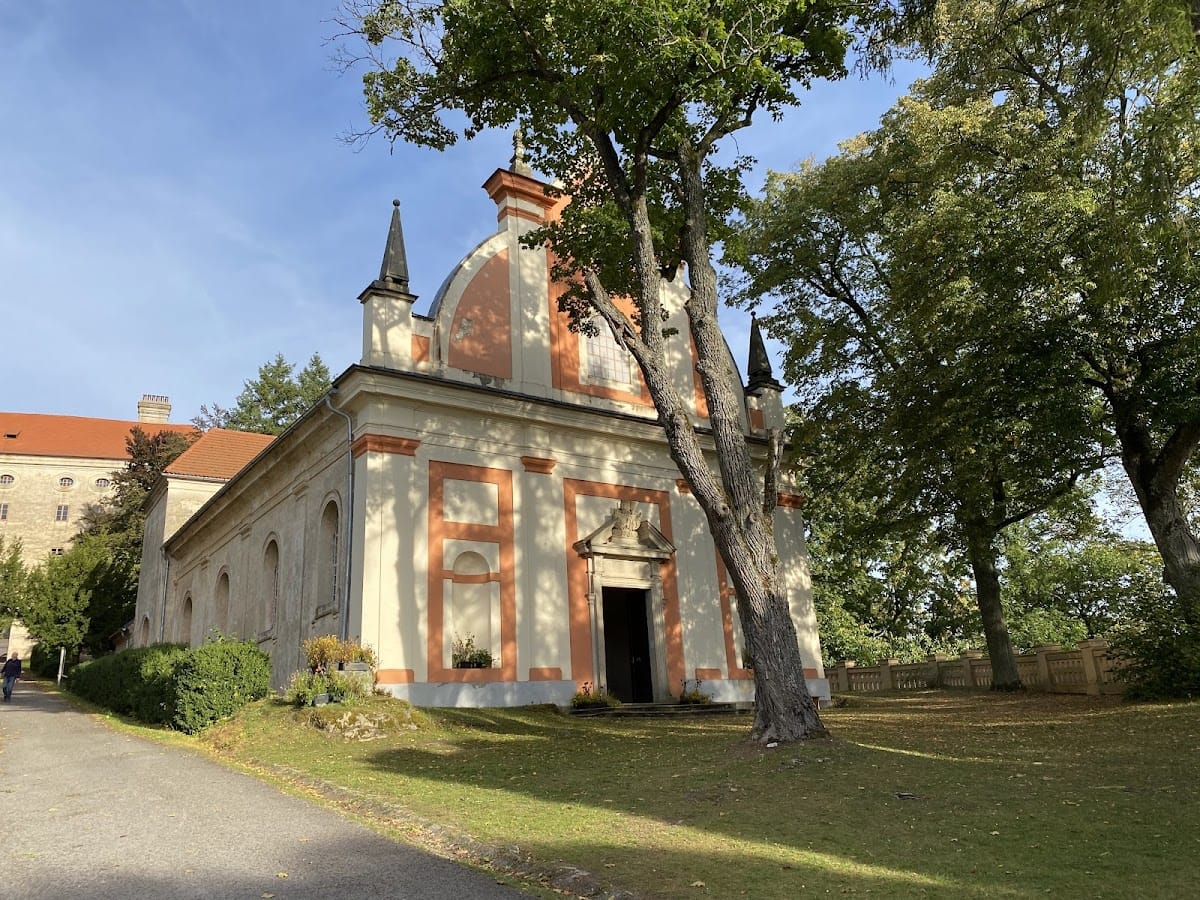
During Adam of Sternberg’s ownership, a waterworks system was built to raise water from the former monastery mill to the castle well. It is regarded as probably the oldest waterworks in Bohemia. Between 1670 and 1688, Wenzel Adalbert of Sternberg transformed the medieval castle into an early Baroque chateau. A pilgrimage church dedicated to the Assumption of the Virgin Mary stood within the complex, which the owners later used as a residence and hunting seat.
The Sternbergs sold the estate to the Martinic family in 1726. In 1784, Maria Dominika Martinic appointed Franz de Paula Gundaker of Colloredo-Mansfeld as her heir, and ownership passed to his son Hieronymus in 1807. During Maria Dominika’s rule, land was allocated to subjects under Raabisation, an eighteenth-century program that reorganized large estates by granting settlement land to dependent subjects. A local tradition claims that Maria Dominika’s father had her illegitimate son killed and walled into the fireplace of the chateau library, after which she entered the convent of Saint Anne in Vienna.
Nineteenth- and early twentieth-century changes
After Hieronymus died, his son Franz de Paula used the chateau mainly as a hunting lodge from 1822. The estate passed through marriage to the Auersperg family in 1852. Wilhelmine Josefine of Auersperg made it her principal summer residence from 1867 and commissioned alterations in 1868–1870 and 1886–1888. Her son Engelbert Ferdinand inherited the property and sold it in 1931 to the Prague industrialists Karel and Marie Plavec. Karel Blažek acquired it in 1938, but the state confiscated it that year because of unpaid taxes.
In 1902, Franz Ferdinand of Austria-Este stayed at the chateau. A hunting event held there in 1904 in honor of James Gordon Bennett reportedly resulted in 20,000 partridges being shot over several days. In 1911, the building was remodeled and received a third storey. After the establishment of Czechoslovakia, the 1921 land reform divided the estate’s large landholdings, reducing the land available for maintaining the chateau.
War, military use, and reconstruction
The Wehrmacht occupied the chateau on 15 March 1939, after the division of Czechoslovakia. Later that year, the property was transferred to the Waffen-SS, the armed branch of the SS, which operated a radio school of the Security Police and the SD there from 1939 to 1945. The chateau was looted at the end of the Second World War.
After the war, valuable furnishings that remained were moved to other chateaus, churches, and museums. The Czechoslovak Army then established a barracks at Zelená Hora. A technical unit was stationed there from 1951 to 1957, and the writer Miloslav Švandrlík completed his military service at the site. The army continued using the complex until 1990. The castle collections had been open to the public until 1947, while from 1948 onward the complex served military purposes and housed an auxiliary technical battalion.
The church tower was reconstructed in 1965–1966, and Zelená Hora has been protected as a cultural monument since 1963. In 1992, the chateau passed to the municipality of Klášter, which began gradual reconstruction. A proposed sale to an investor was halted by a restitution claim from the Plavec heirs, rejected by the Plzeň Regional Court in 1993. The municipality then began roof repairs with support from the Plzeň heritage authorities.
In 2001, Klášter concluded a use agreement with Frank-Rainer Telemann, owner of Janterai International s.r.o., which included the possibility of a future sale. Plans connected with the agreement proposed adapting the chateau for a hotel and company headquarters. Restoration work began in the 2000s, and the complex was used in the 2010s as a company headquarters, conference center, and cultural venue. It also served as a filming location for a comedy based on Miloslav Švandrlík’s novels about the Black Barons, whose story is set at Zelená Hora. Parts of the complex were also used for the French television series John Sinclair.
In 2021, Klášter, the Ministry of Culture, the Plzeň Region, and other institutions signed a memorandum calling for progressive restoration and an exhibition on communist totalitarianism. On 13 November 2025, after the municipality stated that it could no longer afford to maintain the chateau, the timber-processing company KLAUS Timber a.s. acquired it for thirty million Czech crowns. The sale faced opposition and a petition against private ownership.
The Zelená Hora Manuscript
Zelená Hora also became associated with a celebrated literary forgery. In 1817, the estate official Josef Kovář allegedly found a deteriorated box containing two parchment leaves with an old manuscript while clearing the administrative archive. The dean of Nepomuk, František Boubel, identified the text as Old Czech from the eighth or ninth century.
Known as the Zelená Hora Manuscript, the document was sent anonymously in November 1818 to Franz Anton von Kolowrat-Liebsteinsky, one of the founders of Prague’s National Museum. Disputes over its authenticity intensified from the mid-nineteenth century. Scholars identified the manuscript and the contemporaneous Dvůr Králové Manuscript as forgeries in 1886–1887, and scientific examination established that both were forged in 1967.
Remains
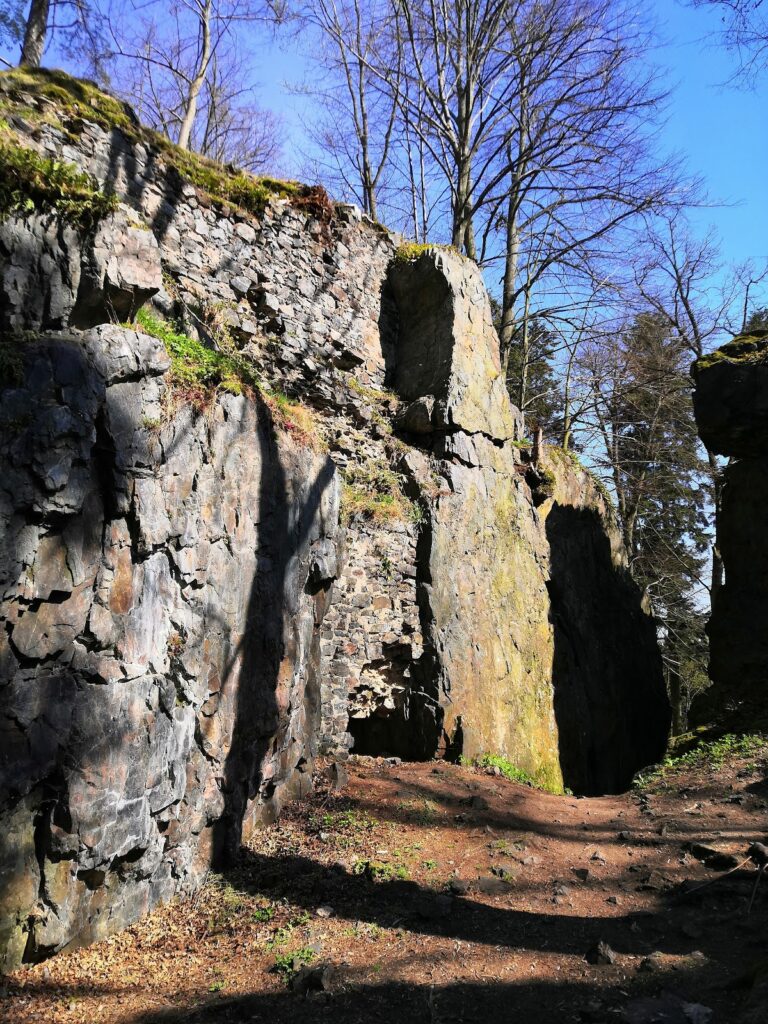
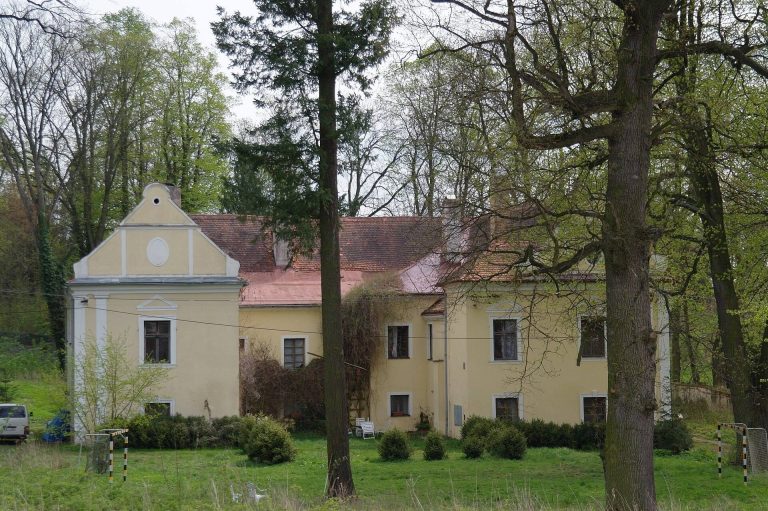
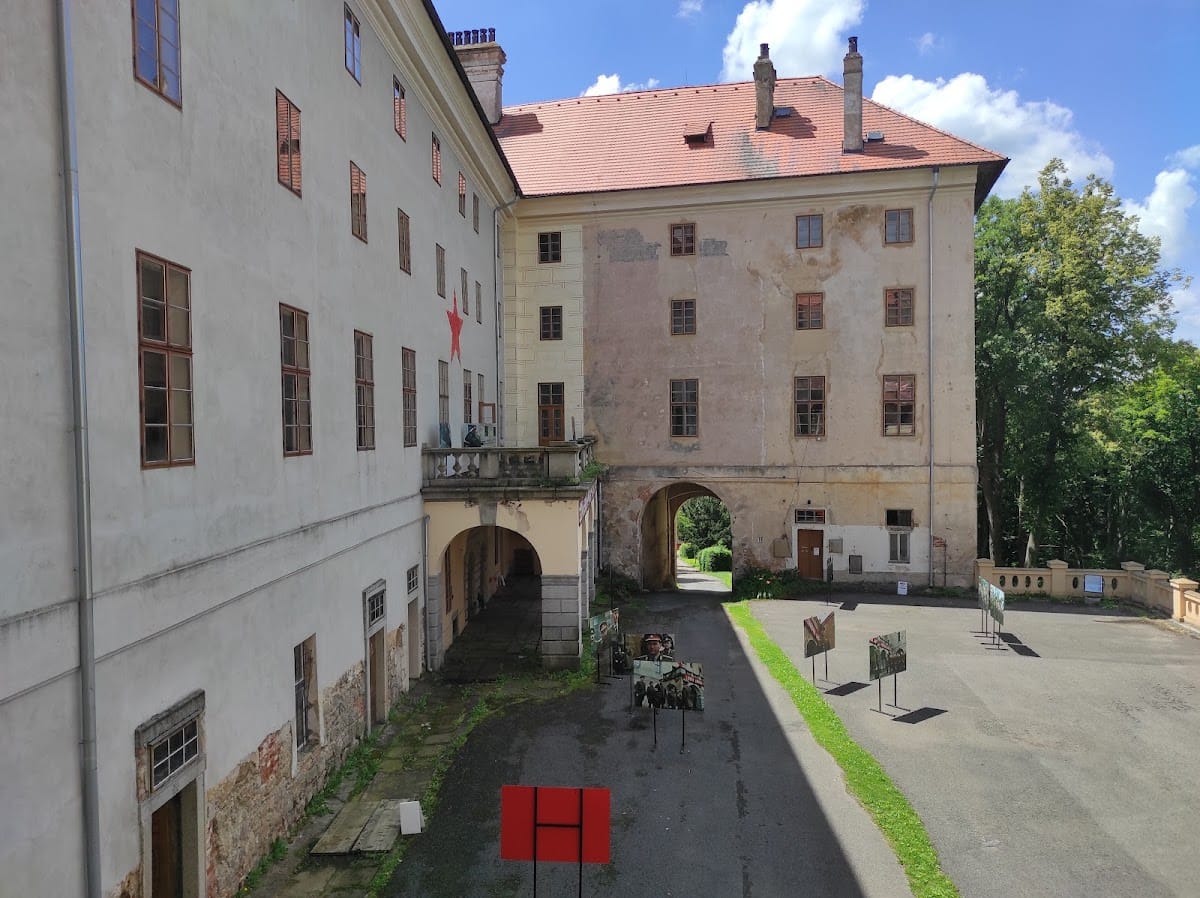
Zelená Hora occupies the 536-metre hill on the right side of the Mihovka stream’s confluence with the Úslava River. The medieval complex was a two-part hilltop fortification. The principal chateau building stands on the former inner castle, where its masonry incorporates fragments of earlier structures. Buildings belonging to the former outer bailey survive in better condition. The architectural character of the complex combines Gothic, Renaissance, and Baroque elements, with the major transformation taking place during the rebuilding of 1670–1688.
Castle buildings and defenses
Main chateau
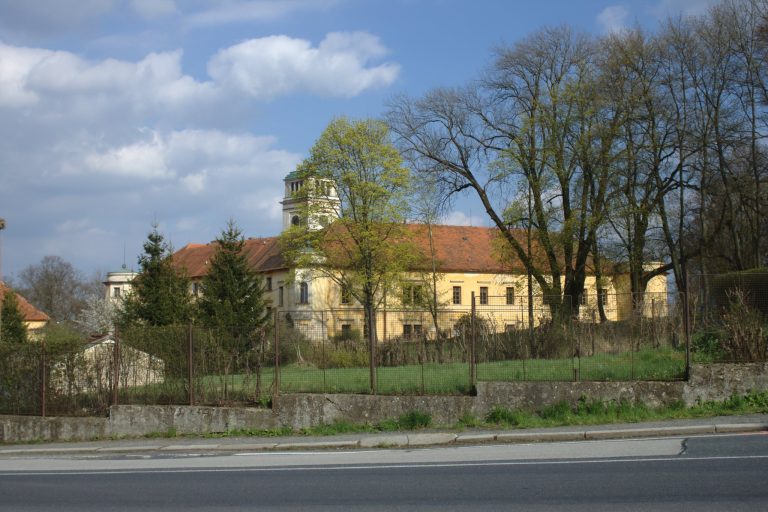
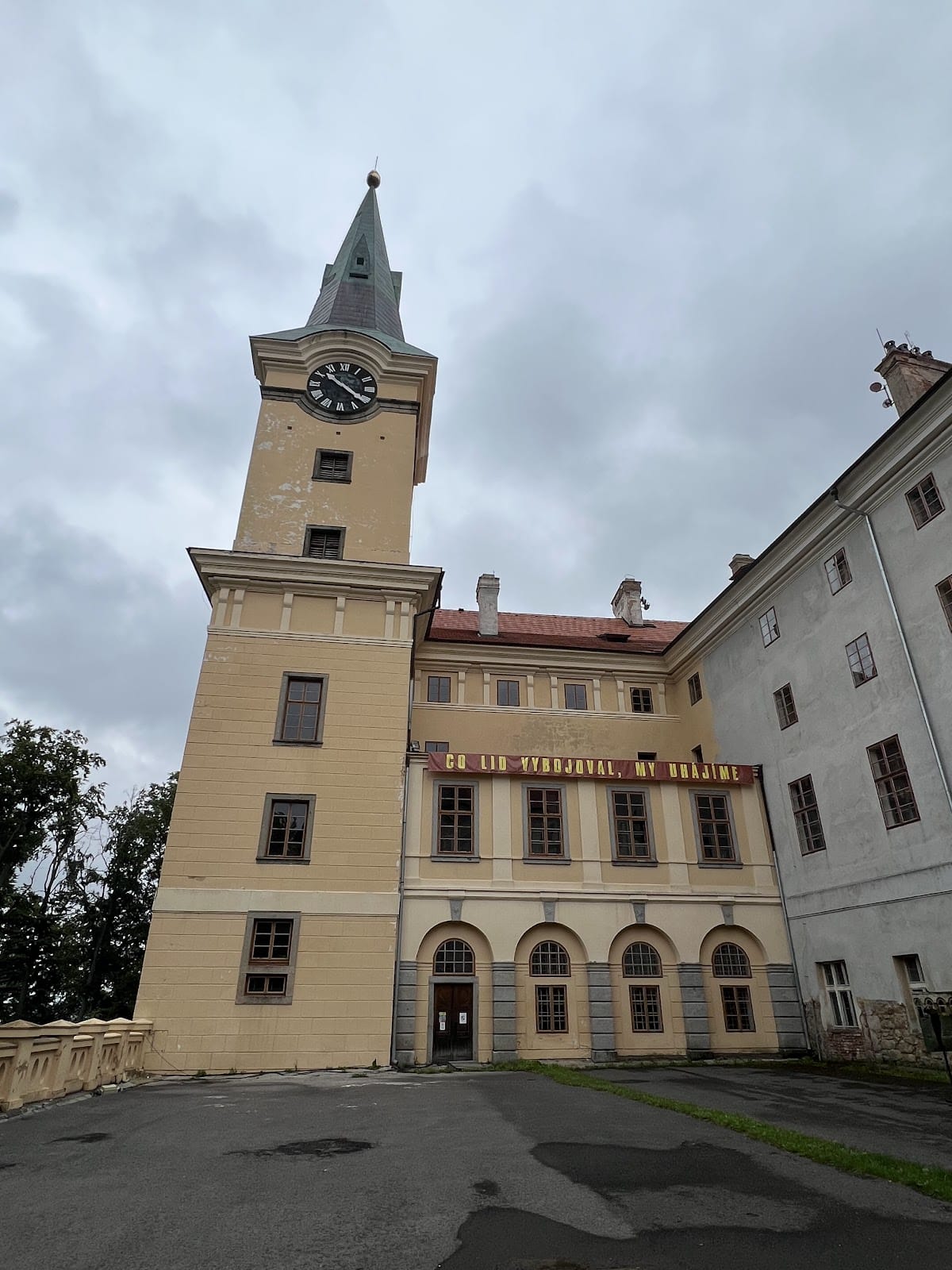
The main chateau is a three-storey, horseshoe-shaped building with a tower in its east wing. It occupies the former inner castle and contains masonry from earlier medieval structures. Its present form reflects the early Baroque conversion of the Gothic castle, while later alterations include the addition of a third storey during the 1911 remodeling. The interior includes the Black Hall, associated with the formation of the Zelená Hora Alliance in 1465 and its agreement with Emperor Frederick III in 1467.
Outer bailey and entrance defenses
The former outer bailey contains the better-preserved group of medieval buildings. It probably included an earlier Church of the Assumption of the Virgin Mary and a round tower that protected the entrance gate. These features belonged to the defensive organization outside the inner castle.
Advanced artillery bastion
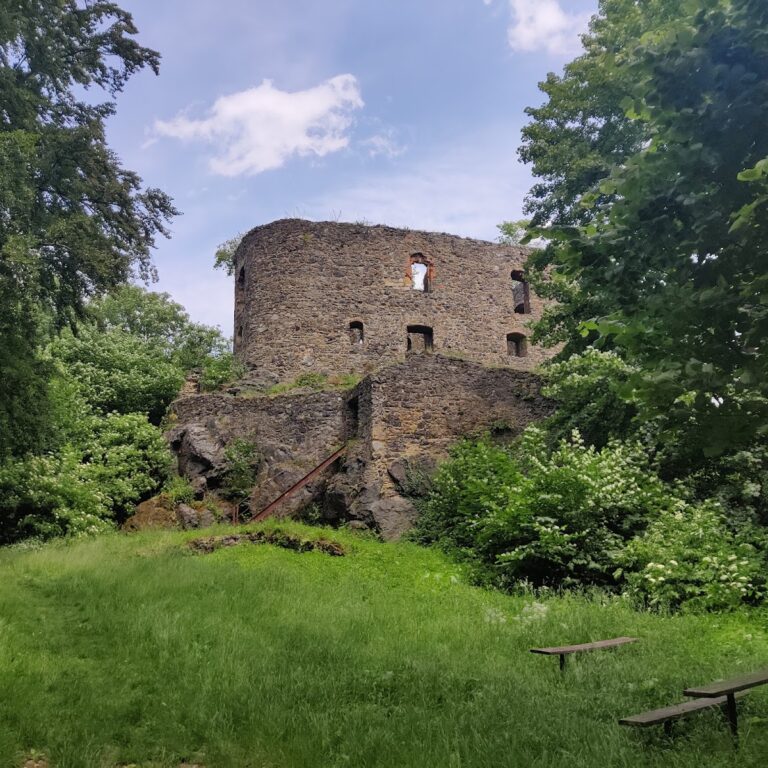
Probably during the second half of the fifteenth century, the fortifications were extended by an advanced round artillery bastion at the foot of the hill. The bastion consisted of a round tower protected by a wall containing casemates, which are sheltered spaces built into or behind fortifications for soldiers, artillery, or defensive movement.
Religious buildings and waterworks
Church and castle chapel
The complex includes the Baroque Church of the Assumption of the Virgin Mary, while the castle chapel contains the sacristy in which the Bohemian coronation insignia were reportedly stored in 1449. Stones traditionally associated with Saint Adalbert are also said to be preserved in the chapel. A local legend connects the hill’s name with the saint, who supposedly prayed there for rain during a drought. According to the tradition, the hill turned green after rain began.
The statue of the Sternberg Madonna, formerly from the pilgrimage church, is now in the Franciscan Church of Saint Jerome in Vienna, near Saint Stephen’s Cathedral. A chapel on the Holy Way from Prague to Stará Boleslav was dedicated to the Madonna. The Jesuits established this pilgrimage route between 1674 and 1690, linking devotional destinations for worshippers.
Castle waterworks
The historic waterworks drew water at the former monastery mill and forced it through wooden pipes to a well in the castle forecourt. The system connected the lower mill area with the hilltop complex and is regarded as probably the oldest waterworks in Bohemia.
Historic collections and storage buildings
A historic granary or storage building forms part of the complex. The former castle library is now held by the West Bohemian Heritage Institute in Plzeň. These surviving associations preserve elements of the chateau’s former domestic, administrative, and cultural functions beyond its defensive architecture.