Castle Hradiště (Blovice): A Noble Chateau and Cultural Monument in Czechia
Site at a Glance
- Rating
- 4.6
- Popularity
- Low
- Country
- Czechia
- Primary era
- Modern
- External website
- Open
- Eras represented
- Medieval, Early Modern, Modern
- Civilizations
- Austrian Empire, Habsburg, Holy Roman Empire, Kingdom of Bohemia
- Site type
- Domestic
- Remains
- Castle
On this page16 sections
History
Castle Hradiště (Blovice) is a noble residence in Czechia that developed from a fifteenth-century fortress into a chateau with Gothic, Baroque, Classical, and Neo-Gothic phases. Its earliest known mention comes from 1422, in a charter issued by Sigismund of Luxembourg, the late medieval king of Bohemia and Holy Roman Emperor.
Medieval origins and the Častolar estate
The knight Jan of Hradiště appears in the 1422 charter and was probably an ancestor of the Ebrzvín family of Hradiště, which later demonstrably held the estate. A fortress probably stood at Hradiště during the fifteenth century, although it enters the written record as a fortress only in 1545.
From 1480, Hradiště belonged to the Častolar family. During the sixteenth century, the family considerably enlarged its property. Jan Častolar of Hradiště of Hořovice expanded the estate further by purchasing the neighbouring town of Blovice and Vlčtejn Castle between 1587 and 1589.
The Karel and Gutštejn owners
Hradiště passed by marriage to the Karel family of Svárov in 1617. Petr Tobiáš Karel of Svárov took part in the Bohemian Estates uprising, the 1618 revolt of Bohemian Protestant estates against the Habsburg monarchy. His property was confiscated after the uprising, but his heir Jan Václav secured a pardon by paying a fine of 1,000 kopas of Meissen groschen, and Hradiště was returned to him.
During the ownership of Karel Rudolf Karel of Svárov, wall paintings were probably added to the fortress. In 1654, he obtained the elevation of his family to the status of lords. After his death in 1663, inheritance disputes continued until Count Maximilian Rudolf of Gutštejn became the sole owner in 1678.
That year, the residence was described as a chateau, although it was probably still a more elaborate fortress with the Chapel of Saint Andrew. The Hradiště estate comprised Blovice, four villages, five manorial farmsteads, and property in twelve further villages. A manorial farmstead was the productive agricultural holding attached to a noble estate.
Changes under the Jeníšek and Kolovrat families
Maximilian Rudolf of Gutštejn died in 1690. His widow, Catherine Polyxena, née Vratislavová of Mitrovice, then administered the estate. Her unsuccessful involvement in iron production created debts, and compulsory administration followed in 1693. Her second marriage to Jan Josef Jeníšek of Újezd helped settle the financial crisis. The couple administered the estate jointly, while Catherine Polyxena remained its sole owner.
Building alterations at the chateau took place around 1704. Jan Josef Jeníšek also commissioned the sandstone Baroque Crucifixion group on nearby Calvary Hill in 1727. As the last male member of his family, he required in his will that future heirs use the Jeníšek coat of arms and the title of barons of Újezd.
His estates passed to the senior chancellor Vilém Albrecht II Krakovský of Kolovrat. Further alterations at Hradiště followed between 1726 and 1738. Prokop Jan of Kolovrat inherited the property after his father and served for many years as chief provincial judge of the Kingdom of Bohemia. His son Josef Maria later received the estate.
Because the chateau was in poor condition, it underwent a substantial rebuilding between 1785 and 1795. The work was financed by a loan, since debts incurred during Prokop Jan’s expensive social life burdened the estate.
Classical and Neo-Gothic transformation
Jan Nepomuk Karel Krakovský of Kolovrat, known as Hanuš, was the last Kolovrat owner. During his tenure, the chateau was rebuilt in the Classical style in 1845 and 1846, and the Chapel of Saint Andrew was altered in 1858. He also developed the park, establishing a productive garden and greenhouse on the site of a drained pond.
Hanuš inherited extensive property, including the Rychnov nad Kněžnou estate, in 1861 and eventually settled there. In 1833, he had built the Chapel of the Holy Cross with a family tomb beside the Church of Saint John the Evangelist. The remains of several family members were later transferred there from Březnice and Prague.
After Hanuš died, Hradiště, Březnice, and Merklín passed to his closer relatives, the Pálffy family. Other property tied to a family entail, an inheritable arrangement intended to keep an estate within a designated family line, went to more distant Kolovrat relatives. Jan Nepomuk Pálffy formally inherited Hradiště in 1872, while his father Eduard Pálffy administered it during his minority.
Eduard Pálffy initiated the final major rebuilding. Neo-Gothic alterations carried out in 1872 and 1873, based on earlier designs by J. F. Jöndl, gave the chateau its present architectural character. At that time, the estate covered 2,444 hectares. Jan Nepomuk Pálffy later settled permanently at Březnice and sold Hradiště in 1918.
Twentieth-century ownership and present use
The 1918 purchaser was Adolf Klikar, an entrepreneur who owned a prosperous textile factory in Hronov and served as mayor of that town. The Hradiště estate became part of the company Adolf Klikar, Ltd., Prague. After Adolf Klikar returned to Hronov, his younger son František Klikar occupied the chateau.
In 1945, national administration was imposed on the Klikar family’s industrial enterprises, and the Hradiště estate, including the chateau, was nationalized. The property initially passed to the state farms. From 1952, the chateau housed an agricultural training school for almost fifty years. Adaptations were made for educational use, but heritage officials prevented the Chapel of Saint Andrew from being converted into classrooms.
Castle Hradiště has been protected as a cultural monument since 1963. Since 2000, it has been administered by the Plzeň Region as a contributory organization, a public institution financed and overseen by a higher governmental authority. The complex has housed the Museum of South Pilsen in Blovice since that year and was opened to the public in 2002.
Remains
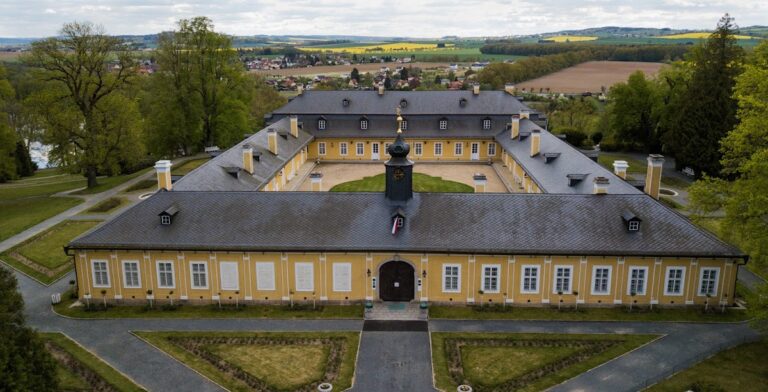
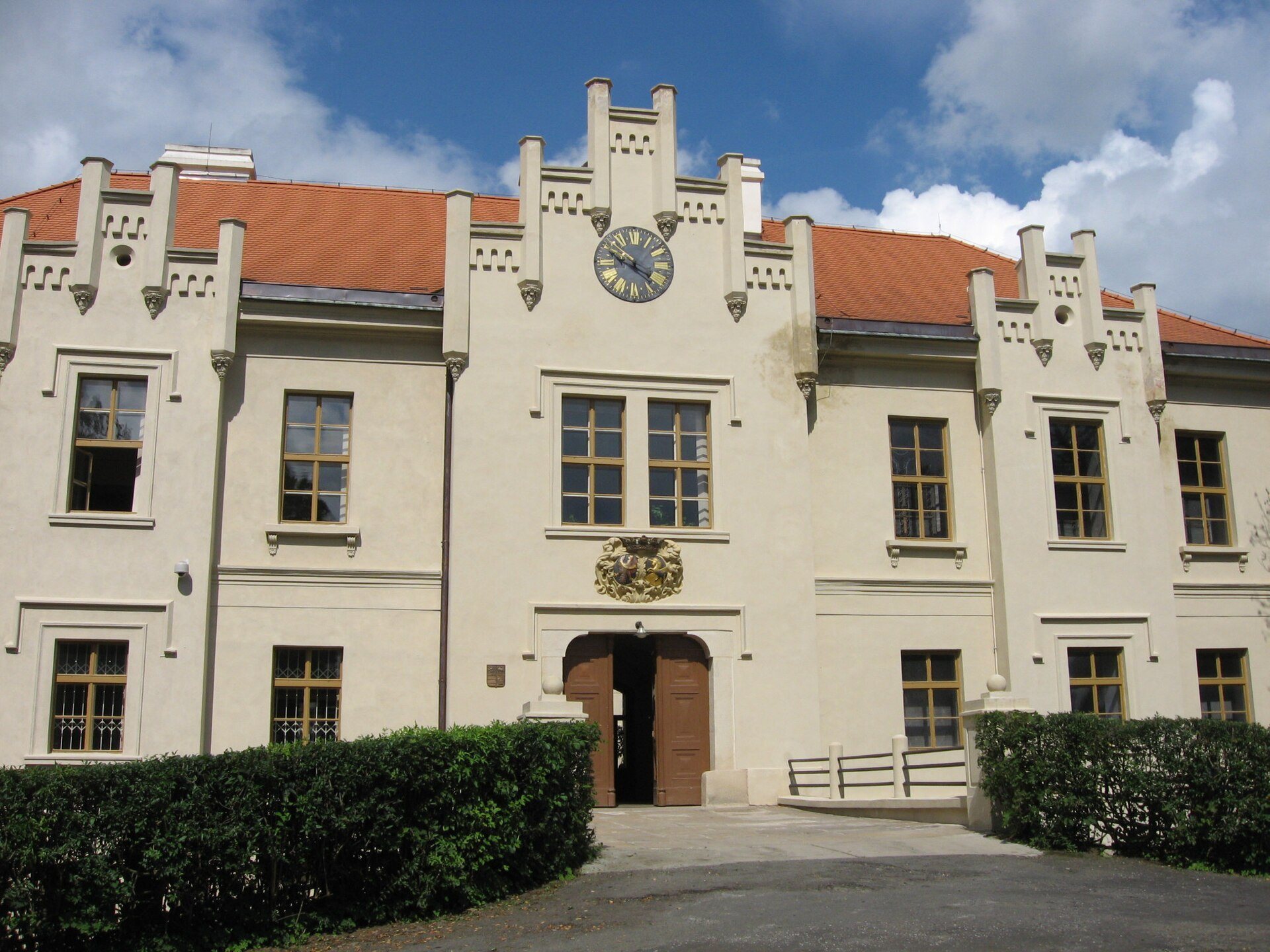
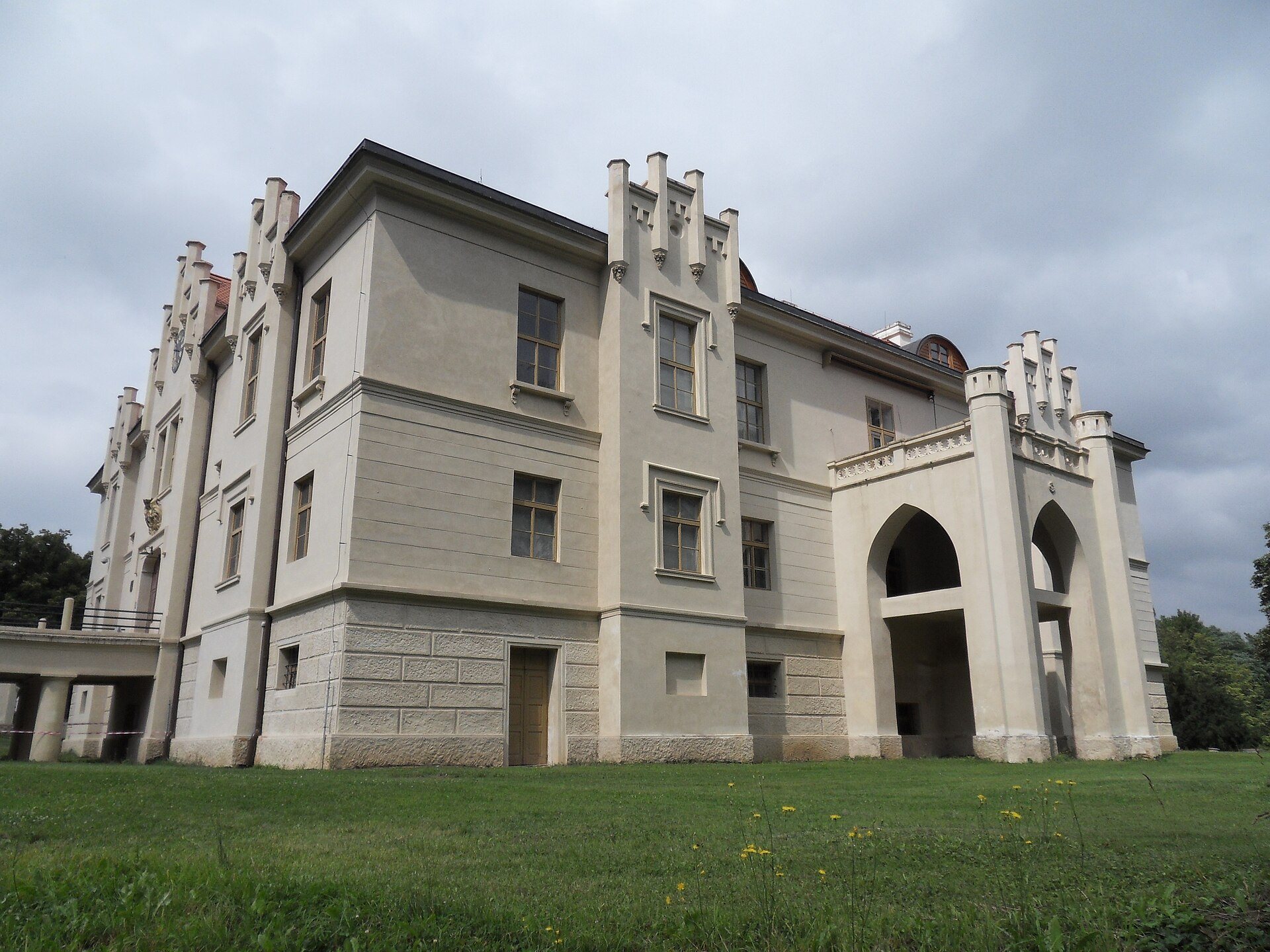
The surviving complex combines a former Gothic fortress with later Baroque, Classical, and Neo-Gothic construction. Its principal phases are the fifteenth-century fortress, the rebuilding of 1785–1795, the Classical work of 1845–1846, and the Neo-Gothic transformation of 1872–1874.
Chateau buildings
Main chateau
The chateau developed from a fortified Gothic residence into a more elaborate Baroque building and was later reshaped in the Classical and Neo-Gothic styles. The 1845–1846 rebuilding enclosed the former courtyard with a southern wing, producing a four-wing plan. The surviving architecture therefore reflects several successive changes rather than a single period of construction.
Wall paintings were probably created during the ownership of Karel Rudolf Karel of Svárov. The building also contains an apartment remodelled for Adolf Klikar in the Cubist style. The former chateau archive was largely destroyed during the Pálffy period, which makes precise dating of some alterations difficult.
Chapel of Saint Andrew
The Chapel of Saint Andrew forms part of the chateau complex and was present by 1678. It was altered in 1858. During the agricultural school period, its interior remained separate from the classrooms, and its organ was later restored and transferred to nearby Kozel Chateau.
Estate buildings and park
Service buildings
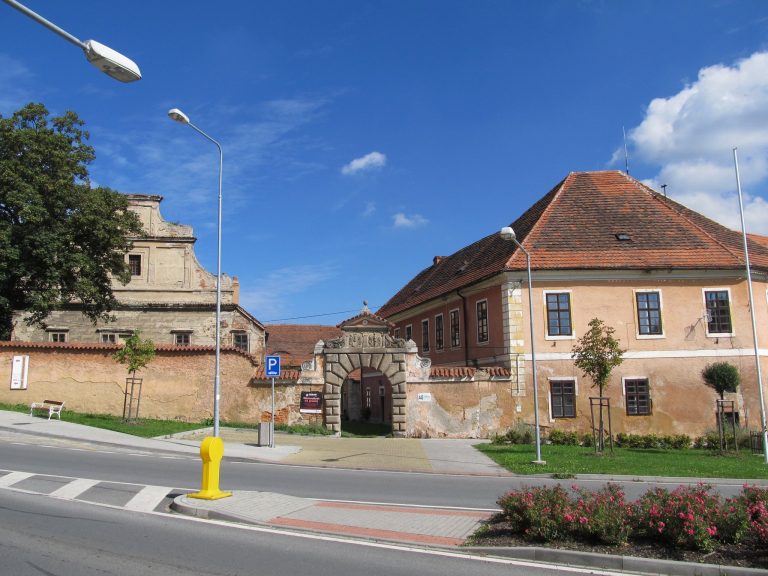
South of the chateau stands a group of buildings that served the agricultural and service needs of the estate. They survive as part of the complex and are now only partly used.
English-style park
An extensive English-style park surrounds the chateau. The park is bordered by the Úslava River and its two left-bank tributaries, the Komorenský and Chocenický streams. Its present layout preserves only part of the design associated with the Kolovrat and Pálffy periods.
A former pond was converted into a productive garden with a greenhouse. Later park elements included additional greenhouses, a grotto with a waterfall, and a romantic bark cottage. The park was revitalized after 2000 and retains dendrological value through almost 80 species of deciduous and coniferous trees.
Religious features near the chateau
Baroque Crucifixion group
A sandstone Baroque Crucifixion group dating from 1727 stands on nearby Calvary Hill. Jan Josef Jeníšek of Újezd commissioned it, and a route from the park connects the group with the chateau.
Statue of Saint Michael
A statue of Saint Michael is also connected with the chateau by the route from the park, forming part of the religious features associated with the estate.