Burg Creuzburg: A Romanesque Hilltop Castle and Administrative Centre in Germany


Site at a Glance
- Rating
- 4.6
- Popularity
- Medium
- Country
- Germany
- Primary era
- Medieval
- External website
- Open
- Eras represented
- Medieval, Early Modern, Modern
- Civilizations
- Holy Roman Empire, Landgraviate of Thuringia
- Site type
- Military
- Remains
- Castle
On this page15 sections
History
Burg Creuzburg, also called Kreuzburg, is a medieval hilltop castle in Germany above the town of Creuzburg in the Werra Valley. Built in the Romanesque tradition between 1165 and 1170 on the orders of Landgrave Ludwig II of Thuringia, it protected the landgraves’ possessions north of Eisenach, the town founded below it in 1213, and an important crossing of the Werra. The castle became one of the secondary residences of the Ludowingers, the medieval ruling dynasty of Thuringia, and reached its greatest importance during the twelfth and thirteenth centuries.
Foundation and Ludowinger residence
Tradition places the castle on the site of an older fortified monastic complex. Benedictine nuns had occupied the hill before the castle was built, and the St. James monastery was founded there around 1173 as its replacement. Another tradition associates the hill with the missionary activity of Saint Boniface in 724 and the erection of a cross.
Elisabeth of Thuringia, also known as Elisabeth of Hungary, regarded Creuzburg as a preferred residence. A landgravine was a high-ranking territorial ruler in the Holy Roman Empire, roughly comparable to a prince. Elisabeth gave birth at Creuzburg to her son Hermann in the early 1220s. The Werra bridge was constructed in connection with his birth and became an important medieval commercial and traffic junction between Thuringia and Hesse.
Conflict and castle-men
Creuzburg was drawn into the Thuringian-Hessian War of Succession, a conflict over the inheritance of the Ludowinger territories after the dynasty became extinct in 1247. In 1260, forces led by Sophie of Brabant, her son-in-law Albrecht, Duke of Brunswick-Lüneburg, and their allies temporarily captured the castle and town. After their defeat at Beesenstedt in October 1263, they withdrew from Thuringia.
King Adolf of Nassau besieged Creuzburg for four weeks in 1295. His forces set the town on fire with pitch wreaths, while the garrison continued to resist until its water supply ran out and it surrendered. Johannes Rothe named the castle-men families of Creuzburg, Nesselrieden, Slune or Schlaun, Buttlar, Stein, Pferdsdorf, Strier or Strieger, Stouben or Steuben, and Frowen. Castle-men were noble retainers responsible for garrisoning and administering a castle for its lord. Later members of the Harstall, Boyneburg, Zenge, and Eschwege families also held this role.
Wettin administration and changing uses
Under the Wettin dynasty, which later controlled Thuringia, Creuzburg became the seat of the Creuzburg administrative office. This office governed a substantial area in the northern part of the present Wartburg district. The castle gained additional service buildings, while castle-men and knights lived within the town walls below it.
From the fifteenth century, the spread of firearms reduced the fortress’s military value. Creuzburg consequently developed into a court and administrative centre. During the Thirty Years’ War, a prolonged European conflict from 1618 to 1648, and the Seven Years’ War, fought from 1756 to 1763, passing armies repeatedly used the castle as a headquarters and as accommodation for officers.
In the eighteenth century, the state master builder Gottfried Heinrich Krohne converted the complex into a palace for Duke Johann Wilhelm of Saxony. Goethe made his first official visit to Creuzburg in 1779. In 1848, members of student fraternities were imprisoned in the residential tower, and the Creuzburg administrative office was dissolved in 1879.
Private ownership and war
A man named von Dreyse, a grandson of the inventor of the needle gun, acquired the castle and its associated properties in 1899. The Erfurt hotelier and patron Georg Kossenhaschen purchased the complex in 1921 and commissioned its renovation by the castle specialist Bodo Ebhardt. Kossenhaschen used Creuzburg as a private residence, furnished it artistically, and made it available as a retreat for writers.
During this renovation, Kossenhaschen had a tall, slender Boniface Cross erected in the courtyard and commissioned the construction of an Elisabeth chamber. The visit of the impostor Harry Domela, later described in his 1927 memoirs, briefly brought the castle international attention. Before the Second World War, the owners hosted children’s festivals and gatherings for elderly residents of Creuzburg. During the war, the castle accommodated refugees and wounded people.
On Easter Sunday, 1 April 1945, heavy United States artillery fire against Creuzburg caused only minor damage to the castle. American forces occupied it the following day and established a special administrative authority there in May. The refugees were then forced to leave their accommodations for the devastated town. After the arrival of the Red Army, the Schäfermeier-Kossenhaschen family was expelled and dispossessed without compensation, and much of the valuable interior furnishing was lost.
Repair and later history
The castle first served as a barracks for the occupying power, then for the East German border troops, and later for the town administration. Its rooms were also used as a school and holiday camp until 1975. Because necessary repairs had not been carried out, the building authorities closed the complex that year.
In 1981, residents of Creuzburg founded the association Die Creuzburg to rehabilitate the deteriorating castle. The association cleared debris and carried out gradual repairs, restoring public access to the castle and park by 1991. Conversion work for hotel use was completed in 1997. The city of Creuzburg now owns the castle. The heirs of Georg Kossenhaschen sought restitution from 1990 onward, but the Office for Open Property Questions in Gera rejected their renewed application in January 2011.
Remains
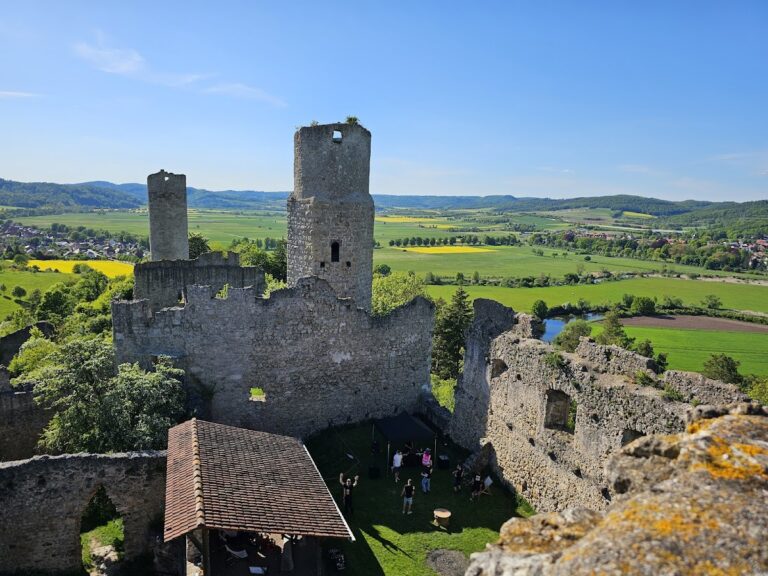
Burg Creuzburg occupies a hill approximately 225 metres above sea level above the town and the Werra Valley. The complex consists of a Romanesque ring-wall castle, terraced parkland on the southern and eastern slopes, approach roads, and part of the town wall. Built mainly from rubble-stone masonry, it covers about 7,400 square metres within a ring wall approximately 340 metres in circumference. Substantial medieval elements survive, including the defensive wall, the tower house, and parts of the palas, the principal residential and representational building of a medieval castle.
Defensive and residential buildings
West gate and outer enclosure
The west gate forms part of the castle’s defensive approach and is associated with a zwinger, a fortified outer enclosure or passage between defensive walls. Together with the north side of the ring wall, it represents the defensive organization of the Romanesque complex.
Palas and tower house
The palas and tower house preserve the principal residential parts of the medieval castle. The tower house contains documents relating to more than 800 years of the town and castle’s history, as well as excavated finds from prehistory and the Middle Ages. Its museum areas include the Elisabeth chamber, the torture cellar, the local-history cabinet, and an exhibition on the castles of the Thuringian landgraves.
Later palace buildings
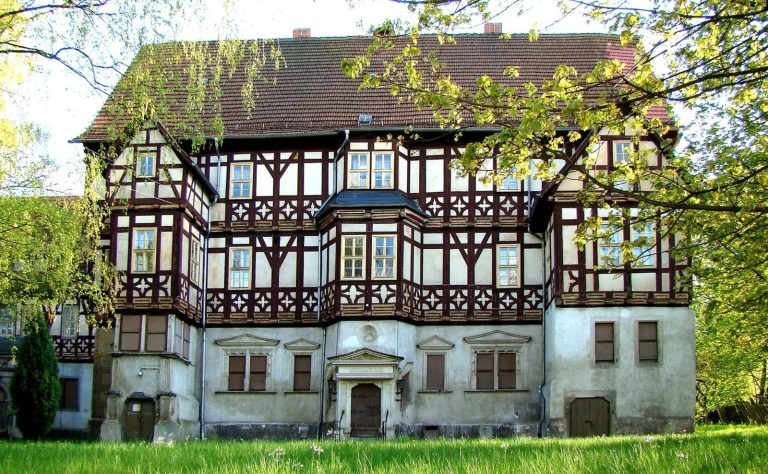
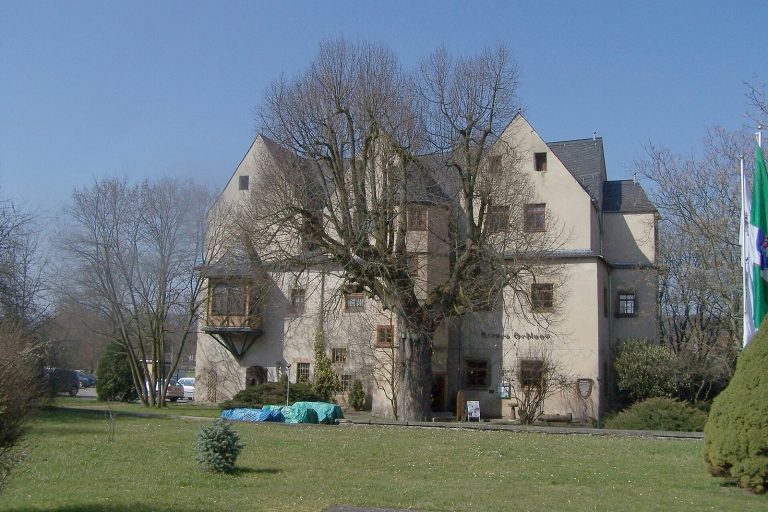
The Yellow House, Duke’s House, and carriage houses belong to the later development of the complex. The Duke’s House and carriage houses, along with probably the putti in the palace park, date from the eighteenth-century conversion of the castle into a palace. Restored rooms now accommodate a hotel and restaurant, a wedding room for the Creuzburg registry office, a private pottery workshop, and the Creuzburg local-history museum.
Water supply and courtyard
Well and well house
A deep well descends 37.5 metres within the castle. A well house was added during the Wettin period, when Creuzburg served as an administrative centre as well as a fortified residence.
Garden and commemorative features
The courtyard contains a small Baroque garden, a wooden Boniface Cross, a summer lime tree stated to be about 500 years old, and a Saxon cannon dated 1691. The northern pavilion contains the Michael Praetorius Room, commemorating the composer and music scholar who was born in Creuzburg. The former administrative office includes temporary exhibition rooms and a regional-history section with approximately 700 objects illustrating everyday life in the nineteenth and twentieth centuries.
Elisabeth chamber and Werra crossing
The Elisabeth chamber is presented as a memorial to Elisabeth of Thuringia. It is identified as the only surviving hall from the Romanesque period, although the chamber itself was commissioned during Kossenhaschen’s twentieth-century renovation.
The Werra bridge, built in connection with the birth of Hermann, remains part of the historical setting of the castle and town. It was an important medieval crossing between Thuringia and Hesse and is the oldest bridge of its type in Germany north of the Main River.