Gottesackerkirche (Creuzburg): A Historic Cemetery Church in Germany
Site at a Glance
- Rating
- 4.9
- Popularity
- Very Low
- Country
- Germany
- Primary era
- Early Modern
- Eras represented
- Medieval, Early Modern
- Civilizations
- Holy Roman Empire
- Site type
- Religious
- Remains
- Church
On this page7 sections
History
Gottesackerkirche (Creuzburg), a cemetery church in Germany, dates from the eleventh century, when it served as the parish church of Creuzburg while the settlement was still a village. Its early form belonged to the Romanesque period, a medieval style associated with massive walls and rounded arches. Tradition connects its original dedication with Saint Boniface, an eighth-century missionary and church organizer, and the Virgin Mary. The church was known as the Church of Saint Mary, or Marienkirche, and in the Middle Ages as the Church of Our Lady, or Frauenkirche. The neighboring Frauentor took its name from this association.
From village parish church to town church
The building may also have functioned as a fortified church, a place of worship adapted to provide refuge during danger. In 1212, Landgrave Hermann I, a high-ranking territorial ruler in the Holy Roman Empire, transformed the market settlement of Cruciburg into a town. He ordered the inhabitants of four villages at the foot of the castle hill to move to Creuzburg.
In 1218, Landgrave Ludwig IV transferred the church to the nuns of St. Jacob’s Monastery, who used it for an extended period. Ludwig often exercised his rule from Creuzburg. In 1227, he took leave there of his wife, Saint Elisabeth of Thuringia, before departing on a crusade from which he never returned. After a fundamental renewal, Bishop Konrad of Hildesheim consecrated the church in 1252.
Reformation, damage, and rebuilding
Creuzburg adopted the Reformation around 1523, after a Lutheran sermon by a Carthusian from Eisenach in the Liborius Chapel and the abolition of the Latin Mass. The Reformation was a sixteenth-century movement that challenged the authority and practices of the Western Catholic Church and led to the formation of Protestant churches. The Gottesackerkirche later fell into disrepair and suffered severe damage in the town fire of 1634, during the Thirty Years’ War, the European conflict fought from 1618 to 1648 amid religious, dynastic, and political struggles.
The Creuzburg architect Johann Georg Busch rebuilt the church in the 1710s. The reconstruction produced a building without a tower or chancel, while much of its earlier Romanesque character was covered by the later work. When the Nikolaikirche, Creuzburg’s Protestant parish church, burned completely in the major fire of 1765, the Gottesackerkirche opened for congregational worship.
Burial ground and later religious use
The church’s internal burial places were removed in 1863. The cemetery around the building continued to serve as Creuzburg’s burial ground until the end of the nineteenth century. After 1945, the Nikolaikirche was severely damaged during an American attack and burned down to its foundations. Until that church was rededicated, the Liborius Chapel and Gottesackerkirche again provided places for worship. Religious use of the Gottesackerkirche ended in 1982.
Since 2017, the building has housed an exhibition by the Eichsfeld-Hainich-Werratal Nature Park, presenting the region’s landscape and the nature park’s work and responsibilities. Along with the Nikolaikirche and Liborius Chapel, it is one of Creuzburg’s three historic churches. The church and cemetery are also linked to a local legend. According to the story, burial monuments were removed for a flood-protection wall along the Werra. The dead whose stones had been taken were said to return and inspect the wall. After a later flood, the stones came loose, and the water caused greater damage to the town than before.
Remains
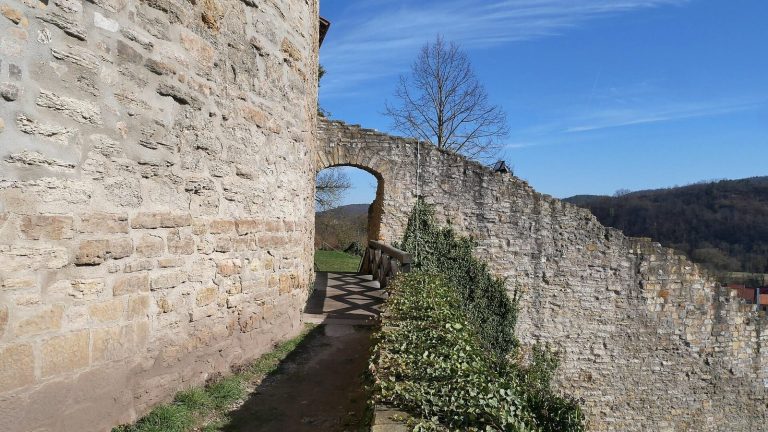
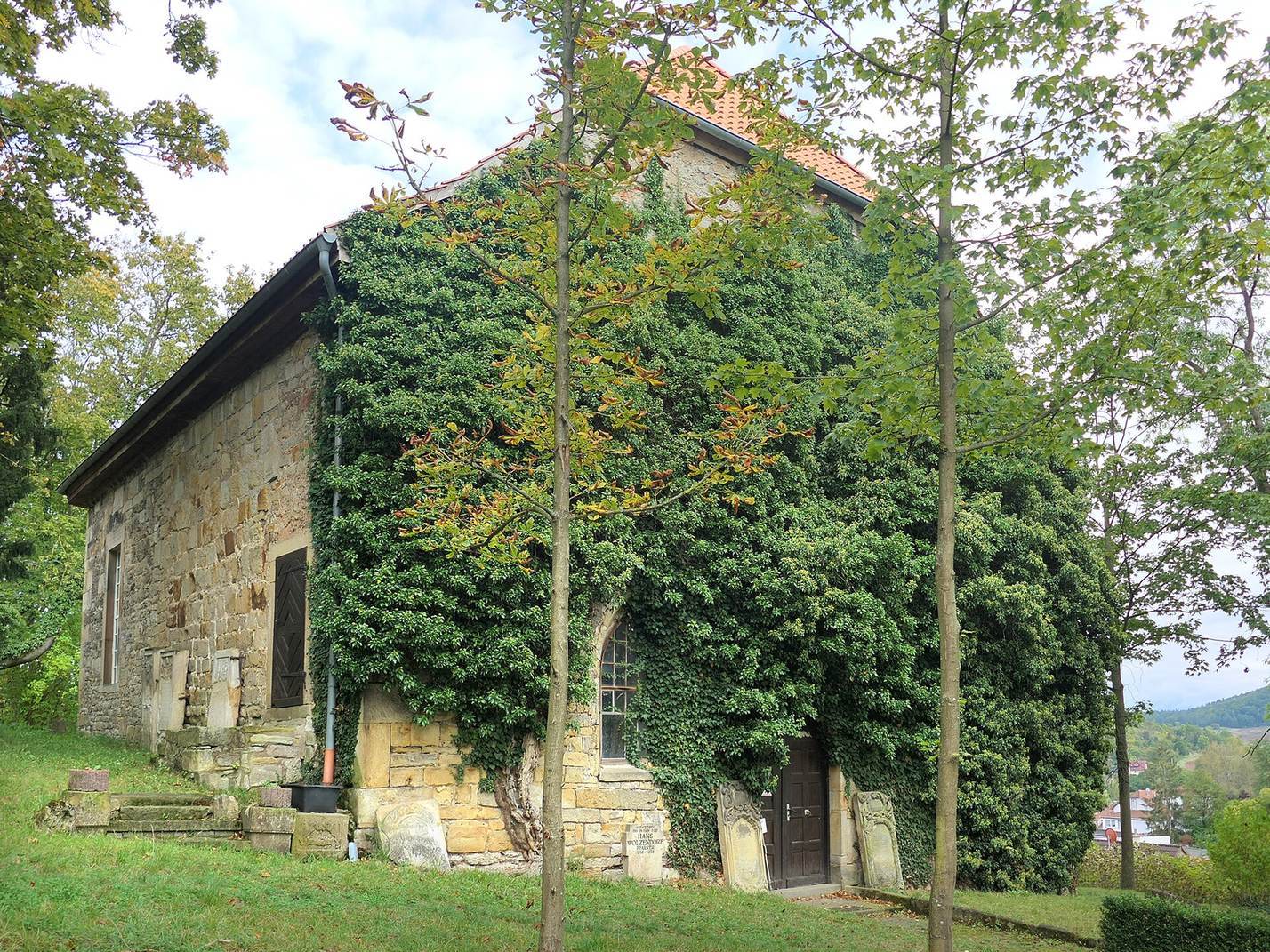
The Gottesackerkirche stands above Creuzburg in the middle of an old cemetery, in front of the former town wall. Its present appearance is largely shaped by the rebuilding of the 1710s. The building has no tower or chancel, and the earlier Romanesque fabric was extensively covered by later construction. Climbing vegetation covers the church exterior.
Approach and cemetery
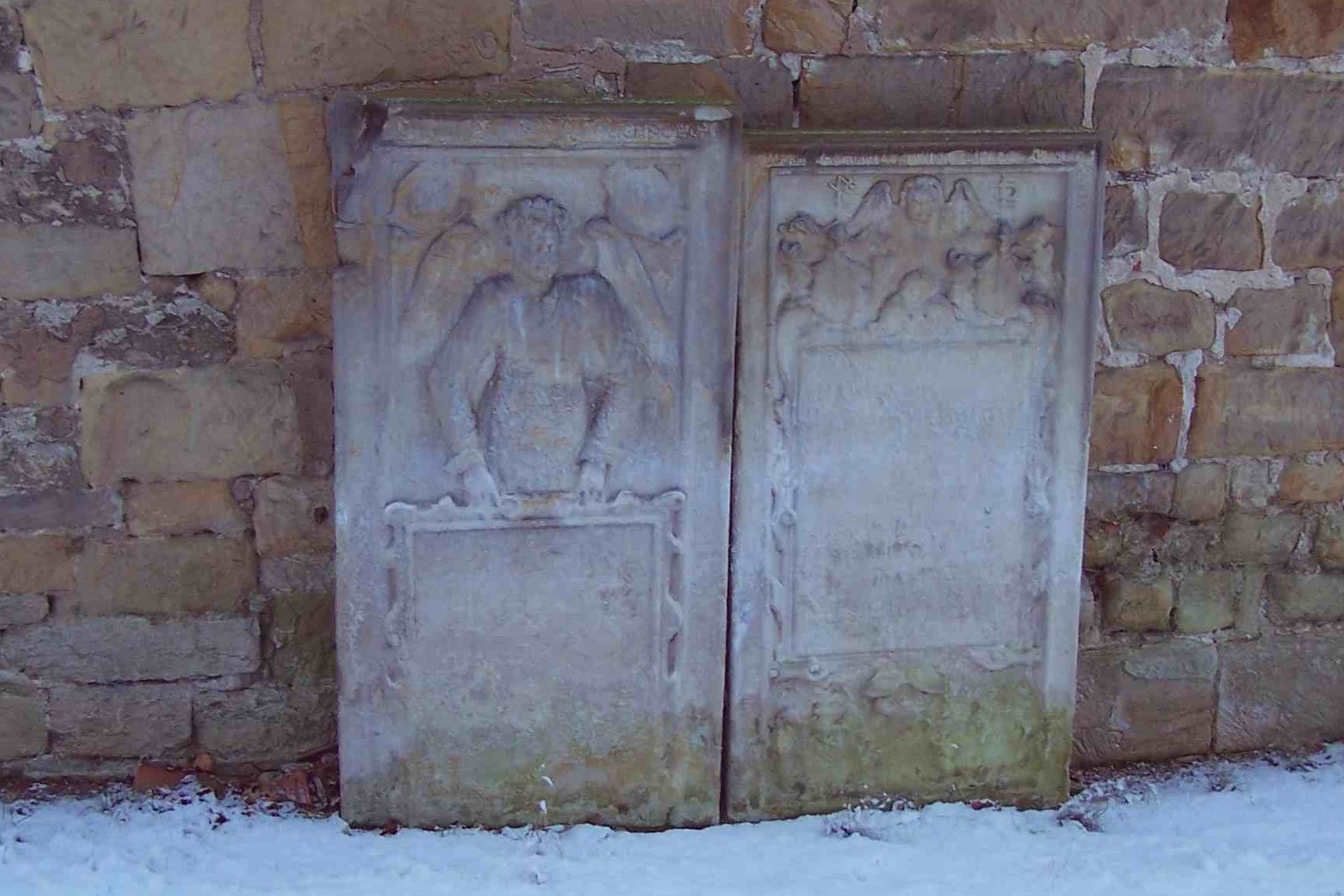
The approach from Bahnhofstrasse passes through a substantial portal dated 1642. From the portal, numerous sandstone steps lead upward toward the church and cemetery. The burial ground contains individual surviving gravestones decorated in Renaissance and Rococo styles. Renaissance and Rococo were later European artistic styles, with Rococo especially associated with elaborate ornament.
Interior exhibition
The church interior contains the Eichsfeld-Hainich-Werratal Nature Park exhibition opened in 2017. Its displays present the surrounding region’s landscape and explain the nature park’s work and responsibilities within the historic church building.