Grey Castle: A Renaissance Residential Castle in Germany


Site at a Glance
- Rating
- 4.4
- Popularity
- Low
- Country
- Germany
- Primary era
- Early Modern
- External website
- Open
- Eras represented
- Medieval, Early Modern
- Civilizations
- Holy Roman Empire, Landgraviate of Thuringia
- Site type
- Domestic
- Remains
- Castle
On this page8 sections
History
Grey Castle is a former residential castle in Germany near Mihla, with origins around 1200 and a Renaissance form developed during the early sixteenth century. It grew from a medieval water castle, a fortified residence protected by a surrounding moat or other water, and became the seat of successive noble lords.
Medieval Lordship
The medieval castle was inhabited by the Lords of Mihla, who served as vassals of the Archbishops of Mainz and the Landgraves of Thuringia. The archbishops were both senior Roman Catholic officials and territorial rulers, while the landgraves governed the historical territory of Thuringia. The Lords of Mihla belonged to a branch of the Truchsesses of Schlotheim, a family whose name derived from the medieval office of managing a ruler’s household and table.
In 1399, the Lords of Roßdorf received Mihla through enfeoffment, the granting of land or jurisdiction by a superior lord in return for obligations. The Heilingen and Wangenheim families later held the estate. In 1436, the Harstall noble family acquired Mihla and its castle seat, becoming its feudal and judicial lords.
Harstall Residence
At the beginning of the sixteenth century, the Harstalls began transforming the medieval stronghold into a residential palace in the Renaissance style. They also established or enlarged the White Castle manor farm to the east. A third complex, the Harstalls’ Red Castle, stood across the Lauterbach on the road toward Eisenach and Creuzburg.
The Mihla Revolt of 1848
During the unrest of March 1848, estate and agricultural workers in Mihla rebelled against the burdens imposed on them. On 13 March, they stormed Grey Castle and forced the estate owner and judicial lord, several village authorities, and Mihla’s pastor to sign prepared declarations renouncing dues and rent obligations.
Troops summoned from Eisenach retook the occupied castles and the parish on 17 March. They arrested the revolt’s leaders. The subsequent separation of landholdings, a nineteenth-century reorganization of communal and feudal rights, abolished at least part of the traditional burdens. A later amnesty by the state government released those who had been arrested.
Twentieth-Century Changes
In 1945, the Harstall family was dispossessed without compensation of Grey Castle and its associated 523-hectare manor estate. The castle was converted into a restaurant in 1971, and its interiors were gradually renovated during the 1990s. The privately owned complex is designated as an architectural and archaeological monument in Mihla and continues to serve as an inn and hotel.
Remains
Layout and Construction
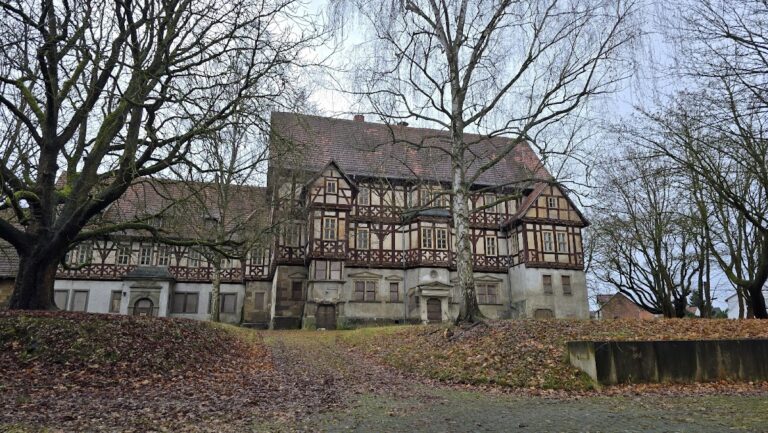
The surviving complex occupies the western part of Mihla’s historic settlement, beside the Werra and the Lauterbach, which joins the Werra at this location. It stands at an elevation of 190 metres. Built from local limestone and rubble stone, the castle follows the Renaissance character of residential castles in the lower and middle Werra valley, with design parallels at Nesselröden and Madelungen.
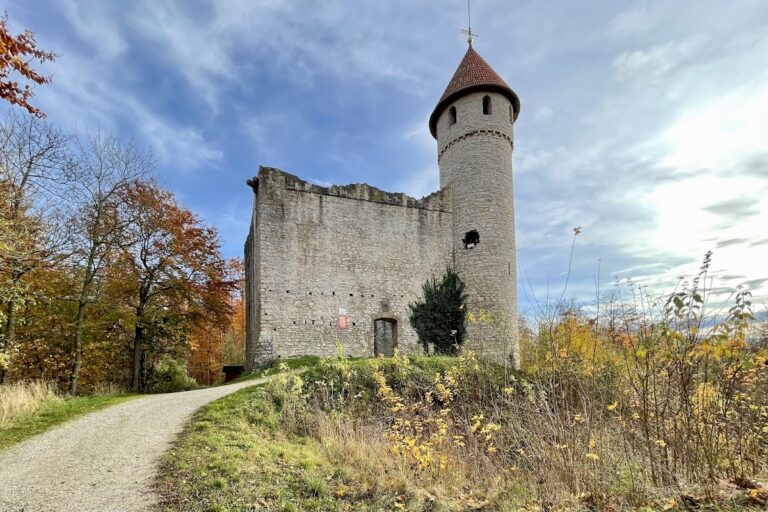
The main building has a rectangular plan. A projecting stair tower stands on its south side, while a lower projecting structure extends from the east. Three tall gable projections are arranged along both the north and south façades. The surrounding moat had been filled in by the nineteenth century, and the main building now survives in wall remains.
Rooms and Grounds
Representative rooms survive particularly on the ground floor and first upper floor. The surrounding area is maintained as a park with old trees and several memorial stones, forming the landscape around the castle buildings.
A linden tree in front of Grey Castle was estimated to be between 250 and 300 years old. It was designated a natural monument in 1966 and felled in autumn 2013 when its stability could no longer be guaranteed.
Nearby sites