Saint-Pierre Castle: A Historic Castle in Italy’s Aosta Valley

Site at a Glance
- Rating
- 4.5
- Popularity
- Medium
- Country
- Italy
- Primary era
- Medieval
- External website
- Open
- Eras represented
- Medieval, Early Modern, Modern
- Civilizations
- Duchy of Savoy, Italian
- Site type
- Domestic
- Remains
- Castle
On this page9 sections
History
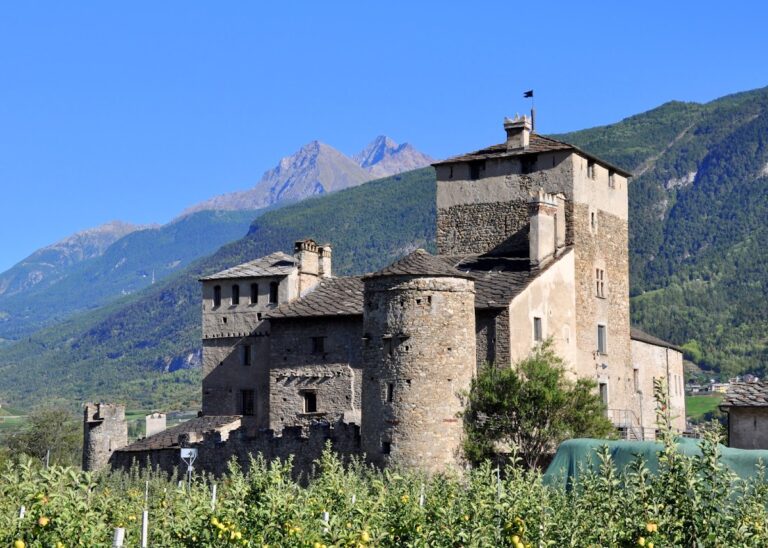
Saint-Pierre Castle is a historic castle in Italy, overlooking the settlement of Saint-Pierre in the Aosta Valley. Its existence is first recorded in 1191, and its earliest development is associated with the De Sancto Petro lords, who built the two original towers. The complex later passed through the hands of the Lords of Quart, the Savoy dynasty, and the Challant family, each of whom modified or expanded it according to changing needs.
From medieval stronghold to noble residence
In 1600, the Roncas family acquired the entire property. Pierre-Philibert de Roncas enlarged the castle and transformed it into a grand residence, giving the complex a new residential character while retaining its earlier structures.
By the nineteenth century, prolonged neglect had left the castle seriously deteriorated. Baron Emanuele Bollati of Saint-Pierre purchased it in 1873 and commissioned the Piedmontese architect Camillo Boggio to renovate it as a summer residence. Boggio added the corner turrets and connecting walkway that contributed to the castle’s present fairy-tale appearance.
Municipal ownership and museum use
The municipality of Saint-Pierre now owns the castle. Since 1985, it has housed the Efisio Noussan Regional Museum of Natural Sciences. The museum’s exhibition site is in the castle, while its operational headquarters are in the municipality of La Salle. Its work encompasses the natural heritage, culture, history, and traditions of the Aosta Valley, together with research, preservation of collections, exhibitions, scientific communication, meetings, experimentation, and the exchange of knowledge.
From 2008 to 2022, renovation and structural consolidation work was carried out alongside the reorganization of the museum’s exhibition route. In 1980, the Italian Post Office also depicted Saint-Pierre Castle on a 900-lire stamp in its Castelli d’Italia collection.
Remains
Castle and courtyard
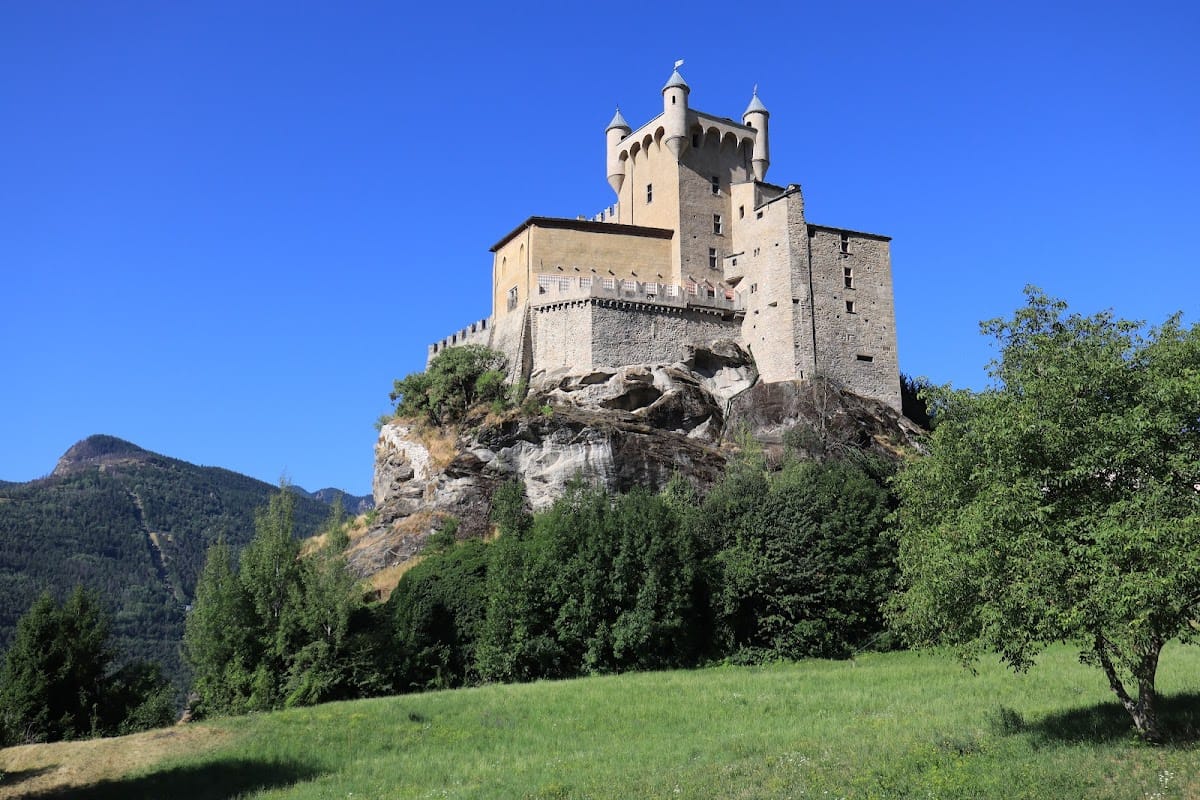
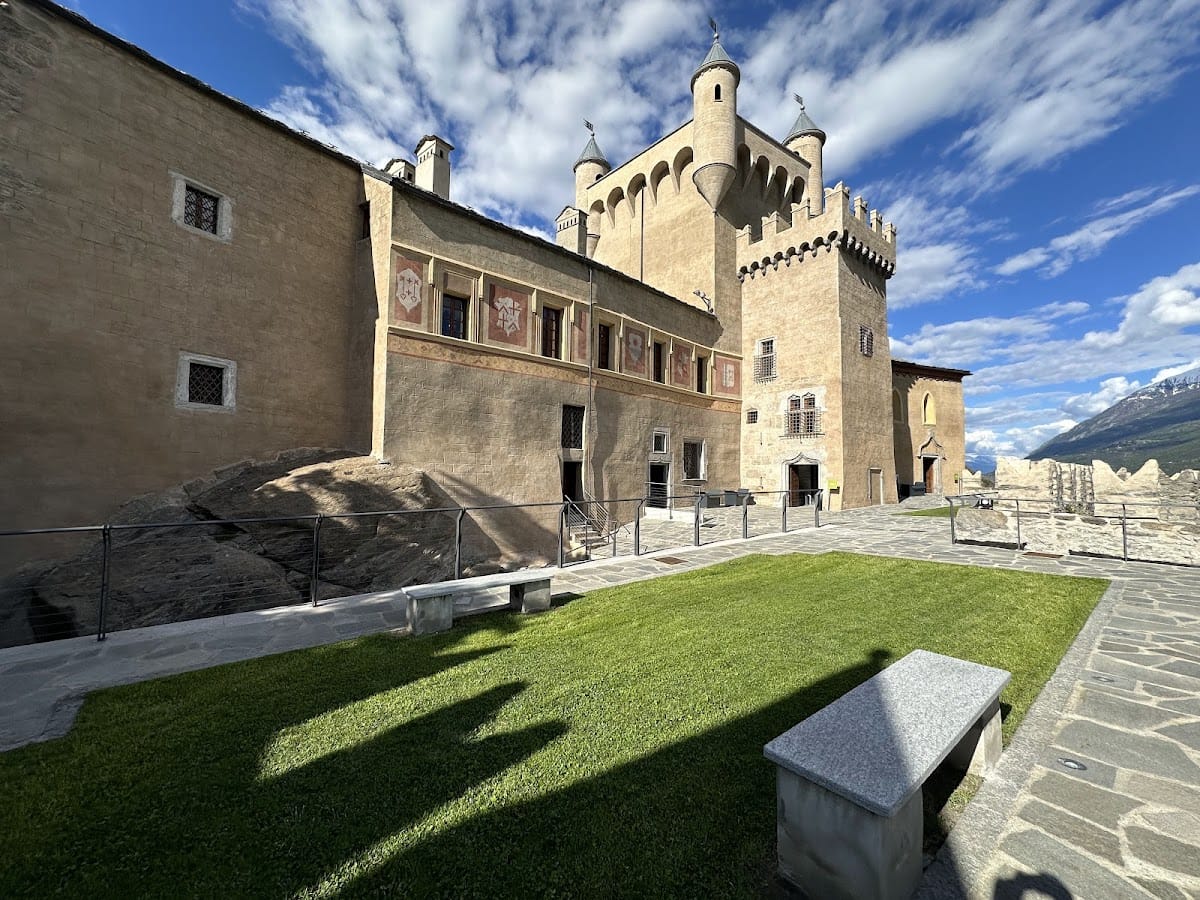
Saint-Pierre Castle stands on a rocky marble outcrop above the SS26 road, which connects Aosta with the Petit-Saint-Bernard Pass. The complex appears from outside as a roughly rectangular building formed by structures from different periods. On the north, its buildings rise directly from the rock. On the south, they face a small courtyard enclosed by a crenellated wall, a defensive wall with alternating raised sections and gaps.
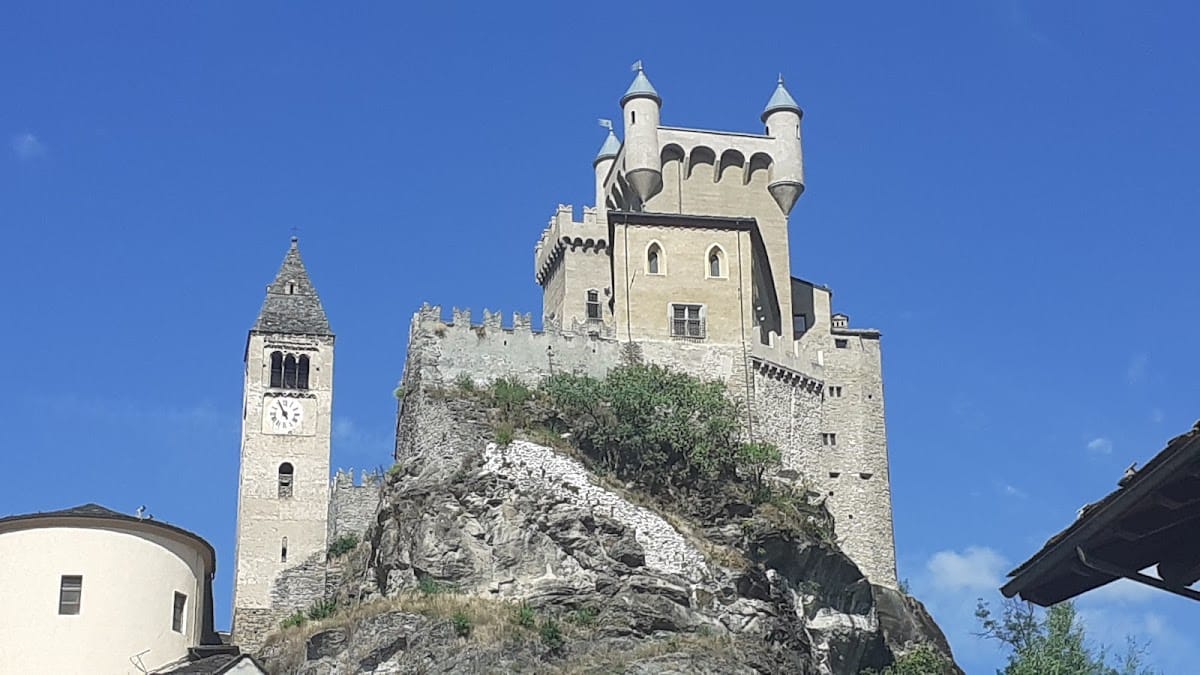
At the center of the main building rises a tall square-plan keep, the principal fortified tower of a medieval castle. Four circular decorative turrets stand at its corners, linked by a walkway supported on small arches. Camillo Boggio added these turrets and the walkway during the late nineteenth-century restoration. Two towers attributed to the De Sancto Petro lords also survive within the complex.
Religious buildings
Parish church of Saint-Pierre
At the foot of the castle, against the southern side of the rocky outcrop, stands the parish church of Saint-Pierre. The present building was reconstructed in 1872 on the foundations of several earlier churches, the oldest of which dates from before the year 1000.
Romanesque bell tower
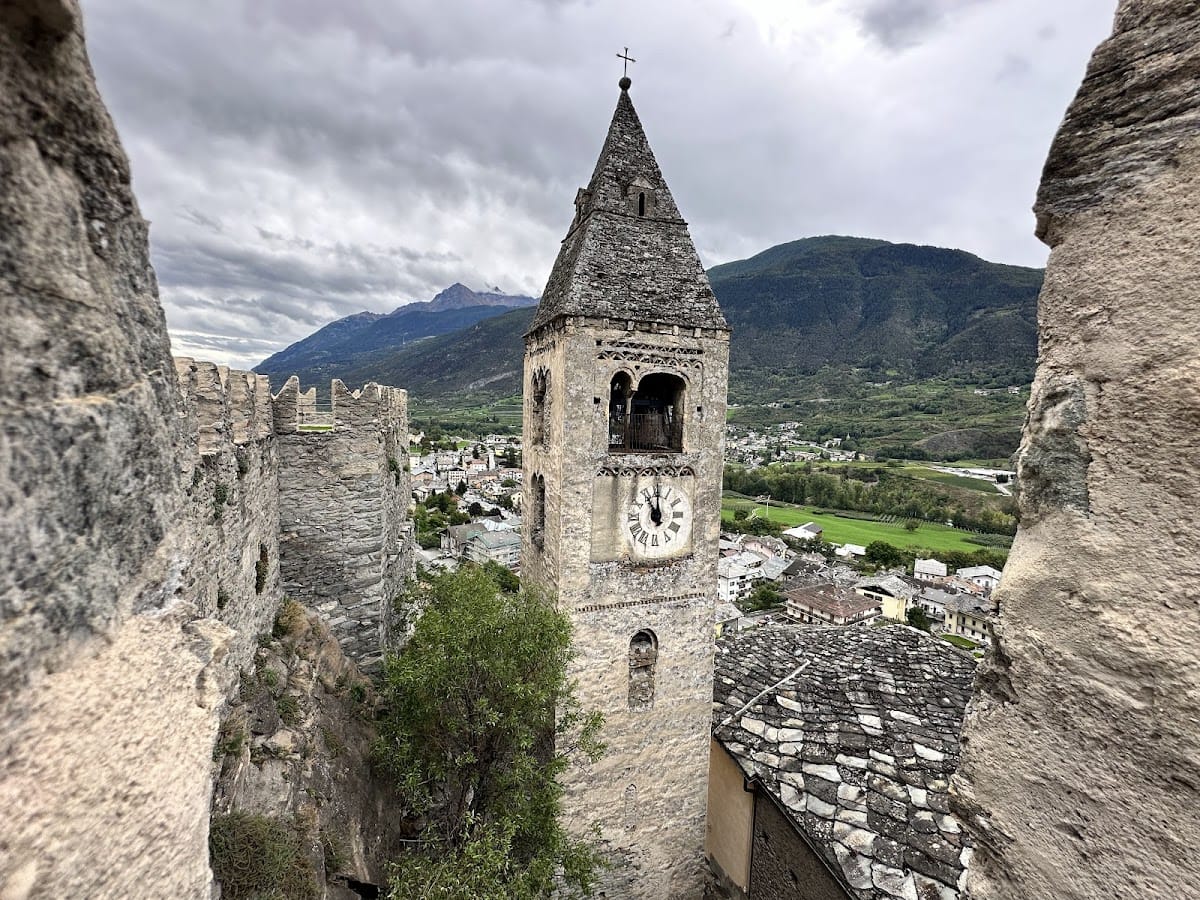
Between the church and the castle is an ancient twelfth-century Romanesque bell tower. Romanesque architecture is characterized by massive masonry, simple geometric forms, and rounded or arched openings. The square-plan tower is built of plastered stone and has a pyramidal stone roof. Paired and triple-arched openings appear at the bell chamber and on the lower floor.
Interior features
Interior features include the fireplace, ceiling, door, and furniture of the Hall of Coats of Arms. The castle also contains a viret, a spiral staircase with characteristic wall decoration, as well as carved stone details.