Burg Oybin: A Gothic Guard Castle in Germany


Site at a Glance
- Rating
- 4.9
- Popularity
- Medium
- Country
- Germany
- Primary era
- Medieval
- External website
- Open
- Eras represented
- Medieval, Early Modern
- Civilizations
- Holy Roman Empire, Kingdom of Bohemia
- Site type
- Military
- Remains
- Castle
On this page13 sections
History
Burg Oybin is a ruined Gothic guard castle in Germany, built and expanded under Bohemian rule on Oybin Mountain above the village of Oybin. The mountain had been settled during the Bronze Age, in the eleventh or twelfth century BC, while Slavic-period occupation is considered probable but has not been demonstrated. The castle became a strategic stronghold beside a trade route and later housed an imperial residence and a Celestine monastery.
Origins and Bohemian fortification
The earliest structural traces at Oybin date from the thirteenth century. In 1291, inhabitants of Zittau destroyed the castle after robber knights had used it as a base for raids. This event provides the first documented reference to the stronghold, whose name then appeared as Moybin. The castle was rebuilt soon afterward.
Between 1311 and 1316, during the rule of Henry of Lipá, marshal to King John of Luxembourg, the base of the castle was enlarged into a more defensible fortress. Its position helped protect a nearby trade route. By 1346, Oybin had once again come directly under the Bohemian Crown.
The imperial residence and Celestine monastery
In 1364, Charles IV, King of Bohemia and Holy Roman Emperor, commissioned the Imperial House at Oybin as a place of rest. A major patron of Gothic architecture, he began a Gothic church at the site in 1366, working with the prominent Parler workshop, a Central European family workshop known for important medieval buildings and sculpture. The church was completed in 1384.
Charles IV founded a Celestine monastery at Oybin in 1369 and dedicated it to the Holy Spirit. The Celestines were a Catholic monastic order founded by Pietro da Morrone, who later became Pope Celestine V. Between six and twelve monks lived at Oybin until the Reformation, the sixteenth-century movement that challenged established Catholic institutions and led to the dissolution of many monasteries. Petrus Zwicker, an inquisitor and the monastery’s prior from 1395, was its most prominent member.
Oybin’s location between Charles IV’s northern and southern territories added to its strategic value. The stronghold also served as a place of protection during the Hussite Wars, fifteenth-century religious and political conflicts in the Bohemian lands associated with the followers of Jan Hus. Part of the treasury of St Vitus was transferred to Oybin to safeguard it from Hussite raids.
Hussite sieges and continued expansion
In 1420, forces led by Zbyněk Buchovec of Buch and Chval Řepický of Machovice besieged the castle. Its massive walls and steep rocky setting compelled the attackers to withdraw, although they burned the farmstead at the foot of the mountain. In 1429, Hussite forces led by Prokop the Great attacked the monastery. The siege lasted four hours and also failed, after which Oybin gained a reputation for being impregnable.
An archaeological investigation later found an armed covered wagon at the foot of the mountain, linking a surviving object with Oybin’s Hussite-period history. The castle continued to be enlarged until the second half of the sixteenth century. Concern that the monastery’s property might be lost during the Reformation led King Ferdinand I to order several inventories of its possessions.
Dissolution and decline
The monastery was dissolved as a consequence of the Reformation, and the Celestines departed. Jesuits occupied the complex briefly in 1556 in an attempt to maintain a Catholic institution within Protestant territory. They soon left, and in 1562 took ecclesiastical valuables and the library back to Prague.
The city of Zittau took control of the monastery’s property, first holding it as pledged land and then purchasing it outright in 1574. The buildings were used mainly for storing weapons. In 1577, lightning struck the church and caused a fire. An eighteenth-century rockfall inflicted further damage. By that time the castle was uninhabited, and people from the surrounding valley used it as a source of building stone, beginning its long decline as a functioning settlement.
Rediscovery and preservation
Oybin was rediscovered during the Romantic period after the Saxon court painter Johann Alexander Thiele depicted its overgrown walls. Caspar David Friedrich, Carl Gustav Carus, and other Romantic painters later helped spread knowledge of the ruins. The site also attracted historical study. Christian Adolph Pescheck investigated the Celestines at Oybin and the history of Zittau, while Moritz Oskar Sauppe produced a three-volume scholarly history of the castle. A monument to Pescheck stands at Oybin.
Rubble was cleared from the castle in 1829, and the Imperial House was stabilized in 1877. At the beginning of the twentieth century, Cornelius Gurlitt and Hugo Rathgens scientifically documented and investigated the complex. Alfred Moschkau founded the first private museum at Oybin in 1879 and publicized the site through guidebooks and periodical articles. His heirs dispersed much of the collection in a 1936 sale, and substantial parts of the museum were looted near the end of the Second World War.
Herrmann Knobloch saved the nearly destroyed Zittau Passion cloth of 1472, a religious textile that had been stored at Oybin. Long-term rescue work continued in the following decades, with a major stage completed in 1991. The castle and monastery ruins were extensively stabilized, and much of the complex was uncovered and reconstructed. Since 1972, the monastery ruins have also served as a concert hall because of their good acoustics. A civic association continues to organize historical monks’ processions in memory of the former Celestines, and since 2008 the Verein Historische Mönchszug Berg Oybin has been an official member of the Centro Celestiniano in L’Aquila, Italy.
Remains
Summit layout and construction
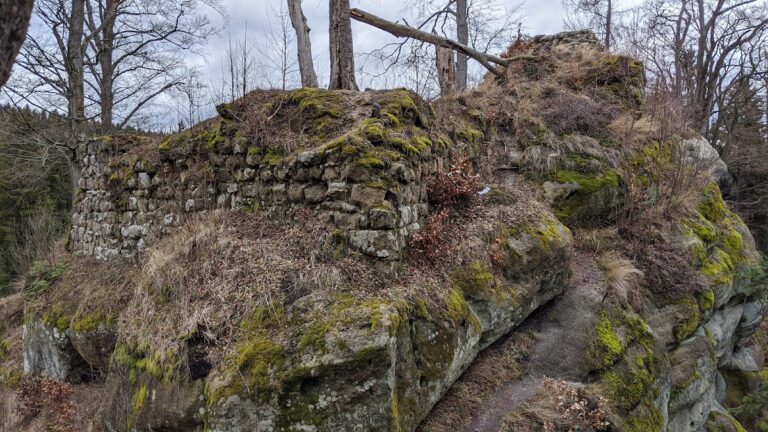
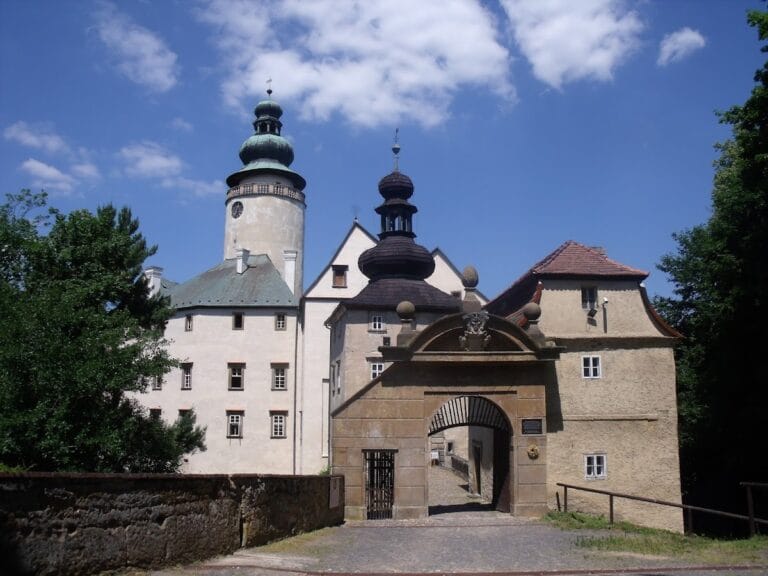
Burg Oybin occupies the summit of 514-metre Oybin Mountain in the Zittau Mountains of Upper Lusatia, approximately two kilometres north of the Czech-German border. The ruined plateau castle is built chiefly of stone, including sandstone, and its complex combines the castle remains, the Imperial House on the western side, and the ruins of the Celestine monastery. An elevated village cemetery, a hut with a restaurant, and a camera obscura at the mountain’s highest point are also part of the summit complex. A camera obscura is an optical installation that projects an outside image onto an interior surface through a small opening.
Imperial House
The Imperial House was constructed in 1364 as an imperial residence and retreat for Charles IV. It occupies the western side of the castle complex and forms part of the Gothic stone-built remains. Stabilization in 1877 protected the surviving structure from further deterioration.
Gothic church
The Gothic church was begun in 1366 and completed in 1384. It stood beside the monastic complex and was destroyed by fire after lightning struck it in 1577. The later rockfall of the eighteenth century caused additional damage to the church, monastery, and castle ruins.
Celestine monastery
The Celestine monastery survives as a ruin within the summit complex. Its remains formed part of the buildings later used mainly for storing weapons after Zittau acquired the monastery’s property. Rescue work in the following decades exposed and reconstructed much of the ruined complex. The surviving monastery has good acoustics and has been used as a concert hall since 1972, including for the traditional Monks’ Procession.
Cemetery and archaeological finds
An elevated cemetery forms part of the summit complex. Its gravestones include that of the knight Peter of Debschitz, who died in 1550. At the foot of Oybin, archaeological investigation recovered an armed covered wagon associated with the site’s Hussite-period history. The Zittau Passion cloth of 1472, a religious textile once kept in the Oybin museum, was nearly destroyed during wartime looting before Herrmann Knobloch saved it.
Related features below the summit
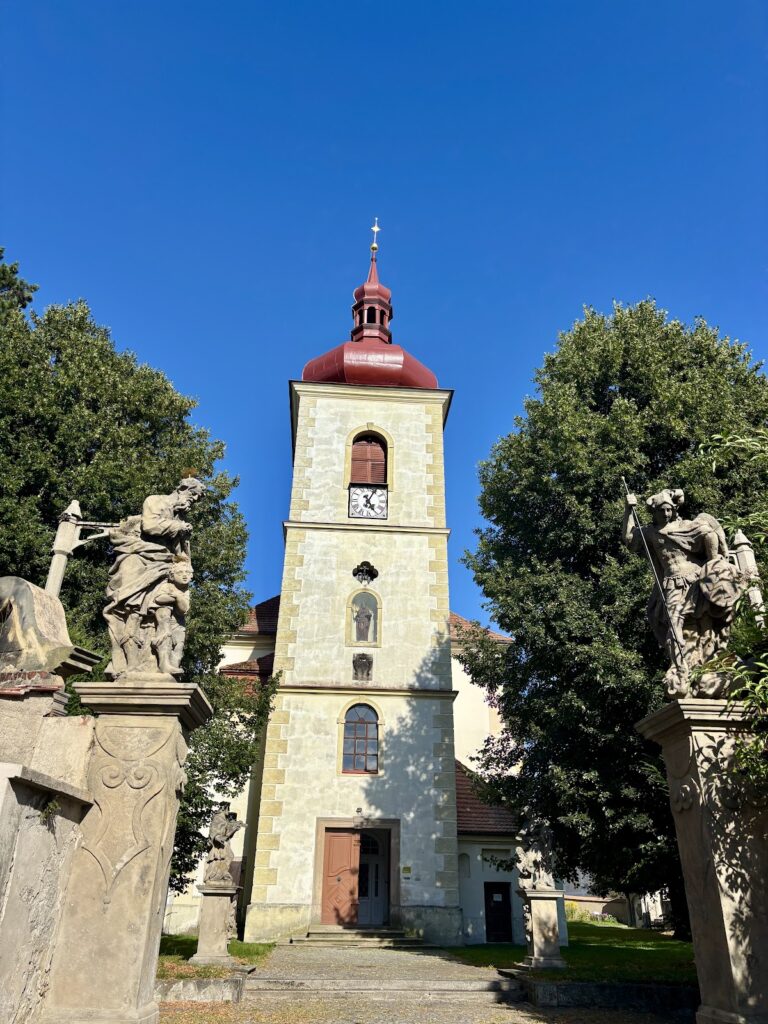
A church beside the path ascending Oybin Mountain contains notable paintings within its interior. Together with the summit buildings, cemetery, and archaeological material from the mountain’s foot, it forms part of the surviving historical setting associated with Burg Oybin.