Karlsfried: A Medieval Fortified Customs Castle in Germany


Site at a Glance
- Rating
- 4.3
- Popularity
- Very Low
- Country
- Germany
- Primary era
- Medieval
- Eras represented
- Medieval
- Civilizations
- Holy Roman Empire, Kingdom of Bohemia
- Site type
- Military
- Remains
- Castle
On this page8 sections
History
Karlsfried is a medieval hilltop castle in Germany, built in 1357 on the orders of Emperor Charles IV by Ulrich Tista, Burgrave of Liebstein. It was established as a fortified customs station on the Gabler Road, a trading route from Prague through Gabel to Zittau that linked Bohemia with Upper Lusatia. The castle collected tolls, accommodated merchants, and provided them with escorts.
Customs station and administration
Karlsfried was not designed as a residence. In 1364, Zittau became its lessee in return for 300 schock of Prague groschen. In 1412, control passed to Hinko Berka von Dubá, a landvogt, or high-ranking territorial governor representing a ruling authority.
Hussite attacks and destruction
The castle resisted a Hussite siege in 1421. The Hussites were followers of the Bohemian religious reformer Jan Hus, and the Hussite Wars were a series of fifteenth-century conflicts in Bohemia and nearby regions. During a second siege in January 1424, Karlsfried was burned. It was later rebuilt under Emperor Sigismund, the son of Charles IV and a subsequent Holy Roman Emperor.
After the rebuilding, Jan von Wartenberg owned Karlsfried and used it as a base for raids in the surrounding area. Zittau bought the castle in 1442 to end these raids and had it demolished. Much of the masonry was then removed for inexpensive local building material. Stones were taken for the church at Lückendorf in 1690, and further demolition in 1721 supplied building material for Zittau.
Remains
Hilltop layout and defenses
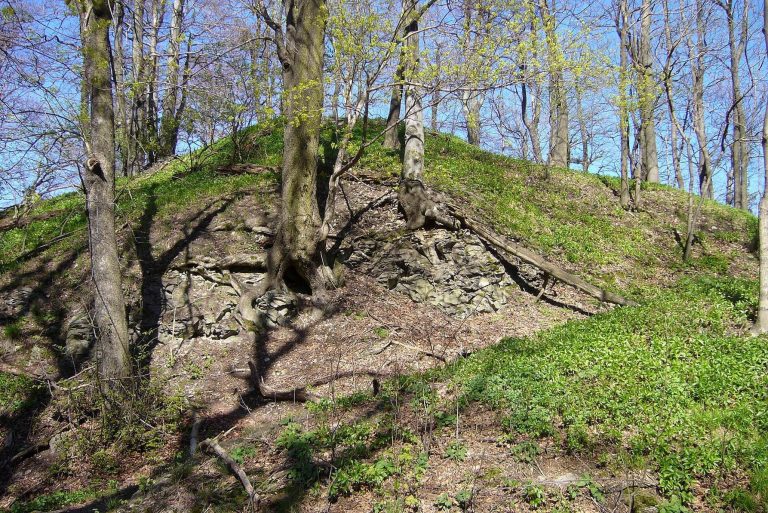
Karlsfried stands on a rocky spur of the Straßberg in the Zittau Mountains, above the road crossing the Stoßsattel between the Straßberg and Heideberg. The ruin lies approximately halfway between Eichgraben, a locality of Zittau, and Lückendorf, in woodland beside the Zittau-Lückendorf road. Its surviving fabric consists mainly of wall remains. A rampart in the valley below the castle made hollow ways created by attempts to bypass the compulsory road route impassable.
Surviving buildings
Entrance tower
An entrance tower survives among the remains of the castle. It formed part of the approach to the fortified customs station, whose position above the road enabled it to control movement along the route.
Residential and defensive buildings
The ruins also include a small palas, the principal residential or representative building of a medieval castle, together with a square bergfried, a substantial tower used mainly for defense and refuge rather than permanent residence. These structures survive within the fragmentary masonry of the hilltop castle, much of which was later removed and reused elsewhere.