Castle Starý Herštejn: A Gothic Stronghold in Czechia


Site at a Glance
- Rating
- 4.7
- Popularity
- Low
- Country
- Czechia
- Primary era
- Medieval
- External website
- Open
- Eras represented
- Medieval
- Civilizations
- Holy Roman Empire, Kingdom of Bohemia
- Site type
- Military
- Remains
- Castle
On this page9 sections
History
Castle Starý Herštejn is a Gothic castle ruin in Czechia, founded after the middle of the thirteenth century, probably before 1266. Its builders were likely members of the German nobility, although an older interpretation attributed its foundation to a ruler. The castle was first mentioned in 1272, when Protivec of Herštejn used its name in his title. It later became an ecclesiastical strongpoint connected with the estates around Horšovský Týn.
Foundation traditions and early ownership
A much earlier foundation tradition places the castle’s origin in 797 and links it to Ratibold of Egmont, a Frisian knight. According to the legend, Ratibold discovered a white hind that had nourished his lost wife, Elsa. He supposedly founded the castle near the place where they were reunited, which was said to have been called Elsenberg, a name later associated with Lysá hora. This tradition differs from the later medieval evidence for the castle’s existence.
Before 1328, Ulrich, Landgrave of Leuchtenberg, bought Starý Herštejn from the children of a man named Bruk. He then sold it to Henry of Bavaria for 1,000 kop groschen. Henry apparently failed to pay the full price, and ownership subsequently passed by an uncertain process to John of Luxembourg, King of Bohemia from 1310 to 1346.
Ecclesiastical strongpoint
In 1331, John of Luxembourg sold the castle for 300 kop groschen to Jan IV of Dražice, Bishop of Prague, who also owned Horšovský Týn. Under the bishop, Starý Herštejn was administered by Zbyněk of Osvračín, who also served as burgrave of Horšovský Týn. The castle supported the church’s local power and helped protect ecclesiastical property around Horšovský Týn.
Archbishop Jan of Jenštejn, who held office in Prague from 1379 to 1396, undertook building works at Starý Herštejn and Horšovský Týn costing 500 kop groschen. At Starý Herštejn, he probably repaired the fortifications rather than substantially rebuilding the castle.
Hussite capture and changing lords
Before 1420, Petr Ebrzvín of Hradiště acquired Starý Herštejn as a pledge for 635 kop groschen. Hussite forces from Domažlice captured it on 17 May 1421 during the Hussite Wars, the religious and political conflicts in fifteenth-century Bohemia that followed the death of the reformer Jan Hus.
The castle was still supposed to belong to the Ebrzvín family, but the brothers Bedřich and Hanuš of Kolovrat held it in 1427. Petr Ebrzvín’s son Bernard transferred his ownership rights to Ctibor of Volfštejn, who in 1437 described himself as residing at Herštejn. Soon afterward, Ctibor exchanged the castle with Zdeněk of Drštka for Touškov, Dolní Metelsko, and Věvrov.
Destruction in 1510
After 1437, Starý Herštejn remained part of the Horšovský Týn estate. Dobrohost of Ronsperg acquired Ronsperg Castle in 1459, and in 1506 Zdeněk Dobrohost of Ronšperka obtained part of Starý Herštejn and probably later the whole castle.
During Zdeněk Dobrohost’s ownership, the castle garrison attacked merchants and travelers. Zdeněk was declared an enemy of the realm, and in 1510 troops from the Plzeň region’s levy, led by Zdeněk Lev of Rožmitál on behalf of the royal administration, besieged and captured Starý Herštejn. The troops then demolished it. Zdeněk Dobrohost fled to the Bavarian castle of Flossenbürg and never returned.
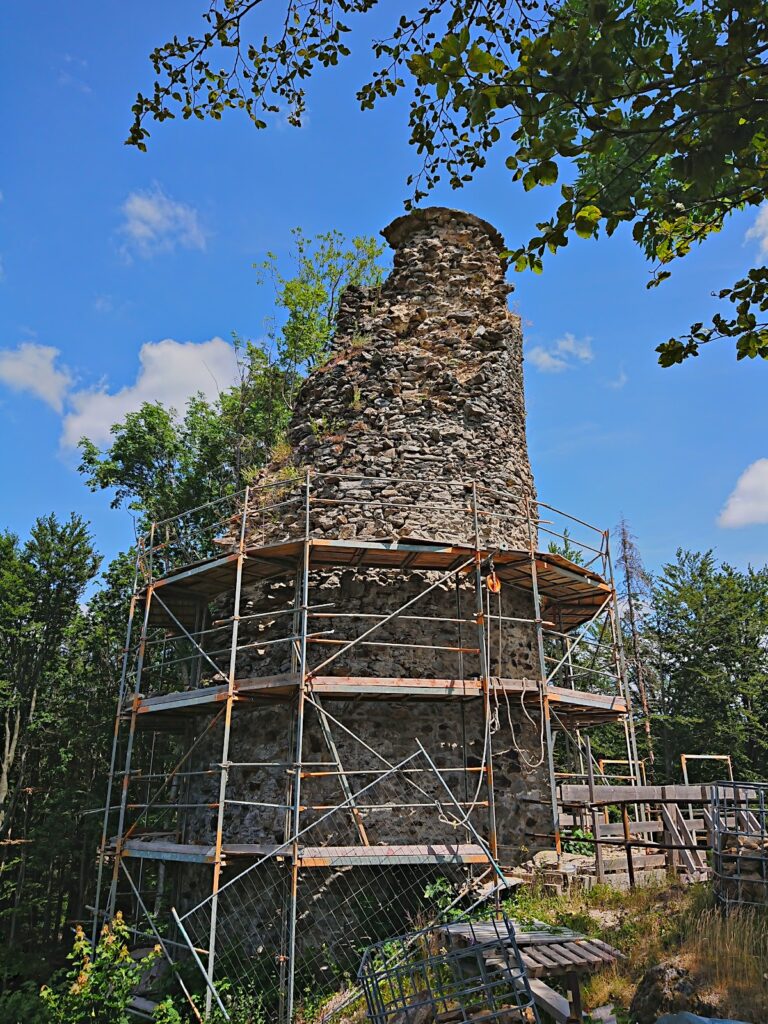
The abandoned ruins remained attached first to the Ronsperg estate and later to the Horšovský Týn estate, but the castle was never rebuilt. Military use of the site in the twentieth century caused further damage to some of the surviving structures. Between 2017 and 2020, a conservation project stabilized the fragmented tower and added masonry where needed. The tower was converted into a lookout tower and opened on 19 September 2020. The ruins are protected as a cultural monument of the Czech Republic.
Remains
Castle Starý Herštejn occupies the summit of the 878-metre Starý Herštejn hill in the Bohemian Forest, within the Starý Hirštejn Nature Reserve. The site lies above the source area of the Pivoňka River, near Vranov. Its defenses were arranged around an outer bailey and a narrower inner castle built on a rocky formation.
Outer bailey
The outer bailey, the enclosed area outside the castle’s inner defensive core, was protected by an earthwork rampart and ditches. Archaeological work identified its gate and parts of the buildings that surrounded it. The entrance stood approximately midway along the northwestern side. It began as an inward-opening square tower with a passage paved with large stones and a wooden-lined portal. A small foregate was added later, and in a still later phase the portal was blocked with masonry.
A brick domed oven stood in the western corner of the outer bailey. Beside it was a building containing an inserted log construction. These features formed part of the service structures within the defended outer area.
Inner castle
The inner castle occupied a narrow rocky formation with a round tower at each end. The entrance-side bergfried, the principal defensive tower of a medieval Central European castle, is partly preserved. Its thicker walls enclosed an irregular interior plan. The second tower was destroyed either during the demolition of 1510 or after the middle of the seventeenth century, when an explosion of gunpowder is associated with its destruction.
A palace stood between the two towers and developed through several stages of construction. Although military use damaged part of the palace remains in the twentieth century, archaeological work confirmed at least one basement room.
Conserved tower
The surviving tower was stabilized and supplemented with masonry between 2017 and 2020. A replica of a medieval wheel crane was used during the conservation work. The structure is now topped by a viewing platform reached by a spiral staircase, with a small footbridge providing access to the platform.