Fyvie Castle: A Historic Scottish Castle and Royal Stronghold
Site at a Glance
- Rating
- 4.7
- Popularity
- Medium
- Country
- United Kingdom
- Primary era
- Medieval
- External website
- Open
- Eras represented
- Medieval, Early Modern, Modern
- Civilizations
- British, Kingdom of Scotland
- Site type
- Military
- Remains
- Castle
On this page15 sections
History
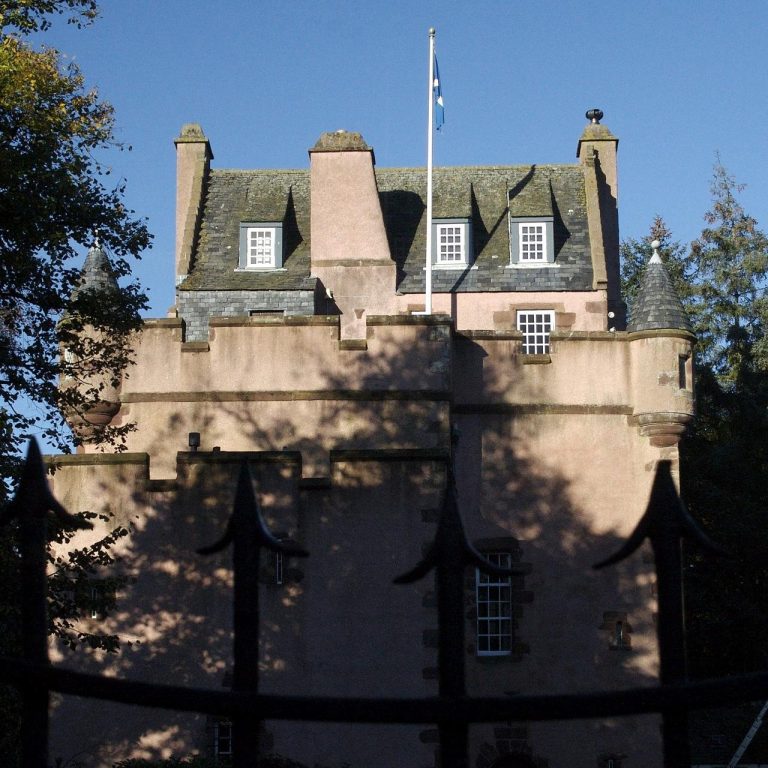
Fyvie Castle is a quadrangular castle in Fyvie, Scotland, in the United Kingdom. Its earliest surviving parts date from the thirteenth century, although tradition and some historical claims place its construction in 1211 under William the Lion, the Scottish king who reigned from 1165 to 1214. The exact foundation date remains uncertain. Fyvie later served as the setting for an open-air court held by Robert the Bruce, king of Scots from 1306 to 1329 and a leading figure in Scotland’s wars of independence. Charles I, who became king of England, Scotland, and Ireland in 1625, also spent four years of his childhood at the castle.
From royal stronghold to family castle
Fyvie’s royal role ended after the Battle of Otterburn in 1388, a major Anglo-Scottish conflict. Robert III granted the castle to Henry Preston, after which it passed through the Preston, Meldrum, Seton, Gordon, and Forbes-Leith families. Each family added a tower, giving the castle its distinctive sequence of additions and recording the changing ownership of the estate in its architecture.
On 28 October 1644, Manus O’Cahan and James Graham, Marquess of Montrose, fought a battle at Fyvie against a Covenanting army. Montrose was a Scottish royalist commander during the Wars of the Three Kingdoms, while O’Cahan was an Irish soldier in his forces. The Covenanters supported religious and political agreements known as the National Covenant and the Solemn League and Covenant. The battlefield was added to Scotland’s Inventory of Historic Battlefields in 2011 and has since been investigated for fuller documentation and protection.
War, landscape, and preservation
Anne Halkett stayed at Fyvie from 1650 to 1652 with the Countess of Dunfermline. Halkett was a Scottish writer and medical practitioner who treated wounded soldiers and local illnesses during her time there. She also negotiated with an English major commanding Commonwealth troops and with the colonels Lilburne, Fitts, and Overton.
Colonel William Gordon oversaw the landscaping of the castle grounds and adjoining Fyvie Lake in the eighteenth century. In 1885, the Scottish industrialist Alexander Leith, later Baron Leith of Fyvie, purchased the castle. His descendants sold it to the National Trust for Scotland in 1984, and the conservation charity has owned and managed the property since then. Fyvie Castle is a Category A listed building. Its grounds were included in Scotland’s Inventory of Gardens and Designed Landscapes in 1987, while the Battle of Fyvie remains separately registered as a battlefield.
Legends associated with Fyvie
Local tradition connects Fyvie with two curses. One concerns a sealed medieval dungeon said to bring death to an intruder and blindness to his wife. The other, traditionally attributed to Thomas the Rhymer, a legendary medieval Scottish prophet and poet, is called the Curse of the Weeping Stones. It is said to explain why the eldest sons of Fyvie’s owning families allegedly failed to inherit the estate.
Another tradition concerns a woman’s skeleton reportedly found inside a bedroom wall during repair or reconstruction work in the 1920s. The remains were said to have been buried in the castle cemetery, after which unexplained sounds and disturbances began. According to the story, the castle’s lord ordered the skeleton to be exhumed and returned to the wall, and the disturbances then ceased. The room has sometimes been identified with a reputed secret room in the castle’s south-west corner, but that identification remains uncertain. Other traditions refer to the Green Lady, identified as Lilias Drummond, wife of Alexander Seton, a Grey Lady connected with the skeleton story, two apparitions, an indelible bloodstain, and several curses.
Remains
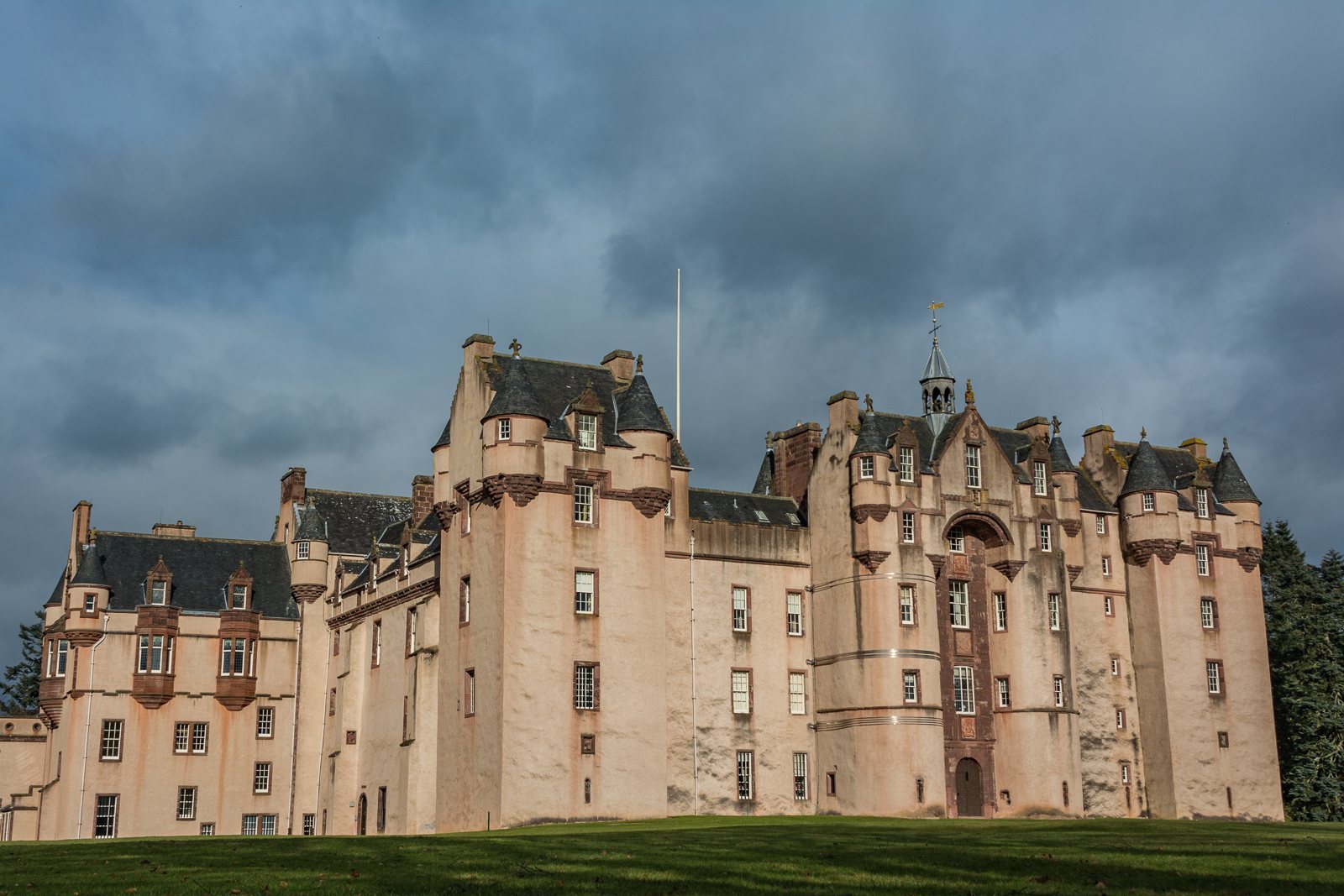
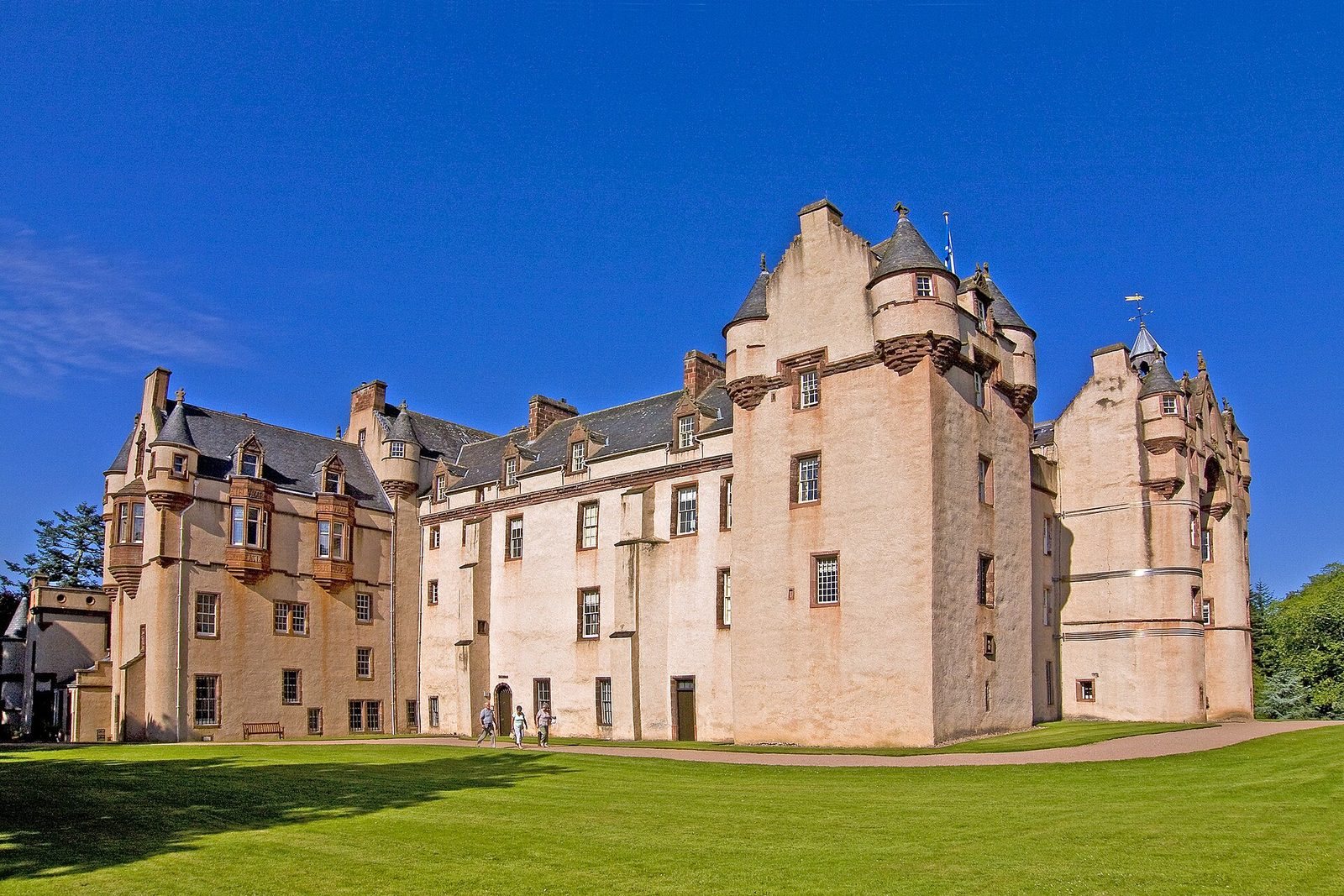
Fyvie is organized as a quadrangular castle near the village of Fyvie and the town of Turriff in Aberdeenshire. Its principal additions are five successive family towers, while the grounds extend to a walled garden and the adjoining Fyvie Lake. The surviving complex combines medieval and early-modern fabric with later additions and landscaped surroundings.
Towers and entrance
Preston Tower
Preston Tower is the oldest of the family additions. It stands at the far right of the main facade when viewed from the front and dates approximately from 1390 to 1433. Its position and date reflect the period after Fyvie passed from its royal role to the Preston family.
Seton Tower
Seton Tower forms the entrance to the castle. Alexander Seton erected it in 1599 and commissioned the grand wheel staircase several years later. A wheel stair is a tightly winding circular stair built around a central newel or open space, a form commonly used in medieval and early-modern towers.
Gordon and Leith Towers
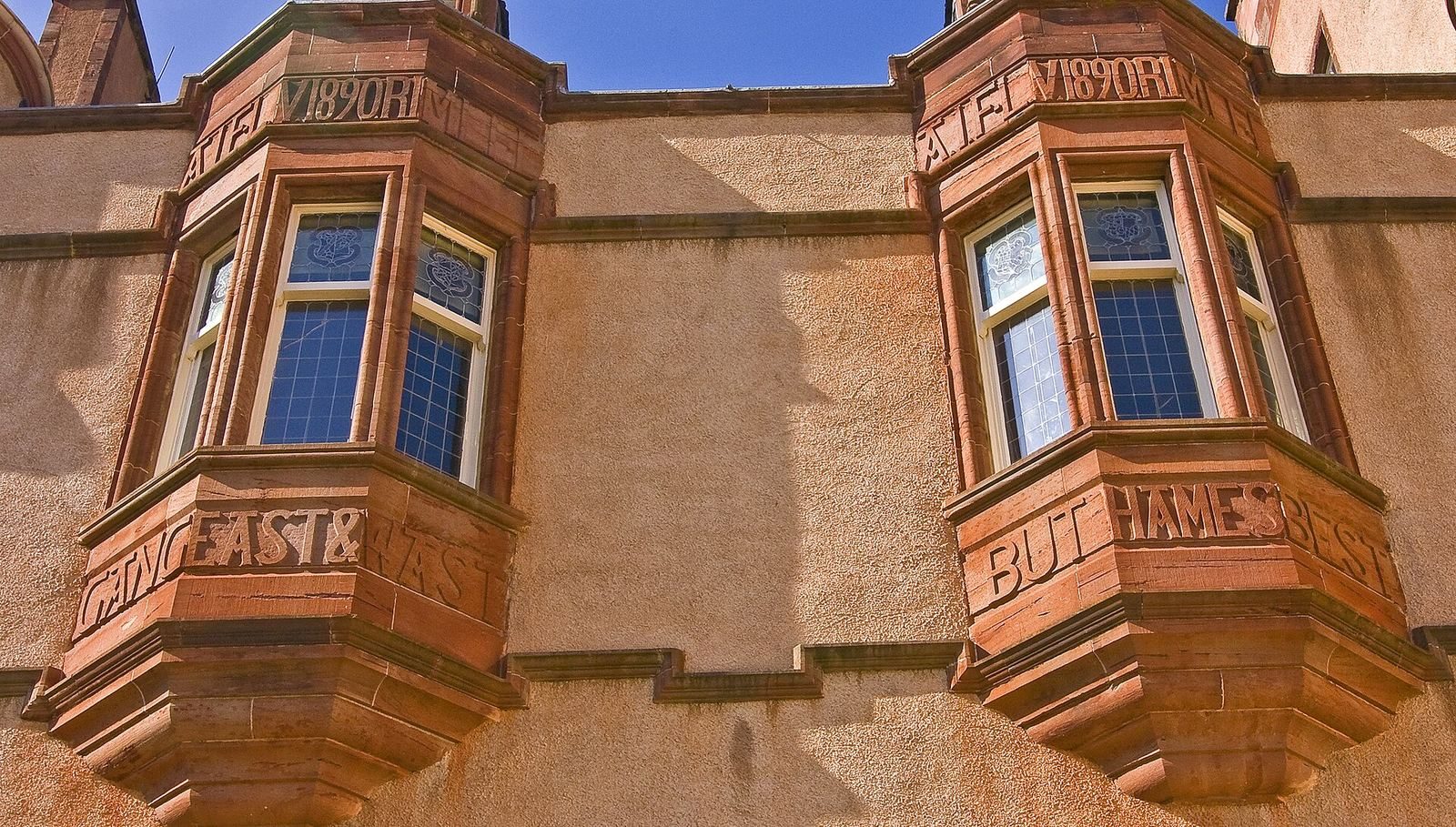
Gordon Tower was added in 1777, and Leith Tower was built in 1890. Together with the earlier towers, these additions show how successive families and owners altered the castle over several centuries rather than leaving it as a single-period structure.
Interior collections and gardens
Castle interiors
The stronghold contains a long wheel stair, original arms and armour, and a portrait collection that includes works by Henry Raeburn, Pompeo Batoni, and Thomas Gainsborough. A reputed secret room lies in the south-west part of the castle and is traditionally required to remain locked. Its possible connection with the bedroom where the woman’s skeleton was reportedly found is uncertain.
Walled gardens and lake
A walled garden lies east of the castle and is used to cultivate Scottish fruit varieties. Two further walled gardens stand closer to the castle on its west and south sides. The western garden appears on an estate plan of 1768. The grounds are also associated with Fyvie Lake, which adjoins the castle landscape.
Objects and traditional features
Weeping Stone
One of the three stones associated with the Curse of the Weeping Stones is displayed in the Charter Room. Tradition says that the other two stones have not been found.
Bedroom wall and bloodstain
The woman’s skeleton was reportedly discovered within a bedroom wall. Tradition holds that it was temporarily buried in the castle cemetery and later returned to the wall. An indelible bloodstain is also associated with Fyvie’s local ghost traditions.