Castello di Rossino: A Medieval Castle and Commercial Center in Italy


Site at a Glance
- Rating
- 4.7
- Popularity
- Low
- Country
- Italy
- Primary era
- Medieval
- External website
- Open
- Eras represented
- Medieval
- Civilizations
- Holy Roman Empire
- Site type
- Military
- Remains
- Castle
On this page12 sections
History
Castello di Rossino is a medieval castle in Italy, associated with Calolziocorte in Lombardy and built on a hill whose military importance began in the Roman period. A Roman garrison monitored the road between Bergomum and Comum, the municipalities now known as Bergamo and Como. The route crossed the Adda by a stone bridge between the areas of present-day Olginate and Calolziocorte, then passed through Rossino toward Lorentino to avoid the river marshes. The garrison controlled the surrounding territory and collected tolls from movement along the road.
Roman foundations and medieval expansion
Rossino grew as a settlement during the Early Middle Ages. In the fifth century, the church of San Lorenzo was built there and became the first Christian church in the Valle San Martino. The Roman military position continued in use and was probably enlarged in the eleventh century by the Lombard-origin da Prezzate family, whose possessions included areas around the Bergamo island, Pontida, and Foppenico. Documents from 1192 and 1193 mention Martinus de Rusino de Prezate.
The castle enters written history in 1281, when the notary Viviano Gatti recorded the seizure of property belonging to Giovanni Salvioni de castro Russino, meaning Giovanni Salvioni of the castle of Rossino. By that time, Castello di Rossino formed part of the possessions of the Bergamo-based Salvioni family. The Salvioni were allied with the Benaglio family, with whom they probably shared ownership of the castle.
Factional conflict and defensive organization
During the medieval struggles for control of the Lordship of Milan, the Salvioni and Benaglio families supported the Guelph faction and the Della Torre family. Guelphs generally favored the papacy, while Ghibellines generally supported imperial authority, although local political alliances often followed regional interests. In 1274, Napo Della Torre led the conquest of the entire Valle San Martino by the Della Torre faction.
During the fourteenth century, the castle was incorporated into the Benaglio family’s feudal defensive system. The system was intended to resist attacks by the Ghibelline Suardi family, which was allied with the Visconti, a powerful family involved in the struggle for control of Milan. Defensive positions surrounded Castello di Rossino, while additional lookout points and a tower occupied the heights of Erve. Another tower stood on the boundary between Rossino and Lorentino and was later transformed into the bell tower of Santa Brigida.
Although the period was marked by sustained conflict, the castle suffered no major attacks. In the second half of the fourteenth century, ownership passed from the Benaglio family to their allies, the Rota family of Carenno.
Venetian rule and commercial use
In the fifteenth century, the Valle San Martino became part of the territories of the Republic of Venice. The Rota family established its wool-cloth trading activity at the castle, helping to shift the site’s role from a primarily defensive position to a commercial center for the valley.
From the fifteenth through the seventeenth century, wool, wine, chestnuts, grain, and fish were traded at Castello di Rossino. Land transactions also took place on the premises. The castle therefore remained an active place of exchange until the seventeenth century, and its commercial function helped keep it outside the later military events caused by the territorial rivalry between the Duchy of Milan and the Republic of Venice. The building is now owned by Lozzi and is designated Italian national heritage.
Remains
Courtyard and defensive structures
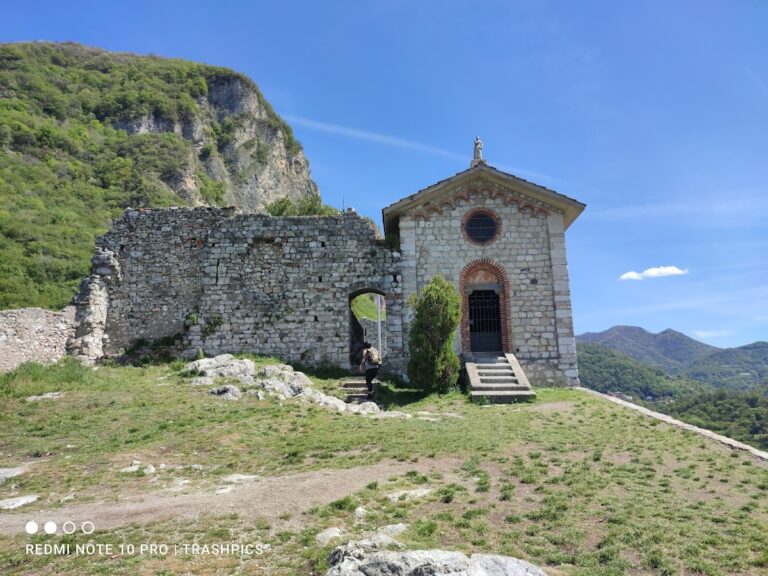
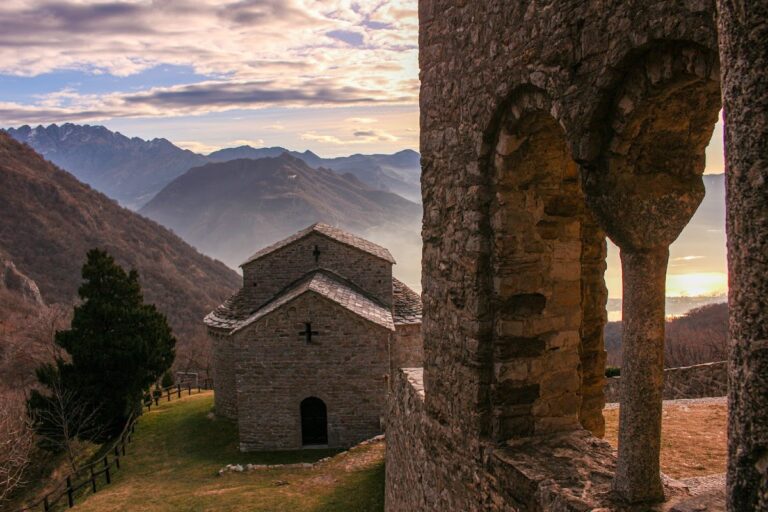
Castello di Rossino is arranged around a courtyard, with a keep standing inside the enclosed complex. The surviving masonry combines older fabric with later work, including reused materials dating from the Roman period. Rooms connected with the façade contain nineteenth-century masonry, while other parts of the structure preserve earlier construction.
The keep
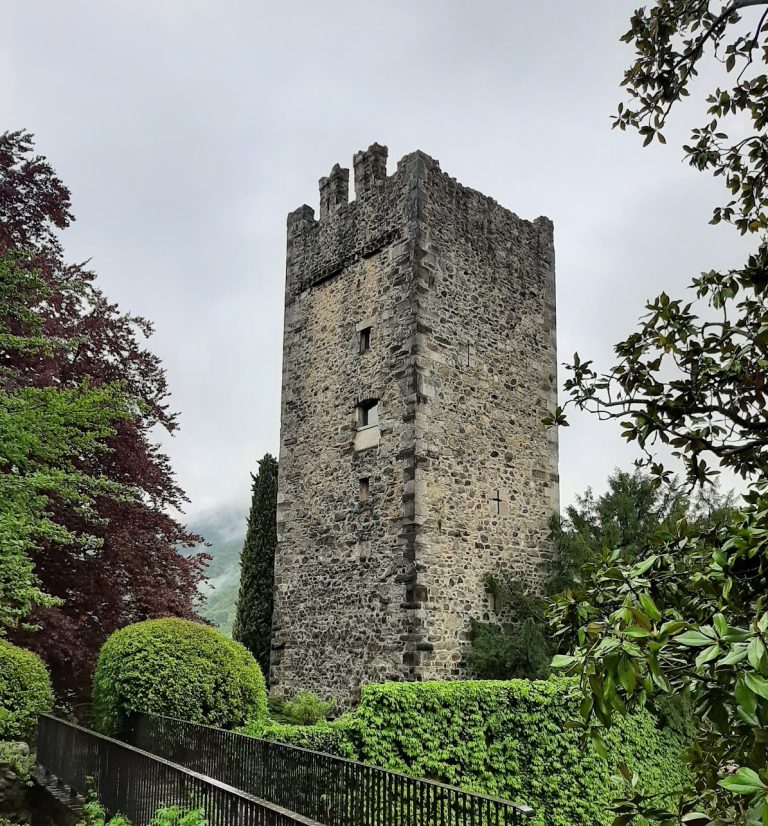
The keep, the principal fortified tower used for defense and protected accommodation, occupies the courtyard. A visible window in the tower dates from the thirteenth century and provides a surviving architectural link with the period when the castle belonged to the Salvioni and Benaglio sphere of power.
The towers and curtain wall
The castle probably originally possessed four towers. One was lowered and incorporated into the fortified curtain wall at the northwestern corner. Two other towers were dismantled, and their materials were reused in the construction of San Lorenzo. These alterations changed the original defensive outline while retaining portions of its fabric within later structures.
The customs house
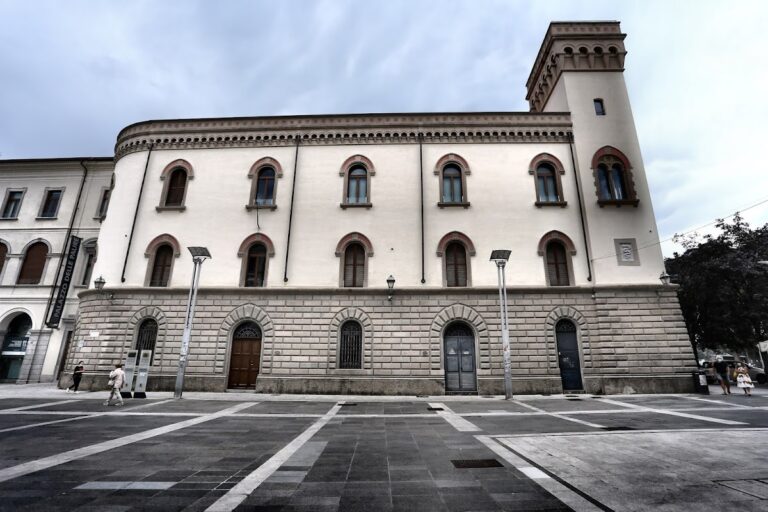
The principal palace is known as the customs house, a name reflecting its later role in collecting duties on goods or movement across a political boundary. It retains most of its original structure, including an entrance portal and two windows used in the modern period to collect duties from merchants crossing the frontier between the Duchy of Milan and the Republic of Venice. The façade-related rooms have nineteenth-century masonry, while other sections preserve older material and Roman-period reused stone.
Underground passages
Popular tradition associates the castle with underground passages extending along two main routes. Twentieth-century investigations and discoveries established the existence of some of these passages. They were built in masonry and were high enough for people to walk upright. Traps protected them, including deep shafts that could remain invisible in darkness. Later infilling, barriers, incorporation into buildings, and connections with water-supply and sewage networks fragmented the routes and compromised their original structure.
Route toward Piazza Regazzoni
One passage route has been reconstructed with reasonable precision from the castle through the settlement of Calolzio to Piazza Regazzoni, about 0.5 kilometers away in a straight line. The square was the site of the Benaglio family’s consorteria, an association of related families or local elites that exercised collective political or territorial influence. From there, the route continued for a short distance toward the church of San Martino.
A branch of this route reached the vicinity of the Buliga stream at La Ca’, a locality inhabited by the twelfth century. Beyond the stream, another passage continued toward Corte.
Route toward Somasca
The longer route toward the castle of Somasca survives in more fragmentary form. Its first identified section ran from Rossino to Tovo on the Gallavesa stream, where it divided toward the Malanotte mill and toward the cellars of a house several dozen metres farther downstream. After the stream was crossed by a wooden bridge, a further passage probably began at Folla and continued in a straight line toward the Sanctuary of San Girolamo Emiliani at Somasca.
The passages resumed near the seventh chapel of the Sacred Mountain of Somasca, a devotional complex organized around chapels associated with the veneration of San Girolamo Emiliani. From that point, one branch led toward Vercurago, near the church of Saints Gervasius and Protasius, while another climbed toward the castle of Somasca.