Castle of the Unnamed: A Frontier Fortress in Vercurago, Italy


Site at a Glance
- Rating
- 4.5
- Popularity
- Medium
- Country
- Italy
- Primary era
- Medieval
- External website
- Open
- Eras represented
- Iron Age, Medieval, Early Modern, Modern
- Civilizations
- Holy Roman Empire, Venetian
- Site type
- Military
- Remains
- Castle
On this page17 sections
History
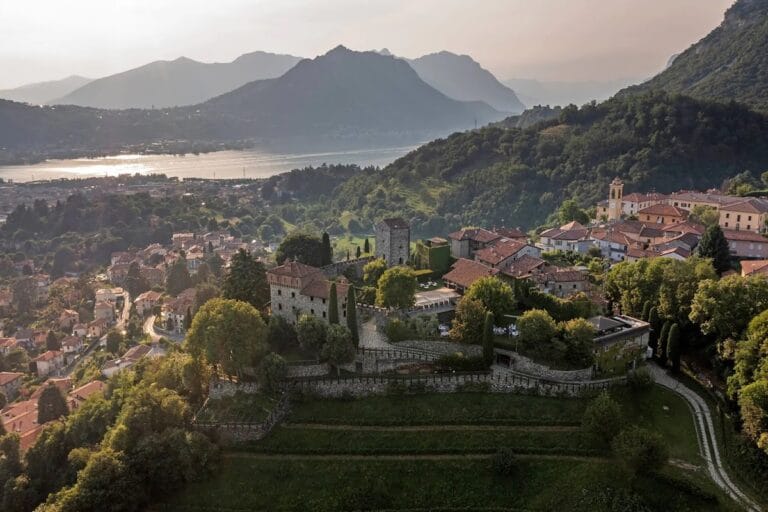
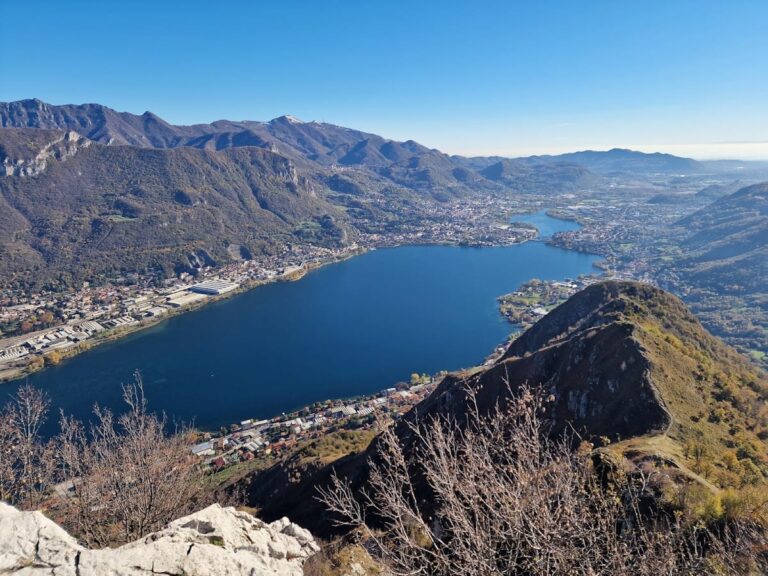
Castle of the Unnamed is a historic fortification in Italy, on the Tremasasso outcrop between Lecco and Vercurago. Its origins probably reach into the early medieval period, while its documented construction belongs to the thirteenth century. The site stands on an elevated limestone height whose position controlled the Adda, the Garlate and Olginate lake basins, the southern end of Lake Como, and the narrow passage between the lakes.
Iron Age and Roman setting
Tremasasso had already been inhabited during the Early Iron Age by a settlement of the Golasecca culture, an Iron Age society of northern Italy. Occupation continued between the ninth and fifth centuries BC. From this height, communities could oversee routes toward Valsassina, the Upper Lake Como region, Valtellina, and the Alpine passes, as well as the waterways and passages below.
Excavations in 1988 identified earlier occupation on the outcrop. During the Roman period, the position also overlooked the Via Speluca and the road between Bergomum and Comum. A Roman watchtower and military post near the later fortress are considered plausible, but their existence has not been proved.
Medieval frontier and the Benaglio fortress
During the Lombard period, the Adda served as a natural boundary between Austrasia and Neustria, while the surrounding territory formed a royal military district. A defensive structure may have occupied the later castle site in the early medieval period, although this remains uncertain. Medieval boundary arrangements placed the site near the southern limit of Lecco and the northern limit of Valle San Martino.
An agreement of 1167 prohibited the construction of new castles and towers along the Adda as far as the “end of Lecco,” a phrase suggesting that the passage may already have been militarized. In the thirteenth century, Bergamo likewise defined the northern edge of its contado, the territory governed beyond the city, at the Lecco passage. In the late twelfth or early thirteenth century, Lecco fortified its frontier with a wall at the narrow passage, although the city eventually submitted to Milan in 1252.
During the thirteenth century, the fortress belonged to the Benaglio family, vassals of the Della Torre rulers of Milan. The Della Torre and Visconti were rival families competing for control of Milan and its surrounding lands, and the Benaglio remained aligned with the Guelph faction, which generally supported papal authority, during their struggle with the Visconti and their Ghibelline allies.
Filippo Benaglio and forces from Como briefly recovered Lecco from the Visconti in 1282. The fortress appears explicitly in the Peace of Lomazzo of 1286 as the “small fortress of Lecco.” It remained in Benaglio hands at least until 1296, when Matteo I Visconti destroyed Lecco after taking it back from the Della Torre.
Customs post and renewed military use
The fortress continued to be drawn into the Guelph and Ghibelline conflicts of the fourteenth century. By the second half of that century, it had partly lost its military role and had been adapted as a customs post. In 1367, control was assigned to Bonino de Mussis of Crema. A castellano, the official responsible for a fortress and its garrison, and five soldiers were recorded there in 1416 under Pandolfo III Malatesta, who controlled Lecco and parts of eastern Lombardy from 1404 to 1418.
The Wars in Lombardy, a series of conflicts involving Milan, Venice, and their allies, restored the fortress’s military importance. In 1426, Valle San Martino voluntarily submitted to Venice. The fortress then served as a base for Venetian expansion toward the Upper Lake Como region. It was called the Rocca of Vercurago and was reinforced and occupied by Venetian castellani in 1431 and 1432.
Control shifted between Milan and Venice in 1440 and 1441. The fortress supported Venice’s attempt to conquer Lecco in 1447 and resisted a siege led by Bartolomeo Colleoni during the winter of 1453. After Pagnone de Locadello became castellano in 1454, the Peace of Lodi transferred the fortress from the Sforza-controlled Duchy of Milan to Venice.
After the peace, Colleoni’s garrison occupied the stronghold of Vercurago. It functioned as a frontier position and as a base for raids toward the Upper Lake Como region. In 1479, it was placed on alert and supplied with ammunition during a Benaglio-backed protest in Lecco supporting Venice.
Destruction and religious transformation
On 15 April 1509, during the War of the League of Cambrai, a coalition formed against Venice, French and Brianza troops led by Carlo II d’Amboise destroyed much of the castle. The stated pretext was that its already damaged walls endangered the settlement below. A customs post was later established among the ruins, while local inhabitants removed building material and substantially changed the original complex.
Battista Medici organized an attempted restoration in 1529, but the Venetian army prevented it. After Milanese control was consolidated in the sixteenth century, Saint Jerome Emiliani used the site in 1534 for an orphanage, a grammar school, and an institution combining study with agricultural work, bookbinding, and turning. He also established facilities associated with the Congregation of the Regular Clerics of Somasca, the Catholic order connected with his work.
The castle remained within a disputed frontier between Milan and Venice. Boundary markers divided the complex and its surroundings between the two states. The surviving castle remains, the Malanotte tavern, and the road from Chiuso belonged to Milan, while parts of the meadow, the slope above the sanctuary, the hermitage area, the Holy Stairway, and approaches from those places belonged to Venice.
The boundary was clarified during the sixteenth century. It extended from an embankment in Lake Garlate toward Somasca along two walls approximately 250 paces apart. Venetian barriers could close the frontier quickly when epidemics threatened. From the sixteenth to the eighteenth century, the boundary was also associated with disputes, shootings, deaths, injuries, smuggling, and the movement of criminals across the frontier.
Later destruction and reconstruction
By the seventeenth century, the fortress could no longer serve military purposes, and an iron cross stood on its principal tower. The Limonta family of Vercurago transferred the castle to the Somascan Fathers on 26 October 1628. The complex was destroyed again in 1799 during Alexander Suvorov’s Italian campaign, part of the war involving Napoleonic and Austrian forces.
In 1802, Napoleon merged Somasca and Vercurago into one municipality and assigned the fortress to the Bergamo district and Diocese of Bergamo. The Somascan Fathers partially reconstructed the complex toward the end of the nineteenth century. Antonio Piccinelli rebuilt the Chapel of Sant’Ambrogio in 1895, reconstructed the principal tower in 1897 and 1898, and created the present access stairway in 1898 along the traces of a medieval staircase.
The present complex forms part of the Sacro Monte of Somasca, a Catholic devotional landscape of chapels and sacred places associated with Saint Jerome Emiliani. The tower became its eleventh chapel between 1900 and 1902, commemorating a miracle attributed to the saint. A permanent exhibition, The Rocca of the Unnamed between Landscape, History and Literature, has occupied the castle since 2017, and restoration work took place in December 2019. The castle has Italian national heritage status.
The literary tradition
Local tradition connects the Rocca of Vercurago with the residence of the Unnamed in The Betrothed, the nineteenth-century historical novel by Alessandro Manzoni, whose story is largely set around Lecco. The attribution is recorded at least from 1830. Manzoni’s description does not correspond directly to a single real castle, but similarities in landscape and setting leave open the possibility that the Rocca contributed to his conception of the fictional residence.
Remains
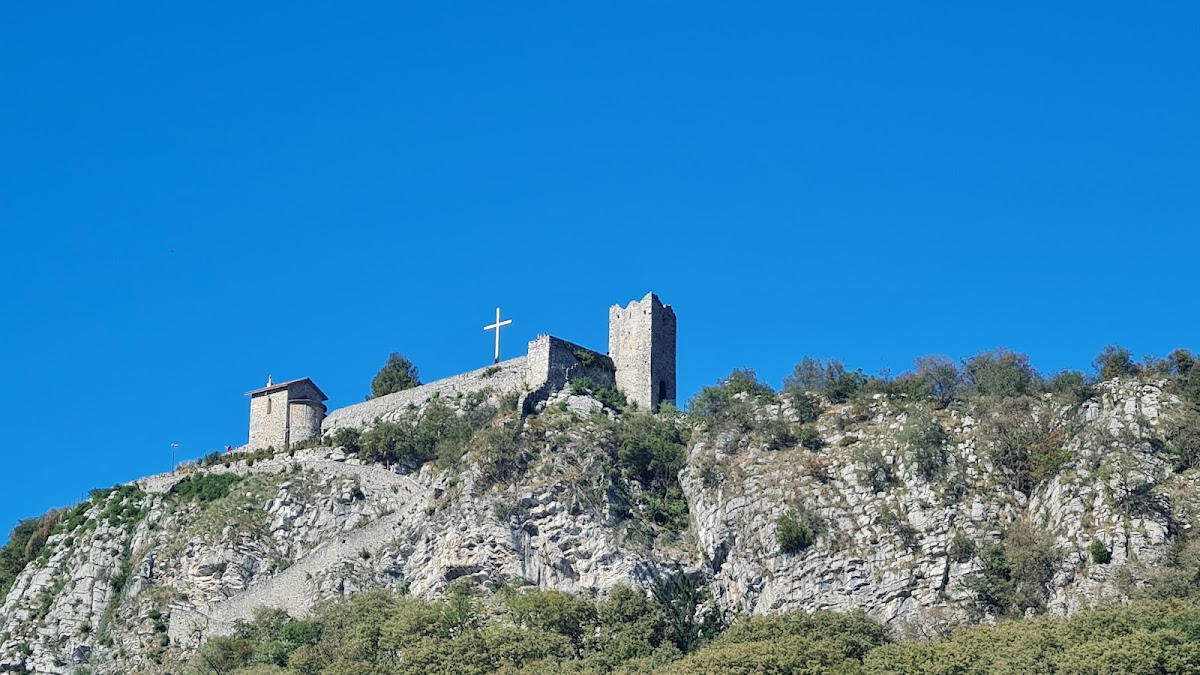
The surviving complex occupies the summit of Tremasasso, a limestone height rising about 200 metres above the surrounding ground at the foot of Mount Magnodeno. The outcrop projects toward the lake and creates a narrow passage between the rock and the water. The present remains combine archaeological traces of the earlier settlement, fragments of the medieval fortification, reconstructed towers and chapels, boundary features, and routes shaped by the religious complex of Somasca.
Early settlement and approach
Iron Age settlement
Archaeological work on Tremasasso produced common pottery fragments dating mainly from the Iron Age. Some pieces date as early as the eleventh century BC and are associated with the Proto-Golasecchian culture. Stone foundations were also uncovered, although later recovery of the stones for the fortress damaged the earlier settlement. Fired-clay fragments indicate that some prehistoric houses had stone foundations and walls made from reed lattice coated with clay. An Attic ceramic fragment from the fifth century BC points to contact with wider exchange networks.
Stairway and boundary marker
From La Valletta, the approach follows a rock-cut staircase of 150 steps. Antonio Piccinelli built it in 1898 along the traces of a medieval stairway. An older route, the Via di Sass, takes a different line and bypasses the Sacro Monte of Somasca.
An eighteenth-century boundary marker stands in the entrance meadow. It formerly marked the frontier between Venice and the Duchy of Milan and now indicates the municipal boundary between Vercurago and Lecco. The former frontier works included an embankment in Lake Garlate and two walls approximately 250 paces apart, extending toward the Rocca of Somasca. Venetian barriers were designed to close the passage rapidly when epidemics threatened.
Entrance chapel and fortress walls
Chapel of Sant’Ambrogio
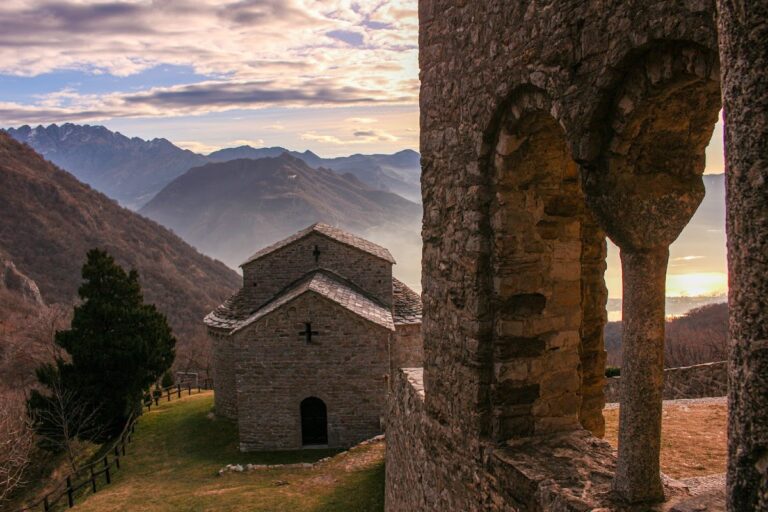
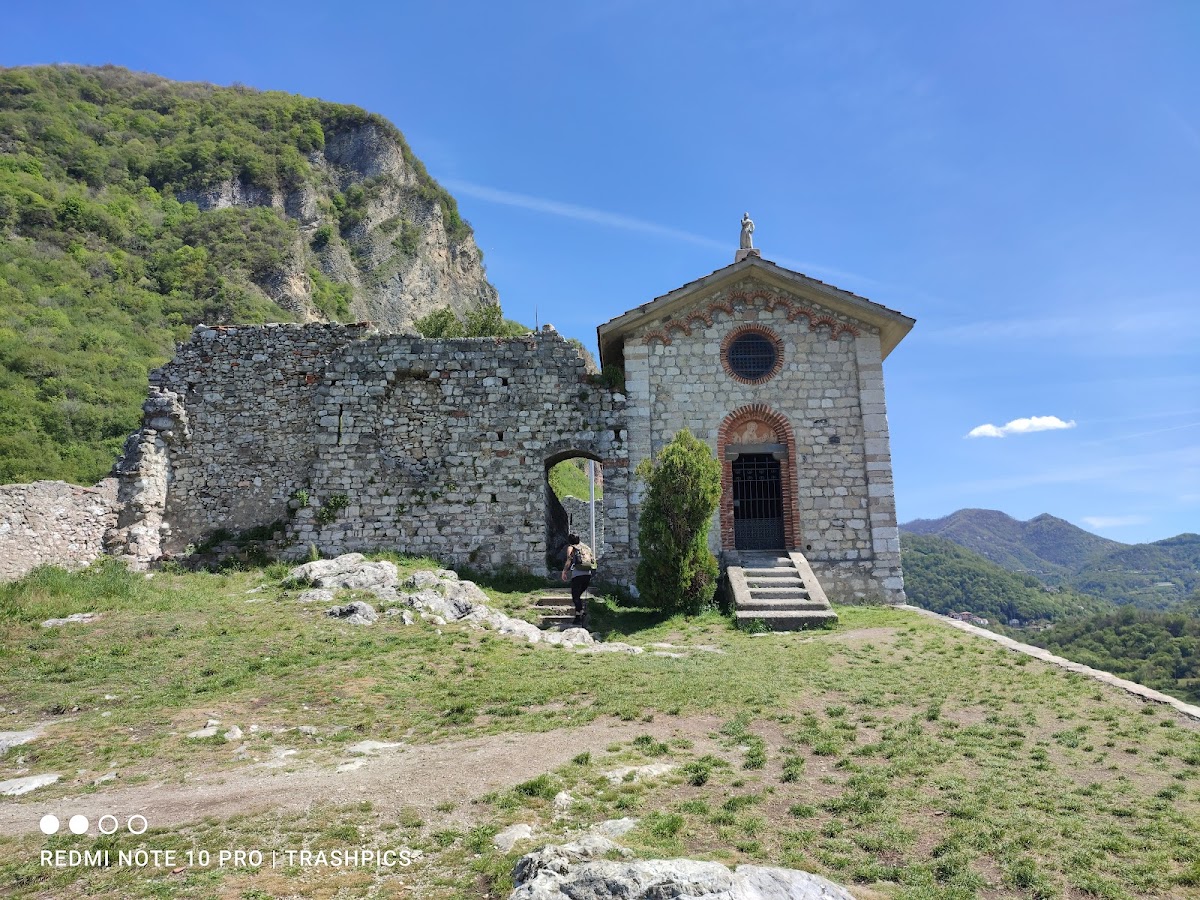
The entrance includes the Chapel of Sant’Ambrogio and a partly original wall along the castle’s left perimeter. The wall carries scars from the cannon bombardment of 1799. The chapel is medieval, with a first written notice dating from 1339, and was probably built to commemorate Azzone Visconti’s victory at the Battle of Parabiago. Saint Jerome Emiliani and his companions restored it in the sixteenth century with stone taken from the fortress, and in 1534 they began constructing a water cistern beneath its floor.
The chapel’s foundations were rediscovered in 1892, and reconstruction was completed and blessed on 8 September 1895. The building is a rectangular Neo-Romanesque structure ending in an apse, a semicircular sanctuary end. Its entrance has an arch beneath a fresco of the Madonna, an iron grille, and six steps. A circular window and ten decorative brick arches enliven the facade. Exposed stonework remains visible inside, while the apse contains two frescoes painted by Antonio Sibella in 1895, with Saint Ambrose enthroned below Saint Jerome Emiliani.
The stone walls support a trussed roof carrying a concrete statue of Saint Jerome Emiliani. On the right side hangs the bell Ambrogia, cast by the Barigozzi foundry of Milan on 9 November 1902. After periods of abandonment and damage during the Guelph and Ghibelline conflicts, the chapel was restored again in the 1970s. It is now used for occasional services.
Reconstructed towers and devotional features
Chapel of San Girolamo
The Chapel of San Girolamo occupies a reconstructed tower on the rear wall of the complex. It is the eleventh chapel of the Sacro Monte of Somasca. Antonio Piccinelli rebuilt the tower and a surrounding wall approximately 1.10 metres high in 1897.
Principal tower
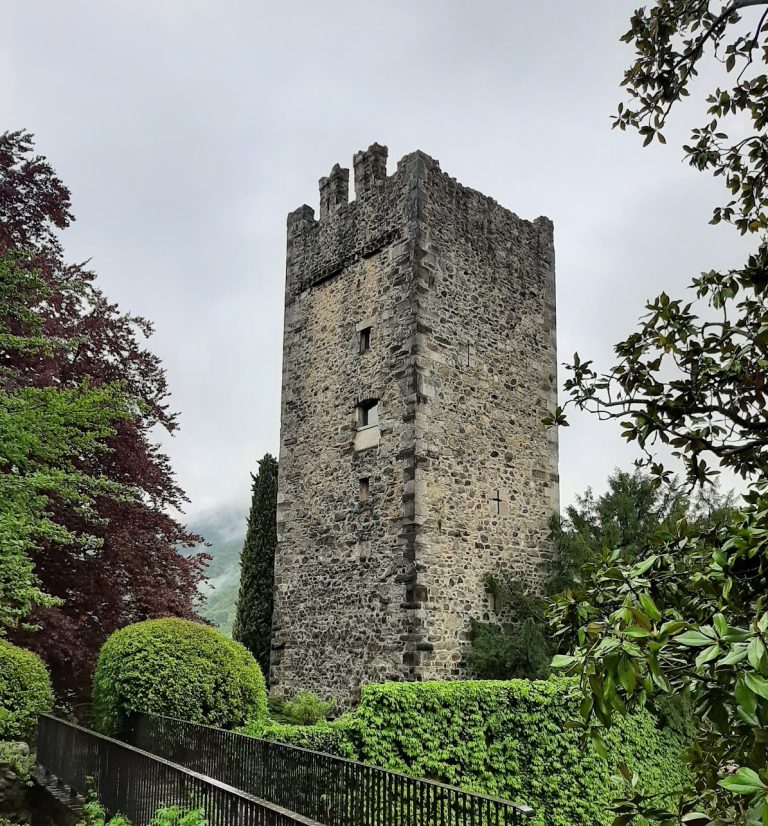
The principal tower was reconstructed after its foundations were found beneath rubble and vegetation. Work began with a mass on 7 December 1897. Local stone was used, and the tower was raised by 8 metres while being given a deliberately partly ruined Neo-Gothic appearance. It was inaugurated on 15 December 1898.
In 1900, the tower was adapted as a chapel. Concrete statues made by Eugenio Goglio on 6 December 1901 represent the multiplication of the loaves attributed to Saint Jerome Emiliani at the castle during the winter of 1536. Goglio also painted the statues after they were installed. The chapel was inaugurated and blessed on 16 November 1902.
Iron cross
A wooden cross stood on an elevation to the left of the castle by the fifteenth century, where residents of Vercurago held processions. The Somascan Fathers erected another wooden crucifix there in 1650, and it was replaced several times, including by a large larch-wood cross in 1847. The present large iron cross was probably installed in 1889 or 1902 through the intervention of Father Michele Rosati. It received numerous bulbs in 1949, was dedicated by Vercurago’s Alpine troops to wartime chaplain Giovanni Battista Pigato in 1979, and was given new floodlighting in 1987.