Abbey of San Pietro al Monte: A Benedictine Romanesque Complex in Italy


Site at a Glance
- Rating
- 4.8
- Popularity
- Low
- Country
- Italy
- Primary era
- Medieval
- External website
- Open
- Eras represented
- Classical, Medieval, Early Modern
- Civilizations
- Holy Roman Empire, Lombard
- Site type
- Religious
- Remains
- Monastery
On this page12 sections
History
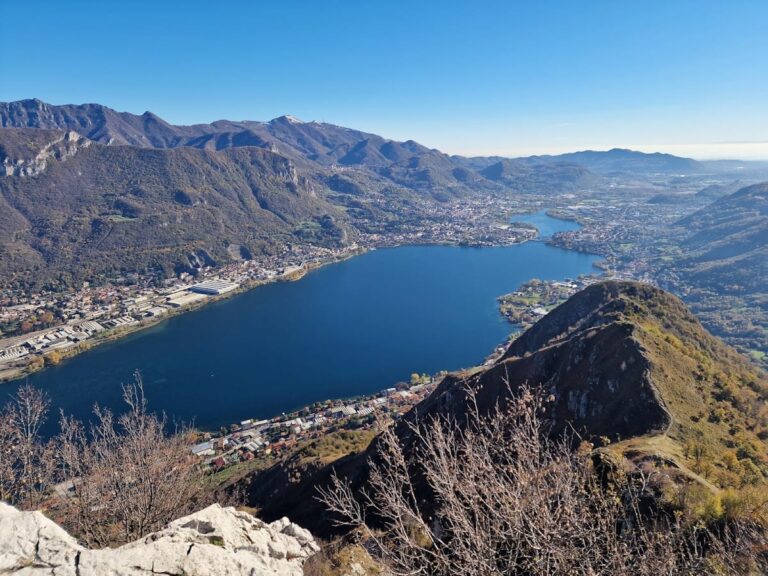
The Abbey of San Pietro al Monte is a former Benedictine complex in Italy, standing in the Valle dell’Oro above Civate in the province of Lecco. Its origins reach back to a small monastic community or hermitage traditionally founded in the eighth century, while the basilica took shape through early medieval and Romanesque transformations. The surviving decoration, produced mainly from the late eleventh to the early twelfth century, makes the complex an important testimony of Lombard Romanesque art.
Early monastic origins
Tradition attributes the foundation of the first community to Desiderius, the last king of the Lombards, whose kingdom in northern and central Italy was conquered by Charlemagne in 774. The story connects the foundation with the miraculous healing of Desiderius’s son Adelchis. Water from a spring near the church was believed to have restored the boy’s sight, although the precise date of this event remains uncertain.
Physical traces indicate that the site had an earlier presence before the mature medieval complex. Remains of a tower, chapels, columns, and walls point to activity between the fifth and eighth centuries. A ninth-century document names Abbot Leutgario and a Benedictine community associated with a Swiss monastery, providing evidence for the organization of monastic life at San Pietro during the early medieval period.
Expansion and Romanesque transformation
The first basilica probably belonged to the eighth or ninth century. During the eleventh century, it was substantially enlarged, its original east-west orientation was reversed, and its interior received an extensive decorative program. Arnulf III, Archbishop of Milan, spent his final years at San Pietro and asked to be buried there in 1097. His presence probably helped promote the transformation of the church. Anselm III, Arnulf’s predecessor, also stayed at the monastery during periods of political turbulence in the 1080s and 1090s.
The principal frescoes and stucco reliefs were created generally from the final decades of the eleventh century through the early twelfth century. Their central subject is the final glorification of Christ and the triumph of the righteous. The imagery draws heavily on the Book of Revelation, the final book of the New Testament, whose visions include Christ’s victory, the heavenly city, angels, the dragon, and the defeat of evil.
The artists’ identities, number, and origins remain uncertain. The fresco of the Heavenly Jerusalem reflects northern European Ottonian influences, while the painter responsible for the Apocalyptic Vision understood the Byzantine artistic language of the second half of the eleventh century. Together, the paintings and stucco form a closely connected symbolic program grounded in Christian doctrine and expressed through highly abstract theological imagery.
Decline and later religious use
The monastery was destroyed in retaliation by the commune of Milan after the monks supported Emperor Frederick Barbarossa, the twelfth-century Holy Roman emperor involved in conflicts with the communes of northern Italy. The Benedictine community then moved down into the valley, leaving the mountain complex to a small group of monks who followed an eremitic, or solitary religious, way of life. After San Calocero was built at Civate, San Pietro al Monte gradually fell into ruin.
Olivetan monks, a reform branch of the Benedictine tradition, returned around the middle of the sixteenth century. They were definitively expelled in 1798 during the Cisalpine Republic, and the complex is no longer occupied by religious. The eighteenth-century cloister belongs to this later phase. A bell tower outside the church was demolished during the nineteenth century.
In 2016, the abbey was included on Italy’s Tentative List as part of a proposed cultural landscape of medieval Benedictine settlements in Italy. This modern recognition reflects the complex’s place within the wider Benedictine history of Civate, which also included the Basilica of San Calocero and the churches of San Nazaro and San Vito.
Remains
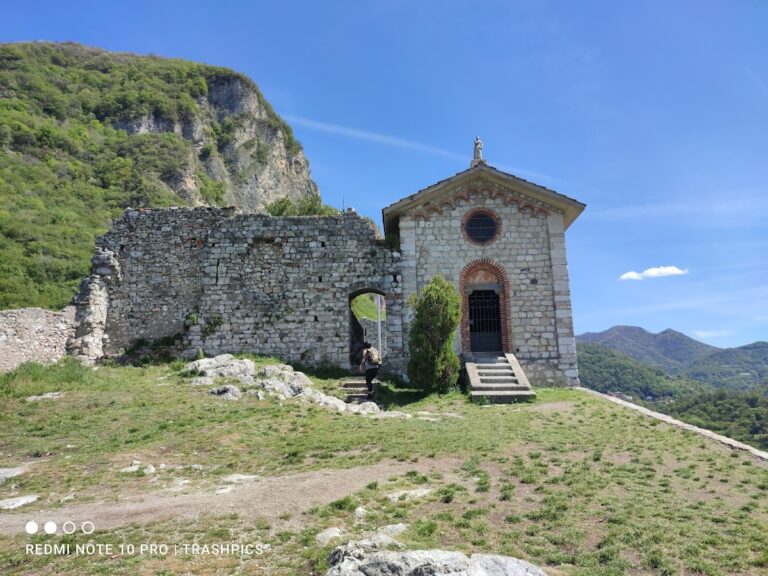
The complex stands at about 630 metres above sea level on a grassy plateau on the slopes of Monte Cornizzolo, near the junction with the wall of Monte Rai in the Valle dell’Oro. Three principal buildings survive: the Basilica of San Pietro, the small building dedicated to Saint Benedict, and the ruins of the former monastery. Two stone portals carry the Benedictine motto “Ora et labora,” traditionally expressing the balance of prayer and work.
Basilica of San Pietro
The basilica has an unusual single-nave plan with apses at opposite ends. The eleventh-century construction of a new western apse changed the earlier arrangement: the former eastern apse became the entrance area, and the church’s original east-west axis was reversed. The western apse now contains the altar and ciborium, a canopy over the altar supported by columns. At the eastern end, a pronaos, or entrance porch, includes two small chapels beside the entrance.
Entrance and atrium
An external staircase made of green serpentine and granite leads to a large semicircular atrium illuminated by paired-arched windows. The atrium has two levels, one aligned with the church and another at the level of the crypt, where pilgrims could lodge. Beyond it, an inner entrance hall is divided into three spaces by four twisted columns carrying round arches. A corridor and two lateral chapels complete the entrance arrangement.
The lateral chapels contain imagery of the angelic hierarchy on the south side and the chosen people on the north side. One associated chapel is decorated with saints and the other with angels. The entrance also contains a fresco of the Traditio Legis et Clavis, showing Christ giving the keys to Peter and the law to Paul. The lunette depicts the Bosom of Abraham, the Christian resting place of the righteous after death, while the vaults show the Heavenly Jerusalem and allegorical celestial rivers. Stucco panels between the columns depict a griffin and a chimera, symbols of evil fleeing the church.
Nave and apocalyptic decoration
The nave is a rectangular hall covered by a timber trussed roof. Above the three arches of the inner entrance hall is a large fresco based on the opening of the twelfth chapter of Revelation. A woman clothed with the sun gives birth to a male child, who is carried toward God’s throne. The archangel Michael and his angels attack a great dragon with their lances and cast it down to earth.
The eastern entrance wall carries the complex Apocalyptic Vision. Christ in majesty occupies the centre, surrounded by Saint Michael, angels, celestial bodies, blessed figures, and condemned souls. Another apocalyptic scene places the enthroned Christ within a stylized zigzag castle shown in an intuitive bird’s-eye view. The symbolism is extensive, and the meaning of some figures remains difficult to interpret.
Ciborium and western apse
The ciborium at the western end of the nave consists of four columns with capitals supporting stucco high-reliefs representing the four Evangelists, known collectively as the Tetramorph. Its four gabled sides show the Crucifixion, the women at Christ’s tomb, the Ascension, and the Traditio Legis et Clavis. The structure closely recalls the ciborium of the Basilica of Sant’Ambrogio in Milan.
The interior of the ciborium’s cupola is covered by a fresco of the mystical Lamb surrounded by eighteen haloed figures, ten men and eight women. Their possible relationship to the Book of Revelation remains contested. The concentration of painted and sculpted imagery makes the ciborium a central part of the basilica’s theological program.
Crypt
A staircase along the south side leads to the crypt, whose parapet carries stucco decoration. Two rows of three columns divide the space into three aisles, and the capitals are decorated with stylized vegetal forms. At the end of the central aisle stands a modest masonry altar.
Stucco scenes behind the altar depict the Presentation of Jesus in the Temple, the Crucifixion, and the Dormition of the Virgin, the representation of Mary’s death or falling asleep before her assumption in Christian tradition. The Crucifixion is considerably damaged. Surviving frescoes include Saint Agnes holding a torch with an attached oil container, possibly referring to the parable of the wise and foolish virgins, together with representations of the wise virgins.
Three stucco slabs on the stair parapet show animals within intertwined scrolls and vine tendrils. One depicts a griffin and a lion, another shows two lions, and the third shows two lions changing into fish. Their symbolism probably refers to the human path toward salvation.
Saint Benedict building
The small building dedicated to Saint Benedict has three apses and a square forebuilding. Its southern apse was probably remodelled. Although it is sometimes called a baptistery, its use for baptism is considered unlikely. The building instead probably served prayer, liturgical, or funerary purposes and may originally have formed part of the Benedictine communal complex.
Above the original medieval masonry altar are three twelfth-century frescoes. They depict Saint Benedict holding a book inscribed with the words “ego sum benedictus aba(te),” Saint Andrew, and Christ blessing with the inscription “ego sum lux mundi,” accompanied by the Virgin and Saint John the Baptist. The building’s present timber-trussed roof probably replaced an earlier cross vault.
Monastery ruins and decorative remains
The former monastery survives only in ruins, alongside the later eighteenth-century cloister. These remains belong to the wider physical organization of a complex that combined the basilica, subsidiary religious buildings, and monastic accommodation on the mountain plateau. The surviving Romanesque frescoes and stucco reliefs preserve an exceptionally rich and complex visual language, in which biblical visions, angelic orders, scenes of salvation, and symbolic animals are linked into a unified program.