Strahlenburg: A Medieval Hilltop Castle Ruin in Germany


Site at a Glance
- Rating
- 4.4
- Popularity
- Low
- Country
- Germany
- Primary era
- Medieval
- Eras represented
- Medieval
- Civilizations
- Holy Roman Empire
- Site type
- Military
- Remains
- Castle
On this page11 sections
History
Strahlenburg is a medieval hilltop castle ruin above Schriesheim in Germany, begun around 1235 by Conrad I of Strahlenberg as the ancestral seat of the Strahlenberg family. Also known as Schloss Strahlenberg or Strahlenberg, it occupied a strategic position above the town and became closely connected with the family’s regional authority. Conrad was first recorded as Schriesheim’s vogt in 1240, a medieval administrative or judicial official acting for a territorial lord or institution.
Foundation and family power
The castle was held as a fief of Ellwangen Abbey, a Benedictine imperial abbey in southwestern Germany. A dispute between Conrad I and the abbey over the castle’s territorial status ended with Conrad recognizing himself as a beneficiary of the monastery. The original defensive tower and inner buildings belong to the first construction phase, while the main residential building, the palas, was probably added in the fourteenth century.
Conrad I’s son Eberhard II became bishop of Worms in 1291. Conrad’s successors, Conrad II and Conrad III, used this position to strengthen and consolidate the family’s regional influence. Financial pressure later altered the castle’s ownership history. In 1329, Rennewart of Strahlenberg pledged Strahlenburg and Schriesheim to Hartmut of Cronberg. Hartmut carried out extensive alterations and expansions before his death in 1334.
Transfers and Palatinate rule
A Cronberg heir proposed selling Strahlenburg to Mainz in 1346, but the transaction did not take place because Rennewart raised the money required to redeem the pledge. In 1347, he sold the castle to Elector Rupert I of the Palatinate. After Rupert died in 1410, Strahlenburg, Schriesheim, and the town’s suburb passed to his youngest son, Otto of Palatinate-Mosbach.
Otto pledged them to his brother Stephen of Palatinate-Simmern-Zweibrücken in 1448. Stephen transferred the pledge to his son, Count Palatine Ludwig I of Veldenz, in 1450. By 1468, the counts of Veldenz held the castle under Ludwig I.
The siege of 1470 and later destruction
Ludwig I’s conflicts with his cousin, Elector Frederick I of the Palatinate, brought war to Strahlenburg. Frederick’s siege of the castle and Schriesheim began on 6 May 1470. Simon of Balshofen, the Electoral Palatinate bailiff of Heidelberg, commanded the besieging force, while the artillery master Martin Merz directed the bombardment.
On 13 May, the castle and then the town were stormed. The garrison of 19 nobles and 30 infantrymen was captured. Sixteen infantrymen were drowned after breaking their oaths to Frederick I. To avoid the town being burned, its inhabitants had to pay 400 gulden and surrender their wine supplies. The town’s towers, enclosing wall, and ditches were later demolished or levelled. Under the peace settlement of 2 September 1471, Strahlenburg and Schriesheim passed to Frederick I.
The castle’s final destruction cannot be assigned with certainty to a single event. The attack of 1470 may have caused burning and severe damage, while another possibility is destruction by Hessian forces during the War of the Landshut Succession around 1504. Strahlenburg was still inhabited in 1485 and burned on 8 February 1488, apparently without military action. The historian Joannis rejected older claims that the castle had been completely demolished in 1725.
Quarrying and preservation
In 1733, official permission allowed stone from the ruin to be quarried for retaining walls protecting the surrounding vineyards. The counts of Oberndorff became hereditary lessees in 1784 and owners in 1828. They secured the surviving remains against further decay. Today, the ruin belongs to a nonprofit citizens’ foundation, while part of the former castle area accommodates the Burggasthof Strahlenburg restaurant.
Remains
Setting and construction
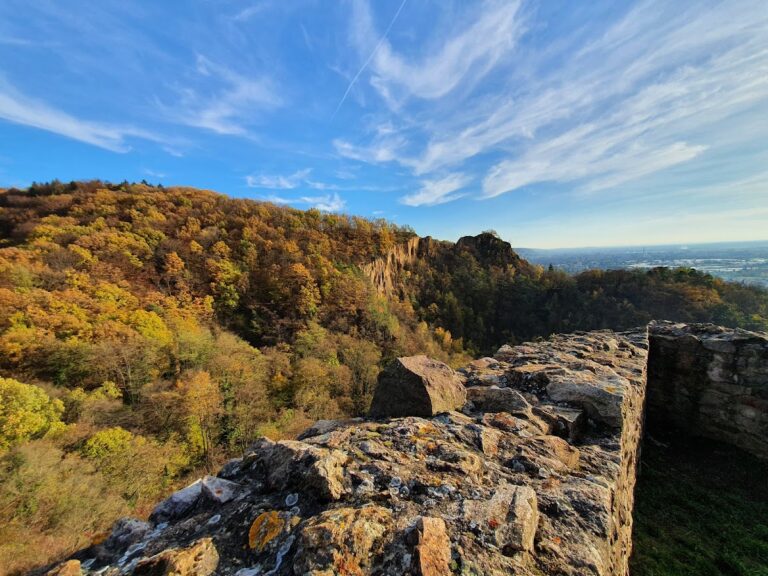
Strahlenburg stands on a flank of the Ölberg, also called Schriesheimer Schlossberg, directly above Schriesheim. The Kanzelbach valley cuts into the Odenwald beside the mountain, and its stream rises at Altenbach. The elevated site looks across much of the Upper Rhine Plain, the broad lowland along the Upper Rhine, toward settlements along the Neckar and Rhine. In clear weather, the Palatinate Forest and, in exceptionally clear conditions, the Donnersberg massif can be seen.
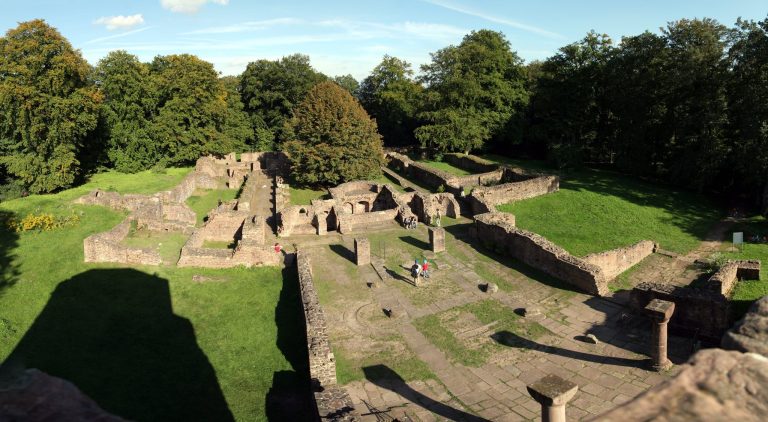
The castle was built mainly from locally available porphyry and granite, including granite taken from the rock beneath the site. Odenwald sandstone was used for the window reveals. Its enclosing defensive perimeter, or enceinte, forms an almost regular pentagon, with one point directed toward the more vulnerable mountain slope.
Surviving buildings
Bergfried
The surviving bergfried, the principal defensive tower of a medieval German castle, is a slender and very simple circular structure. It originally stood about 30 metres high and now reaches approximately 27 metres. Structural defects prevent climbing the tower.
Palas
The rectangular palas, the castle’s main residential or representative building, survives in a gutted and partly torn-open condition. Three Early Gothic windows dating from around or before 1237 remain in the building. Each has two narrow lancet openings beneath a circular upper light.
Castle complex
The Burggasthof Strahlenburg restaurant occupies part of the former castle complex. Its modern use forms part of the present arrangement of the surviving site.