Asserbo Charterhouse: A Medieval Carthusian Monastery and Fortress in Denmark


Site at a Glance
- Rating
- 4.1
- Popularity
- Low
- Country
- Denmark
- Primary era
- Medieval
- External website
- Open
- Eras represented
- Medieval
- Civilizations
- Danish
- Site type
- Military
- Remains
- Fort
On this page7 sections
History
Asserbo Charterhouse is a former Carthusian monastery and fortress in Asserbo, Denmark, founded around 1163 during the Middle Ages. The Carthusians were a Catholic monastic order whose enclosed communities combined shared worship with long periods of solitary religious practice. The site later became a monastic estate and village before drifting sands overwhelmed it, leaving ruins that were excavated in the nineteenth century.
The Carthusian foundation
Asserbo originally belonged to the Hvide family. Skjalm Hvide was the father of Asser Rig, who was the father of Absalon, bishop of Roskilde and later archbishop of Lund and primate of Denmark. The family connection helped shape the monastery’s early history, because Absalon received the first monks at Asserbo.
While in exile in France, Eskil of Lund encountered the Carthusian order in 1156 and sought to establish a Danish foundation. Eskil, a Danish church leader who served as bishop of Lund and later archbishop, asked Pierre, abbot of Celle and later abbot of Saint-Remi of Reims, to present the proposal to the order’s general chapter. He also requested that Dom Roger, whom he had met at Mont-Dieu Charterhouse, lead the new community.
French Carthusian monks arrived at Asserbo around 1162. Since Eskil was still in exile, Absalon received them at the site, which lay within his diocese. The foundation is generally dated to 1163, although the Carthusian presence began about a year earlier. The location proved unsuitable, and the short-lived monastery was abandoned in 1169. Absalon then donated Asserbo to Sorø Abbey.
Monastic estate and later abandonment
After the Carthusian community ended, Asserbo belonged to Sorø Abbey, while parts of the estate also came under Esrum Abbey. Until the end of the Middle Ages, monks of Sorø administered it as a monastic grange, meaning a farm or agricultural estate operated for a monastery. By 1248, written evidence places a small village at Asserbo, which continues under that name today.
From the fifteenth century, Asserbo was leased to various noble families. Poul Laxmand, Steward of the Realm, became its owner in 1490. Ownership subsequently passed between the Crown and noble families until the early eighteenth century. During the sixteenth and seventeenth centuries, drifting sand and advancing dunes increasingly covered the site, and the process continued into the early eighteenth century.
The sands were halted in the 1730s through the planting of Tisvilde Hegn. Asserbo was excavated and cleared from the sand in 1849, while its embankments were restored in 1972. In Carthusian annals, the foundation is sometimes called Lund Charterhouse or Lunden.
Remains
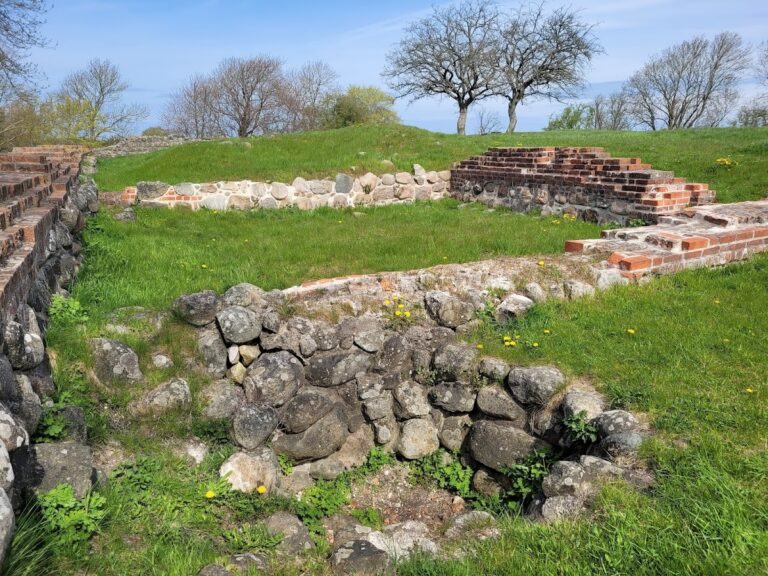
Asserbo’s surviving archaeological layout reflects a fortified monastic complex enclosed by an embankment or earthwork. The site stood amid medieval wetlands on former seabed extending west and south from the coast through the Holløse inlet toward Lake Arresø. These wet areas made approach from the south particularly difficult. Access to the enclosure was available from the north, across a drawbridge.
Buildings and enclosure
Main building and cellars
The complex included a main building, a tower with a cellar, additional cellars, and several half-timbered houses. Large bricks known as monk bricks formed the lower parts of the buildings. The main building’s cellar survives as an archaeological ruin, with its western and southern sides identified among the remains. The buildings remain in ruinous condition.
Earthwork and entrance
The enclosing earthwork forms part of the surviving layout and was restored in 1972. Together with the evidence for the northern drawbridge, it preserves the defensive boundary of the former fortress and monastery. The surrounding wetland landscape helps explain the site’s restricted approach and its physical relationship to the wider area.
Nearby sites