Capitole de Toulouse: Municipal Palace and Seat of City Government
Site at a Glance
- Popularity
- Very High
- Country
- France
- Primary era
- Early Modern
- Eras represented
- Medieval, Early Modern, Modern
- Civilizations
- French
- Site type
- Civic
- Remains
- Palace
On this page18 sections
History
Establishing a municipal seat
The Capitole de Toulouse is the municipal palace in Toulouse, France. The Capitouls, the city’s governing magistrates, decided in 1190 to create a seat for municipal government. Their 13th-century plans envisaged an administrative centre enclosed by walls, although the palace took shape through a much longer sequence of acquisitions and building projects.
The chosen site lay near the borough of Saint-Sernin, beside a disused tower in the former Gallo-Roman wall and at a distance from the count’s castle. The Capitouls acquired neighbouring land and buildings for offices, archives, a prison, meeting rooms and reception spaces. By the 14th century, the municipal complex was fortified and occupied an area roughly corresponding to today’s Capitole and Charles-de-Gaulle Square.
The municipal seat was first known as Capitulum or Capítol. In 1522, the city clerk Pierre Salmon adopted the Latin form Capitolium, drawing an association with Rome’s Capitol. For more than eight centuries, the Capitole has remained a centre of city government.
Fortification and civic conflict
Following a major fire, the Capitouls ordered an archive tower in 1525. It was intended to protect municipal records and gunpowder against a possible Spanish attack during the conflict between Francis I and Charles V, rival monarchs of France and Spain. The tower was also meant to reinforce the defences near Villeneuve Gate. Pierre de Naves and Laurent Clary built it over about four years. An outdoor wooden stairway, added in 1527, was soon lost to the weather. A building for artillery supplies was erected beside the tower in 1557 and enlarged in the early 17th century.
During the Toulouse riots of 1562, French Protestants known as Huguenots seized cannons and held the archive tower. In 1761, the tower was also the setting for the interrogation of Jean Calas, a Protestant merchant. His trial, shaped by religious prejudice, ended the following year with his execution on the wheel.
A palace and a place of royal authority
The Capitouls developed the Henri IV courtyard as a setting for displaying civic arms and portraits and asserting the standing of their office. The Parlement of Toulouse, a regional judicial and administrative institution, objected to the expense. Henry IV approved the project in exchange for a statue of himself. The courtyard later became the scene of the execution of Henri II de Montmorency, a nobleman and military leader who had rebelled against royal authority. He was beheaded there on 30 October 1632, on the orders of Cardinal Richelieu and Louis XIII.
In the 17th century, the city pursued a unified municipal palace intended to be exceptional in France. Its construction unfolded over nearly two centuries, with the principal façade designed by Guillaume Cammas and built between 1750 and 1760. The Capitouls also adapted buildings as the administration’s needs changed. A performance hall created in 1737 later gave rise to the Théâtre du Capitole opera company and the Orchestre national du Capitole de Toulouse.
Revolution, public life and preservation
During the French Revolution, the allegorical painting The Birth of Madame Royale, made by François Cammas in 1778, was destroyed. A large ceremonial hall dating to 1552 was demolished in 1808 for Napoleon I’s visit. In 1871, revolutionary guardsmen inspired by the Paris Commune, a revolutionary municipal government in Paris, occupied the Capitole while attempting to establish a commune in Toulouse. Their insurrection lasted only a few days, and they left the building peacefully on 27 March.
The archive tower was restored by Eugène Viollet-le-Duc between 1873 and 1887. Later work repaired the façades and coats of arms, with major campaigns in 1974, 1987 and 1994; work in 1988 also revealed the natural colours of the façade’s building materials. The Capitole’s principal features received historic-monument protection in 1840 and 1911. The 1840 measure was France’s first such protection. Further parts of the complex, including important public rooms, received protection in 1995 and 2021.
The Jeux Floraux, poetry awards associated with Toulouse’s literary tradition, trace their formal beginnings to 3 May 1324. On that date, seven troubadours of the Gay Saber company awarded Arnaut Vidal de Castelnaudary a prize for a poem to the Virgin. The annual awards ceremony is held on 3 May in the Salle des Illustres, with flowered trophies brought in procession from the Basilica of the Daurade. Today the Capitole houses Toulouse City Hall and the Théâtre du Capitole opera house.
Remains
Exterior and courtyard
Main façade
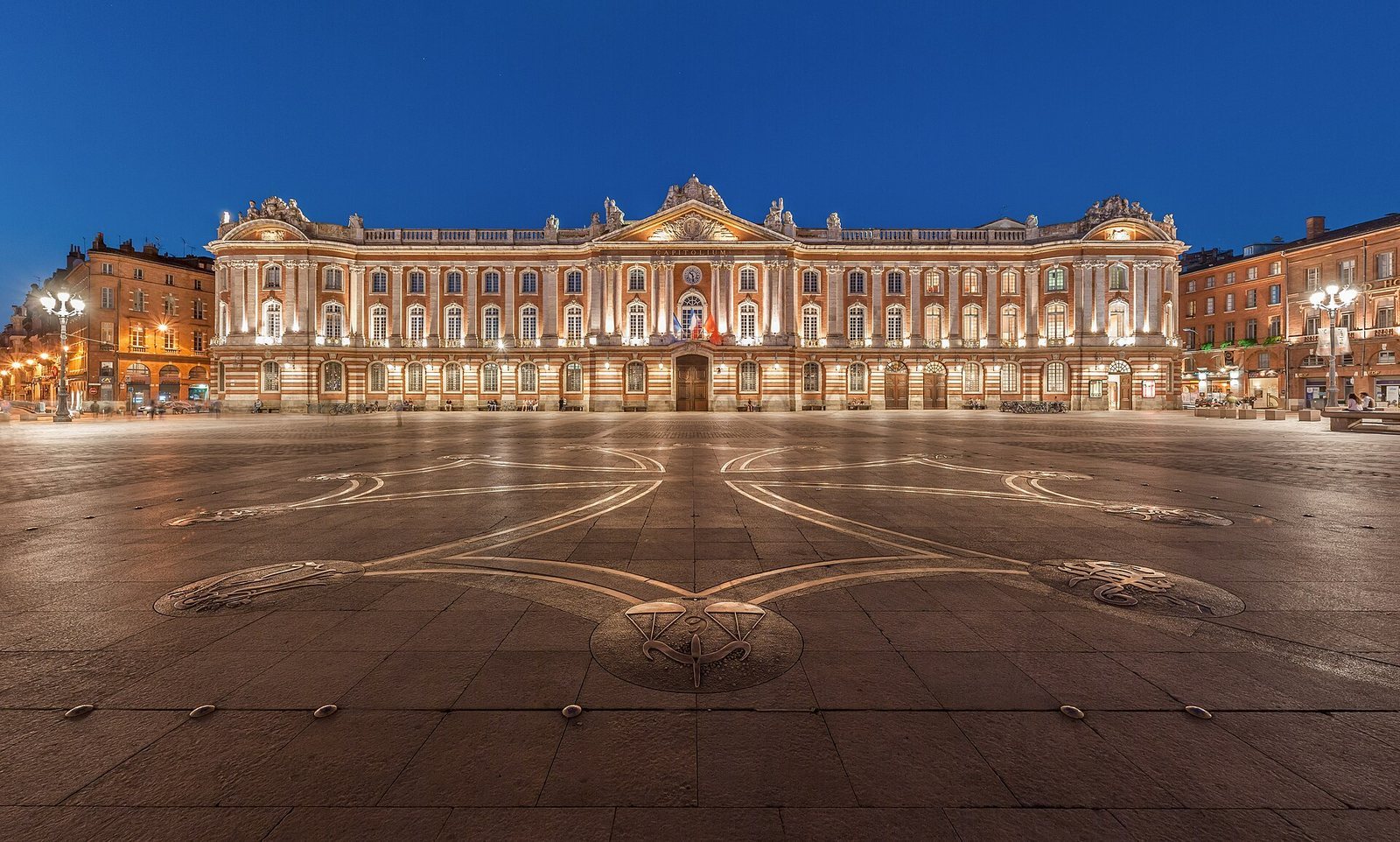
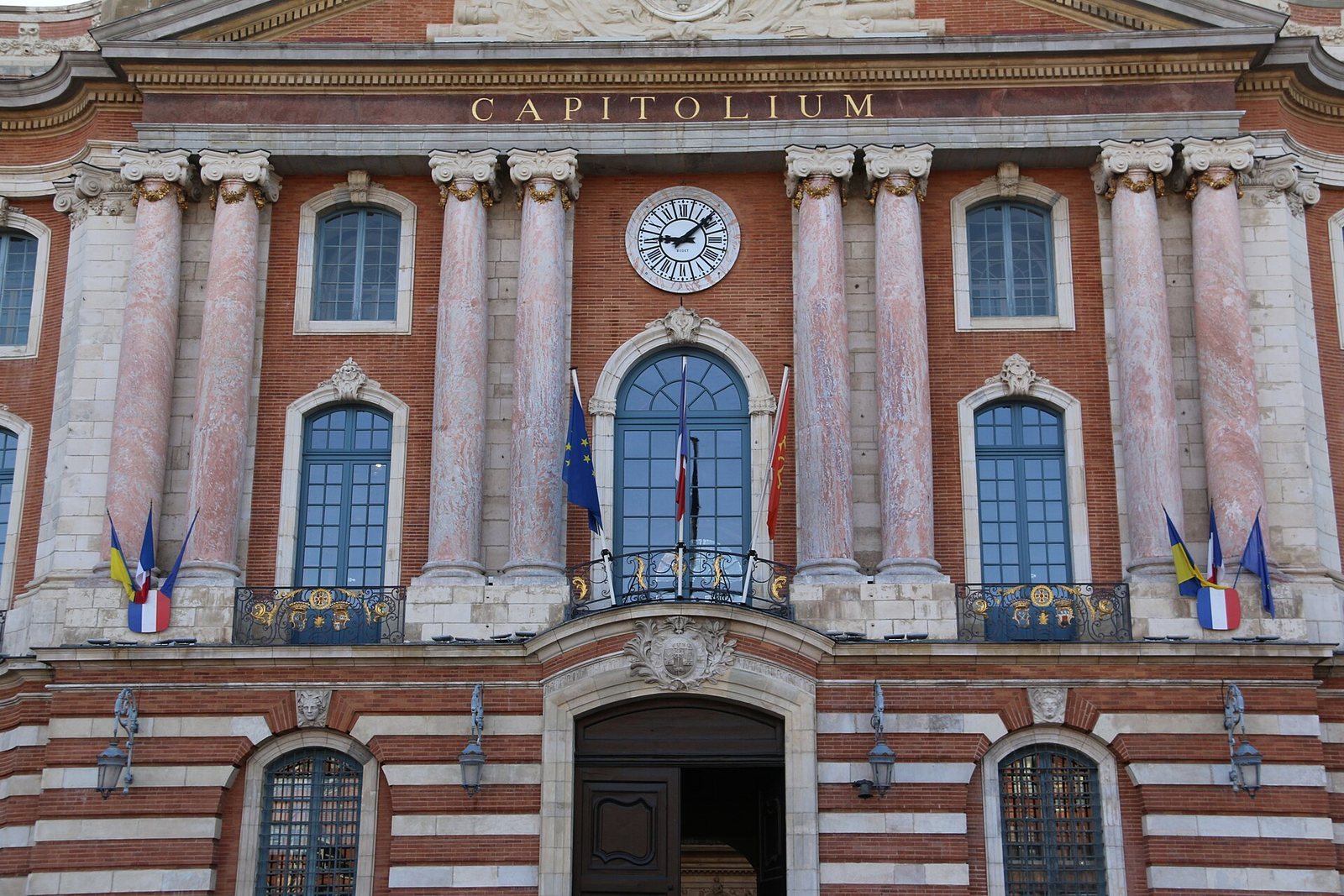
The principal façade is about 135 metres long and combines limestone and brick above a base of grey to grey-beige sandstone from the Carcassonne molasse, a regional building stone. Two storeys rise above the base, divided into three projecting sections with triangular pediments. A horizontal structure above the columns supports an upper attic section. The central projection has eight Corinthian columns, whose capitals are decorated with acanthus leaves. Made of Caunes-Minervois marble, they represent the first eight Capitouls and the city’s eight governing districts. The façade has 41 windows with wrought-iron balconies.
The sculptor Bernard Ortet made the balcony coats of arms. The sixth and sixteenth balconies display Toulouse’s coloured arms; the others show the Capitouls in office when the façade was constructed. Those magistrates initially replaced the arms of their predecessors with their own. The displaced arms were kept in the attic and installed on the balconies in 1827. Revolutionaries tore down the displayed arms in 1793, while the set stored above remained intact. The façade’s colours also changed: brick was painted white in 1771, then red while the stone was painted white in 1883. The materials’ natural appearance was exposed again in 1988.
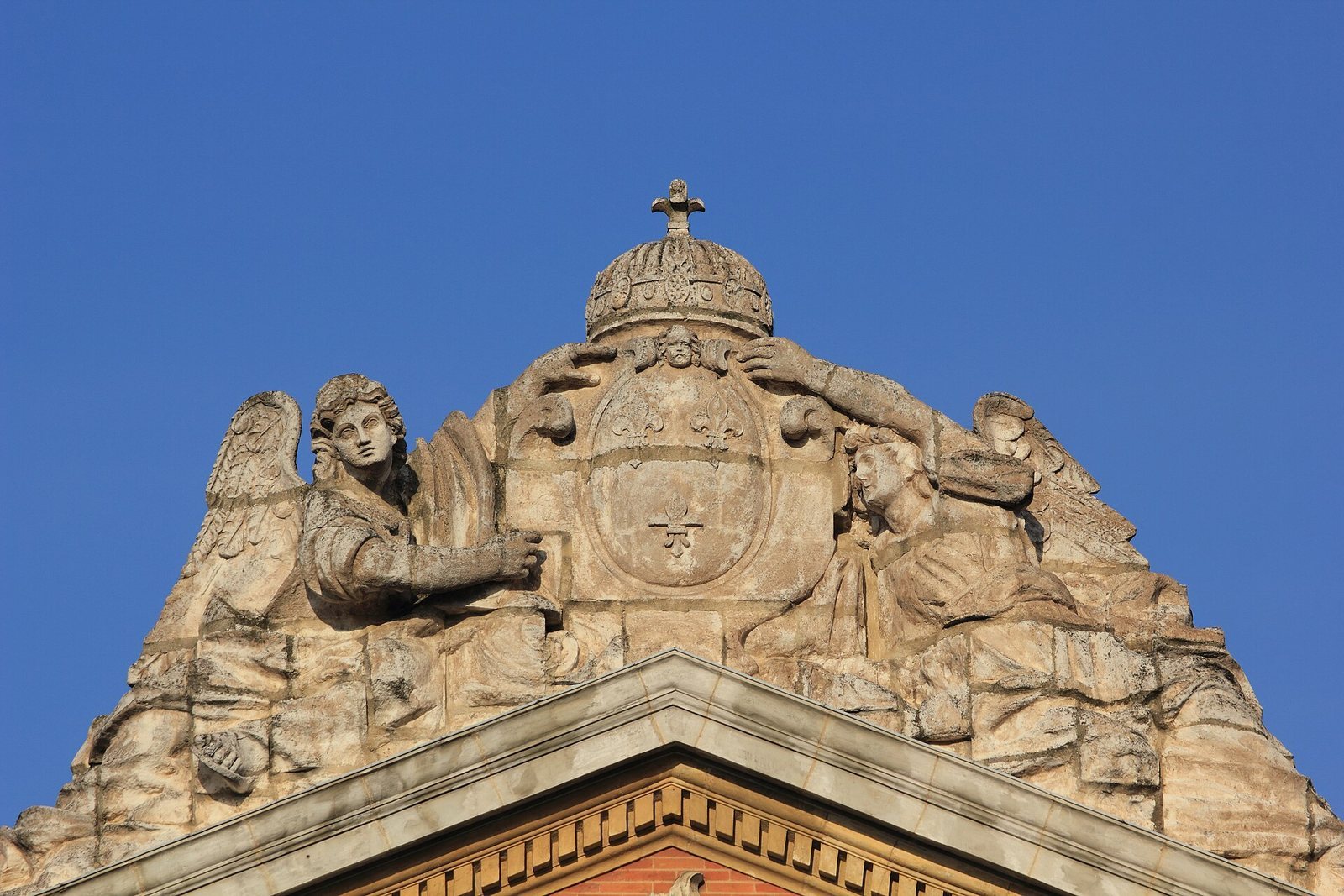
An entrance porch pierces the centre of the façade beneath a triangular pediment. Its central emblem changed with political regimes, bearing in turn the image of Louis XV, Liberty, Napoleon I, Louis XVIII and the motto “Liberty, public order.” Since 1871 it has displayed the gold initials “R.F.” for the French Republic. Sculptures above the pediment include copies of works by Louis Parant: Justice and Force, angels with the French royal arms, Clémence Isaure and Pallas on the town-hall side, and Tragedy and Comedy on the theatre side. The originals were replaced by copies in 1988. A marble plaque dated 1759 bears the inscription “Capitolium,” and decorative faces on the façade include figures from Greek mythology.
Entrance and Henri IV courtyard
The porch leads from Place du Capitole through the Henri IV courtyard towards the Charles-de-Gaulle garden and the archive tower. The courtyard and its portal belong to the older municipal complex. Its two galleries, built to Pierre Souffron’s plans between 1602 and 1607, replaced a pair of towers and a guard post. The Petit Consistory portal, carved by Nicolas Bachelier in 1546 and later moved into the courtyard, has an ornamental surround by Geoffroy Jarry dated 1561.
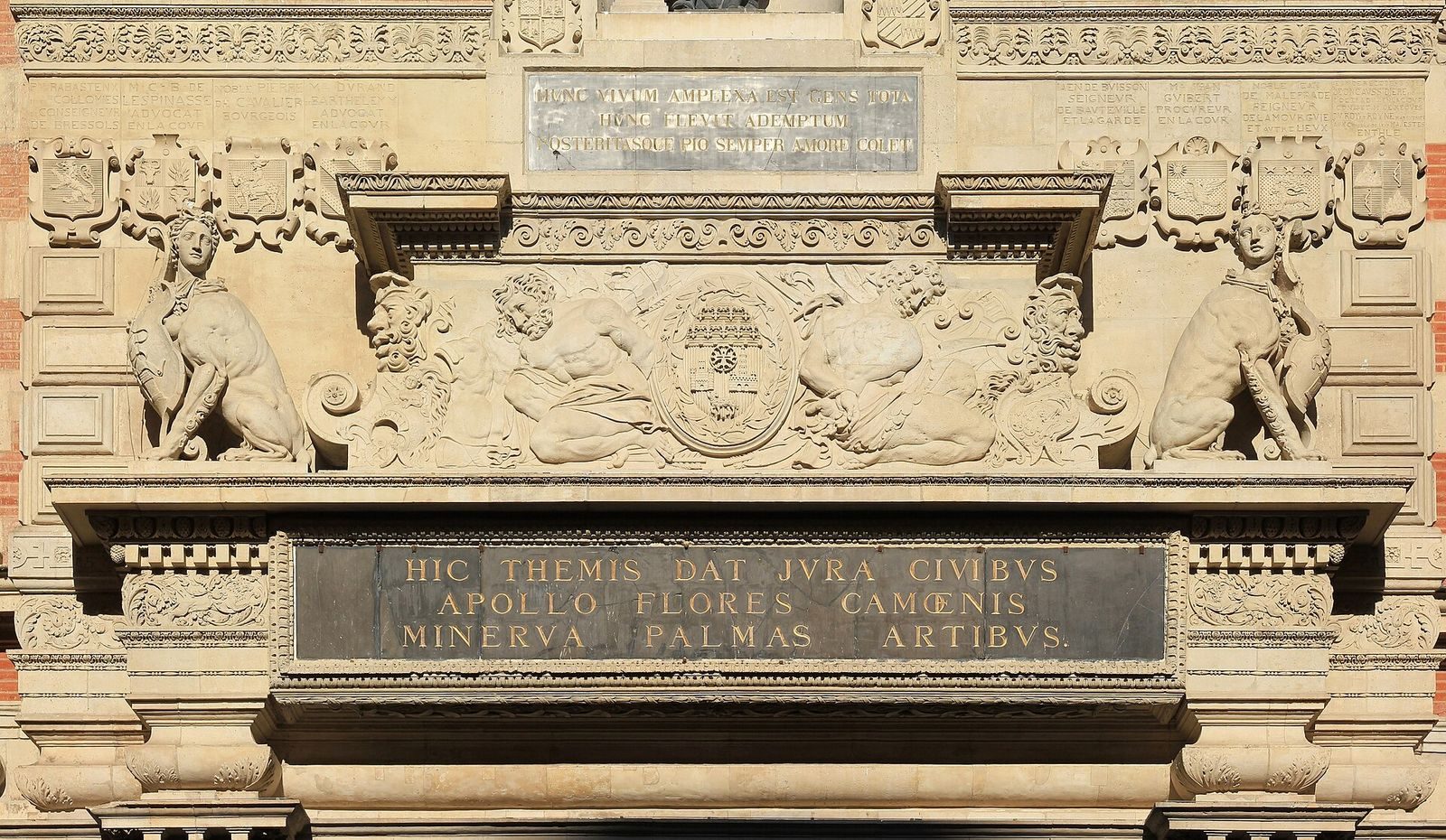
Above Bachelier’s rounded arch, Pallas and winged figures form part of the carved decoration. One figure carries a staff that once supported an owl and has borne an Occitan cross since a restoration in 1873. Jarry’s surround includes sphinxes, chained figures and Toulouse’s arms. An inscription added in 1771 invokes Themis giving laws, Apollo inspiring poets and Minerva rewarding artists. Above the portal stands a polychrome marble statue of Henry IV, made by Thomas Hurtamat in 1607. Removed and replaced with a figure of Liberty around 1799–1800, it returned in 1815. The statue stands in a niche between two round openings and the Capitouls’ arms. A painted wooden canopy dated 1610 and attributed to Pierre Fournier has eight-pointed stars in a Mudéjar-influenced pattern, shaped by Islamic artistic traditions in Christian-ruled Spain. A stone slab in the courtyard commemorates Montmorency’s execution.
Interior rooms
Grand staircase
The grand staircase was first built in 1674 by Jean-Pierre Rivalz and reconstructed in 1886. It displays a monumental bust of Jean Jaurès by Paul Ducuing. Jean-Paul Laurens’s The Tournament depicts a contest from the late 14th century. A painting of Raimond VI, Count of Toulouse, by René Henri Ravaut was acquired by the city in 1890 and placed on the staircase in 1930; its background shows the Basilica of Saint-Just at Valcabrère.
Two large paintings date to 1912. Jean-Paul Laurens depicted the first formal Jeux Floraux ceremony, while Paul-Albert Laurens painted the ceiling with the Triumph of Clémence Isaure. Jean-Pierre Laurens’s The Shepherds is displayed with Paul-Albert Laurens’s Music and Poetry. Four busts on the landing are copies by Marc Arcis or his workshop; the originals are in the Musée des Augustins. They represent Emmanuel Maignan, Jean de Pins and two members of the Parlement from the Nogaret and Bertier families. The inscriptions beneath the last two busts have been switched.
Paul Gervais Room
The room named for painter Paul Gervais was decorated by him around 1900 with scenes and allegories of Love, and served as a wedding room. Three paintings on its east wall show Love as a source of happiness at the ages of 20, 40 and 60. The Island of Cythera occupies the north wall. On the ceiling, Eros appears among four nymphs representing Grace, Purity, Innocence and Fidelity.
Salle Henri Martin
The Salle Henri Martin contains ten large canvases painted by Henri Martin in the 1900s. Three works on the north wall, The Lovers, The Dreamers and The Poet, form part of The Banks of the Garonne; a cycle on the south wall represents the four seasons. The Dreamers includes members of Martin’s family and circle, among them his sons Gilbert and René, Jean-Paul Laurens, Jean Jaurès and Henri Bellery-Desfontaines. Terracotta busts in the room represent Nicolas Bachelier, Pierre de Fermat, Jacques Cujas, Guillaume Maran and Guillaume Catel. Formerly called the Hall of Lost Steps, the room once displayed portraits of prominent Capitouls.
Salle des Illustres
Along the façade, the Salle des Illustres forms a gallery about 60 metres long and 9 metres wide. It replaced an earlier room built in 1674 and demolished in 1887, combining that space with two ballrooms and the throne room. Paul Pujol and Pierre Esquié designed the present gallery. Its metal frame is filled with cement, and transverse arches that do not carry the building’s weight help counter the ceiling’s central bulge. Most of its columns are stucco painted to resemble marble. Pujol also reworked and decorated the walls, drawing inspiration from the gallery at Rome’s Palazzo Farnese.
Conceived as a tribute to Toulouse, the gallery’s decoration was assigned to artists selected in 1892, with the city favouring painters from the Toulouse school. Works include Jean-Paul Laurens’s The Defense of Toulouse Against Simon de Montfort, Benjamin-Constant’s Pope Urban II’s Entry into Toulouse in 1096, and Henri Martin’s The Apotheosis of Clémence Isaure and The Poets of the Gay Saber. Other paintings include Jean-André Rixens’s Toulouse Contributing to National Defense, Paul Gervais’s Apollo and the Arts and The Law, Justice, Truth, and Édouard Debat-Ponsan’s The Crown of Toulouse. Sculpture and portraiture include works by Antonin Mercié, Laurent Marqueste, Alexandre Falguière and other artists, as well as busts of figures including Nicolas Dalayrac and Pierre-Paul Riquet.
Henri Rachou’s La Belle Paule portrays Paule de Viguier, chosen at age 15 to present Toulouse’s keys to Francis I when he entered the city in 1533. His admiration for her gave rise to her familiar epithet. Other works in the gallery include Casimir Destrem’s Minerva Watching over Toulouse, Théophile Barrau’s Fermat and His Muse, and Antonin Carlès’s Monument to Goudouli. The room is used for civic receptions and weddings.
Municipal council chamber
The municipal council chamber contains paintings by Paul Gervais depicting local monuments and rural scenes, alongside works by Edmond Yarz, André Roucolle, Édouard Debat-Ponsan and Henri Bonis. Busts by Marc Arcis include Raymond IV and Visigothic kings. A plaque in pink marble lists the city’s mayors from 1790. Olivier Vadrot decorated two ceiling panels in 2025.
Archive tower and former civic spaces
Archive tower
The archive tower, also known as the tower of the Consistories, has chambers on the ground floor and above. The upper chamber held the city archives until 1946. The ground-floor Petit Consistory, a small council chamber, served as a meeting room for the Capitouls. Frescoes depicted the magistrates, while a timber ceiling vault carried decorative bosses bearing the arms of the king, the city and the Capitouls.
The tower’s original steep slate roof stood about 7.5 metres high. A wooden weather vane shaped like a child was installed in 1529 and replaced in 1544 by Dame Tholose, an allegorical figure representing Toulouse. The statue was dismantled and restored in 1827, then placed on a column in Place Dupuy in 1834. Its original was moved to the Musée des Augustins in 2005 and replaced on the column by a copy. After the slate roof fell into disrepair, it was removed in 1829 and replaced with a low roof of canal tiles the following year. Viollet-le-Duc’s restoration added a slate belfry in a Flemish style and an empty bell turret. Three quarter-hour bells are behind the town-hall façade rather than in the tower; the two largest survive from a nine-bell carillon cast in 1768 and tuned by Cammas.
Consistory rooms and gates
The Petit Consistory was completed on the tower’s ground floor in 1526. The Grand Consistory, a ceremonial hall, was built in 1552 with a large roof frame, a monumental fireplace, stained glass and frescoes bearing the arms of hundreds of Capitouls. Its paintings included The Entry of Louis XIV into Toulouse in 1659 and Jean Chalette’s The Virgin of the Prisoners, now in the Musée des Augustins.
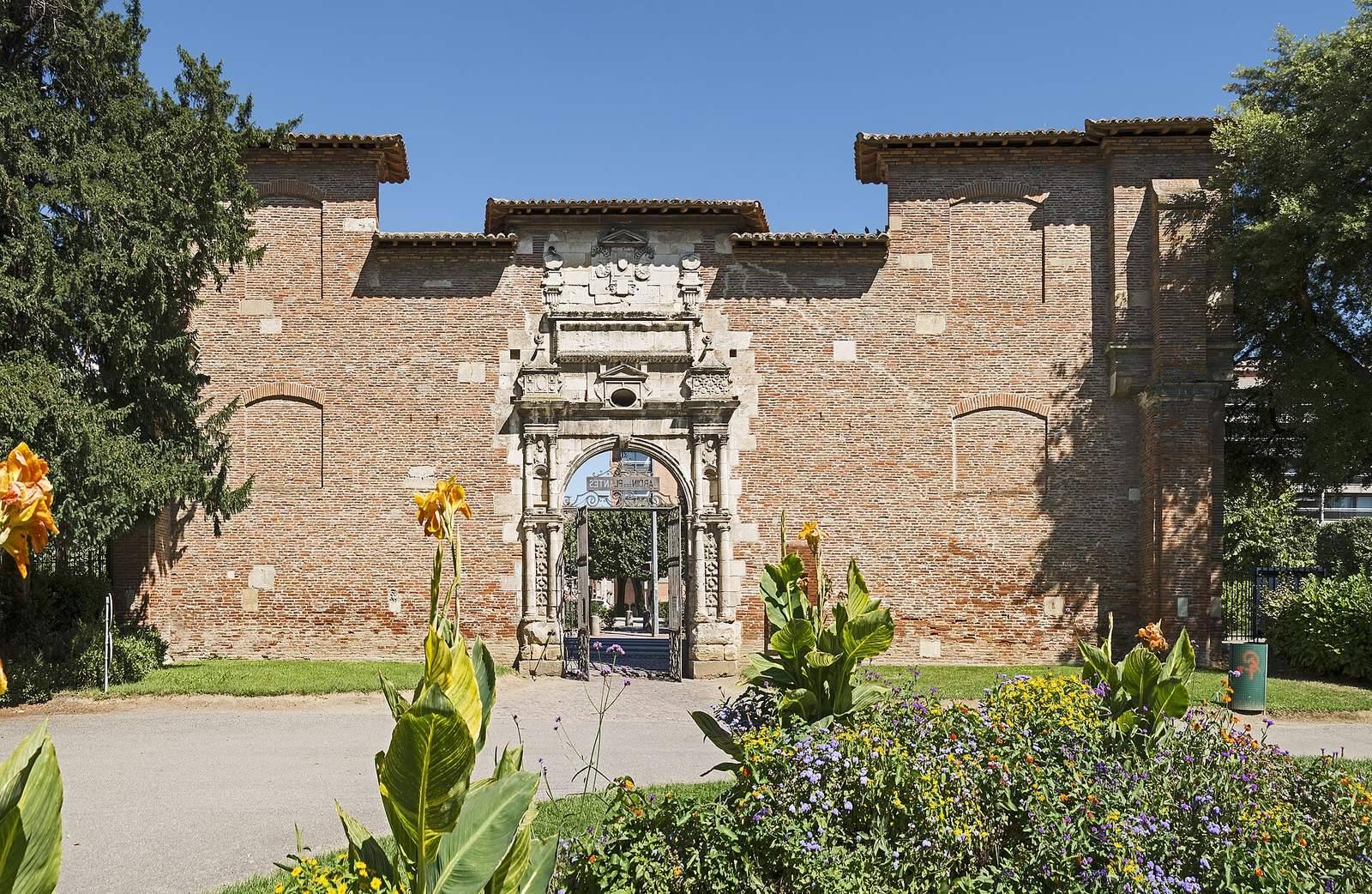
Guiraud Mellot’s Grand Consistory Gate, made in 1553, bore the arms of that year’s eight Capitouls and was reassembled at the Louvre in Paris. Its carved wooden leaves and 17th-century tympanum are held at Toulouse’s Musée Paul-Dupuy. Two further gates, made by Jean Aleman in 1576 and Pierre Monge in 1620, were moved to Toulouse’s Jardin des Plantes and placed back to back.