Chapelle Notre-Dame-de-Nazareth de Toulouse: A Historic Roman Catholic Chapel


Site at a Glance
- Rating
- 4.5
- Popularity
- Low
- Country
- France
- Primary era
- Early Modern
- External website
- Open
- Eras represented
- Medieval, Early Modern
- Civilizations
- French
- Site type
- Religious
- Remains
- Chapel
On this page15 sections
History
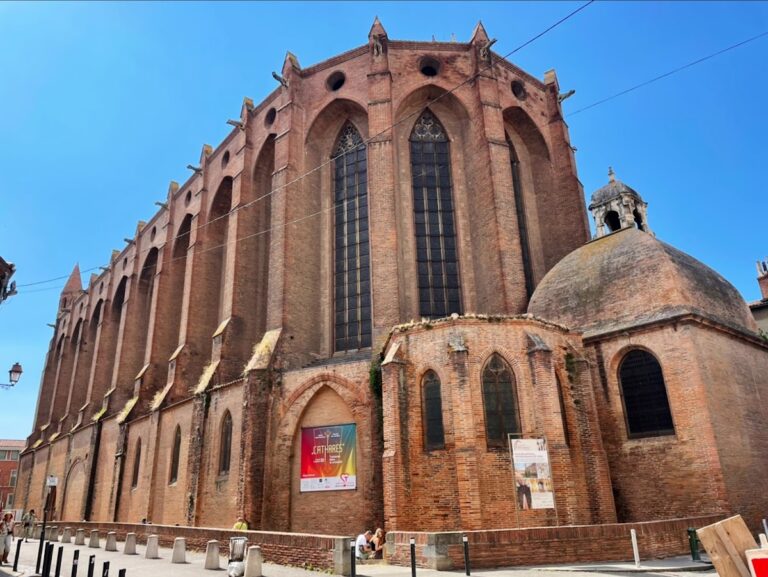
The Chapelle Notre-Dame-de-Nazareth de Toulouse is a Roman Catholic chapel in France, built between 1452 and about 1520 in the late medieval and early Renaissance period. Its history began around 1260, when an image regarded as miraculous was found in the ditches near the Montgaillard Gate. The image may have been an ancient statue or relief of Cybele, an Anatolian mother goddess whose worship spread through the Roman world, shown seated with a dish resembling a solar disk. This possible identification remains an interpretation rather than an established fact.
Origins and relocation
The inhabitants placed the discovered image in a converted suburban house outside Toulouse and dedicated the chapel to Mary. Bishop Bertrand-de-L’Isle endowed it with an annual rent of 300 livres. During the first half of the fourteenth century, fighting connected with the Hundred Years’ War, the prolonged conflict between the English and French crowns and their allies, devastated the city’s suburbs. The chapel was demolished and transferred within Toulouse.
The present building rose in the Saint-Barthélémy capitoulat, one of Toulouse’s historic municipal districts, between 1452 and about 1520. The surrounding area contained numerous houses and private mansions belonging to members of the Parlement of Toulouse, the region’s high royal court whose magistrates formed an influential legal and political elite. The chapel became their place of worship, received many donations, and served as a burial place for benefactors. Among those associated with it were the parliamentary councillor Michel de Vabres, the first president of the Parlement, Jacques de Minut, and the jurist Antoine Dadin de Hauteserre.
The proposed collegiate church
In 1525, Parlement president Georges d’Olmières sought to establish the chapel as a collegiate church, meaning a church served by a formal community of canons rather than by a cathedral chapter. Pope Clement VII approved the proposal on 29 March 1525 through a papal bull promulgated by Jean de Pins, Bishop of Rieux. Six canons were installed, with the university regent Blaise d’Auriol as dean.
The canons of Toulouse Cathedral opposed the new foundation. Royal Council decisions dated 16 July 1527 and 30 December 1529 confirmed their position, preventing the chapel’s elevation from taking effect as intended.
Revolutionary and modern changes
The chapel closed in 1789 during the French Revolution, a period of political upheaval that transformed France’s institutions and religious life. It may have lost its bell tower at that time. The building was soon sold as national property to the lawyer Pierre Bruneau Roucoule, but returned to Catholic worship after religious practice was restored in 1800.
During the nineteenth century, the two chapels on the south side were demolished and absorbed into neighboring buildings. The Catholic lay confraternity of the Black Penitents, whose members practiced penitential devotion and charitable religious activities, occupied the chapel from 1832 to 1843. The Diocesan Missionaries then took over the building.
In 1912, the state confiscated and sold the chapel again as property taken from religious congregations. The Diocese of Toulouse subsequently purchased it. From 1939, Toulouse’s Italian Catholic Mission was directed by Alfonso Masiello. The mission brought a statue of Our Lady of Loreto to the chapel in 1950 and relics of Pope Pius X, the Roman Catholic pope from 1903 to 1914, in February 1952.
On 6 March 1954, Cardinal and Archbishop Jules Saliège made the mission an Italian parish and provided it with its own chapel, the present Notre-Dame de Nazareth, with Don Alfonso Masiello as chaplain. The chapel entered the register of historic monuments on 27 December 1974. It remains in Roman Catholic use, depends on the parish of Notre-Dame de la Dalbade, and forms part of the Saint-Étienne parish group.
Remains
Entrance and vaulted interior
Enclosed by neighboring buildings, the chapel has no prominent independent facade. Its principal entrance is a semicircular vaulted portal surmounted by a Gothic pointed arch with an ogee profile. The tympanum contains a carved corbel decorated with winding vine branches, a snail, and a bird pecking at a bunch of grapes. A statue of the Virgin and Child stands above the entrance.
Inside, an apse and two bays covered by ribbed vaults form the main space. The bays differ in design, indicating that the building passed through several construction campaigns. The vault of the final bay has an elaborate arrangement of ribs, including liernes and tiercerons. Liernes are short secondary ribs that do not reach the springing points, while tiercerons extend from the supports toward the central part of the vault. Heraldic and foliate bosses decorate this structure.
Side chapels and memorials
Northern chapels
Two chapels originally opened on each side of the nave. The southern pair was removed during the nineteenth century and incorporated into neighboring buildings. The northern chapels survive with Louis XIII-style decoration from the first half of the seventeenth century.
Tomb of Antoine Dadin de Hauteserre
The tomb of the jurist Antoine Dadin de Hauteserre remains between the two northern chapels. The tombs of Michel de Vabres, who died in 1546, and Jacques de Minut, who died in 1536, have disappeared.
Apse furnishings and artworks
High altar and altarpiece
The apse contains a seventeenth-century classical high altar surmounted by a pediment and a gilded wooden altarpiece. At its center is a wooden Annunciation scene set against a blue background strewn with fleur-de-lis. Fluted columns frame the scene, while Jean-Pierre Rivalz’s painting of the Visitation is placed above it.
Painted reliefs
Four thirteenth-century painted and gilded wooden bas-reliefs line the apse walls. They depict episodes from the life of Mary and provide a group of early devotional works within the later architectural setting.
Apse windows
The sixteenth-century apse window was donated by the lawyer Jacques de Cazeneuve. It depicts the Nativity and bears his coat of arms. The neighboring window carries the coat of arms of Michel de Vabres.
Virgin and Child painting
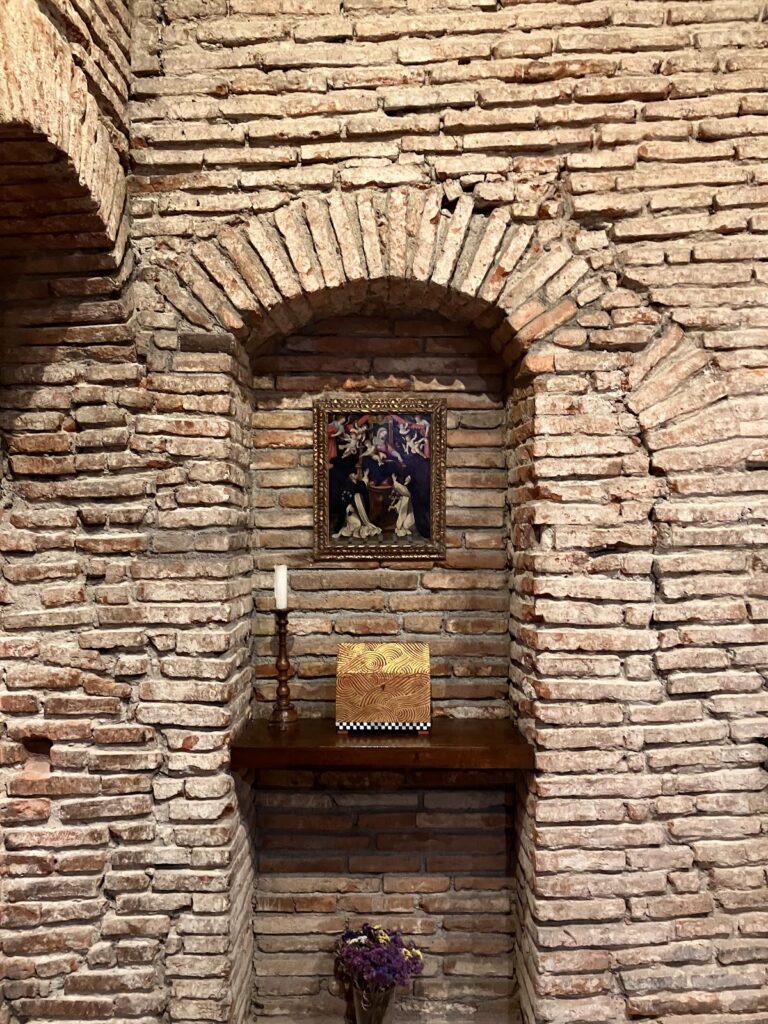
A large sixteenth-century painting shows the Virgin and Child sheltering nine nuns beneath her mantle. Ignatius of Loyola, the sixteenth-century founder of the Society of Jesus, appears with an angel in the composition.
Later devotional objects
The chapel also preserves the devotional additions brought by Toulouse’s Italian Catholic Mission. These include the statue of Our Lady of Loreto, installed in 1950, and the relics of Pope Pius X, brought there in 1952.