Jesuit Church, Bratislava: From Lutheran Worship to Jesuit Use
Site at a Glance
- Popularity
- Medium
- Country
- Slovakia
- Primary era
- Early Modern
- Eras represented
- Early Modern, Modern
- Civilizations
- Austria-Hungary, Habsburg, Hungarian
- Site type
- Religious
- Remains
- Church
On this page26 sections
History
The Jesuit Church of Bratislava, Slovakia, began as a late Renaissance place of worship built from 1636 to 1638 for the city’s growing German-speaking Evangelical, or Lutheran, community. It later became a Roman Catholic church associated with the Society of Jesus, the order commonly known as the Jesuits and founded by Ignatius of Loyola.
Foundation as an Evangelical church
The new church replaced the Armbruster house and was designed by Hans Stoss, a builder from Augsburg. Rules for Protestant churches restricted their outward form: they could not resemble sacred buildings, could not have a tower, and had to include the presbytery, the area containing the main altar, within the main plan. Despite these limits, the building was conspicuously larger than its neighbours.
After construction, the Lutheran theologian and pastor Josua Wegelin preached a thanksgiving sermon on 18 December 1638. A two-day consecration festival, the formal dedication of a church to religious use, began on 21 December. Wegelin dedicated the church to the Holy Trinity and delivered the festival sermon. He was then a senior pastor of the German Evangelical congregation and its eleventh pastor in succession. Construction cost 22,925 talers, a Central European silver coin and monetary unit.
Transfer to the Jesuits
Evangelical worship continued until 1672, when the church was taken from the congregation after the suppression of the Wesselényi conspiracy. The seizure was ordered by György Szelepcsényi, Archbishop of Esztergom and Primate of Hungary. On 1 January 1673, the building was handed to the Jesuits. They first dedicated it to Saint Margaret, then transferred to it the dedication to the Holy Saviour, or Salvator, from Bratislava Cathedral. They also altered the interior and established new Catholic furnishings and symbols.
When the Jesuit order was suppressed in 1773, the church came under municipal administration. For a time it served as the court church of Albert of Saxony-Teschen, an Austrian archduke who was Hungary’s governor. The Jesuits regained it in 1855.
Later administration and conservation
State authorities took the church from the Jesuits again in the 1950s. It then passed to diocesan clergy and became a branch church of the Parish of St Martin. The Jesuits returned in 1989. The church is designated a Slovak National Cultural Monument, with its registration dating to 1963. Repairs in 2004 included the removal of Eucharistic frescoes from the nave vault.
Remains
Plan and setting
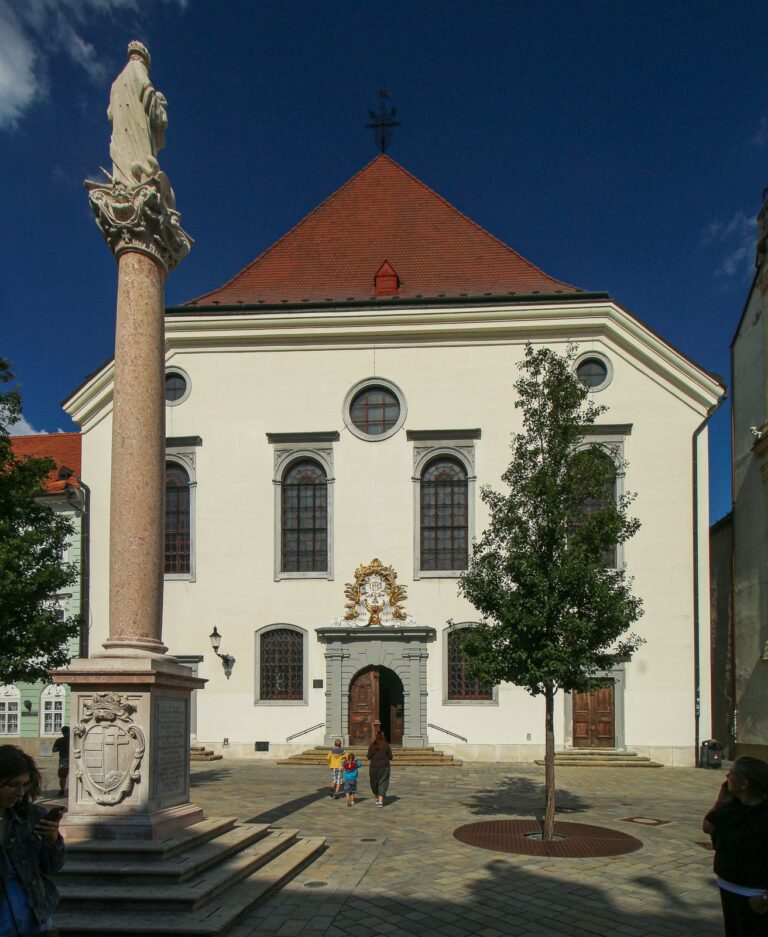
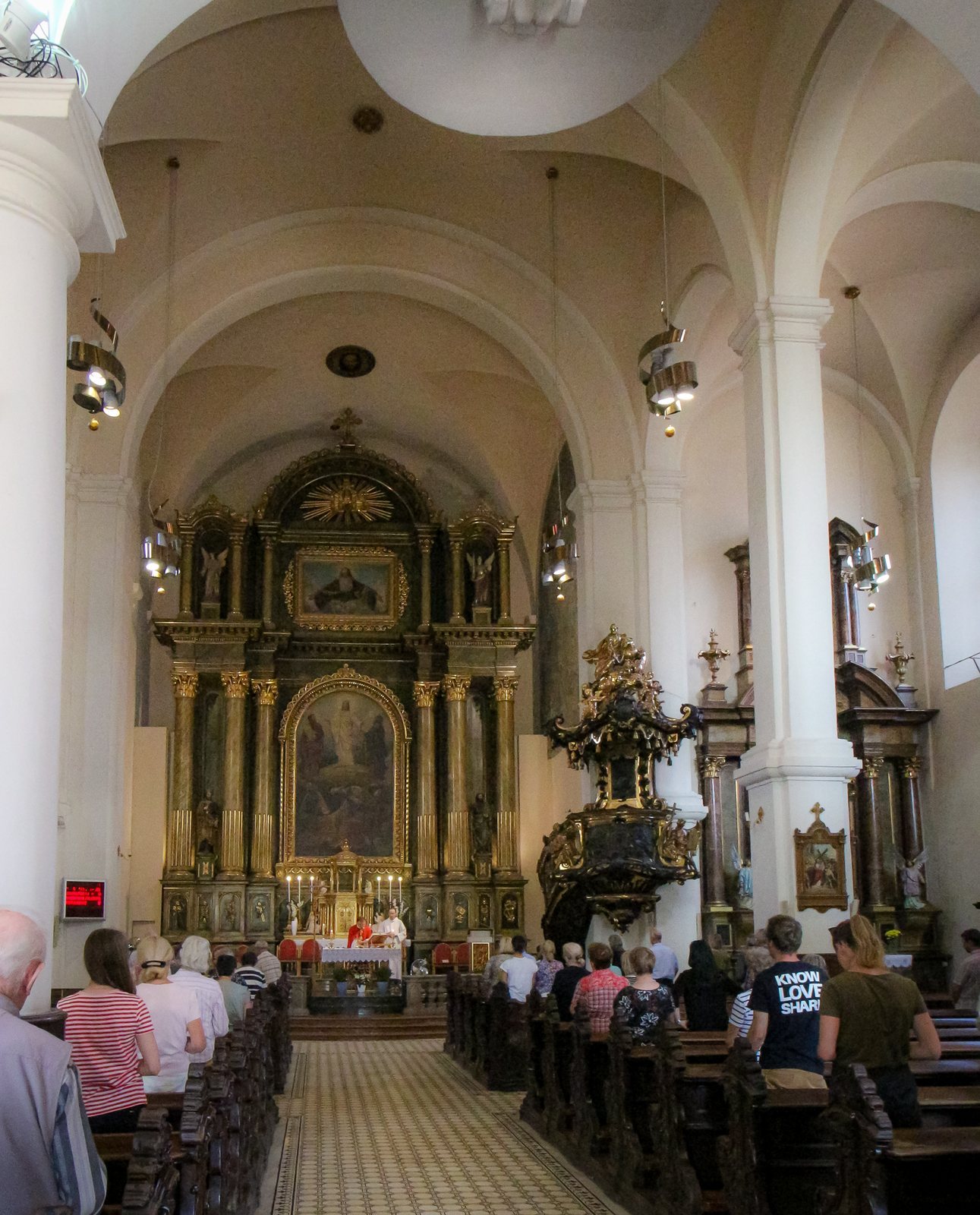
The church is a stone, three-aisled hall building, meaning its nave and side aisles are of similar height. Its fabric combines late Renaissance work with later Baroque alterations. The presbytery is incorporated into the main plan; three steps, a marble balustrade and a triumphal arch mark its division from the nave. High windows in the side aisles bring light into the interior.
Exterior and portals
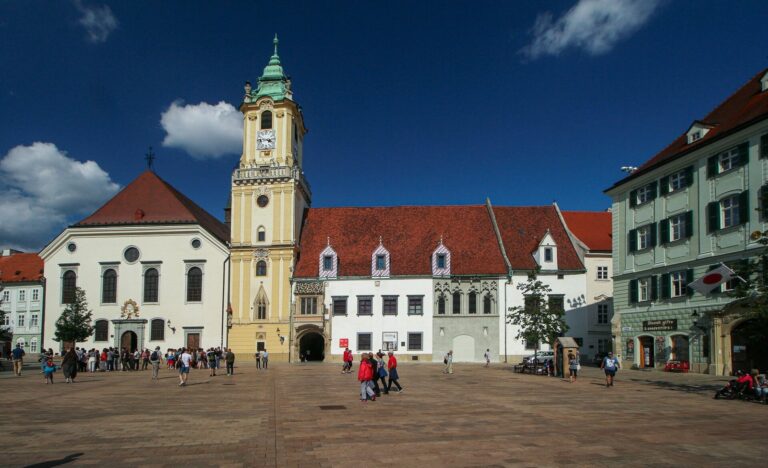
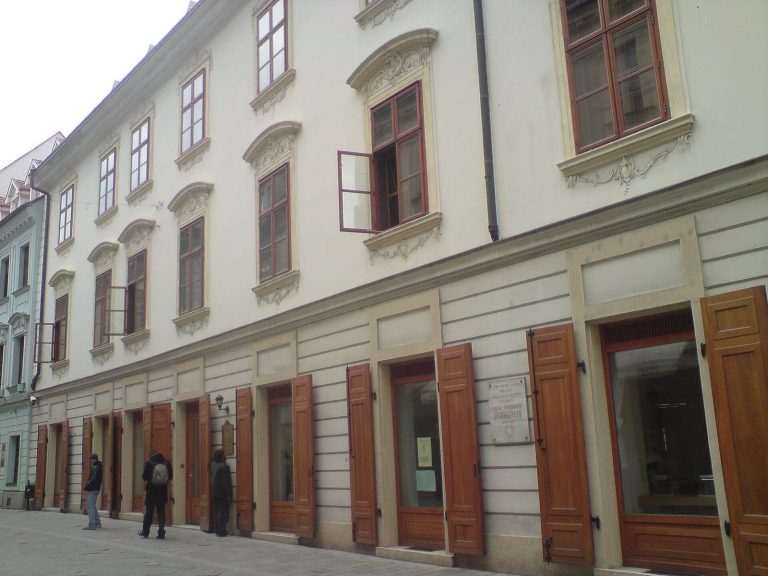
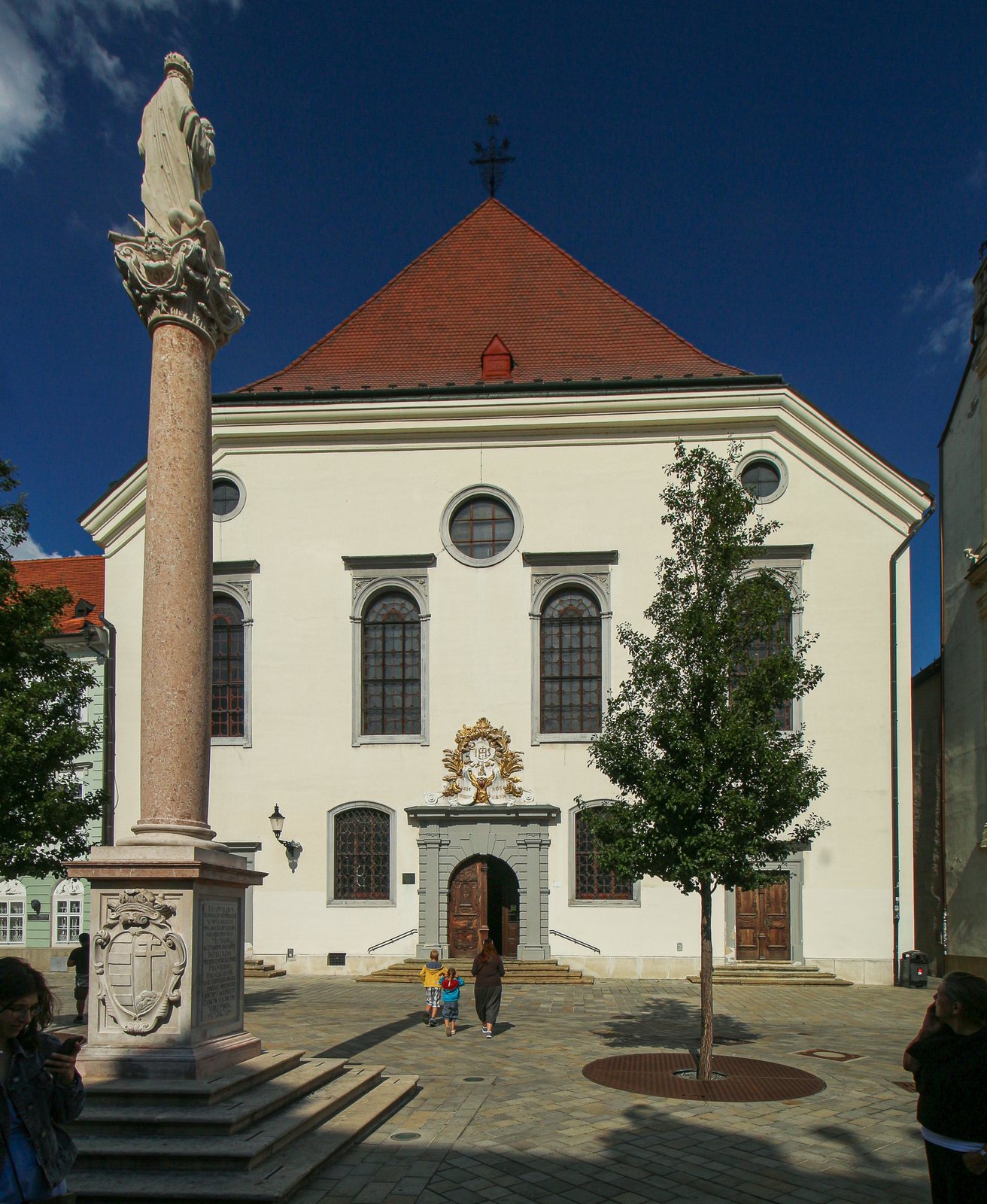
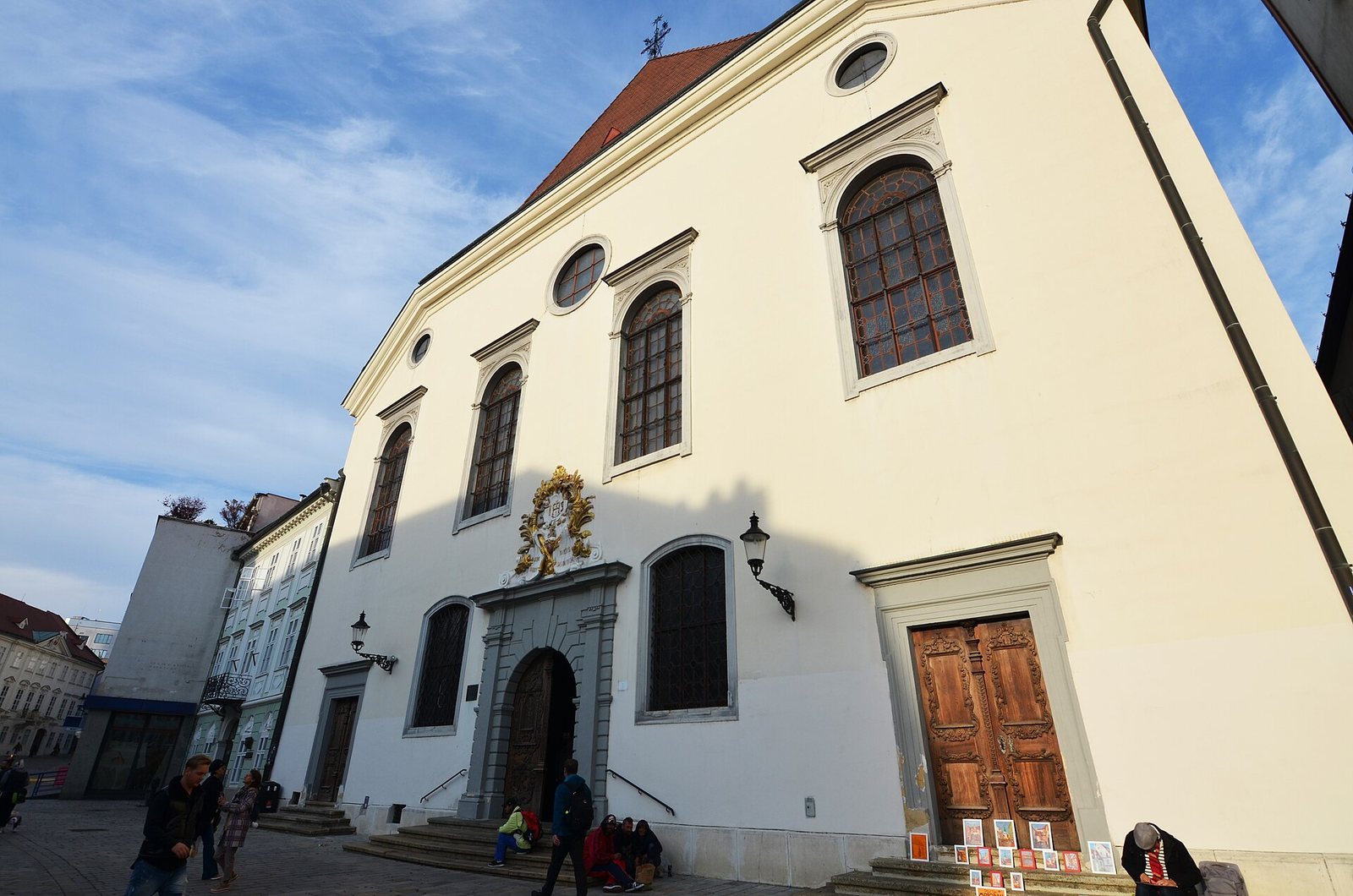
The building stands immediately north of Bratislava’s Old Town Hall, at the edge of Hlavné námestie and facing the junction with Franciscan Square. Its south wall forms the north side of Kostolná Street, which links Franciscan Square with Primatial Square. A building for young Jesuits adjoins the church to the north. The main façade has four tall, round-arched windows and three entrances. Above the central entrance, a molded-plaster relief of the Jesuit arms sits within a stylized leaf wreath and between scroll-shaped ornaments. The arms include the letters IHS, a flaming heart and the Latin motto SIC DEVS DILEXIT MVNDVM, meaning “For God so loved the world.” Panels beside the relief originally held the arms of Hungary and Cardinal Leopold Kolonič.
The main entrance is framed by flat vertical strips and has deeply molded double doors carved with mask faces. Side entrances also retain doors. A small turret rises above the presbytery. Its present bell weighs 135 kilograms and was cast in 1846 by Bratislava bell-founder Anton Belloni.
Entrance and music
Organ gallery and organ
The gallery above the main entrance preserves an element of the church’s original interior arrangement from the 1630s. It holds a Rieger organ built in 1924. The instrument has three keyboards and a pneumatic mechanism, in which air pressure operates its action. Its controls include octave-shifting couplers, two stored combinations, a crescendo that progressively adds stops, a tutti setting that engages them all, and a control that silences reed stops.
Saint Anthony
At the beginning of the north wall in the entrance area, a plaster statue depicts Saint Anthony of Padua. Bratislava sculptor and painter Alojz Rigele made it in 1912.
Main altar and presbytery furnishings
Present main altar
The large main altar, installed in the late nineteenth century, is in a revived Baroque style. Its monumental painting of the Transfiguration on Mount Tabor is by Bratislava artist Sebastián Majsch. Above it, a painting of God the Father by Jozef Henrich Krikler is dated 1884; a cross and Jesuit emblem crown the upper section. Statues of Saints Peter and Paul stand beside the altar, with the Archangel Michael and a guardian angel above them. Carved Christian symbols decorate the lower structure and altar table.
Earlier main altar
An earlier columned altar was made in 1721–1722 by Viennese carpenter Johann Jakub Müller. Anton Wellser, also from Vienna, painted its altarpiece. Sculptor Johann Andreas Englauer made figures of John the Baptist, John the Evangelist, the Archangel Michael and a guardian angel, along with other sculptures for the upper section. The altar was removed in the late nineteenth century, and its original statues went to the Bratislava City Gallery.
Pulpit and presbytery paintings
A decorative pulpit made in 1753 by Ľudovít Gode stands on the right side of the presbytery. Anton Jäger, a Bratislava chamberlain, commissioned it. A seated Christ the Saviour crowns its overhead canopy, above two angels carrying symbols of the Old and New Testaments. Four lead reliefs decorate the staircase, while the parapet bears a central relief with five scenes from Christ’s life. The canopy carries the inscription QUI EX DEO EST VERBADEI AUDIT, meaning “Whoever is of God hears the words of God.” On the same side of the presbytery, above the sacristy entrance, is Alojz Rigele’s 1926 wall painting Eucharistic Jesus, measuring 880 by 600 centimetres. Rigele painted it directly in its finished form. Another work of his from 1926 is set into the presbytery ceiling: a circular wooden ornament, one metre across, showing Christ as the Holy Saviour with his face framed by a crown of thorns.
Side-aisle altars and furnishings
Saint Jude Thaddeus altar
In the left aisle, the altar nearest the entrance is a late nineteenth-century work dated 1895. Its principal painting, by Jozef Henrich Krikler, dates to 1886 and depicts Saint Jude Thaddeus. Beneath it is an oval painting of Saint John of Nepomuk by an unidentified artist. A relief of the Holy Trinity occupies the altar’s upper section.
Saint Ignatius of Loyola altar
Made from 1759 to 1761 by Lower Austrian architect Johann Fiedler, this altar has a richly sculpted arrangement. Its central painting, The Vision of Saint Ignatius of Loyola, was painted by Franz Anton Palko in 1757. Figures of Saints Francis Borgia and Francis Xavier, made in 1761 by Anton Štefan Steinmassler, flank the painting. A circular painting of the Sacred Heart of Jesus by Franz Rulz, dated 1865, sits on the altar table.
Calvary altar and epitaph
The Calvary altar, dated 1760–1770, includes a sculpted group from 1760 set against a painted background. In its upper section, Palko’s 1758 painting shows Christ on the Mount of Olives, flanked by weeping angels. Nearby, a marble epitaph dated 1737 gives thanks to Cardinal Leopold Kolonič and commemorates his part in the church’s transfer to the Jesuits.
Virgin Mary altar
The Virgin Mary altar dates to 1759–1761. Its statue of the Immaculate Virgin, made in the late nineteenth century by Italian sculptor Ferdinand Stuffaser, stands against gilded rays. The altar formerly displayed Fra Antonio’s 1773 painting Saint Anthony before the Madonna. Its upper section holds a painting of the Virgin Mary and Saint Anne.
Saint Francis Xavier altar
Made from 1759 to 1761, this altar is framed by Corinthian columns with a polished plaster finish. Palko’s painting The Death of Saint Francis Xavier, made in the 1750s, occupies the centre. Steinmassler’s statues of Saints Aloysius Gonzaga and Stanislaus Kostka stand on either side. Above them, a relief shows an angel carrying a cross with the crucified Christ as other angels bow before him. Decorative vases on the interrupted pediment depict scenes from Xavier’s life. A painting of the Virgin Mary with the infant Jesus stands on a separate pedestal on the altar table.
Saint Joseph altar
The Saint Joseph altar, dated 1895, has a statue of the saint in a niche. Its simple upper section bears the inscription ITE AD JOSEPH, meaning “Go to Joseph.”
Sculptural commissions
Jesuit rector Jozef Koller commissioned the altars of Saints Ignatius and Francis Xavier. Their sculptures were initially intended for Gode, but after his death in 1759 the work passed to his former pupil Steinmassler. Steinmassler also made the sculpture for the Virgin Mary altar and other altar figures and reliefs in the church. Marble worker Václav Pfeifer contributed by giving sculptures a white polish and colored finish.
Confessionals
A carved Baroque confessional in the left aisle was made in 1761 by Steinmassler. It is open and divided into three sections, with a painting of the penitent Mary Magdalene in its upper part. Two matching confessionals in the right aisle have paintings above them, one showing Christ instituting the sacrament of reconciliation and the other Saint Peter.
Burial place and Marian column
Crypt
A crypt, an underground burial chamber, is entered from the main nave and extends beneath the whole north, or left, aisle. It holds the remains of Jesuits who served in the Bratislava community and died there. Among them is Cardinal Leopold Kolonič, who died in Vienna in 1707 and requested burial in the church crypt without funeral pomp.
Marian column
A column dedicated to the Virgin Mary stands in the open space before the church. It commemorates Leopold I, Habsburg emperor and king of Hungary, and his victory over Protestant rebels.