Kaštieľ svätej Žofie: A Royal Castle and Likava Estate Center
Site at a Glance
- Popularity
- Medium
- Country
- Slovakia
- Primary era
- Early Modern
- Eras represented
- Medieval, Early Modern
- Civilizations
- Habsburg, Hungarian
- Site type
- Military
- Remains
- Castle
On this page9 sections
History
Royal residence and medieval development
Kaštieľ svätej Žofie is a castle in Ružomberok, Slovakia. Its original Gothic building dates to 1397–1399, and it later became an important administrative and representative center of the Likava estate. It is among Slovakia’s oldest castles recorded in writing. A tradition places a Dominican convent on the site, associating it with a mission to Slavic communities in northern Hungary around 1230, during the reign of Andrew II. The tradition does not establish that the building was a convent.
A royal residence was established in connection with privileges granted to Ružomberok by Charles Robert of Anjou in 1340 and extended by Louis I in 1376. It served for administration, tax collection, signing documents, and royal lodging. The town’s position on the route between Krakow and Budapest gained strategic value when Poland and Hungary shared a monarch.
Sigismund of Luxembourg stayed in Ružomberok in 1397 and signed an extension of privileges for Nemecká Ľupča. He returned for a longer, intermittent stay in the summer of 1399. Matthias Corvinus granted privileges to local shepherds in 1474, an act associated with the royal residence, and Vladislaus II Jagiellon visited the castle in 1505. The Crown held the site from 1300 to 1526.
Renaissance transformation and estate rule
After the 1526 Battle of Mohács, an Ottoman victory that helped bring about the partition of the Kingdom of Hungary, officials administered the site on the Crown’s behalf. Louis Pekry was associated with its administration from about 1520 to 1569. In 1534, he and his wife, Sophia of Mazovia, began transforming the Gothic building into a Renaissance residence. Further changes under Ján Krušič, associated with the estate from about 1569 to 1580, and the Illésházy family developed it into a representative castle. The Illésházys owned the Likava estate from 1580 to 1693.
The origin of the name Kaštieľ svätej Žofie is uncertain. Its earliest known written appearance is in a 1611 entry of the Spiš Chapter, a Catholic ecclesiastical institution. A 1629 foundation charter for Oravské Veselé, signed at the castle by Countess Helena Illésházy, is another early record. Explanations include a possible connection to an earlier church, to Sigismund of Luxembourg, or to the 16th century. The establishment of a chapel dedicated to Saint Sophia is often linked to Sophia of Mazovia; interpretations have also cited a 1534 plaque at Likava Castle bearing the arms and names of Sophia and Pekry. Kaštieľ svätej Žofie is the only known secular building in Slovakia named after a saint.
In the 17th century, the castle combined defensive, administrative, and representative roles. It hosted guests of the Likava estate’s lords, county assemblies, local judicial elections, a seigneurial court, and a prison. Visitors and residents included Hungarian monarch Louis II Jagiellon and the Transylvanian princes Gabriel Bethlen and Sigismund Báthory.
Estate seat and later institutions
Likava Castle burned in 1707. After its demolition, the Ružomberok castle became the seat of the Likava estate and an administrative center. Following the estate’s consolidation in 1762, the building housed an office serving the united estate. Its administration shifted from Crown control to management by the Royal Chamber, the Crown’s fiscal and administrative body. Eighteenth-century maps show changes to the complex.
After 1848, the site housed a county-level court and a tax office. From 1871 to 1896 it served as barracks for the Trenčín regiment of Hungary’s territorial defense force, and from 1871 to 1880 it contained a Jewish prayer hall. Between 1876 and 1930, its offices and prison served county and district courts and the state prosecution service. Emperor Franz Joseph I visited in 1852. Andrej Hlinka and Vavro Šrobár were later imprisoned there.
Twentieth-century change and decline
The castle became a National Cultural Monument. In the 20th century it passed through state control during the Czechoslovak and Slovak-state periods, and an agricultural school occupied it from 1948 to 1968. The Soviet Army owned it from 1968 to 1990, followed by the city of Ružomberok from 1990 to 2000. Private owners and companies held it from 2000 to 2013, then companies associated with J&T from 2013 to 2022.
By the end of the 20th century, the building was in very poor condition. The city agreed to a proposed hypermarket development, while plans for a cultural center or museum in the historic part were never completed. The building deteriorated again.
Remains
Layout and construction
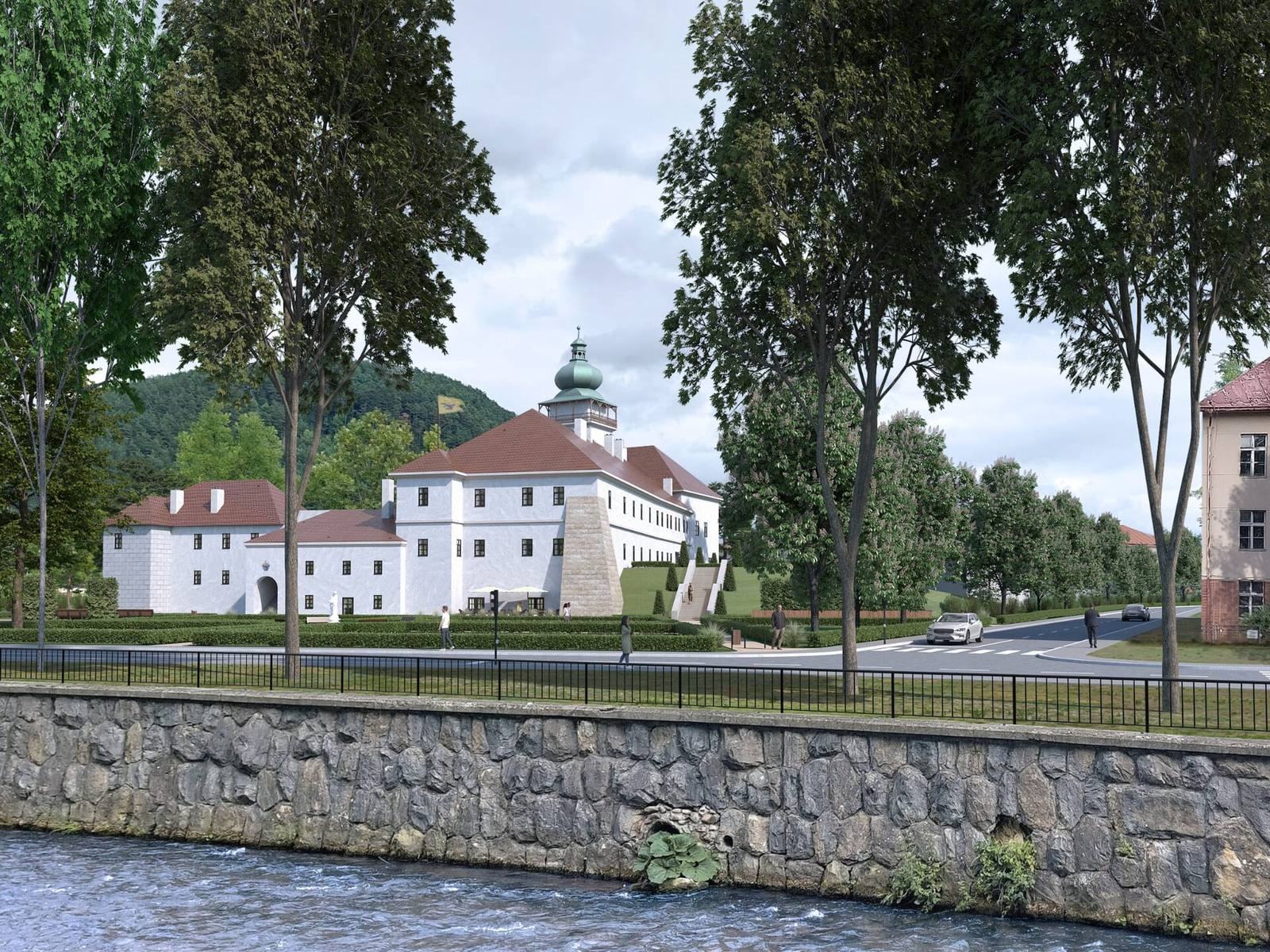
The castle stood on a rise at the northeastern edge of Ružomberok’s historic center, near the confluence of the Váh and Revúca rivers. Its complex consisted of interconnected one- and two-storey buildings constructed between the 14th and 19th centuries and arranged around an irregular courtyard. The main building reached its characteristic architectural form in the 17th century, when the oldest surviving architectural elements were also made. Historical records describe the building as a small castle or fortified noble residence; the label kaštieľ became more common in later writing, including through the influence of Hungarian terminology for aristocratic residences.
Earlier sacred site
Archaeological work in 2002 uncovered remains of a 12th-century sacred building and an adjoining cemetery in the courtyard. These finds show that the site had earlier religious use, but do not establish that the building belonged to a Dominican convent. The earliest known settlement in Ružomberok lay within the castle grounds.
Surviving fabric
During hypermarket construction in 2002, about one-third of the historic fabric in the west wing was demolished. The remaining two-thirds was stabilized and partly conserved, but later deteriorated. This surviving fragment became part of the Hypernova complex. The natural rise on which the castle stood was also partly removed.