Lystra: A Roman Colony and Early Christian City in Turkey
Site at a Glance
- Popularity
- Very High
- Country
- Turkey
- Primary era
- Medieval
- Eras represented
- Classical, Medieval
- Civilizations
- Byzantine, Roman
- Site type
- City
On this page10 sections
History
Lystra was an ancient city in present-day Turkey, where Rome established a colony, a settlement under Roman authority, in 6 BC and named it Colonia Iulia Felix Gemina. Human settlement there reaches back to the Copper Age, the period between the Stone and Bronze Ages. The city may have had Hittite origins, and may have been known as Lusna; the Hittites were an ancient Anatolian people. Rome may have established the colony to strengthen its control over mountain tribes to the west. Lystra later became part of the Roman province of Galatia.
Roman rule and routes
Lystra lay on the ancient Persian Royal Road. Another route linked Ephesus through Sardis, Pisidian Antioch, Iconium, Lystra and Derbe, then crossed the Cilician Gates toward Tarsus and Syrian Antioch, continuing to destinations farther east and south. Rome also built a road connecting Lystra with Iconium to the north.
Paul and the early Christian community
Paul came to Lystra in AD 48, during his first missionary journey, after persecution forced him to leave Iconium. The Acts of the Apostles relates that he healed a man who had been unable to walk from birth. The crowd, speaking Lycaonian, the local language, identified Paul as Hermes, a Greek deity associated with speech, and Barnabas as Zeus, the chief god of the Greek pantheon. They tried to offer sacrifices to the two visitors. Paul and Barnabas rejected the worship and urged the crowd to turn to the Creator, pointing to rain and fruitful seasons as signs of divine generosity.
Acts also recounts that Jewish leaders from Pisidian Antioch and Iconium persuaded the crowd to stone Paul and leave him for dead. When disciples gathered around him, he rose and returned to the city. The following day he and Barnabas set out for Derbe. On their return, they stopped at Lystra to encourage the disciples.
Lystra apparently had no synagogue, although Timothy’s mother and grandmother were Jewish. The city appears to have been the first place where the missionaries preached directly to non-Jewish people without first approaching them through shared ground with Judaism. Timothy, a young disciple from Lystra, may have witnessed Paul’s earlier persecution. In AD 51, during Paul’s second journey, Timothy left with Paul and Silas and accompanied them for the remainder of the journey. Paul may also have visited Lystra near the start of his third journey. The English theologian John Gill later connected Paul’s reference to rain and fruitful seasons with the prophet Jeremiah’s criticism of idols that cannot bring rain.
Christian and Byzantine periods
Lystra served as a bishop’s seat during the Christian period, and continued to be cited as one through the 12th century. Its name also remained in use as a Roman Catholic titular see, a former diocese whose title is held by a bishop without an active local diocese. The most recent titular bishop named for Lystra was Enrique A. Angelelli Carletti in the 1960s; he later became bishop of La Rioja, Argentina.
During the Byzantine period, Lystra declined in importance. Some inhabitants moved to nearby Kilistra, a more defensible settlement founded by people from Lystra. The city may have been destroyed by the forces of Timur, a Central Asian ruler and military conqueror, in the summer of 1402.
Identification and investigation
In 1860, an inscribed stone found at a hillock near Hatunsaray led to the identification of the site as Lystra. The British archaeologist and New Testament scholar William Mitchell Ramsay called for excavation in 1907. In 1941, he urged investigation of the city’s topography, arguing that further discoveries could help make otherwise uninformative fragments meaningful.
Remains
The site is identified with Zoldera hill, about 500 metres from Hatunsaray, roughly 30 kilometres south of Konya and about 15 kilometres north of Akören. A 2004 laser scan revealed a hilltop archaeological landscape that includes an elevated central area, walls, a Byzantine church building and a cemetery from the Roman imperial period.
Hilltop structures and cemetery
Acropolis and walls
The scan identified an acropolis, an elevated fortified or central area, along with walls on Zoldera hill.
Basilica and cemetery
The hill contains a Byzantine basilica, a large building type adopted for Christian worship, probably built over an earlier temple to Zeus. The scan also revealed an extensive cemetery dating to the Roman imperial period.
Inscribed stone and finds
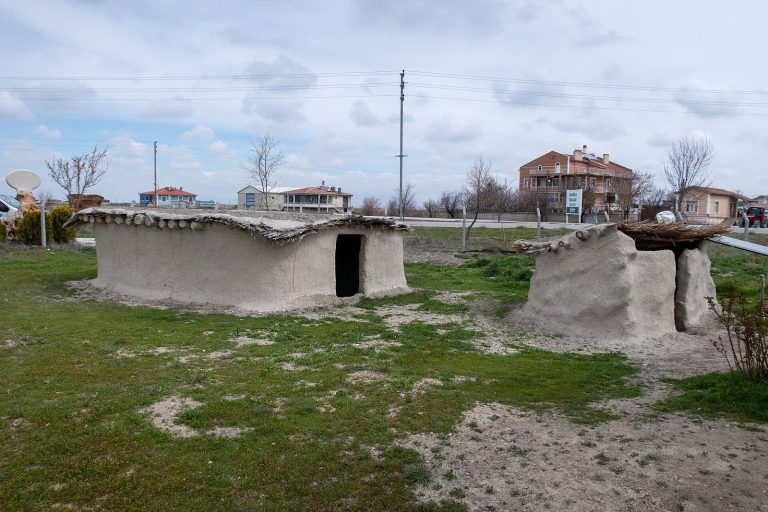
The inscribed stone that helped identify Lystra is now kept at the Konya Museum. A small museum in Hatunsaray displays artifacts from the ancient city.