Aquincum Military Amphitheatre: A Roman Arena in Budapest
Site at a Glance
- Popularity
- High
- Country
- Hungary
- Primary era
- Classical
- Eras represented
- Classical
- Civilizations
- Roman
- Site type
- Entertainment
- Remains
- Amphitheatre
On this page10 sections
History
Roman foundation and use
The Aquincum military amphitheatre is a Roman arena in Budapest, Hungary, developed in stone around AD 145 from a training ground used by the legion stationed at Aquincum. The legion used the natural hollow from the first century. The stone building took shape during the reign of Emperor Antoninus Pius, who ruled from AD 138 to 161. An inscription found near an entrance names Legio II Adiutrix and dedicates a building project to the emperor. Its connection to this amphitheatre is disputed, so it may refer to the building’s construction or to a major expansion.
The arena hosted gladiatorial combat and animal hunts, and it may also have been used for staged water battles. Legionaries may have exercised and paraded there. Imperial visits probably brought public events and speeches, as Aquincum had no other venue of comparable size.
Fortress and early medieval activity
In the fifth century, the amphitheatre was converted into a fortress, partly because it stood beside a major road. Its seating entrances were blocked during the conversion. Heruli, Lombards, Avars, and later Magyars also used the fortified structure. A silver hoard sealed into the southern gate indicates activity there by the sixth century; Heruli or Lombards may have buried it. In the seventh and eighth centuries, Avars established burials north of the amphitheatre.
Magyar tradition and later use
During the ninth-century Magyar conquest, authority was divided between a military ruler, the gyula, and a sacral ruler, the kende. Kursan, a Magyar sacral king who died in 904, chose an installation in the former Aquincum area as his residence. Medieval references call the place “Kursan’s Castle,” though the amphitheatre is only a possible identification.
In the eighteenth century, the site served as an execution ground and became known as Gallows Hill. It was also called King’s Hill, and workers’ houses were later built there.
Recognition and excavation
The remains were recognized as an ancient structure in the early nineteenth century. Trial excavations began under Lajos Nagy in 1932, followed by work in 1935 and a campaign from 1938 to 1941 led by János Szilágyi and Tibor Nagy, after houses on the site had been demolished. László Gerő planned a restoration carried out in the early 1940s and completed in 1942 using building material found at the site.
Remains
Setting and construction
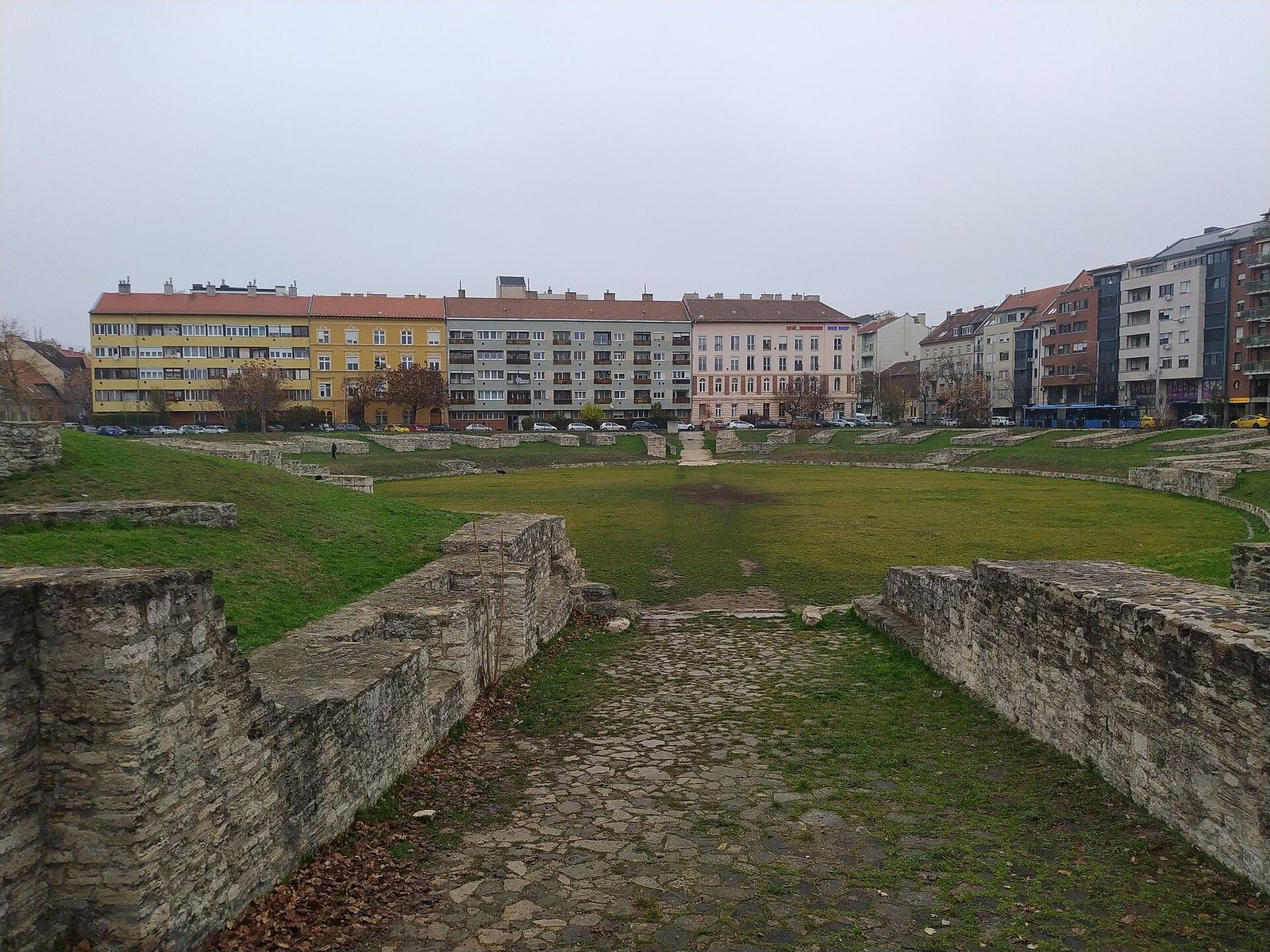
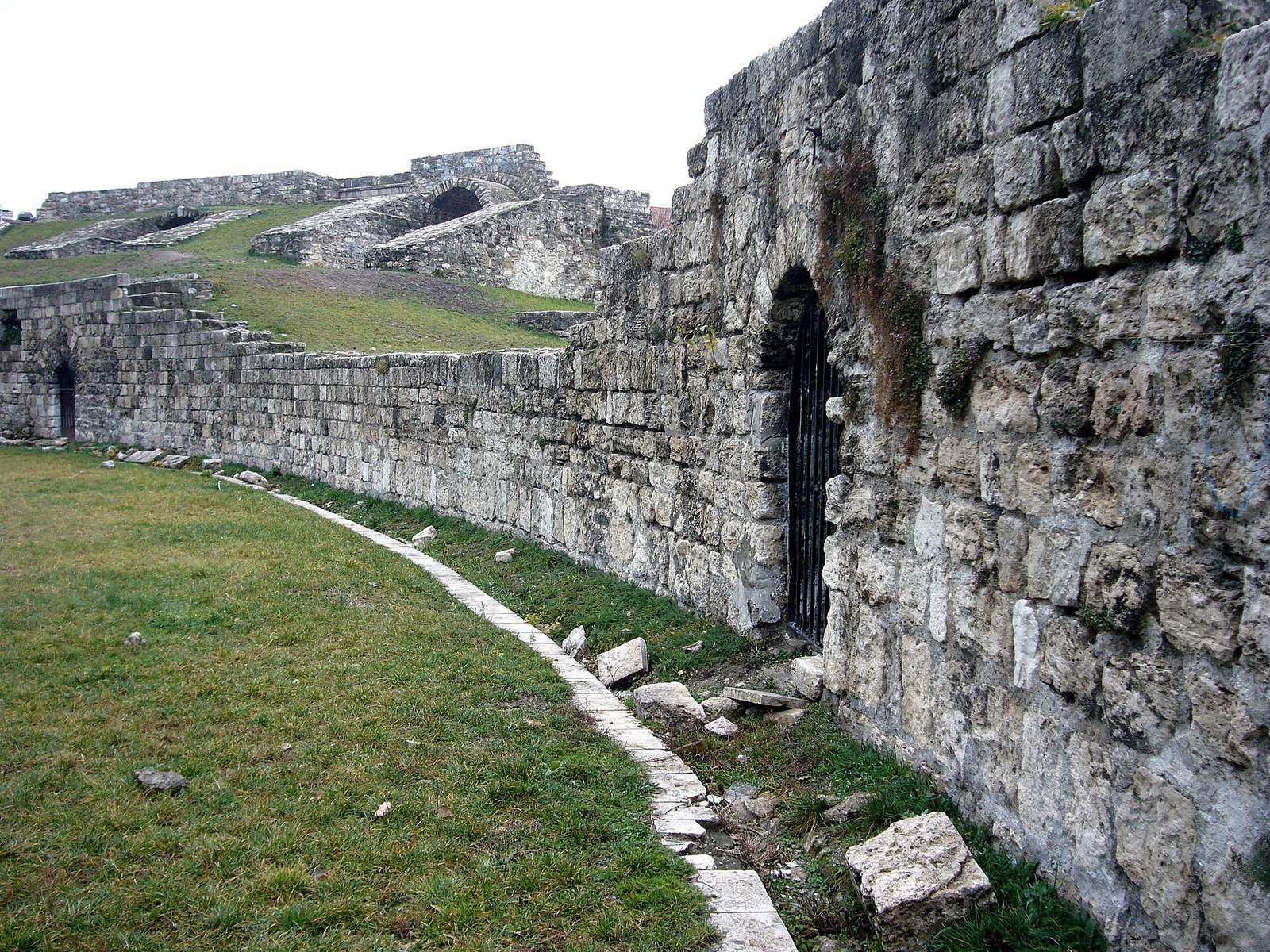
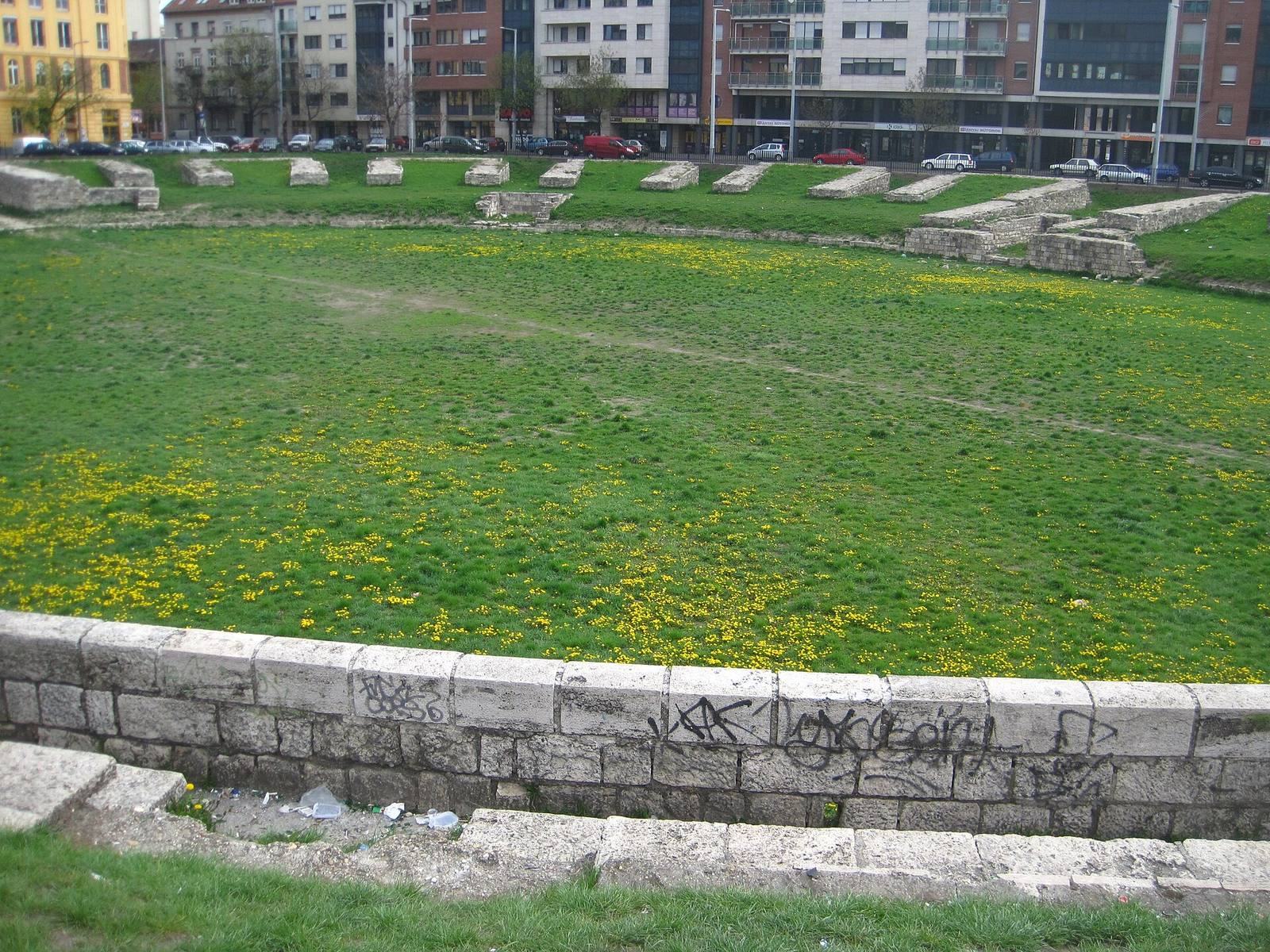
The elliptical amphitheatre occupies a natural hollow south of Aquincum’s military camp, at the southern end of the canabae, the civilian settlement associated with a Roman military camp. It was the larger of Aquincum’s two amphitheatres; the civil amphitheatre stood farther north. The building measures about 131.8 by 108.4 metres, and its arena is approximately 89.6 by 66.1 metres. The arena was larger than the Colosseum’s, and the amphitheatre was among the largest Roman examples outside Italy. Estimated seating capacity ranges from 10,000 to 13,000. The seating rested on an earth bank, while inner and outer stone walls enclosed earth packing. The stonework included 24 U-shaped wall sections and a podium wall, the barrier between arena and seating. The inner wall originally stood about four metres high, with up to 2.5 metres surviving; the outer wall was higher.
Arena and access
Four entrances opened into the arena, with animal cages incorporated into the eastern and western entrances. Twenty additional entrances served the seating, which was reached by stairways with vaulted ceilings. Parts of the stair system and projecting support walls survive. Five cells in the inner wall may have held animals or provided spaces for their keepers during performances. A northern niche is identified as the porta Libitinae (a gate associated with removing the dead).
Religious and water features
An altar dedicated to Nemesis, a goddess associated with fate and retribution and with amphitheatre games, was found beside the eastern niche. It may have marked her shrine, although the shrine may have stood elsewhere. Inscribed altar stones were also recovered on the eastern side. An underground network of water conduits made it possible to flood the arena.
Preservation
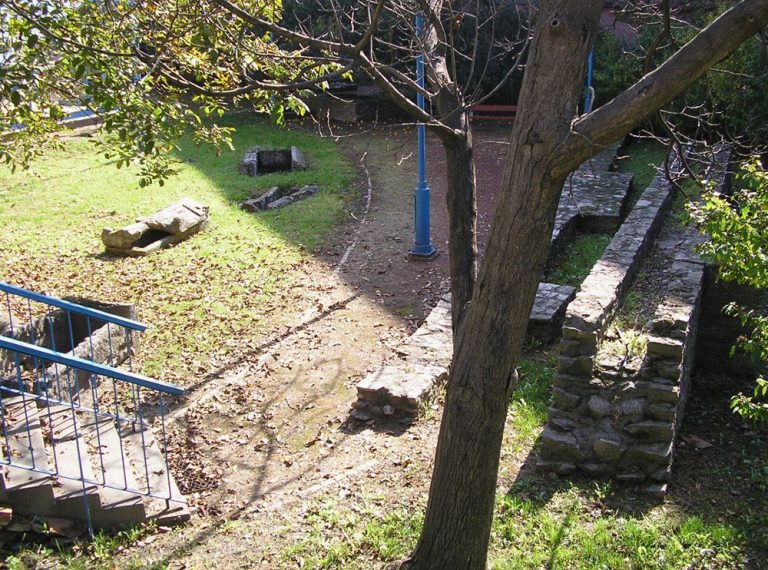
Earth accumulated in the amphitheatre during the Middle Ages. Its foundations have been conserved, and the remains form an open-air archaeological site.