Saint George’s Monastery: An Antiochian Orthodox Monastery in Syria
Site at a Glance
- Popularity
- Medium
- Country
- Syria
- Primary era
- Medieval
- Eras represented
- Medieval, Early Modern, Modern
- Civilizations
- Byzantine, County of Tripoli, Crusader, Ottoman
- Site type
- Religious
- Remains
- Monastery
On this page13 sections
History
Saint George’s Monastery is an active men’s monastery in Almishtaya, Syria, dedicated to Saint George and belonging to the Antiochian Orthodox Church, one of the historic institutions of Eastern Orthodoxy. Its foundation date is uncertain, though tradition places it in the sixth century and links it to Byzantine Emperor Justinian I, ruler of the Eastern Roman Empire. The monastery has served as a regional center of the Greek Orthodox Church since that century.
Early history and medieval development
A possible earlier history connects the monastery with a pagan temple to Humaira, a deity associated with rain. The nature of this connection is uncertain. The earliest known reference to the monastery is by the Persian Muslim historian at-Tabarī, who lived from 839 to 923.
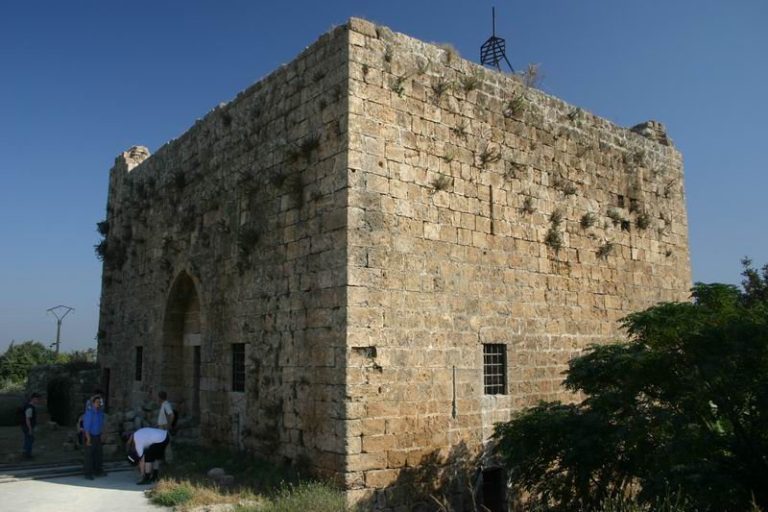
During the twelfth century, while the Crusades were underway, the monastery’s second floor was built. The Crusades were medieval military campaigns, principally led by Latin Christian powers seeking control of lands in the eastern Mediterranean.
Later use and conflict
The church on the third floor was built in the nineteenth century, and the modern church was rebuilt in 1857. Bishop John (Yazigi), later Patriarch John X of Antioch, served as abbot from 1995 to 2002. A theologian and dean of Balamand University’s theology faculty, he played an important part in revitalizing the monastery. Its church school trains clergy and other church workers, and the monastery is a pilgrimage destination for the feasts of Saint George on May 6 and the Exaltation of the Holy Cross on September 14.
During Syria’s civil war, Islamist gunmen attacked the monastery in August 2013. Volunteers defending it drove off the attackers, but eleven defenders were killed. In Holy Week 2014, mortar fire hit a school beside the monastery, killing and injuring several children.
A Saint George icon was stolen and sold in London for £2,500. Interpol recovered it and returned it to the monastery.
Remains
Setting and layout
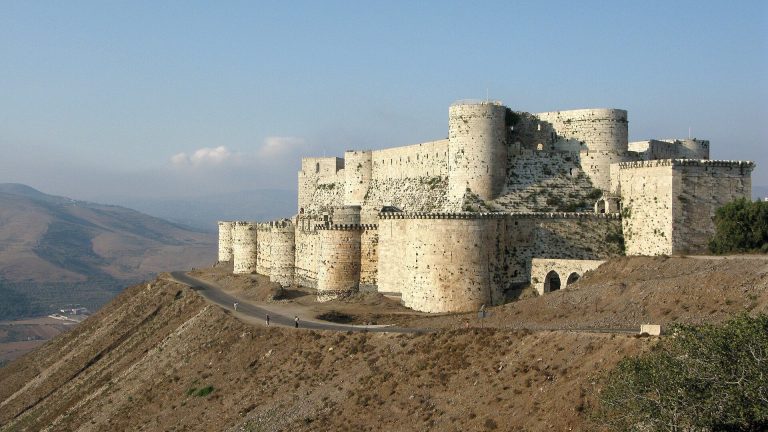
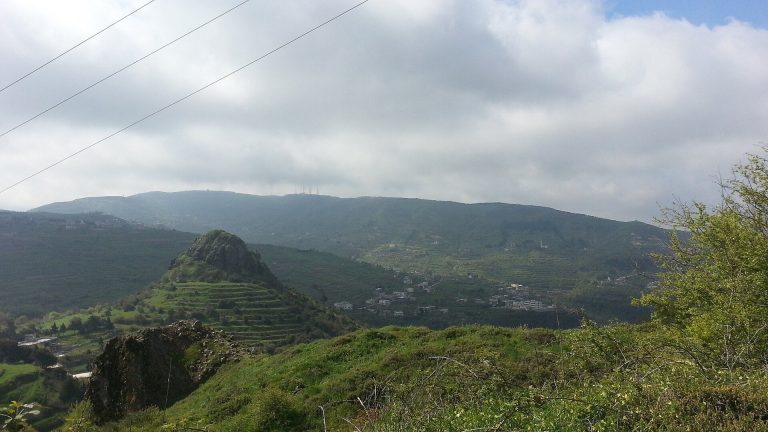
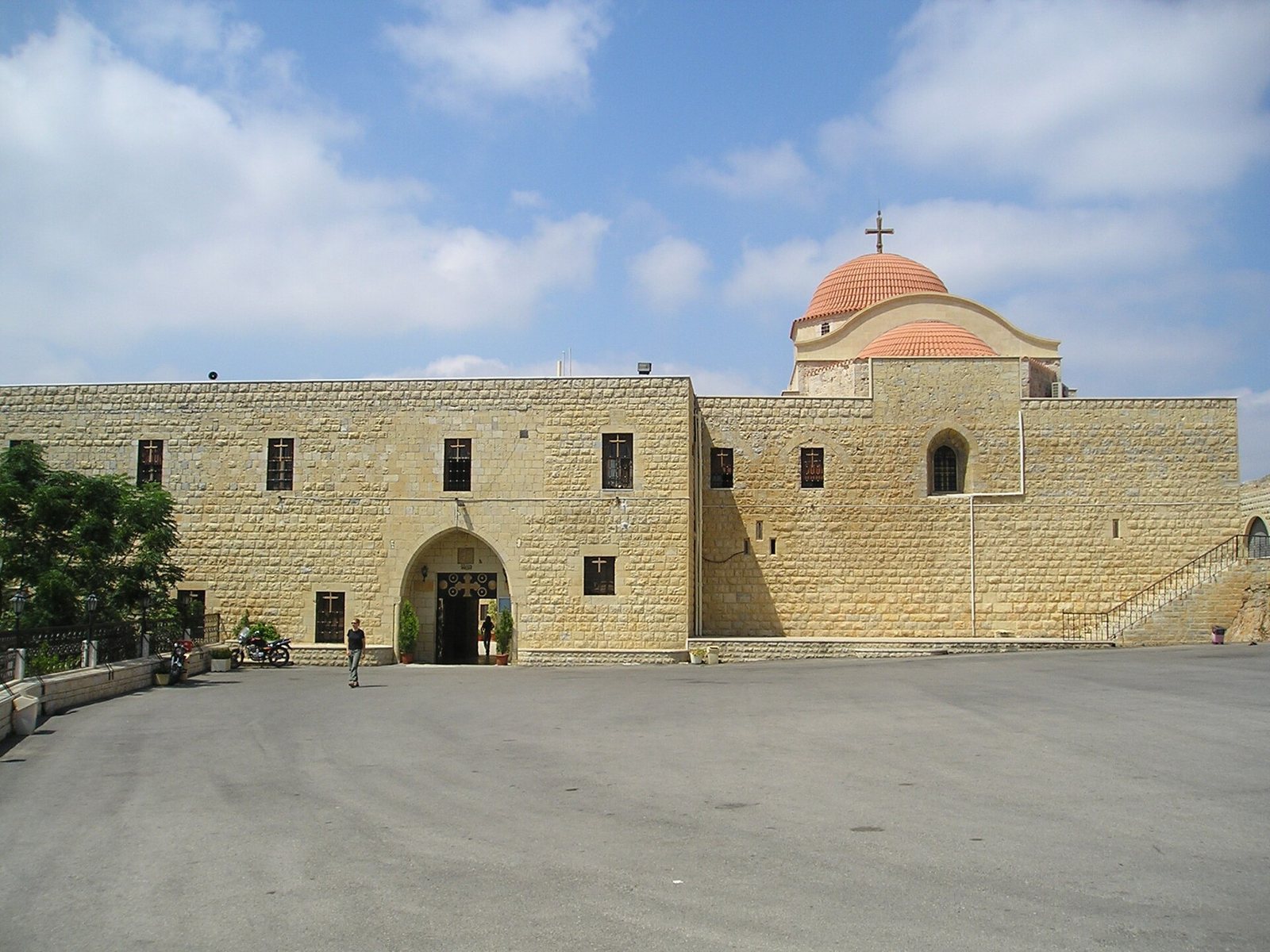
The stone monastery occupies about 6,000 square metres in the Valley of the Christians, near al-Mishtaya and Humaira, around Marmarita in Homs Governorate. It stands on an ancient Roman road linking the coast with inland cities including Homs and Palmyra, about five kilometres northwest of Krak des Chevaliers. Evergreen hills surround the valley, with a park and a spring nearby. The buildings use Byzantine forms, an architectural tradition associated with the medieval Eastern Roman Empire.
Entrances and early spaces
Southern entrance
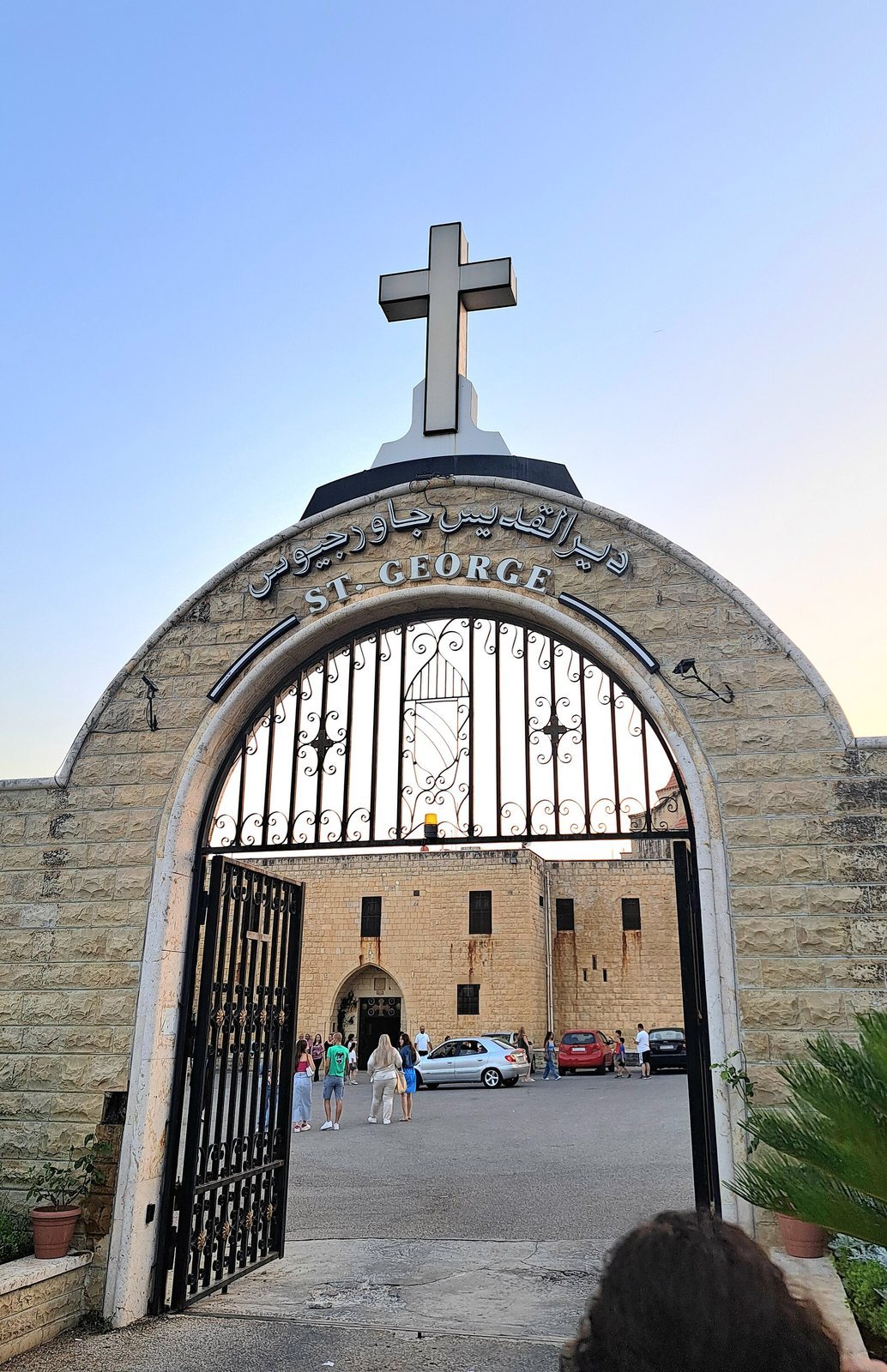
The main entrance on the south has a Byzantine-style facade with three arches and two central columns of Byzantine origin. Its gate, made of black stone, measures 93 by 64 centimetres. A large stone carved with religious imagery is set into the gate. Nearby, a window was used to give bread and food to people in need; a learned monk also taught Orthodox beliefs from it.
Upper and lower entrances
The entrance to the second floor faces west. Made from black stone slabs, it has a sculpted cross above it and is known as the horse gate because horses also passed through its narrow opening. On the lower level, an entrance is believed to have served the original sixth-century monastery. The earliest monastic arrangement centered on a cave with cells for monks, and several large storage vessels, called amphorae, are also found on this level.
Churches and chapel
First-floor church
The first-floor church, known as the old church in contrast with the one above, has semicircular vaulted ceilings and a carved wooden iconostasis, the screen of icons separating the sanctuary from the main worship space. Its eighteenth-century icons combine Byzantine painting with local characteristics, a style that attracted collectors.
Third-floor church
The richly decorated church on the third floor has a wooden iconostasis whose construction took 22 years. A painter from Jerusalem created its nineteenth-century icons. Carved wooden screens also display gold-painted scenes from the life of Christ.
Chapel beneath the courtyard
A chapel beneath the main courtyard dates to the thirteenth century. It has a smaller iconostasis described as more than 300 years old, with icons showing episodes from the life of Saint George.
Collections
The monastery preserves and displays crosses, manuscripts, books, carvings, chalices, trays, documents, and other objects. Its sacristy, a room for church objects, contains grant charters from the period of Arab rule and gifts from Armenian and Georgian princes and Russian tsars. The collection also includes a manuscript by Umar ibn al-Khattab concerning relations between Muslims and Christians.