Church of the Ascension: A Serbian Orthodox Church in Belgrade
Site at a Glance
- Popularity
- High
- Country
- Serbia
- Primary era
- Modern
- Eras represented
- Modern
- Civilizations
- Ottoman, Serbian
- Site type
- Religious
- Remains
- Church
On this page11 sections
History
The Church of the Ascension is a Serbian Orthodox church in Belgrade, Serbia, built from 1861 to 1863 in the Romantic style. Planned to serve a growing congregation connected with the military, it became a parish church and the starting and finishing point of Belgrade’s annual Ascension procession.
Foundation and early service
Before the present church was built, soldiers at the cavalry barracks used a small chapel made from tent fabric. As Belgrade’s population grew, the military complex needed a permanent place of worship, while nearby St. Mark’s Church in Tašmajdan could no longer accommodate its expanding congregation. In 1860, Prince Mihailo Obrenović and Metropolitan Mihailo ordered the new church to be built on land then used as a state nursery for white mulberry trees.
Construction began in spring 1861, and the building was almost complete by the end of 1862. Metropolitan Mihailo consecrated it in March 1863. It first served as a military church; three years later, a decree by the metropolitan established it as a parish church. The church also served military congregations in Serbia and later Yugoslavia. During the Austro-Hungarian occupation in the First World War, Protestants used it for worship.
Parish life and civic traditions
A church house was built in the courtyard in 1865. Part of it housed the Finance Ministry’s Statistics Department, whose section was transferred to the Belgrade Lower Gymnasium in 1886. By 1891 the school rented the entire building except its basement, which was leased to merchants. A second church house was built between July and September that year. After the gymnasium moved out in 1906, a women’s teacher-training college used the premises until 1935; businesses and institutions later rented them.
The church is dedicated to Spasovdan, the Serbian Feast of the Ascension, which is also Belgrade’s slava, a communal Orthodox patronal feast. Its observance recalls 1403, when Despot Stefan Lazarević, a high-ranking title-bearing Serbian ruler, made Belgrade the Serbian capital. A procession traditionally begins and ends at the church. On 5 October 1912, King Peter I Karađorđević departed from the church for the Balkan War and later returned to give thanks for victory. A plaque on the western gate commemorates his departure.
War, damage, and restoration
In 1914, an Austro-Hungarian shell fired from a monitor on the Sava struck the church but failed to explode. It was removed in the early 1920s, while services continued. Repair work begun in December 1920 continued until 1923, and the church underwent a major repair in 1937. As German and Austro-Hungarian forces retreated at the end of the First World War, bells were taken from churches across Belgrade; one bell remained at the Church of the Ascension.
In April 1940, the largest bell fell and killed the boy who was ringing it. On 6 April 1941, German bombing struck the churchyard, where people had taken shelter in a trench, and partly damaged the church. About 200 people were killed. Around 180 bodies were later recovered and taken to New Cemetery for burial. About 20 days after the attack, German forces made prisoners of war and Jewish people search for human remains. Allied bombing also struck the church in 1944.
Repairs followed in several stages: the church was partly restored in 1945–47, its exterior was restored in 1958, and its interior was restored by 1962. Serbian Patriarch German consecrated it on 25 November that year. After the 1947 Ascension procession was attacked by communist youth activists, the procession was prohibited. It resumed in 1993, following a 46-year interruption. The church belongs to the Serbian Orthodox Church and the Belgrade-Karlovci Archdiocese, and it was declared a cultural monument in 1969.
Remains
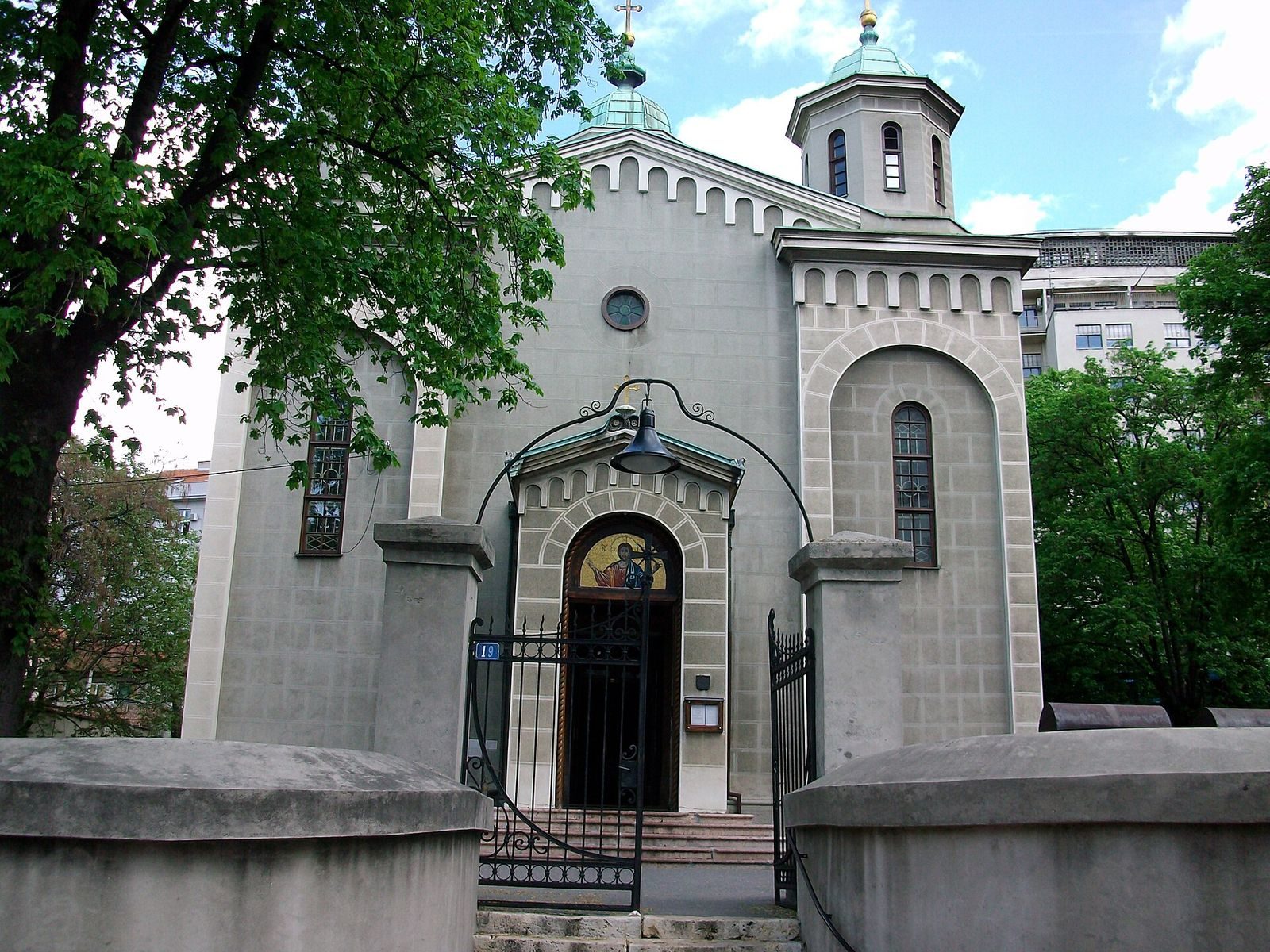
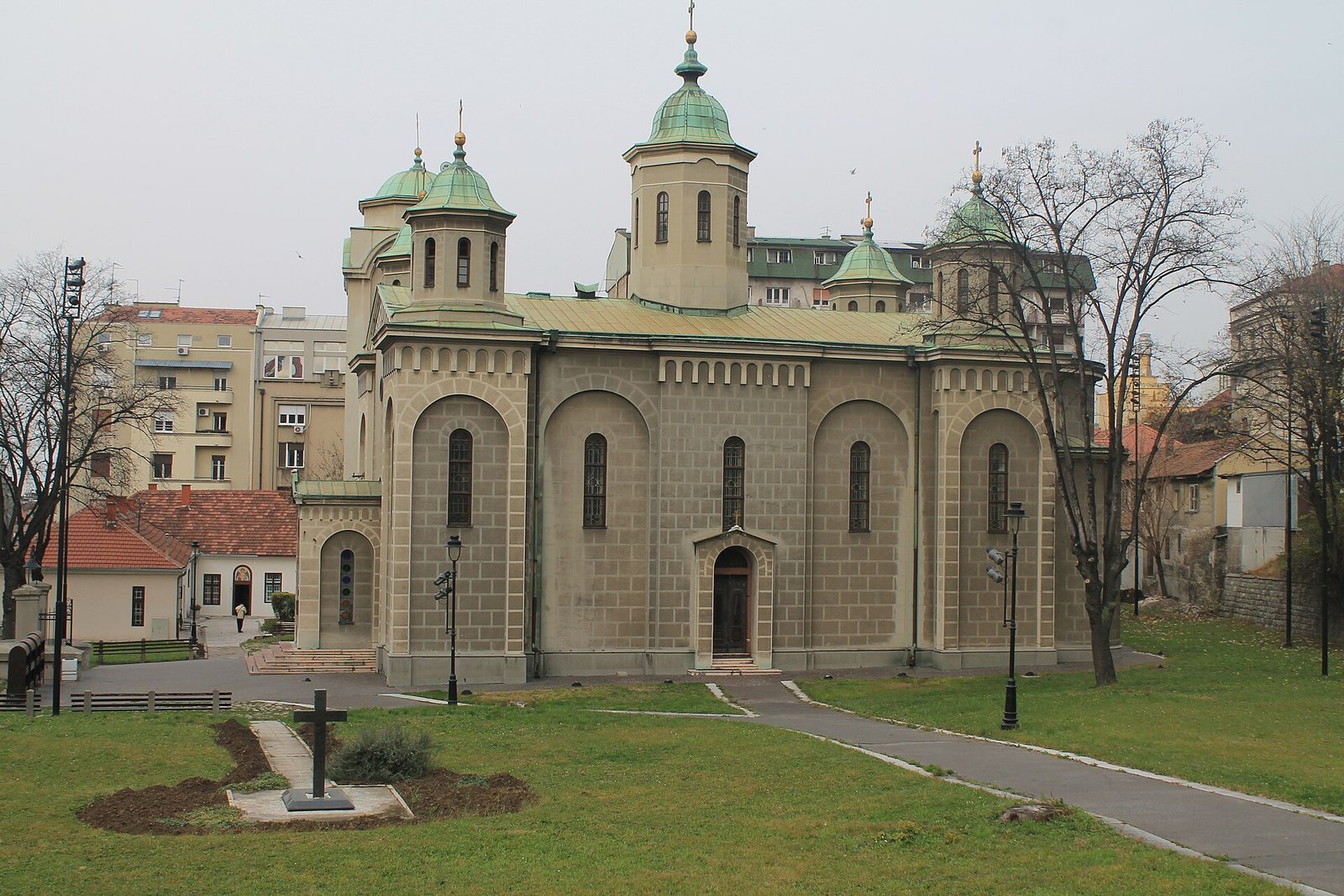
The church complex occupies a city block bounded by Kneza Miloša Street to the east, Kraljice Natalije Street to the north, Dobrinjska Street to the west, and Admirala Geprata Street to the south. Designed in the Romantic style and modeled on old Serbian monasteries, especially Ravanica, the church required specially built foundations because the ground proved unexpectedly yielding.
Church building and interior
Structure and exterior
The church’s façade dates to 1870 and was renovated in 2013. Its stairs are made of black Hungarian marble. These features belong to a building whose design drew on Serbian Orthodox monastic architecture.
Interior and treasury
Nikola Marković painted the first icons in 1864 and was commissioned to make the original screen of icons near the end of 1862. Stevan Todorović replaced or reworked the icons and screen in 1880–81. Andrej Bicenko’s compositions replaced Marković’s original wall paintings in 1937; Bicenko’s frescoes cover the walls and the area beneath the dome. Artist Jaroslav Kratina restored the frescoes and interior in 1962. The frescoes were refreshed in the early 2000s, and the icons and screen were conserved in 2006. The church treasury contains nineteenth-century icons, old books, goldwork, and other objects.
Courtyard features
Bell tower and bells
The original wooden bell tower collapsed, and a replacement was built in the 1940s. A bell used at the church had previously been kept at the Cathedral Church of St. Michael the Archangel. It is associated with the announcement at Tašmajdan of the Ottoman imperial decree of 1830 and is now operated by an electric mechanism.
Memorial and grounds
A black marble cross erected in the 1970s commemorates people killed in the 1941 bombing. Conifers planted in 1906 were uprooted in that attack. In 2013, chestnut, black locust, and lime trees more than 50 years old were cut down after inspections found them rotten and their falling branches hazardous.