Manak’s House: A Nineteenth-Century House and Museum in Belgrade, Serbia
Site at a Glance
- Popularity
- Medium
- Country
- Serbia
- Primary era
- Modern
- Eras represented
- Modern
- Civilizations
- Ottoman, Serbian
- Site type
- Domestic
- Remains
- House
On this page7 sections
History
Before Savamala’s redevelopment
Manak’s House is a residence in Savamala, Belgrade, Serbia, generally dated to around 1830, before the district’s later regulation and redevelopment. At the time, Savamala and Palilula were Belgrade’s only suburbs populated predominantly by Serbs. The house is thought to have been built around the same time as the Residence of Princess Ljubica, wife of Prince Miloš Obrenović, and a tavern.
After Miloš received the Sava riverfront as a gift from a Turkish pasha, he set out to modernize Belgrade. Development proceeded without a consistent plan: landowners built on their plots as they chose, while streets followed the terrain and practical needs. As buildings were cleared and new streets cut through the area, Miloš ordered that the house be preserved.
Tradition identifies the house as a post station on a route used by Miloš’s mounted couriers. They carried official letters and state papers, stopping at relay stations to rest and change horses. Another legend says the house was intended for an Ottoman agha, a title for certain officials or military figures, and his harem.
Manak’s ownership
In the 1870s, the Greek Manojlo Manak bought the house. He operated a bakery and tavern on the ground floor and lived upstairs. The house was named for his cousin, Manak Mihailović, and older Belgrade residents remembered it as a tavern. The oldest photograph of the building held by the Belgrade City Museum shows a sign bearing the name Arsa Petrović and tables on the sidewalk. Architect Štaudinger and graphic artist Luka Mladenović also recorded its appearance.
Preservation and museum use
By the mid-1950s, the house had deteriorated and was in danger of collapse, but demolition was prevented. It was designated a cultural monument in 1963 and a cultural property of great importance in 1979. The Belgrade Cultural Heritage Preservation Institute carried out restoration and conservation from 1964 to 1968 under architect Zoran Jakovljević.
The work was undertaken partly to accommodate the collection of Hristifor Crnilović (1886–1963), a Serbian painter and collector of folk and ethnographic material. After his collection was donated to the City of Belgrade, the restored house was assigned to the Ethnographic Museum for its storage, care, and display. Today, the house serves as a museum and cultural and educational venue, with exhibitions and workshops in traditional crafts such as hand weaving and ceramics, as well as instruction in classical graphic techniques.
Remains
House structure and restoration
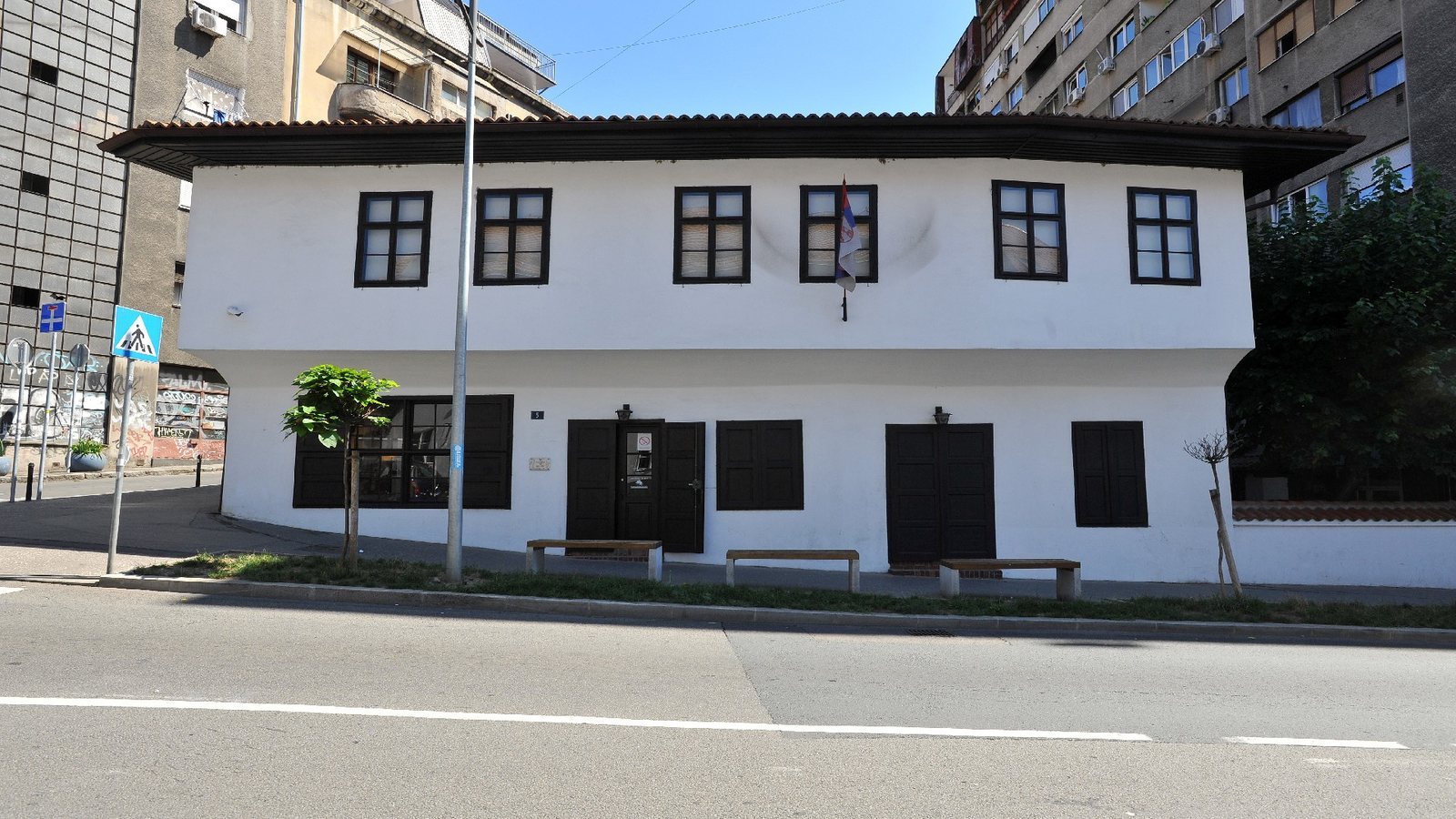
On the outskirts of Savamala, the house stands at the corner of Kraljevića Marka and Gavrila Principa streets, following the old street alignment. Its irregular room arrangement reflects the inherited street pattern and sloping ground. The building has a basement, ground floor, intermediate level, and upper floor. Its timber frame is filled with unfired bricks set in mud, and the roof is tiled. This construction and adaptation to the site reflect Belgrade’s domestic building practices of the period.
During restoration, the foundations were reinforced and the timber frame replaced, while the rooms’ arrangement and dimensions were retained. Wooden ceilings, fireplaces, and stairs were preserved. The projecting balcony was completely rebuilt by comparison with buildings of similar period and architecture in Belgrade, Grocka, and Sopot.
Ethnographic collection
The house holds Crnilović’s collection, including traditional costumes from Kosovo and Metohija and southern Serbia, along with material relating to folk customs, jewelry, furniture, and everyday objects. An ethnographic display is maintained on the ground floor.