Yonghe Temple: An Imperial Tibetan Buddhist Monastery in Beijing
Site at a Glance
- Rating
- 4.7
- Popularity
- High
- Country
- China
- Primary era
- Early Modern
- External website
- Open
- Eras represented
- Early Modern
- Civilizations
- Qing
- Site type
- Religious
- Remains
- Monastery
On this page14 sections
History
Yonghe Temple is a Tibetan Buddhist monastery in Beijing’s Dongcheng District, China, whose construction began in 1694 under Qing rule. Its architecture brings together Han Chinese and Tibetan traditions, and its religious affiliation is with the Gelug school, a major Tibetan Buddhist tradition known for its organized monastic life. It became one of the largest Tibetan Buddhist monasteries in China proper and, during the middle and late Qing dynasty, was regarded as the country’s highest-ranking Buddhist temple.
Palace residence under the Qing
The complex was built on the site of a Ming-dynasty residence for court eunuchs. In 1702, the Kangxi Emperor granted it to his fourth son, Yinzhen, who moved there in May 1703. Yinzhen’s promotion in 1709 from second-rank to first-rank prince brought a new name for the property, the Residence of Prince Yong of the First Rank. His son Hongli, later the Qianlong Emperor, was born in the East Academy in 1711.
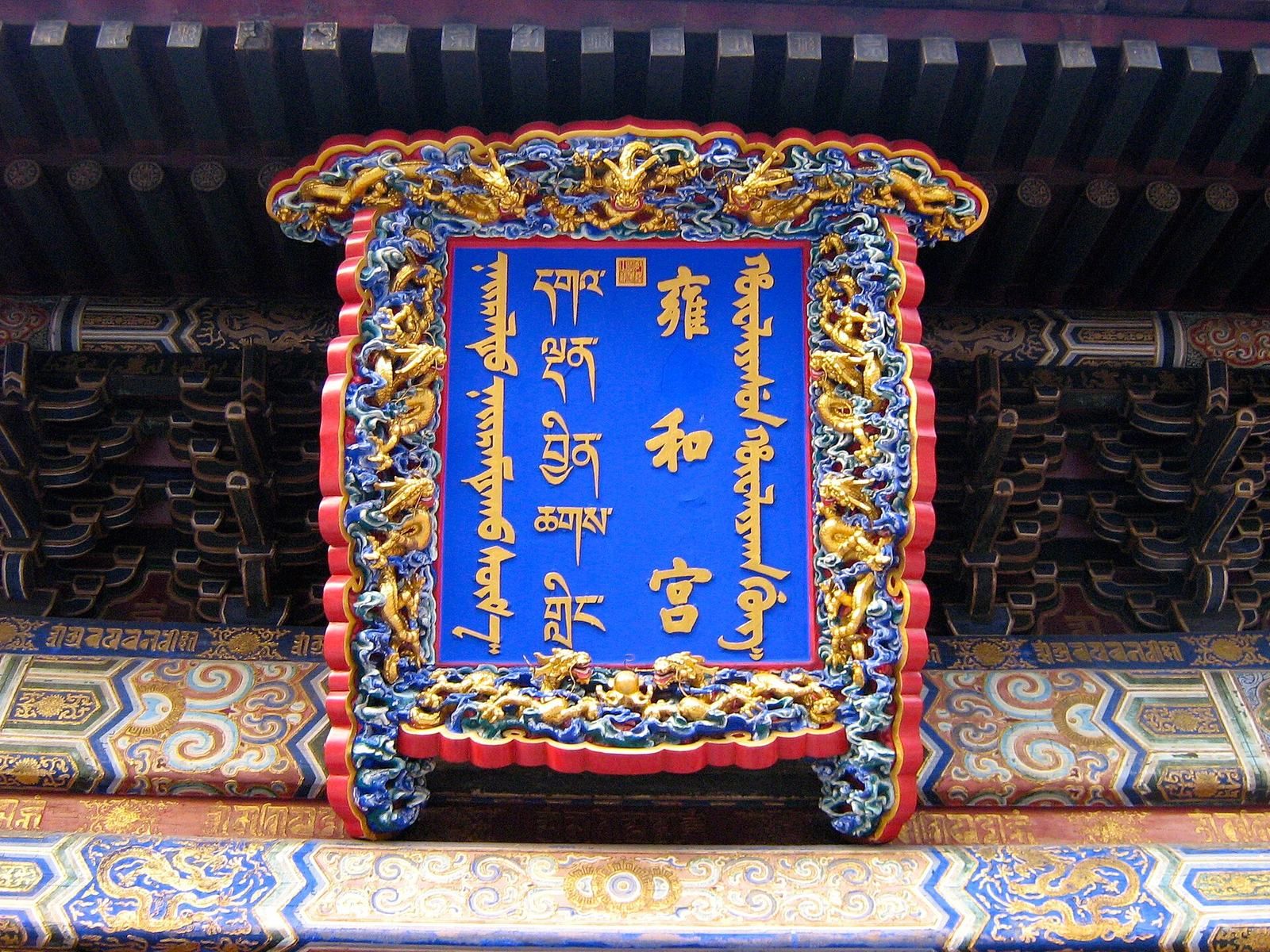
When Yinzhen became the Yongzheng Emperor in 1722, the residence was elevated to the Palace of Peace and Harmony. After Yongzheng died in 1735, his coffin remained there until 1737.
Conversion into an imperial monastery
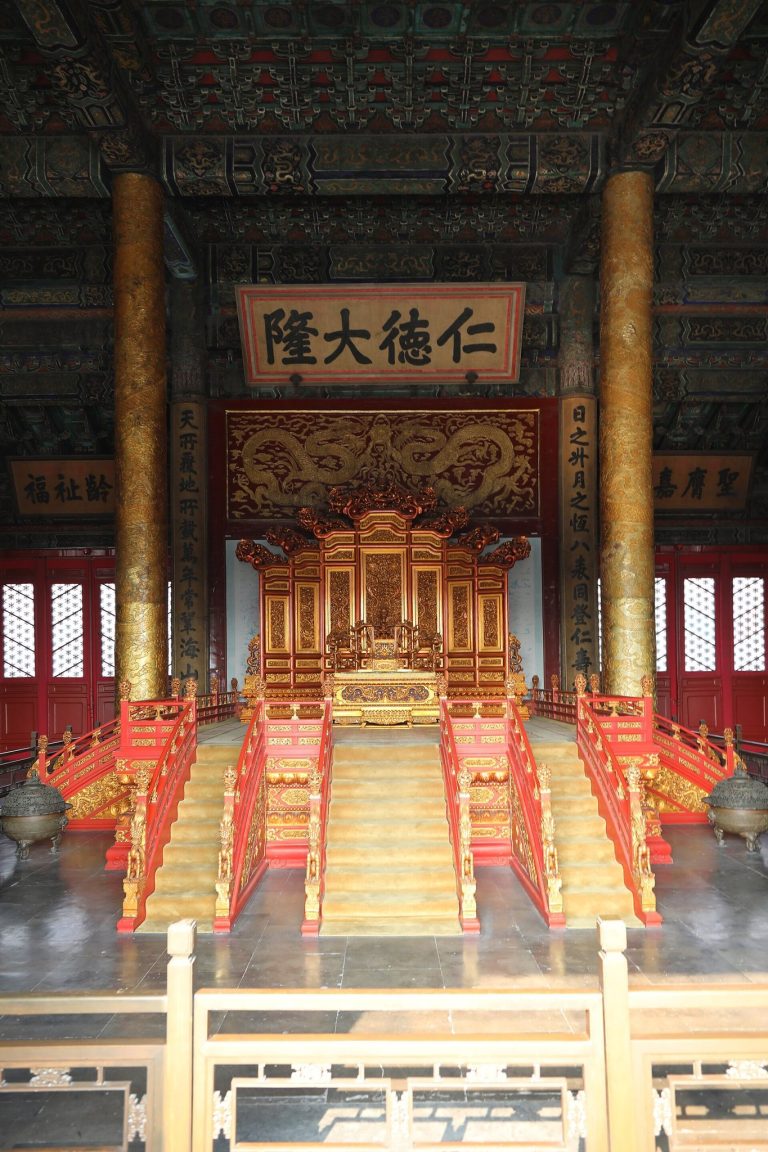
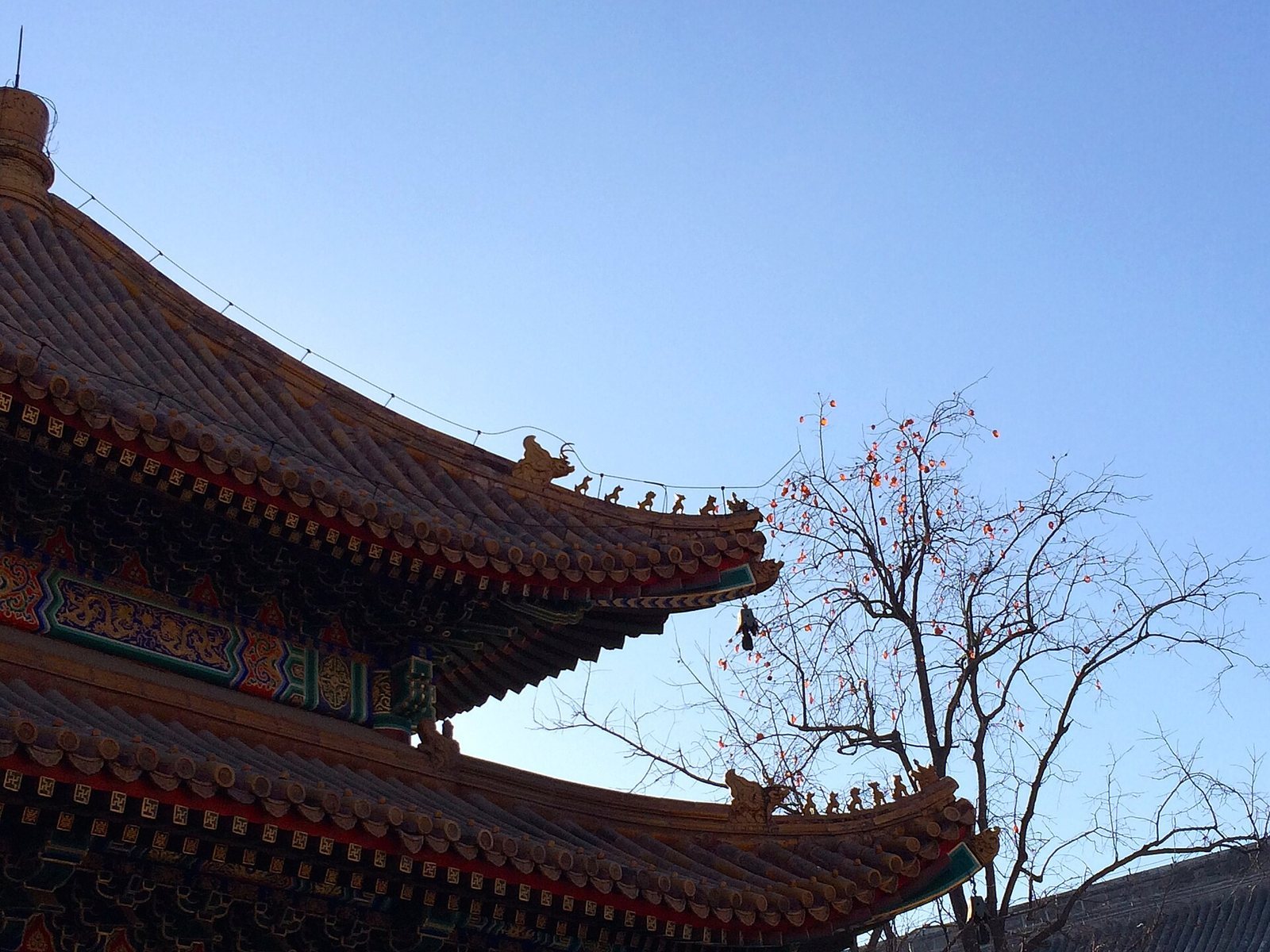
Qianlong granted the complex imperial status, including by replacing turquoise roof tiles with yellow tiles reserved for imperial buildings. In 1744 he ordered the palace converted into a lamasery, or Tibetan Buddhist monastery. The Buddhist images were consecrated in 1745, and the institution went on to house many monks from Tibet and Mongolia. It became a national center for the administration of Tibetan Buddhism.
Under Qing rule, an appointed prince or second-rank prince supervised secular affairs. The Imperial Household Department and the Ministry of Foreign Affairs managed administrative matters, while religious leadership rested with a senior Khenpo, a monastic teacher generally from Tibet. In 1936, the formal title for the temple’s religious head changed to abbot.
From 1792, the temple also took part in the Qing Golden Urn procedure, used to select or confirm certain high-ranking Tibetan and Mongolian Buddhist reincarnations. The temple’s cham, a masked ritual dance performed in Tibetan Buddhism, is first recorded at a 1746 banquet held by Qianlong for a Dzungar envoy. During the Guangxu Emperor’s reign, the performance was rescheduled as an eight-day event.
Twentieth-century history
An armed revolt against the Chinese Nationalist government took place at the temple in 1929. Following the Chinese Civil War, it was declared a national monument in 1949 and closed for about 32 years. Repairs were made in 1950 and 1952, and the temple was designated a national relic in 1961.
The temple survived the Cultural Revolution, reportedly after Premier Zhou Enlai intervened. Restoration work followed in 1979, and it reopened in 1981. The government restored its national monument status in 1983. The cham performance, suspended while the temple was closed during the Cultural Revolution, resumed in 1987.
Yonghe Temple remains a functioning Buddhist temple affiliated with the Gelug school. Lama Hu Xuefeng is identified as its religious head.
Remains
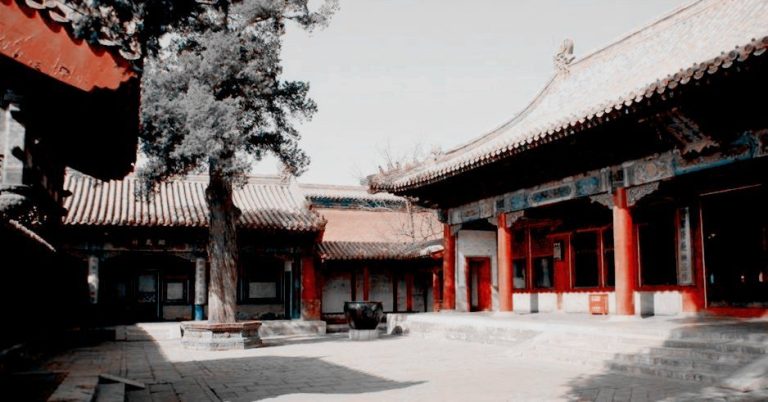
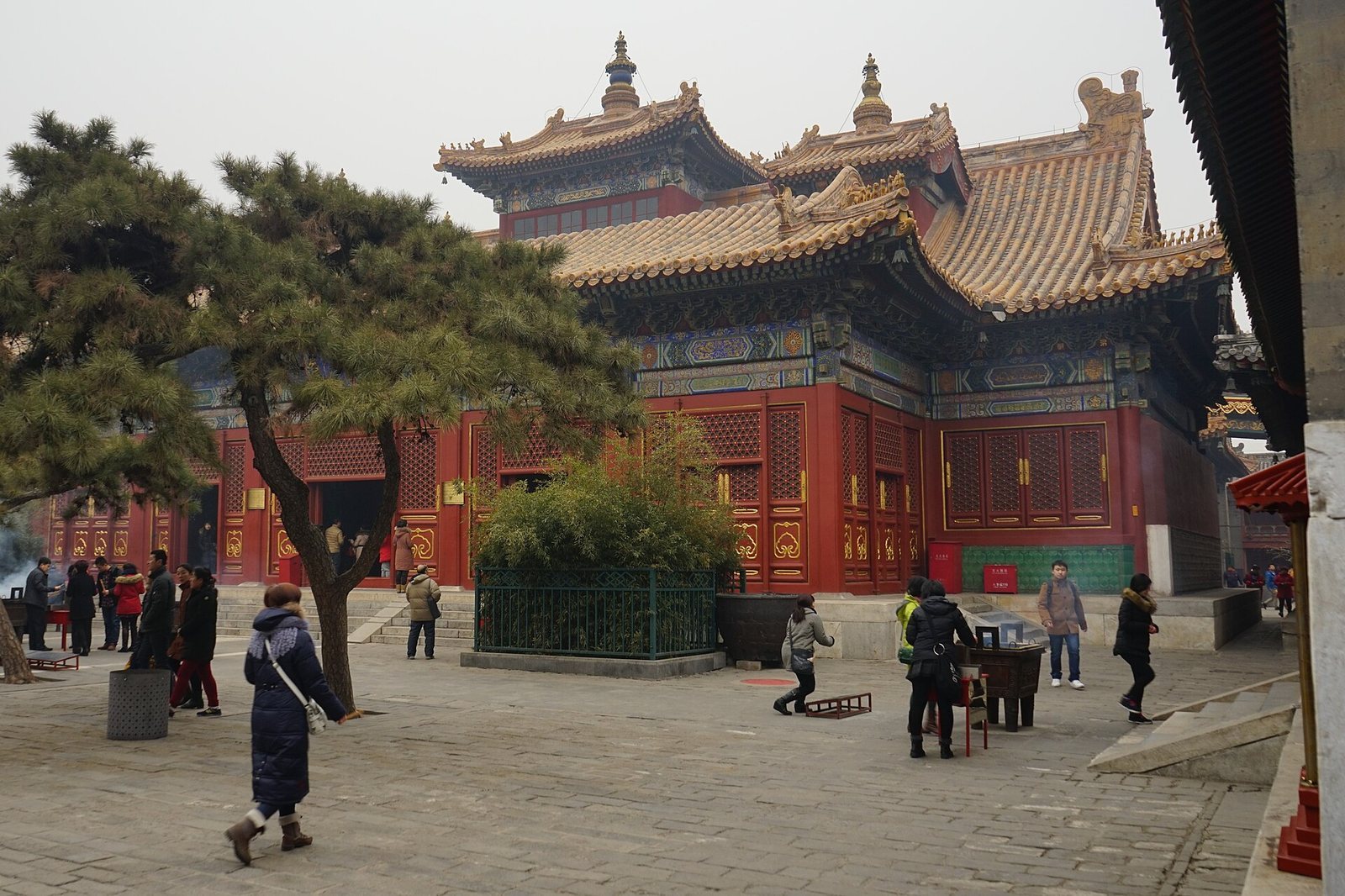
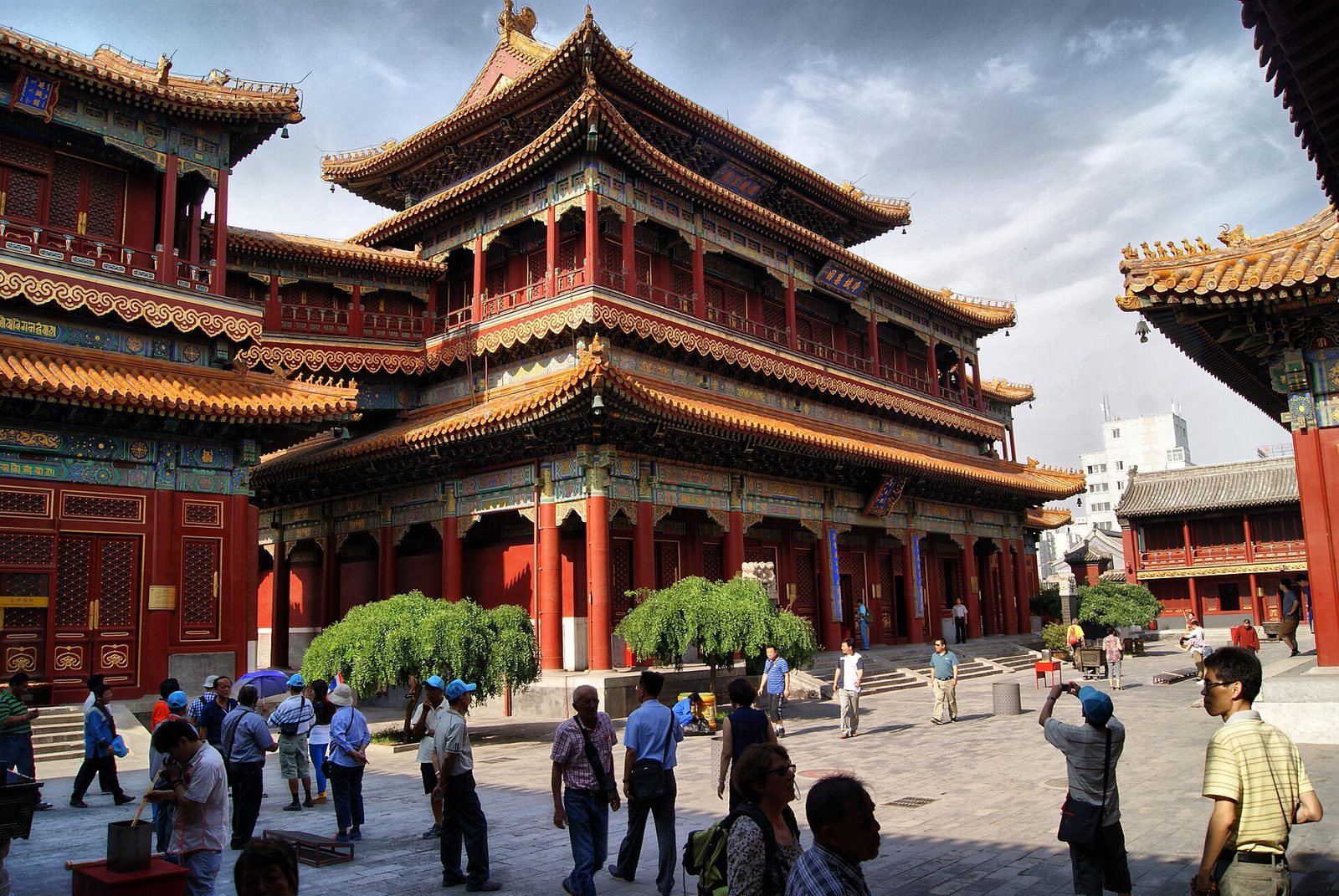
The complex covers about 66,400 square metres and is laid out along a south-to-north axis approximately 480 metres long. Five principal halls stand in sequence, with courtyards between them. The buildings combine Chinese and Tibetan architectural traditions, and balconies and suspended corridors link some halls and sanctuaries. The temple’s sculptural and painted imagery follows Gelug practice, with ritual halls dedicated to Vajrabhairava, Guhyasamaja, and Chakrasamvara.
Southern entrance and first courtyard
Imperial approach
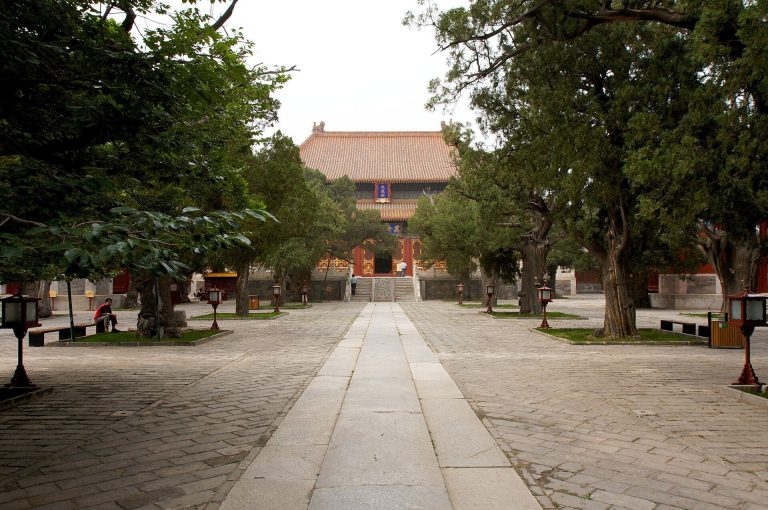
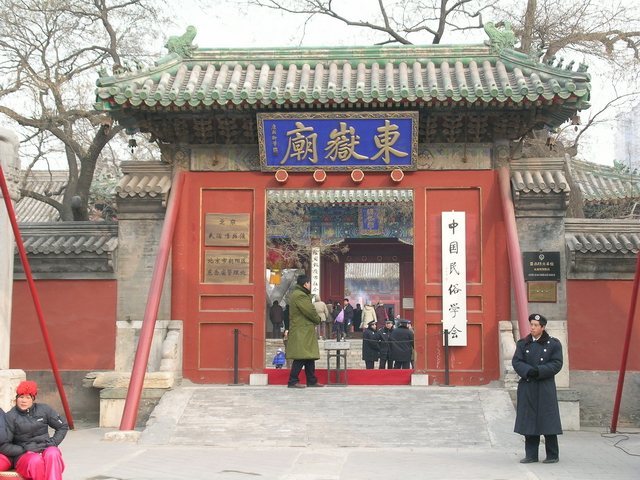
Three memorial archways mark the southern entrance. From there, the Imperial Carriage Way, an approach for imperial vehicles, extends about 170 metres to the Gate of Clarity and Prosperity.
Gate Hall of Harmony and Peace
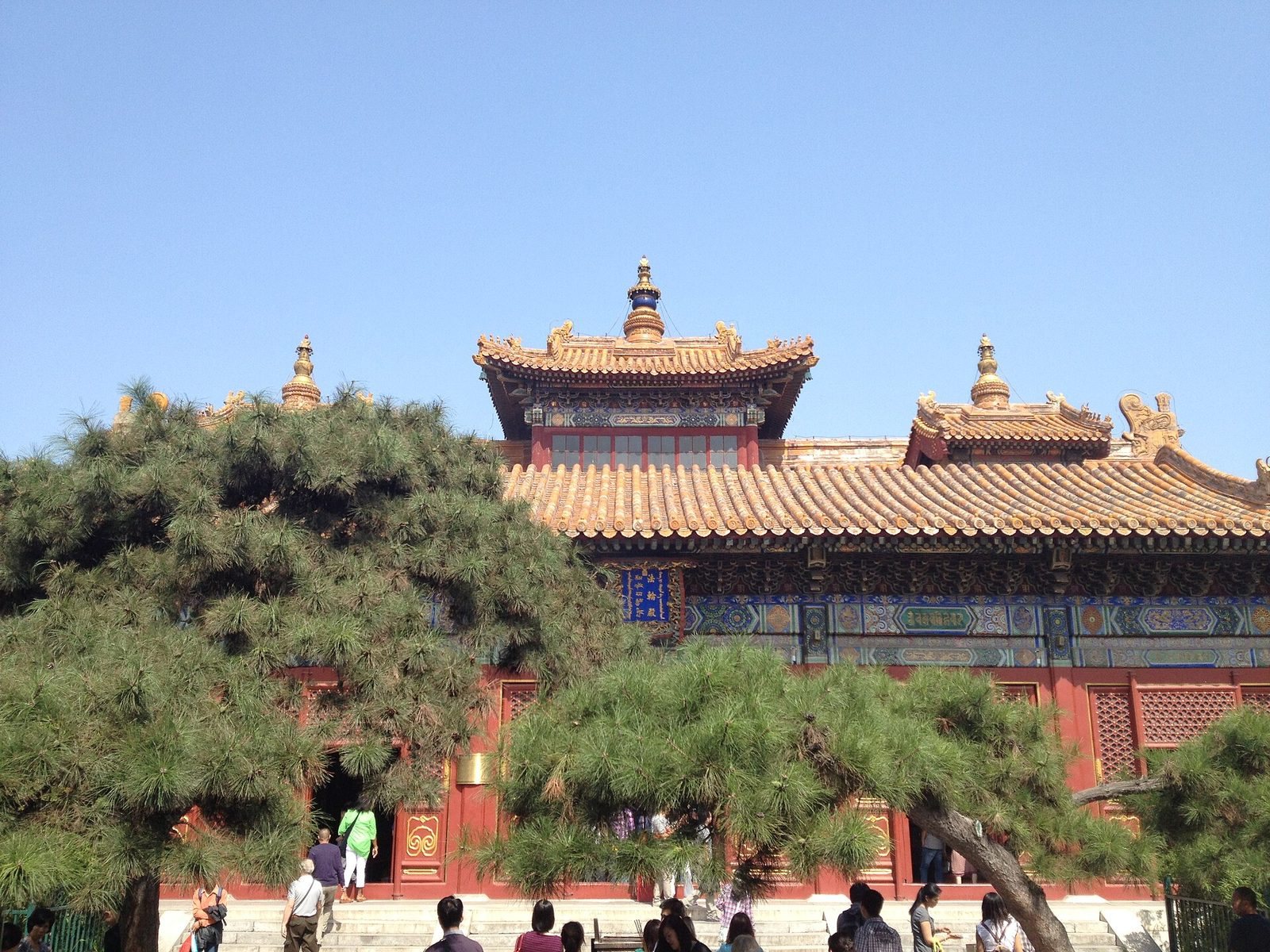
The Gate Hall of Harmony and Peace was originally the palace’s main entrance and later became the Hall of the Heavenly Kings. Maitreya, the Buddha of the future, stands at the center, with statues of the four Heavenly Kings along the walls. A sandalwood figure of Skanda, a Buddhist protector, stands at the rear. Bronze statues of a male and a female lion are positioned near the entrance.
Inscriptions and courtyard furnishings
Two inscribed-stone pavilions in front of the Gate Hall contain texts in Chinese, Manchu, Tibetan, and Mongolian. One inscription, erected in 1744, marks the palace’s conversion into a monastery; the other, raised in 1792, contains a statement by Qianlong addressing abuses in the administration of reincarnation. In the courtyard beyond, a four-metre bronze incense burner cast in 1742 stands with bell and drum towers and eastern and western inscription pavilions.
Halls beyond the gate
Hall of Harmony and Peace
The principal central hall contains three bronze Buddhas representing past, present, and future. Gautama Buddha, representing the present, occupies the center; Dīpankara, associated with the past, stands on the right; and Maitreya, associated with the future, is on the left. Eighteen arhats, Buddhist disciples who have attained a high level of spiritual realization, line the sides. A mural depicts Avalokiteśvara, a Buddhist figure associated with compassion, and statues portray Gautama’s disciples Ānanda and Mahākāśyapa. In front of the hall, a Ming-period bronze sculpture of Mount Sumeru represents the Buddhist universe’s central mountain and its Three Worlds of paradise, the earthly realm, and hell.
Hall of Everlasting Protection
The hall’s devotional images include Bhaisajyaguru, the Medicine Buddha, and sandalwood statues of Simhanada, Amitayus, and Bhaisajyaguru.
Hall of the Wheel of the Law
Used for reading scriptures and religious ceremonies, this hall contains five gilded pagodas and a six-metre gilded statue of Je Tsongkhapa, the Tibetan teacher traditionally regarded as the founder of the Gelug school. It also holds the Five-Hundred-Arhat Hill, carved from red sandalwood. Its arhat figures are made from five metals: gold, silver, copper, iron, and tin.
Pavilion of Ten Thousand Happinesses
Also known as the Hall of Boundless Happiness and the Great Buddha Tower, the pavilion contains a Maitreya statue carved from a single piece of white sandalwood. The statue measures 26 metres from its base to its top, with 18 metres above ground and a further eight metres below. The seventh Dalai Lama presented it to Qianlong, and its transport from Tibet to Beijing took three years. It was included in the Guinness Book of Records in 1993.