Choragic Monument of Thrasyllos: A Choral Victory Monument in Athens
Site at a Glance
- Popularity
- Medium
- Country
- Greece
- Primary era
- Classical
- Eras represented
- Classical, Early Modern
- Civilizations
- Ancient Greek, Kingdom of Macedon, Ottoman, Roman
- Site type
- Civic
- Remains
- Monument
On this page7 sections
History
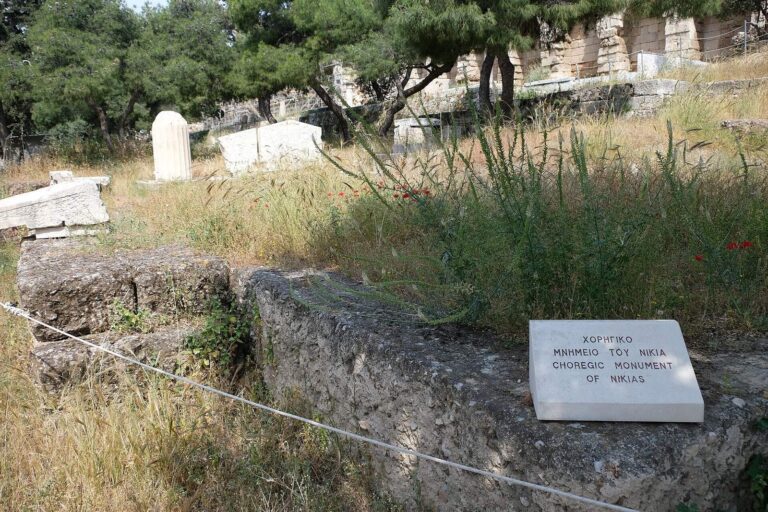
The Choragic Monument of Thrasyllos is an ancient Greek victory monument on the southeastern side of the Acropolis in Athens, Greece. It was built in 320–319 BCE in the form of a small temple. Thrasyllos, a choregos from Dekeleia, erected it to mark his victory in a men’s chorus competition for Hippothontis, one of Athens’ civic tribes. A choregos was a citizen who sponsored and organized a chorus for a competition as part of Athens’ system of civic support for performances.
Dedication and later victories
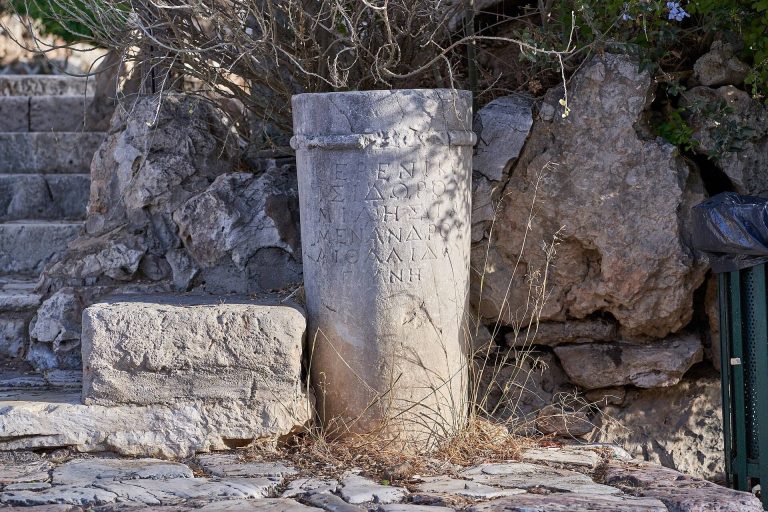
The monument’s inscription names Euios of Chalkis as flute player, Neaichmos as archon, a senior civic magistrate, and Karidamos son of Sotios as director. Around 270 BCE, Thrasyllos’s son Thrasykles modified the monument while serving as the official who presided over festival contests. Inscriptions record two further victories: a boys’ chorus for Hippothontis and a men’s chorus for Pandionis, another Athenian tribe. They name Pytharatos as archon and the demos, the civic body of the people, as choregos. The listed flute players are Theon and Pronomos of Thebes and Nikokles of Ambracia; the directors are Pronomos of Thebes and Lysippos of Arcadia.
Christian reuse and damage
During the Byzantine period, the era of the medieval Eastern Roman Empire, the cave became a chapel or church dedicated to the Virgin Mary, known as Panaghia Chrysopeliotissa. Under Ottoman rule, the church took its present form, with an iconostasis, a screen bearing religious images, painted interior rooms, and chapels at different levels. It remained in use until the late twentieth century. A statue of Dionysos may have been mistaken for a female figure and may have helped prompt the dedication to Mary.
The statue was probably a later addition, perhaps made during Phaidros’s repair of the Theatre of Dionysos in the fourth century CE. Eighteenth-century records by James Stuart and Nicholas Revett show it in place of the original tripods, three-legged prize stands. Lord Elgin removed the statue in 1802. Its removal spared it from the Ottoman bombardment that destroyed the monument during the 1827 siege of Athens.
Documentation and restoration
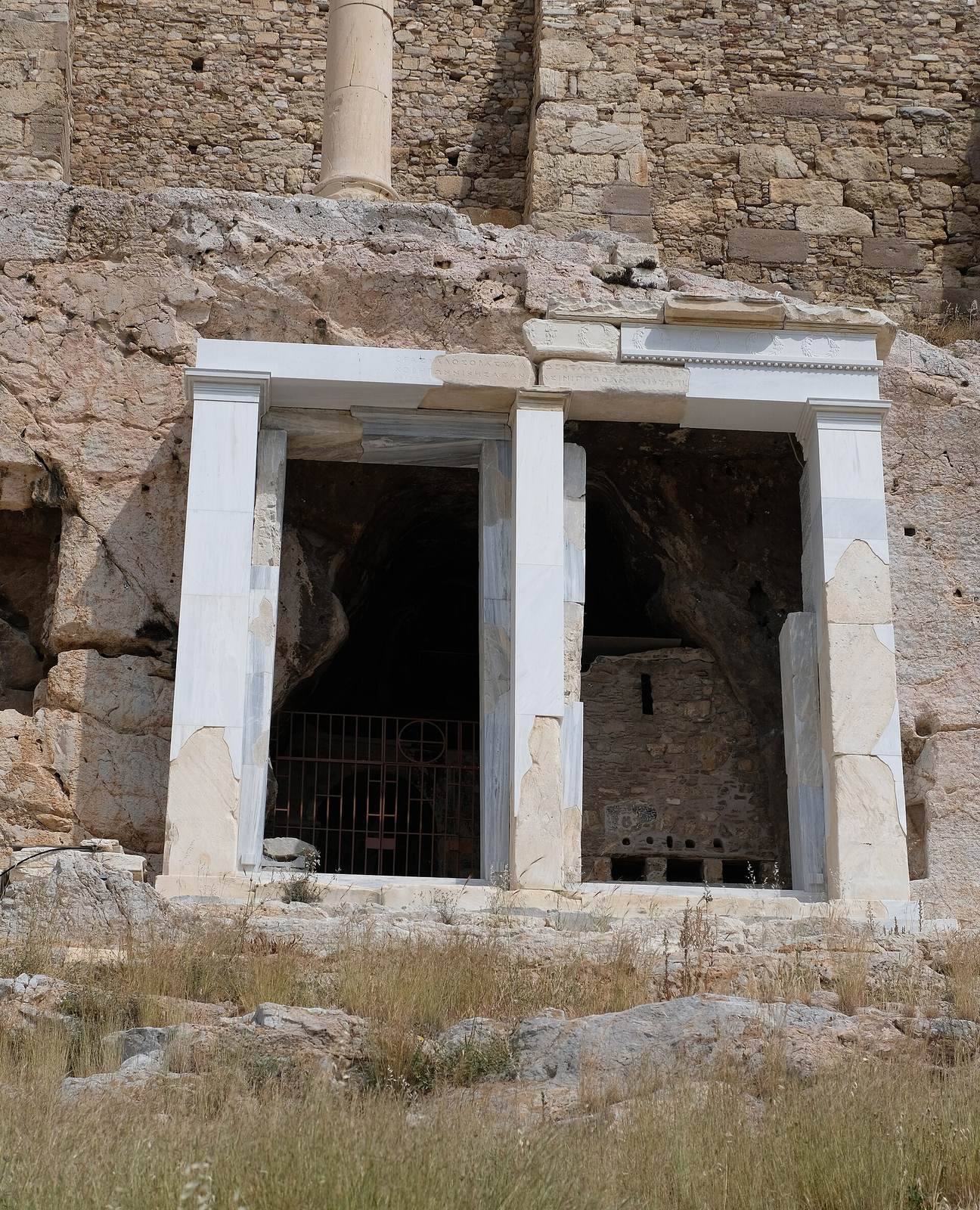
Stuart and Revett’s records, together with J. D. Le Roy’s 1758 book Ruines des plus beaux monuments de la Grece, helped spread the monument’s architectural influence. Karl Friedrich Schinkel and Alexander Thomson adopted its post-and-lintel construction, in which upright supports carry a horizontal beam. In the nineteenth century, a restoration planned by the Athens Archaeological Society did not prevent some marble from being recut and reused in the restoration of the Byzantine Church of Soteira Lykodimou, now known as the Russian Church of Athens. Restoration and reconstruction began in 2002, drawing substantially on Stuart and Revett’s measured drawing. Work on marble sections was completed in 2016.
Remains
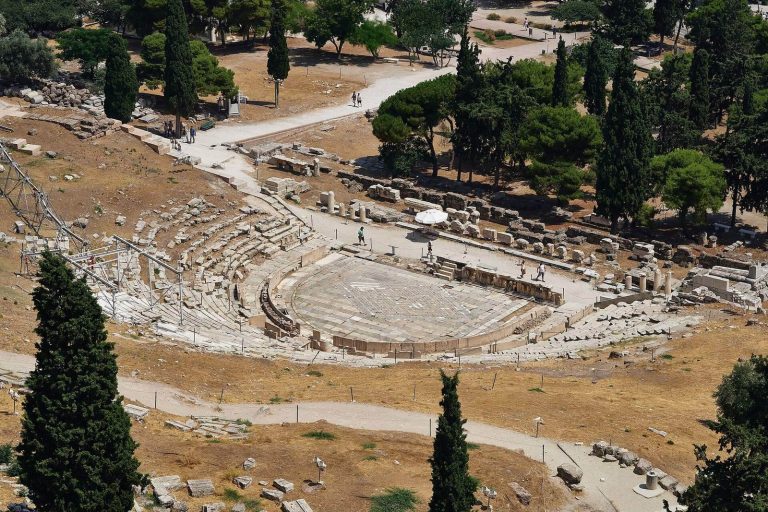
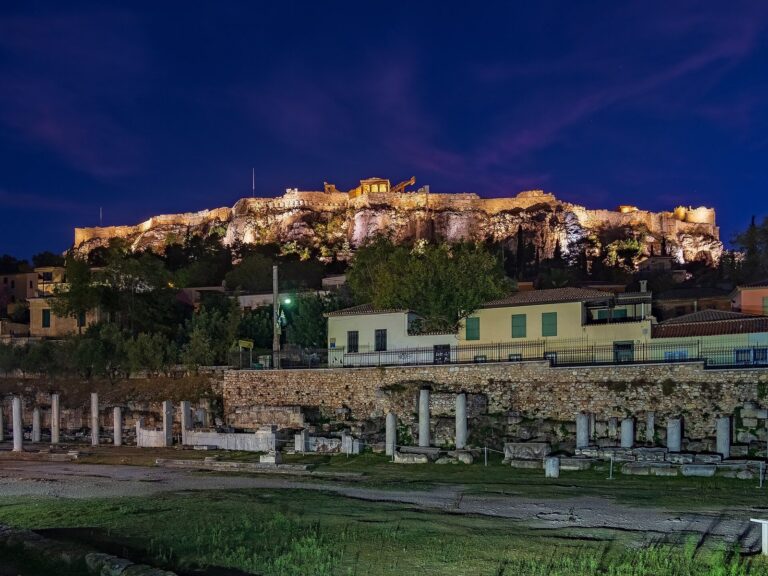
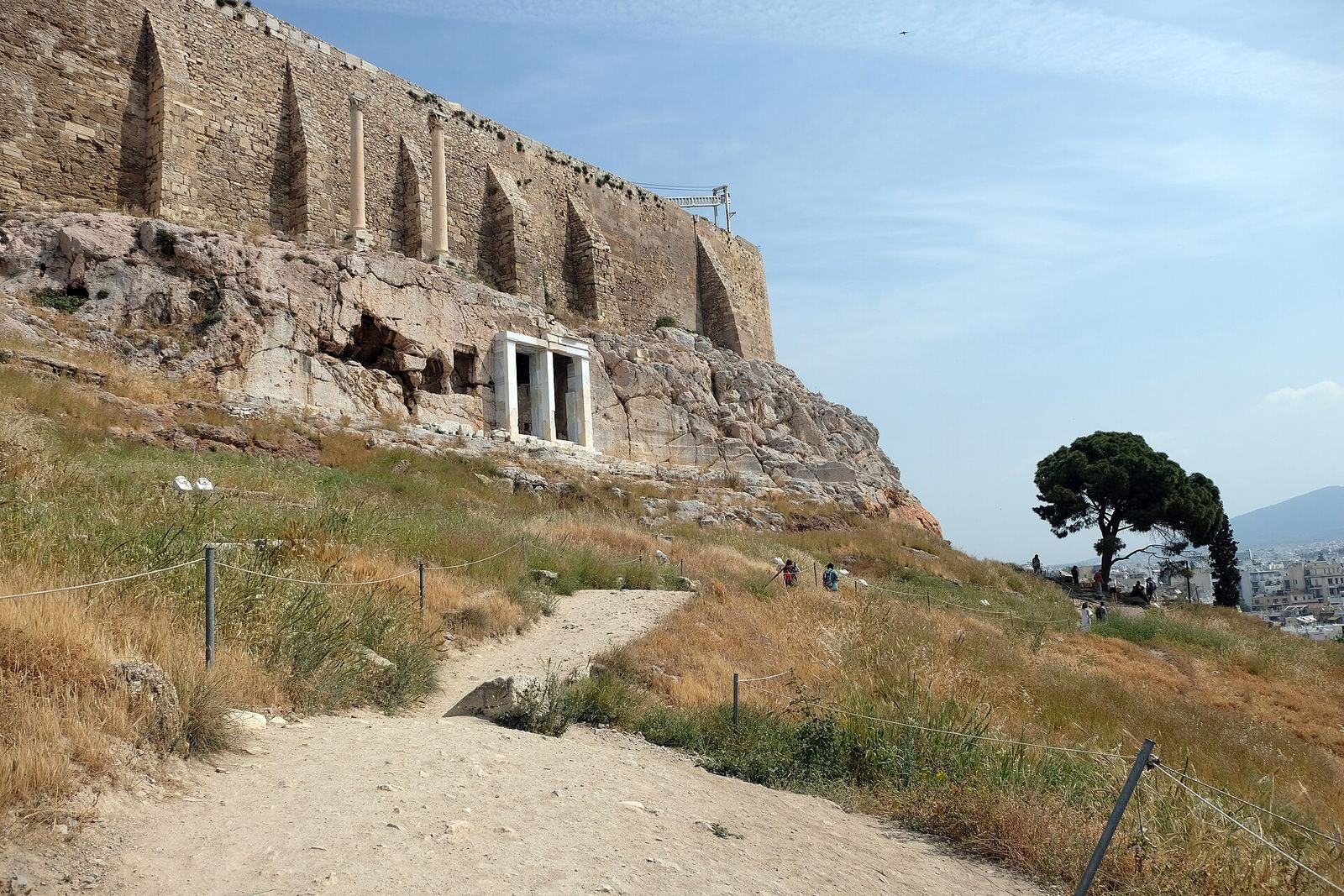
The monument stands above the Theatre of Dionysos, an ancient venue for dramatic performances, on the southern face of the Acropolis, Athens’s fortified high citadel. Its temple-shaped frontage fills the opening of a large natural cave cut into an artificially formed cliff face.
Façade and supports
The façade echoed the western part of the Propylaea’s southern wing, the Propylaea being the Acropolis’s monumental entrance gateway. It had two large doorways, projecting wall ends that framed the openings, and a central pillar. Above them, an architrave, the horizontal beam resting on supports, carried rows of small, drop-shaped ornaments. The decorated band above it displayed five olive wreaths on each side of a central wreath, while the projecting cornice held bases for three bronze tripods intended to crown the monument. The structure used several marbles from local quarries. Three stone supports may have been added by Thrasykles around 270 BCE, perhaps in 269 BCE. Corinthian columns above the cave, with their elaborate leaf-shaped capitals, may have supported tripods or belonged to a later Roman structure. A carved capital from one of the supports was found in storage at Athens’s National Archaeological Museum in 1985.
Cave and interior
A Doric frame, using a plain ancient Greek architectural style, decorated the cave opening and measured 7.50 metres in length. Inside the rock-cut cave was a representation of the gods Apollo and Artemis killing the children of Niobe, a figure from Greek myth. The second-century CE Greek travel writer Pausanias alluded indirectly to this scene. The church’s later interior included rooms with painted decoration and chapels cut into different levels. A Hellenistic statue of Dionysos, from the period after Alexander’s conquests and before Roman rule, is now in the British Museum.