Saint Paraskevi Church, Siatista: A Seventeenth-Century Orthodox Church
Site at a Glance
- Popularity
- Very Low
- Country
- Greece
- Primary era
- Early Modern
- Eras represented
- Early Modern, Modern
- Civilizations
- Ottoman
- Site type
- Religious
- Remains
- Church
On this page15 sections
History
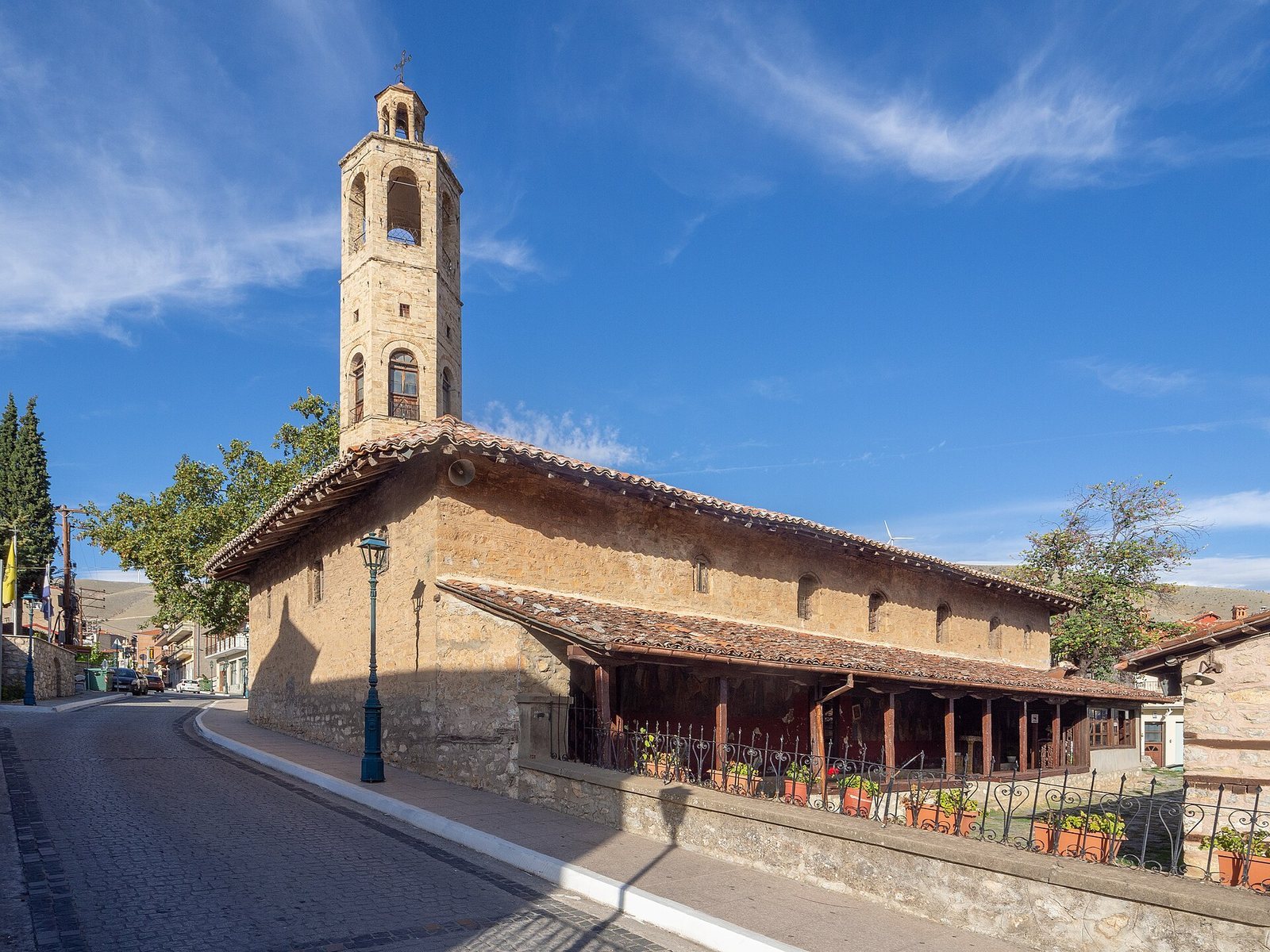
Saint Paraskevi Church is a seventeenth-century Eastern Orthodox church in Siatista, Greece, built in 1677. It is identified as the oldest church in Siatista and is dedicated to Saint Paraskevi and Saint Catherine, martyrs venerated in Orthodox Christianity.
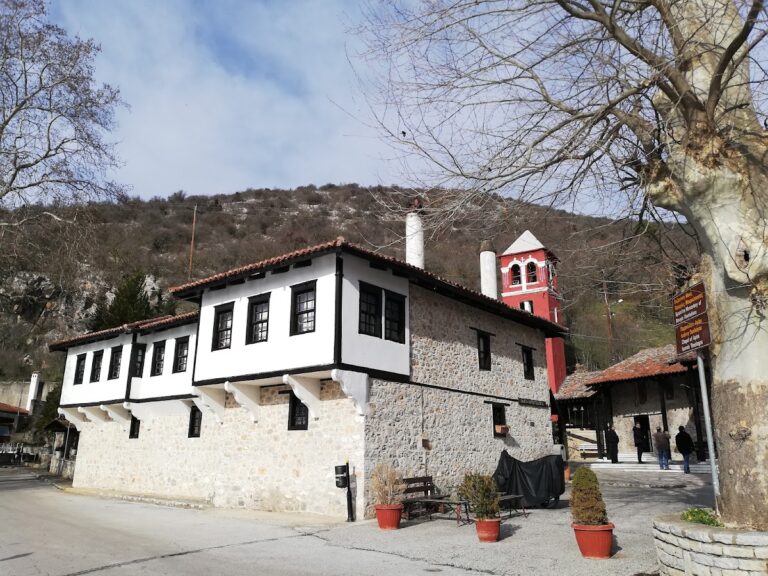
The church stands on the central square of Gerania, the southern neighborhood of Siatista. It belongs to the parish of Saint Nicholas, within the Metropolis of Sisani and Siatista, an Orthodox church district comparable to a diocese and part of the Ecumenical Patriarchate. With its bell tower, the Church of the Dormition in its courtyard, and nearby Saint Nicholas Church, it forms Gerania’s religious center. The Dormition commemorates the Virgin Mary’s death and reception into heaven in Orthodox belief.
Foundation and early patronage
The church was painted in 1679, two years after its construction. Its foundation inscription names Bishop Leontios, whose tenure extended from before 1676 to 1683, and the donors Triandafilos and Dimitrios, described as pilgrims to the Holy Sepulchre in Jerusalem, the Christian site associated with Jesus’s burial and resurrection. It also names Emanuel, son of Georgios; Nikolaos; and Theodoros, son of Kotso Peyos. The donors’ families appear in Zosimos’s register.
Later painting and nineteenth-century changes
The church’s exterior was painted in 1741. In 1862, the bell tower was built to match the large tower of Saint Demetrius in Chora. Repairs and further painting followed in 1898 through the initiative of Georgios M. Trachos, with help from Gerania parishioners. The bishop at the time was Athanasios II Nikolaidis, also known as Bistis, who served from 1893 to 1900 and came from Andros. Trachos was one of Gerania’s school trustees in 1899. The church was declared a protected monument in 1939 and remains active.
Remains
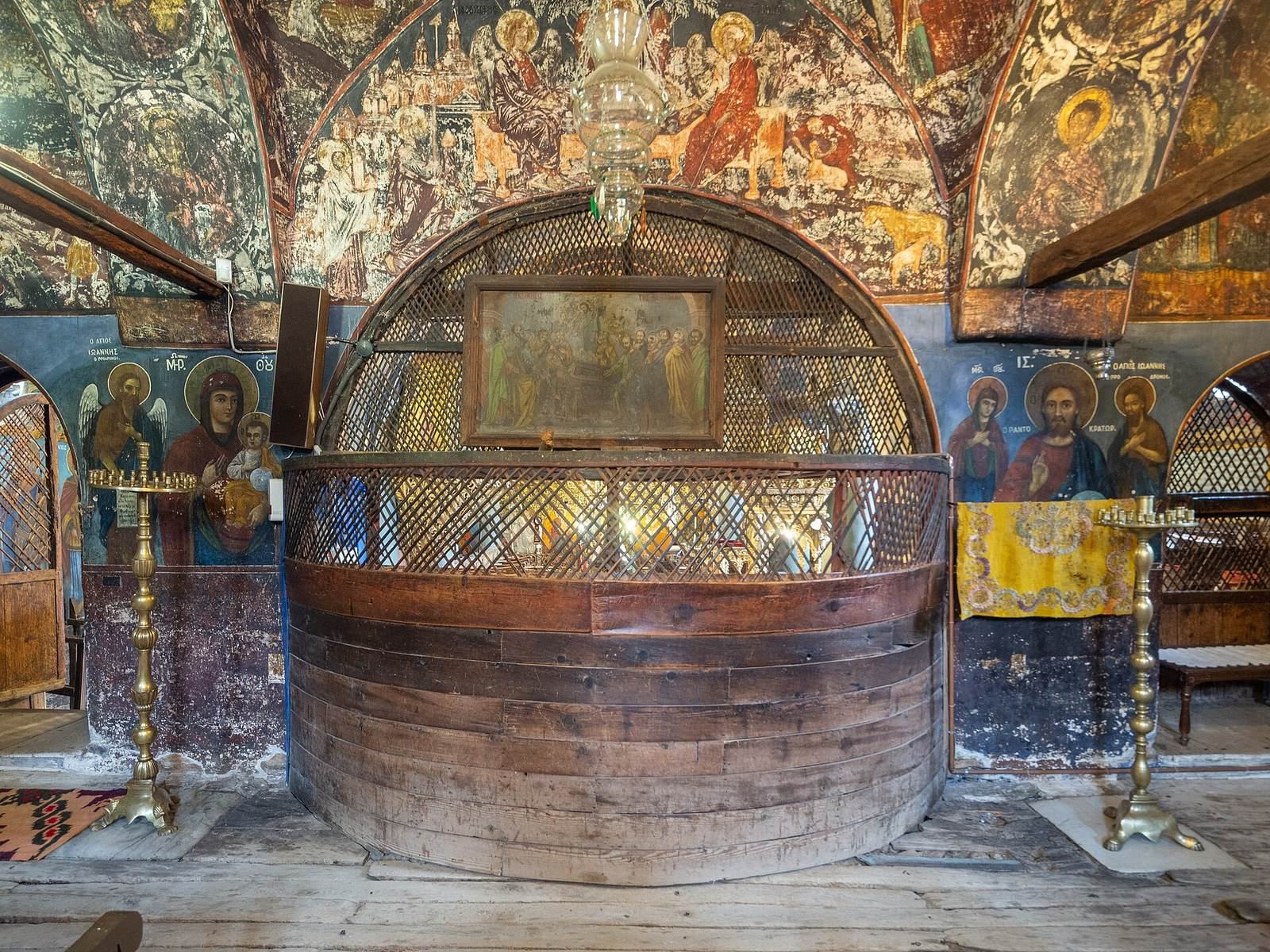
The church is a large three-aisled basilica, a church with a central aisle and two side aisles, on a cross-shaped plan with a cross set within the building’s rectangular outline. It has a dome, a narthex (entrance area at a church’s west end), and a gallery for women. A porch runs along the south side; its enclosed eastern end contains a chapel dedicated to the Virgin Mary. The exterior is simple, and the domes are covered by a roof with four sloping sides. The bell tower forms part of the group of religious buildings at Gerania’s central square.
Inscriptions and wall paintings
Foundation inscription
A nine-line foundation inscription occupies the lintel inside the south wall, above the main church entrance. Its black lettering is painted on nearly white mortar, within a rectangular frame of gilded plaster and preceded by a red cross. The text now in place was copied from an earlier inscription and supplemented during the 1898 repairs.
Interior paintings
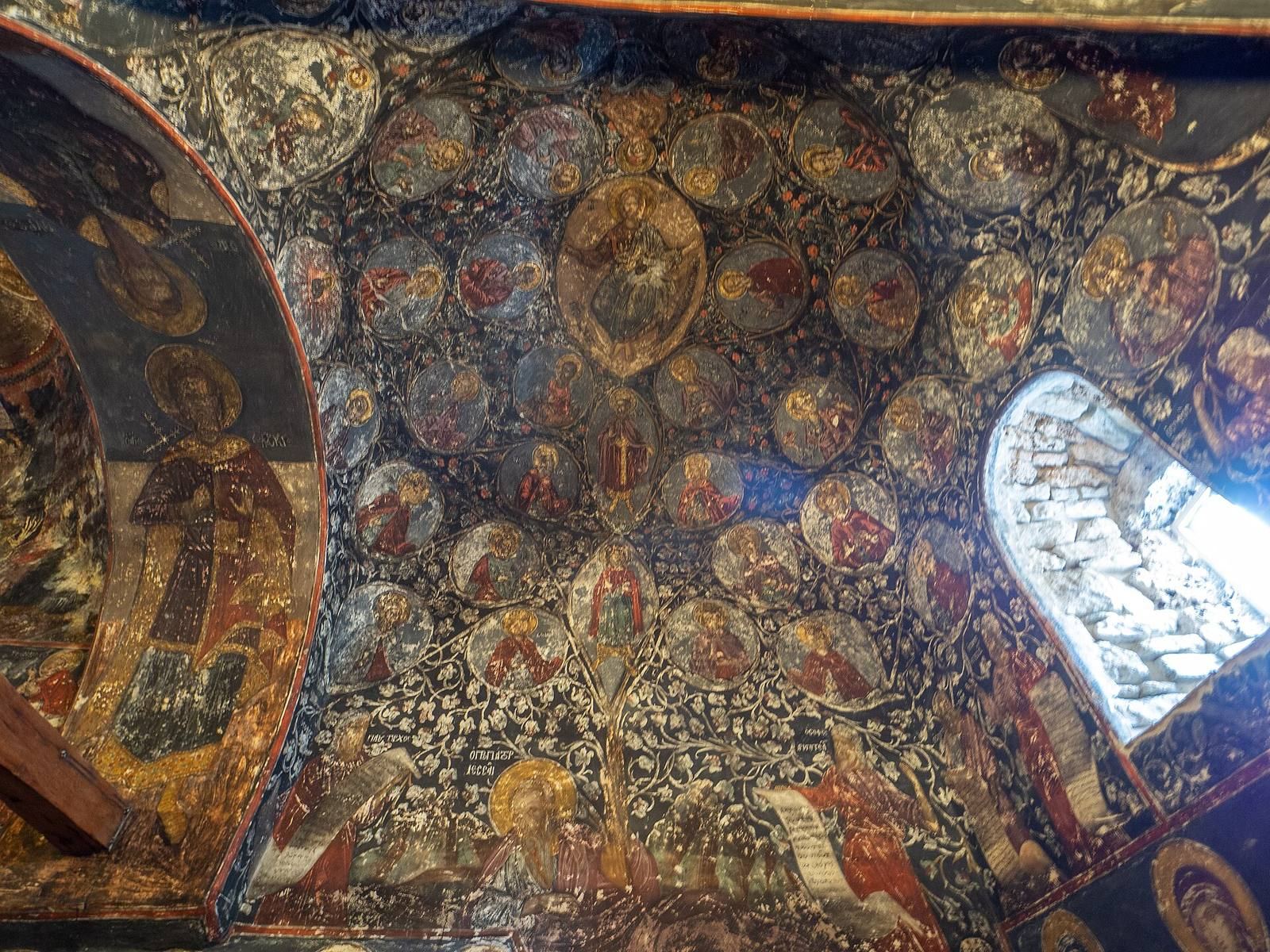
The earliest surviving wall paintings cover the church interior and are attributed to a workshop associated with the regional Epirus tradition of religious painting. Some images have been compared with paintings at Meteora and Mount Athos. The scenes include the Life of the Virgin Mary, the Twelve Feasts of the Orthodox liturgical year, Christ’s miracles and Passion, the Creation, and the Second Coming.
Tree of Jesse
A composition known as the Tree of Jesse, a Christian image of Christ’s lineage shown growing from Jesse, is in the southwest corner of the narthex and its corresponding niche. Above Jesse, outside the tree, appear Solon, an Athenian lawgiver; Plutarch, a biographer; Aristotle and Plato, philosophers; Thucydides, a historian; and a Sibyl, a prophetic figure. A similar composition appears in the narthex of Siatista’s Saint Elijah Church, whose paintings date to 1744.
Exterior paintings and inscription
Paintings of ascetics, monks, and hermits associated with the Palestinian desert cover the south exterior wall. An inscription above the narthex entrance on the north wall sits between images of Saint Nicholas and Saint Spyridon. Its five lines, painted in white on reddish mortar, record prayers by Ioannis and Manoil Hadzikonstantinou. Painters from Kapesovo may have worked on the exterior decoration. Their activity in Siatista at Saint Minas and Saint Elijah, and similarities between the lettering here and at Saint Elijah, support that possibility.
Later paintings
The chapel at the east end of the south porch contains a mural of the Virgin Mary by Christodoulos Ioannou. He also painted full-length saints in the lower parts of the side aisles, mainly over earlier paintings, and worked on portions of the southwest and northwest niches. Ioannou, who lived from 1839 to 1919 and was born in Siatista, is also credited with copying and extending the foundation inscription. That attribution rests on comparison with his signed works.
Carved furnishings and icons
Iconostasis
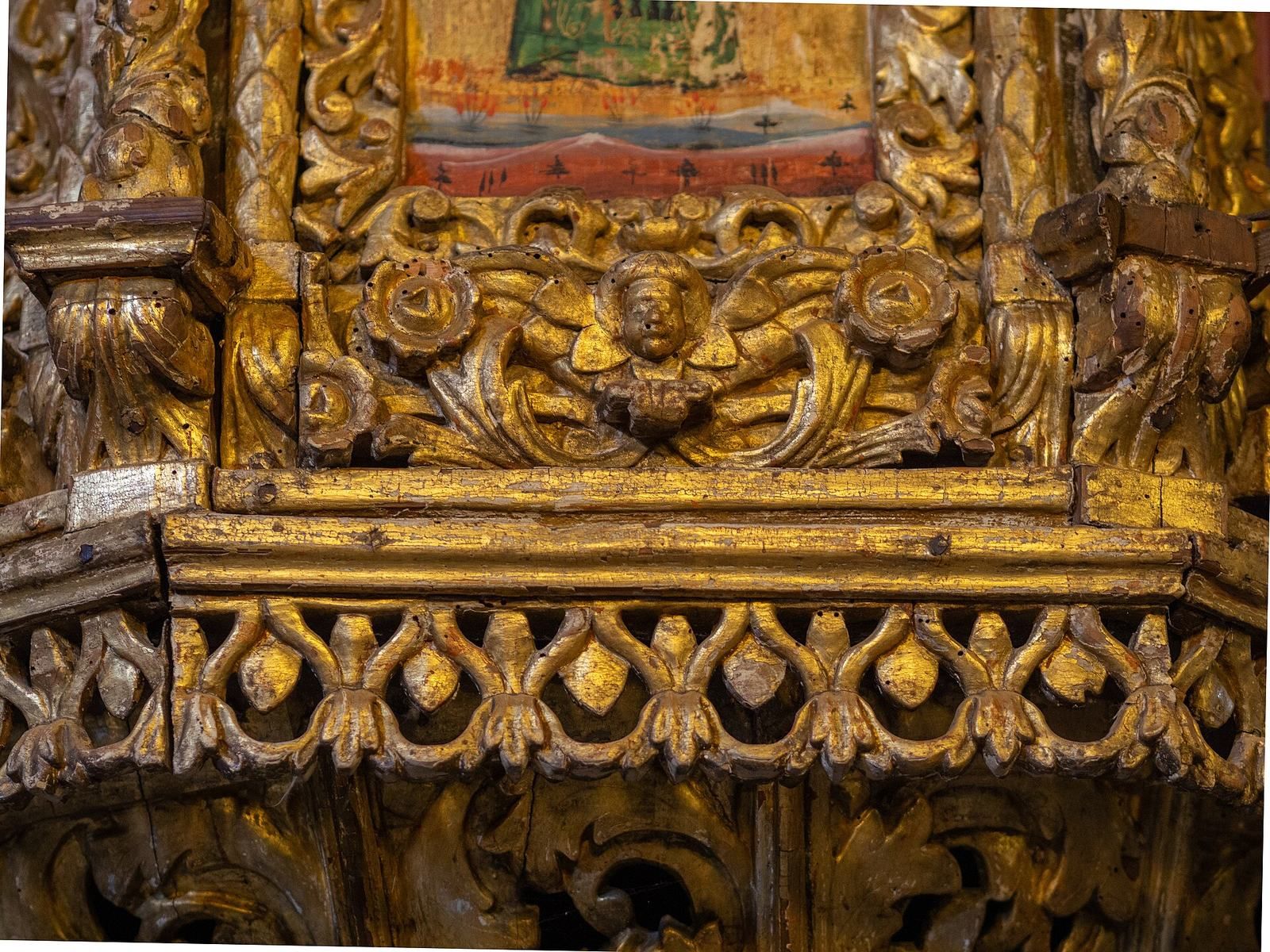
The carved and gilded iconostasis, the screen bearing icons that separates the sanctuary from the main worship area, dates to the church’s first painting period, apart from its lower zone. It is described as a major work comparable to icon screens on Mount Athos. The lower zone, railings, and small columns are ungilded and differ in style; they have been compared with the iconostasis at Saint John the Baptist Church.
Other carved furnishings
The bishop’s throne, pulpit, and icon stand are somewhat later, dating to the middle of the eighteenth century. Their carving combines features associated with the Linotopi and Metsovo regional woodcarving traditions.
Icons
Local historians attribute the principal icons and other icons on the iconostasis to the Cretan painter Theodoros Poulakis and date them to 1711. Yiannis Sisios notes that, although they combine Cretan style with Western elements, their particular manner differs from Poulakis’s work. An icon of Saint Paraskevi, with a silver covering and scenes of her martyrdom, dates to 1743.
Epitaphios
A carved wooden epitaphios, a liturgical image of Christ laid in the tomb for Orthodox Holy Week rites, has Western stylistic features and an inscription naming Anastasios Ioannou of Ioannina. The inscription identifies the work with the hand of Anastasios Ioannou Kaloudis, whose name also appears in donor inscriptions at Saint Minas and Saint Elijah.