Early Christian Catacomb of Villagrazia di Carini: A Sicilian Burial Complex
Site at a Glance
- Popularity
- Very Low
- Country
- Italy
- Primary era
- Classical
- Eras represented
- Classical, Medieval
- Civilizations
- Byzantine, Roman
- Site type
- Burial
- Remains
- Catacomb
On this page11 sections
History
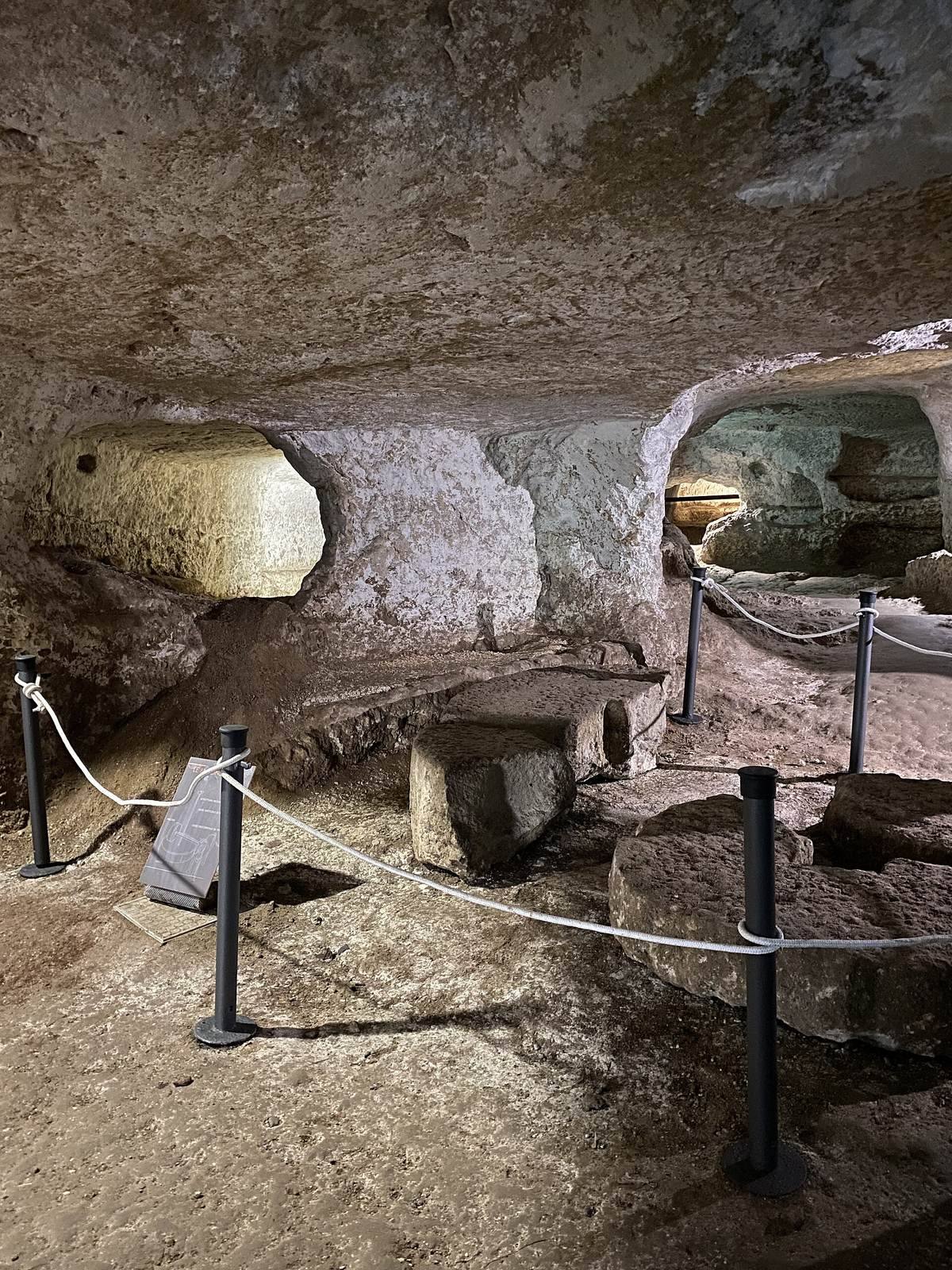
The Early Christian Catacomb of Villagrazia di Carini, in Italy, is a Christian funerary complex used from the fourth to the eighth century. It is one of Sicily’s most important witnesses to early Christianity and the largest funerary complex in western Sicily. The cemetery provides evidence for Christian communities in rural Sicily during the Constantinian period, the era of Constantine and his successors, and in later centuries.
Christian cemetery, fourth to eighth centuries
The catacomb was identified in 1899 by archaeologist Antonio Salinas, northeast of the San Nicola district. A discovery there in 1873 had already drawn attention to the area: Prince De Spuches found a large polychrome mosaic belonging to a space with an apse, a recess usually semicircular at the end of a building. Salinas’s discovery strengthened the interpretation that the mosaic came from a Christian place of worship.
The cemetery’s most intensive use ran from the later fourth through the sixth century. Its expansion reflects a growing Christian community’s need for more burial space. A local Christian church at Carini, mentioned in a letter by Pope Gregory the Great in 595, points to an organized rural Christian community. The nearby cemetery may also have served that community as an important place of worship.
Later reuse and deterioration
During the Islamic period, when Muslim political and cultural presence shaped Sicily, the coverings of tombs were destroyed. The cemetery was later abandoned and deteriorated during the medieval period. From the late fourteenth to the early seventeenth century, a sugar-production plant altered the southern sector, as archival records attest. Some spaces were subsequently used to cultivate mushrooms. The site also suffered abandonment and deterioration during the twentieth century, and alluvial deposits dating to around the mid-1970s mark a later phase.
Research and conservation
From 2000, archaeological investigations concentrated on the southern sector. The Pontifical Commission for Sacred Archaeology, a Catholic body concerned with Christian antiquities, promoted extensive work with scholars and heritage authorities at the University of Palermo and with the Carini municipal administration. In 2011, laser technology was used to remove calcium-carbonate crusts and mud from the painting in tomb VIII.32.
Remains
The excavated area covers more than 5,000 square metres. Galleries, burial chambers, and tombs built beneath arches form the complex. Its surviving burial arrangements combine table-type tombs, arched graves, and carefully grouped children’s burials.
Burial layout and finishes
Table-type tombs, with flat upper surfaces resembling tables and associated with burials intended for nobles, occur above arched tombs. They are especially common in Galleries VIII, IX, X, and XII and burial chamber VI. Comparable arrangements have been noted in fourth-century funerary settings in Lazio and Abruzzo, while table-type burials appear earlier in Rome. Children’s graves were arranged in orderly groups, including stacked tiers and spaces between adult burials. Finishes included plaster, mortar made with crushed pottery, and painted decoration. The most important paintings recovered so far come from three arched tombs associated with children.
Painted tombs and imagery
Tomb X.2
Tomb X.2, between Galleries VII–X and VIII–IX, was used for nine burials at different times. Its earlier decoration covered the underside of the arch with red floral patterns and green garlands of serrated leaves against white, extending from a knotted corner onto the curved field beneath the arch. A later painting shows a child in a long white tunic encouraging a horse by its reins, one foreleg raised. The scene has been read as recalling the child’s delight in playing with a horse and as evoking paradise. The child’s individualized face has been compared with funerary portraits from the reign of Theodosius I, Roman emperor from 379 to 395.
Adoration of the Magi
A painted Adoration of the Magi includes red roses on green stems and a stylized, serpent-shaped garland. The Magi approach in a line, carrying gifts on golden trays with their hands veiled, toward the Virgin and Child seated on a high-backed chair. The scene has been interpreted through court ceremonies in which visitors paid homage to a ruler: the guiding star identifies Christ as Messiah, and the Magi’s gestures present him as King. These themes were understood as expressing the painters’ Christian orthodoxy, while imagery focused on children commemorated those who died young.
Tomb VIII.32
The painting in tomb VIII.32 portrays a woman against a blue background, originally made with Egyptian blue, an ancient synthetic pigment. Red garlands frame her, and scattered red brushstrokes suggest flowers in a paradisiacal setting. She wears a voluminous, long tunic with wide sleeves and decorative bands across the chest, probably reaching her ankles. The extensive damage has erased her arm gesture; comparison with another praying figure has suggested that her hands were once outstretched.
The woman’s face is carefully modelled, with pink skin, shaded features, a forward and leftward gaze, and naturally wavy hair covering her ears and gathered into a large knot. Her hairstyle has been compared with images of the empress Valeria Galeria, wife of Galerius, and especially Helena, Constantine’s mother. Comparisons include a bronze medallion of Helena dated to 335 and a marble portrait in the Berlin museums. Helena’s hairstyle, also seen on commemorative coins issued between 329 and 337, influenced women’s portrait fashion in the Constantinian and following periods. The woman’s refined appearance has been interpreted as that of someone mourning a young child and perhaps presenting the deceased at the end of a child’s tomb into paradise.
Tomb X.10.9
A figure on the outer face of the arch of tomb X.10.9, in burial chamber X.10, provides a comparison for the woman in VIII.32. Shown in perspective, the figure wears a heavy dark-red tunic with wide sleeves and turns slightly left toward a young man. Its composed posture and expressive gaze remain visible.