San Michele Arcangelo: A Historic Catholic Church in Palermo


Site at a Glance
- Rating
- 4.3
- Popularity
- Low
- Country
- Italy
- Primary era
- Medieval
- External website
- Open
- Eras represented
- Classical, Medieval, Early Modern
- Civilizations
- Kingdom of Sicily, Norman, Roman, Spanish
- Site type
- Religious
- Remains
- Church
On this page14 sections
History
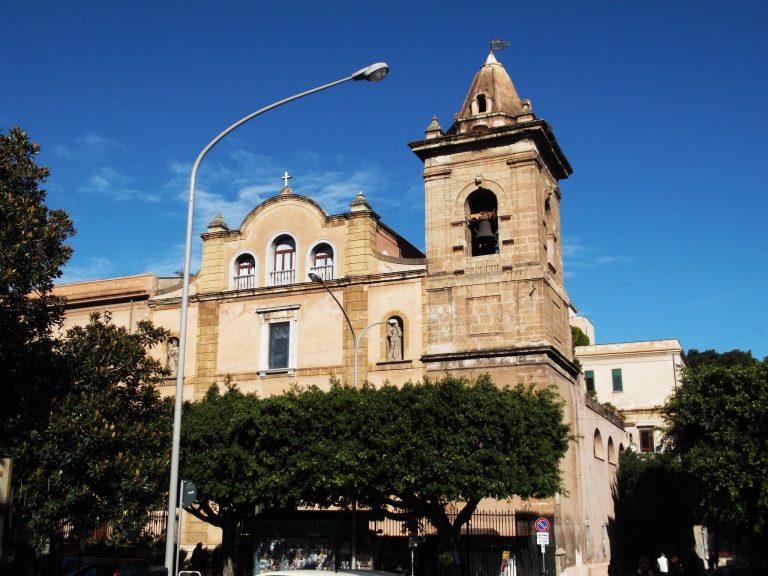
San Michele Arcangelo is a Catholic church in Palermo, Italy, built over the medieval church of Santa Maria la Grotta and shaped by successive religious and civic uses. Its surviving fourteenth-century basilican plan, a long church layout with a central nave and side aisles, reflects the medieval development of the site. The church stands near the Palazzo dei Normanni in the Ballaro district and forms part of the Jesuit Casa Professa complex, the principal residence of a religious order.
Early Christian and Norman Setting
The area around the church contained a dense network of caves during the imperial and Byzantine-Arab periods. Early Christian communities used some of these underground spaces as refuges during persecution and as burial places. During the Arab period, other chambers were adapted as thermal baths or burial spaces, creating an underground setting that remained connected with the later church.
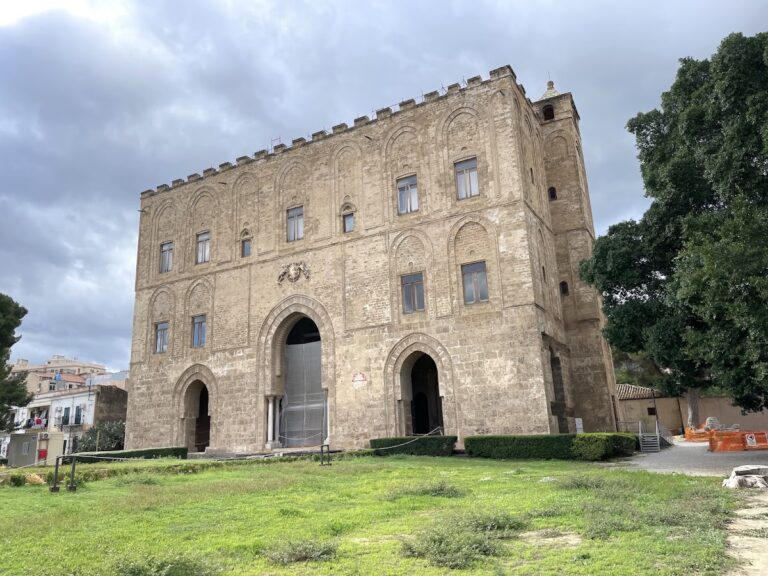
When the Normans reached this part of Palermo, near the southern inlet of the harbour, shipyards occupied the site. Notarial acts from 1149 record the construction of a Chapel of Saint Anne by Crisando, a cleric of Roger II of Sicily, the Norman king whose reign helped consolidate Norman rule on the island. Studies by Bernardo Riera also associate the existence of the church with this period.
Medieval Dedication and the Confraternity
A will from 1264, confirmed by a related document of 1269, identifies the church as San Michele de’ Indulciis. In the early fourteenth century, the Confraternity of San Michele de’ Indulciis was founded. A confraternity was a lay religious association organized around shared worship, charitable activity, and devotion. This association continued until its abolition in 1800.
Sixteenth-Century Changes
During the Spanish period, the restoration of a fresco of the Virgin Mary led to a popular belief that the image was weeping. Archbishop Giovanni Paternò, who held office in Palermo from 1489 to 1511, investigated the claim personally and found that the supposed miracle had been fabricated to attract and steal offerings. He ordered the images removed and the church closed.
In 1513, the confraternity commissioned Antonello Gagini, a prominent Renaissance sculptor, to make a marble statue of the archangel Michael. The building was repeatedly modified, enlarged, and embellished during the sixteenth century, adding new layers to its medieval structure and devotional identity.
Inspection of the Underground Chambers
On 28 June 1718, the Palermo canon and antiquarian Antonino Mongitore inspected the underground chambers through a small door behind the altar of the Holy Archangels, beside the high altar on the Gospel side. He noted partly removed wall paintings, niches, eight small chapels, human bones, and burials associated with the Chapel of the Crucifix. The inspection also helped reconstruct how the paintings had been removed, including the discovery that many of the painted works had been fabricated.
Hospital and Library Uses
In 1800, the church was incorporated into the Great and New Hospital. The hospital rectors permitted the Congregation of the Priests of Saint Charles Borromeo to meet there for spiritual exercises, and the congregation commissioned a painting of its patron saint.
After the Jesuits were expelled from the kingdom, the wider complex became the seat of the Senate’s public library. San Michele Arcangelo later served as a book depot and became a branch facility of the municipal library. Conservation began in September 1997 and ended in June 2005. A second restoration campaign ran from 2009 to December 2016, and archaeological remains were discovered within the library structures during these campaigns.
Remains
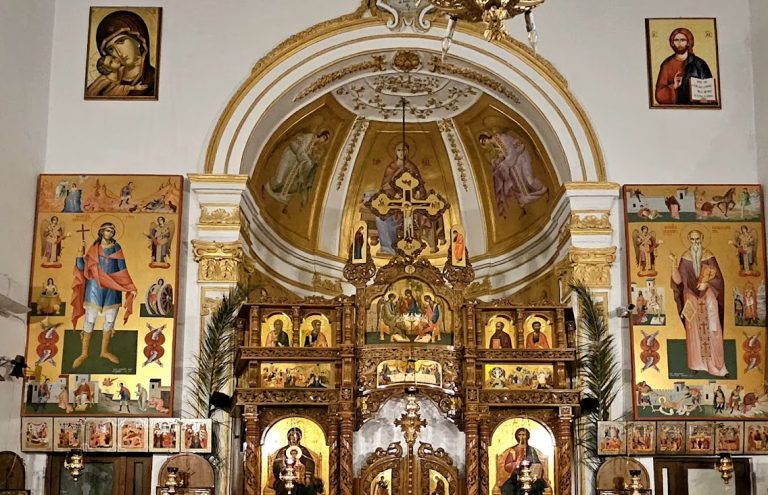
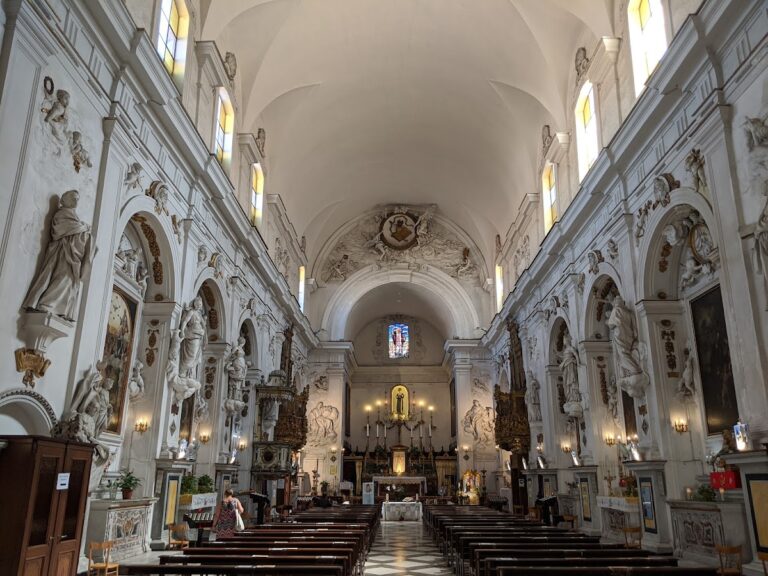
The surviving building combines a fourteenth-century basilican layout with later additions and decoration. An uncovered atrium precedes the west-facing main portal, whose elaborate, curving ornament reflects the Rococo style, an eighteenth-century decorative style. Inside, 14 columns and 12 arches divide the church into three aisles. Seven altars are recorded, including the high altar in the central semicircular apse, and a tower forms part of the building.
Chapels and Artworks
Chapel of the Most Holy Crucifix
The Chapel of the Most Holy Crucifix contains a niche and plaques bearing inscriptions in Latin, Greek, Hebrew, and Arabic. Comparable multilingual plaques appear in other niches in the church. The chapel is also associated with burials in the underground chambers inspected in 1718. A Crucifix from Palermo Cathedral was donated to San Michele Arcangelo after the plague of 1575 and placed above the organ.
Chapel of Saint Jerome
The Chapel of Saint Jerome occupies the third bay of the right aisle. It contains a painting of Saint Jerome by Zoppo di Ganci, a Sicilian painter active in the early modern period. A tomb dated 1550 is also recorded within the church.
Chapel of the Epiphany and Chapel of Saint Anne
The Chapel of the Epiphany contains an Epiphany triptych attributed to Filippo Lippi, a prominent Renaissance painter. The church also includes a Chapel of Saint Anne, recalling the chapel associated with the site in the notarial record of 1149.
Chapel of the Seven Angels
The Chapel of the Seven Angels, also called the Chapel of the Holy Archangels, stands to the left of the high altar. A trapdoor in the chapel provides access to the catacombs, underground burial complexes often associated with early Christian communities. The chapel contains a painting of the Holy Archangels.
Additional Furnishings
A wooden statue of the archangel Michael, carved in 1684 by Antonino Rallo of Trapani, is now documented at the Church of San Francesco Saverio. The church also retains the recorded association with the painting of Saint Charles Borromeo commissioned around 1800 by the Congregation of the Priests of Saint Charles Borromeo. A floor design by Francesco Ferrigno is dated to 1718, although the floor associated with that work no longer survives.
Catacombs and Archaeological Evidence
Early Christian catacombs extend beneath the church. The underground chambers lay beside the city walls and near the right arm of Palermo’s former harbour. They contain niches, eight small chapels, human remains, burials, and traces of wall paintings removed by chiselling. The chambers connect the physical remains of San Michele Arcangelo with the earlier burial and devotional uses of the area.
Further archaeological remains were found within the structures occupied by the library during the restoration campaigns of 1997–2005 and 2009–2016. These discoveries form part of the evidence for the complex sequence of construction, reuse, and institutional change preserved by the church and its surrounding buildings.