Abbey of San Martino delle Scale: A Benedictine Monastery in Sicily


Site at a Glance
- Rating
- 4.6
- Popularity
- Low
- Country
- Italy
- Primary era
- Early Modern
- External website
- Open
- Eras represented
- Medieval, Early Modern
- Civilizations
- Kingdom of Sicily, Spanish
- Site type
- Religious
- Remains
- Monastery
On this page21 sections
History
The Abbey of San Martino delle Scale is a Benedictine monastery in Italy, located at San Martino delle Scale, a locality of Monreale between Monte Cuccio and Monte Caputo. Dedicated to Saint Martin of Tours, it belongs to the Cassinese Congregation, a reforming federation of Benedictine monasteries associated with Monte Cassino. The present abbey church was built between 1564 and 1595, during the major rebuilding of the complex in the early modern period.
Origins and early uncertainties
Tradition places a primitive monastery here in 573 or 581 and attributes its foundation to Pope Gregory the Great. According to this tradition, Gregory established six Sicilian monasteries on lands belonging to his maternal family. The connection between San Martino delle Scale and one of those foundations remains uncertain, however, and the early history cannot be established with confidence.
The first community was said to have been reserved for women. Disputes among the nuns, followed by a scandal involving a physician named Anastasio, led Archbishop Vittore to move them to the urban institution of Santa Maria della Speranza. Benedictine monks from monasteries in the Palermo area then occupied San Martino. A traditional account also places the destruction of the early monastery by Saracen forces around 820, but both this event and the supposed Gregorian foundation remain uncertain. The site was later linked with rebuilding in the Norman period, although firm evidence for that phase is limited.
The fourteenth-century refoundation
The first securely dated refoundation took place in 1347 under Emanuele Spinola, Archbishop of Monreale. Benedictine monks from San Nicola l’Arena at Nicolosi, near Mount Etna, were brought to the monastery, which was then known as San Martino delle Scale di Sant’Anna. Angelo Sinisio became its first abbot in 1352 and remained in office until 1386.
During Sinisio’s administration, the monastery received extensive land donations. These included the fiefs of Cinisi, Borgetto, Sagana, and Milocca, where the abbot also exercised baronial authority. King Frederick IV of Sicily granted privileges, exemptions from duties, and customs concessions, while Pope Gregory XI added further prerogatives. These arrangements helped consolidate the monastery and contributed to the enlargement of the young Diocese of Monreale.
In the fifteenth century, the abbots governed several nearby villages and held the title of baron. The monastery’s expansion was challenged by rival nobles toward the end of the century, and these conflicts contributed to a decline in its fortunes. Giuliano Majali, a monk and diplomatic envoy of King Alfonso of Aragon to the Bey of Tunis, also influenced the institution’s development. Tunisian royal garments given to Majali were later kept in the monastery sacristy.
Cassinese reform and rebuilding
From 1506, the monks followed the rule of Monte Cassino, and the monastery’s territory came under direct papal authority. Its incorporation into the Cassinese Congregation encouraged stricter monastic observance and cooperation among Benedictine houses. The reform movement also addressed interference by lay and ecclesiastical nobles who attempted to control monastic revenues.
The older abbey was demolished, and a large building campaign transformed the site between the sixteenth and eighteenth centuries. Construction of the present church began in 1564 and ended in 1595. Diego Haëdo, Archbishop of Palermo and Primate of Sicily, consecrated it solemnly on 20 May 1602. During the seventeenth and eighteenth centuries, San Martino delle Scale developed into a center of artistic patronage, publishing, education, manuscript work, and scholarship. Its library was expanded and renewed during the eighteenth century and attracted scholars and researchers.
The abbey was regarded as the largest institution of the Cassinese Congregation in the Kingdom of Sicily and, consequently, as one of the most important Benedictine institutions in the Italian peninsula. Several dependent or affiliated houses were associated with it in the eighteenth century, including the monastery of the Holy Spirit near the Church of Sant’Agostino in Palermo, San Carlo in Palermo, Santa Caterina of Cinisi, Santa Maria delle Ciambre, and Santa Maria del Santissimo Romitello at Borgetto.
Eighteenth-century expansion
In 1775 Giuseppe Venanzio Marvuglia designed a new dormitory and the monastery’s principal facade. The facade reached its eighteenth-century form in 1778. The Bourbon rulers of Sicily later allowed the abbots of San Martino delle Scale to hold a seat in the Sicilian Parliament. King Ferdinand I of the Two Sicilies frequently stayed at the monastery while visiting the royal residence at Palermo. In 1787 Johann Wolfgang von Goethe visited the convent during his journey to Monreale.
Nineteenth-century decline and twentieth-century revival
The monastery declined during the nineteenth century as internal tensions grew and monks progressively departed. In 1866, after the suppression of religious orders in unified Italy, ecclesiastical property was confiscated. The measure impoverished the monastery and dispersed much of its artistic and historical heritage. By the end of the century, the community had been reduced almost to extinction, and part of the library holdings had been transferred to the municipal library of Casa Professa.
Monastic life began to revive in the early twentieth century, partly through the work of Ercole Tedeschi, a monk who undertook parish duties. In 1932, under the arrangements that followed the Lateran Pacts of 1929, the community was recognized as a legal entity. By 1946 it had reached the number of monks required by the Cassinese constitutions.
Activities were restored in part of the historic complex. They included teaching in the college and monastic boarding school, the restoration of books, the reopening of the reconstructed library, and the sale of monastery products. Organ concerts, exhibitions, conservation of old books, and a museum displaying surviving works of art, including porcelain vases, formed part of the institution’s cultural renewal. In 1969 a new abbot was elected, the first holder of the office in approximately a century. San Martino delle Scale remains a Benedictine monastery.
Remains
The surviving complex occupies the hills between Monte Cuccio and Monte Caputo near Monreale. It consists of the abbey church and extensive monastic buildings arranged around six courtyards, together with cloistered and courtyard structures. The church and the surrounding buildings preserve the results of the rebuilding campaign that followed the demolition of the older abbey.
The abbey church
Plan and crossing
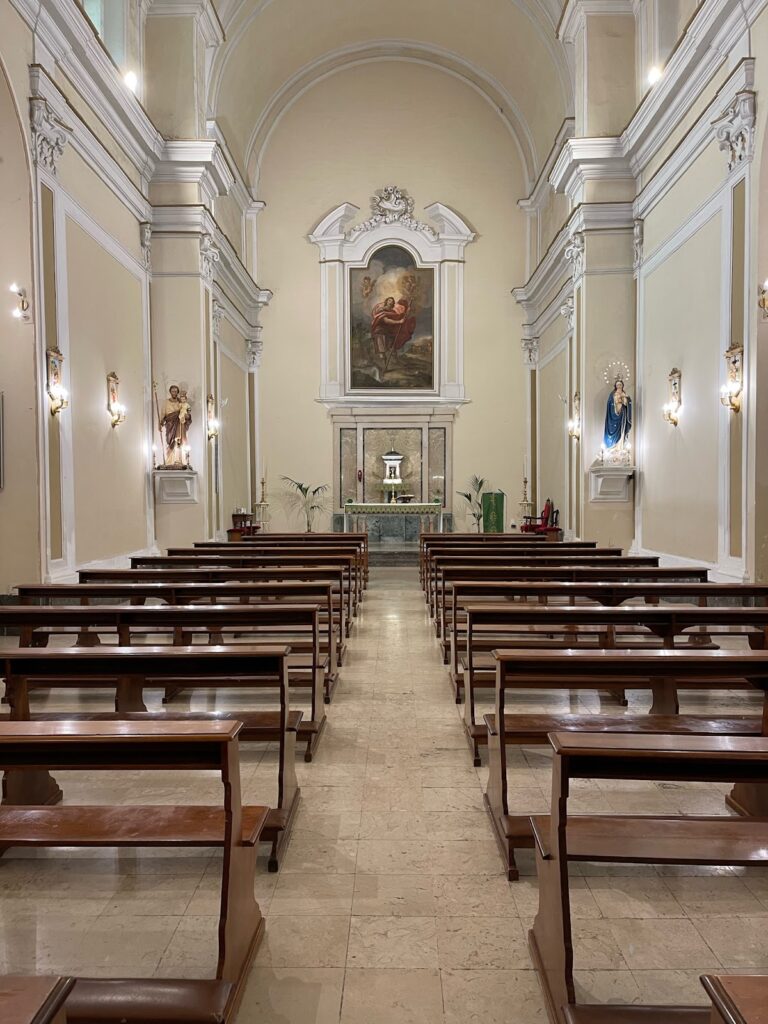
The church follows a Latin-cross plan, with a long central axis crossed by transept arms. A dome rises over the crossing, while the choir is accompanied by two small apses. Ten minor chapels, five on each side, open from the aisles. The interior received an extensive stucco decoration in 1602. On the crossing piers are statues of Saint Benedict of Nursia, Pope Gregory the Great, Saint Placidus, and Saint Maurus.
Presbytery and choir
The presbytery, the area surrounding the main altar, contains a double-sided altar, an organ made by Raffaele la Valle in 1594, and a wooden choir associated with the Neapolitan school. Made around 1597 in the workshop of the cabinetmakers Ferraro and Vitagliante, the choir has 68 stalls. About a century later it was enlarged with two large wooden panels showing the ecstasy of Saint Benedict and the ecstasy of Saint Scholastica, made by local craftsmen. Marble medallions of Saints Peter, Paul, John, and Andrew are set into the choir walls.
Paolo De Matteis painted the presbytery scenes in 1727. They include Saint Benedict with Saint Maurus, Saint Placidus with Tertullus and Eutychius, Saint Maurus with King Theodobert, and Saint Martin with the beggar. Other paintings show the Meal of Saint Gregory the Great for the Poor, the Martyrdom of Saint Placidus and Saint Flavia, and Saint Benedict Meeting Totila, King of the Ostrogoths.
Right aisle and transept
The right aisle contains the chapels of Saint Placidus, the Crucifix, the Holy Apostles, Saint Dominic of Silos, and Saint Nicholas of Bari. Their altarpieces include Saint Placidus and Saint Scholastica by Guglielmo Borremans, the Sorrowful Virgin by Paolo De Matteis, the Holy Apostles by Gaspare Vazzano, Saint Dominic of Silos by Jusepe de Ribera, and Saint Nicholas of Bari by Gaspare Vazzano.
The right transept contains the Chapel of Saint Benedict. Its altarpiece by Pietro Novelli shows Saint Benedict distributing his Rule to religious, military, and chivalric orders that observe it. The right small apse contains the Chapel of the Virgin, also called the Chapel of Our Lady of Consolation. Marble statues of the Virgin between Saint Agatha and Saint Catherine of Alexandria date from 1368. Giuseppe Meli’s frescoes of the Assumption of the Virgin and two large wall paintings complete the chapel.
Left aisle and transept
The five chapels along the left aisle are dedicated to Saint Matthew, Saint John the Baptist, the Seven Angels, Saint Rosalia, and the Epiphany. Gaspare Vazzano painted the altarpieces of Saint Matthew the Apostle, the Seven Angels, and the Epiphany. The image of Saint John the Baptist Preaching to the Jews is attributed to Filippo Paladini. Paolo De Matteis painted Saint Rosalia in 1727.
The Chapel of Saint Martin occupies the left transept. It contains a work by Giacomo Amato and an altarpiece of Saint Martin painted by Filippo Paladini in 1608. A marble portal dating from the twelfth or thirteenth century carries twenty scenes of the Paschal Mystery. Near the sacristy stands a baptismal font dated 1396.
Sacristy and associated artworks
The sacristy contains cupboards made for precious garments presented by the King of Tunis to Giuliano Majali. Its paintings include a seventeenth-century Madonna and Child by Carlo Cignani, a Last Supper by Matthias Stomer, and a Madonna of the Pietà by a painter of the Caravaggesque school. Other works associated with the abbey include Simone de Wobreck’s 1538 Supper at the House of Simon, Pietro Novelli’s 1634 Madonna and Child between Saint Benedict and Saint Scholastica, and Novelli’s 1635 Saint Benedict Distributing the Loaves, now in the Regional Gallery of Palazzo Abatellis.
The group also includes Guglielmo Borremans’s 1727 Madonna with Saint Anne and Benedictine Saints and a sixteenth-century Saint Gregory Enthroned from the school of Vasari. These works, together with the church paintings, reflect the artistic patronage that accompanied the monastery’s early modern expansion.
Monastic buildings and courtyards
Principal facade and dormitory
The principal facade, completed in 1778, has a vestibule containing Ignazio Marabitti’s equestrian statue of Saint Martin and the Beggar. Marabitti also made the Fountain of the Oreto, which is attached to the church. Marvuglia’s new dormitory, designed in 1775, forms a facade approximately 137 metres long. It is divided into three orders and faces toward Palermo.
Cloisters and courtyards
The Cloister of Saint Benedict lies near the apse, on the northern side of the right transept. It has a square plan of seven bays by seven and contains 36 columns. Its terracotta pavement is arranged with axes and diagonal bands of stone blocks. At the center is the Fountain of Saint Benedict, made by Giuseppe Pampillonia in 1728.
The southern cloister, known as the Marble Courtyard, has nine bays on each side. Arcaded passages are supported by pillars, and a fountain made by Giovanni Biagio Amico occupies the courtyard. Other parts of the complex include a rectangular northern courtyard, eastern and western structures, a square courtyard associated with the southern wing, a rectangular courtyard associated with the northern wing, and a square courtyard beside the northern facade that opens to the east.
Chapter house and refectories
The chapter house, where the monastic community conducts formal business, contains a crucifix above a fresco of Mary Magdalene and Saint John the Evangelist. Its vaulted ceiling is painted with frescoes, and its floor is covered with maiolica tiles. The Refectory of the Observance contains Pietro Novelli’s 1629 fresco The Prophet Habakkuk, Supported by an Angel, Feeds Daniel in the Lions’ Den, together with a Last Supper. The Recreation Refectory contains a fresco in the Caravaggesque manner.
Library, gallery, and treasury
Collections and monastic facilities
The complex includes a library, clock, apothecary, workshops and laboratories, a hospice for pilgrims, a museum, a medal collection, and a picture gallery. The library was rebuilt after the community’s revival, while part of its earlier holdings had been moved to Casa Professa after the nineteenth-century confiscations.
Picture gallery
The picture gallery includes a restored sixteenth-century Judith and Holofernes, an eighteenth-century marble bust of Pope Pius VII by Filippo Pennino, and a seventeenth-century Holy Family by a painter of Titian’s school. It also contains an elderly man healing a dying woman by Gerard van Honthorst, a seventeenth-century Herodias by a painter of the Carracci school, and Pietro Novelli’s seventeenth-century Martyrdom of Saint Lawrence.
Further works include Pietro Novelli’s Annunciation, formerly belonging to the Congregation of the Most Holy Annunciation of the Nobles of the Jesuit order, and his 1634 Virgin between Saint Scholastica and Saint Benedict, from the Novitiate Chapel. Jusepe de Ribera is represented by seventeenth-century canvases of the Nativity of the Saviour, Saint Paul the First Hermit, and Saint Peter Weeping over Sin.
Treasury
The treasury contains a monumental silver monstrance, a vessel used to display the consecrated Eucharistic host. Giovanni Fecarotta made it in the nineteenth century, following models from the sixteenth century.
Nearby sites