Milrei and Padrão Menhir Group: A Prehistoric Monument in Portugal
Site at a Glance
- Popularity
- Low
- Country
- Portugal
- Primary era
- Stone Age
- Eras represented
- Stone Age, Classical, Medieval
- Civilizations
- Roman, Visigothic
- Site type
- Civic
- Remains
- Megalithic Monument
On this page11 sections
History
The Milrei and Padrão Menhir Group is a prehistoric monument in Portugal, probably raised during the Neolithic–Chalcolithic period, spanning the later Stone Age and the transition to copper use. The Padrão Menhir is regarded as the most important megalithic monument in its municipality and as a marker of the region’s prehistoric past.
Prehistoric origins
The stones are thought to have been erected in prehistory. Settlement remains uncovered in 1994 date to around 4500 BCE, prompting the suggestion that the principal menhir may be among the oldest in western Europe. The group belongs to a dense concentration in Vila do Bispo, where an estimated 250 to 300 menhirs are spread across 42 square kilometres. This is described as the Iberian Peninsula’s highest concentration of prehistoric monuments.
Later occupation and burial
Occupation appears to have continued with few interruptions, perhaps from the erection of the menhirs around 4500 BCE until Muslim rule in Portugal ended in the mid-13th century. The site also appears to have been associated with Mozarabic communities, Christian communities in medieval Iberia that lived under Muslim rule and adopted elements of Arabic language and culture. Late Roman and medieval tombs were probably established here because prehistoric monuments were already present. The burial area has been interpreted as reflecting a blend of Roman and Christian practices from the Visigothic period, the era of Visigothic rule in Iberia after Roman rule.
Research and heritage status
Eduardo Prescott Vicente and Adolfo Silveira Martins identified the menhirs, and archaeologist Mário Varela Gomes later excavated the site. The principal menhir was re-erected in 1984. Investigations in 1994 uncovered settlement remains and several late Roman and medieval tombs.
On 6 July 1983, the Ministry of Culture began a joint classification process for the Milrei and Padrão menhirs following an opinion from the Provisional National Commission of Archaeology. The process expired without completion. In 2010, Algarve Regional Director of Culture Dália Paulo announced an intention to complete outstanding regional classification cases. The Padrão menhirs are listed as having no legal protection.
Remains
The menhir group
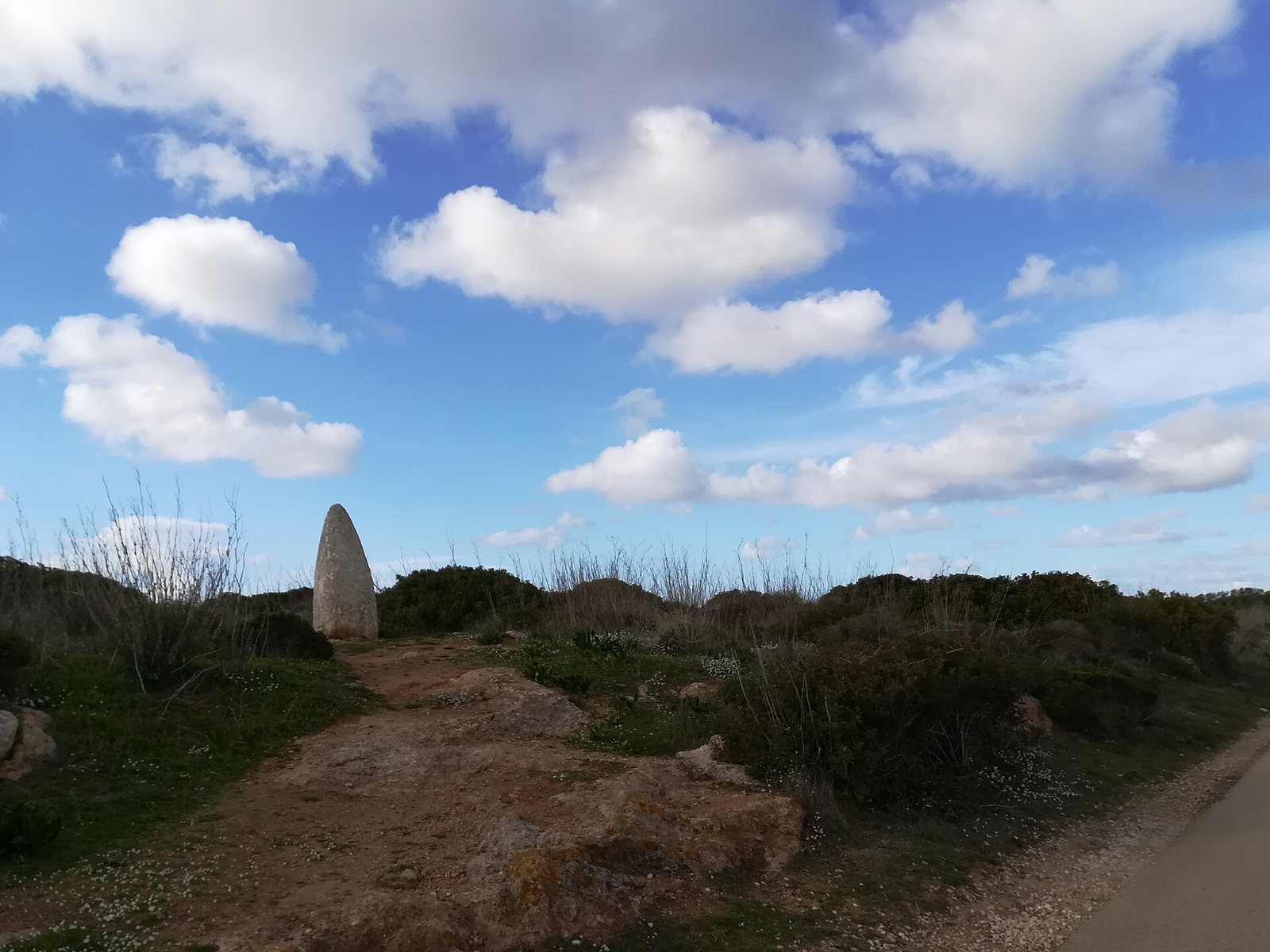
The stones are dispersed across separate hilltops in the Padrão area, near Praia da Ingrina and south of Raposeira. The road between Raposeira and Praia da Ingrina divides the site, which lies about one kilometre south of the Milrei surveying marker. The fifteen stones were originally arranged as a cromlech, an arrangement of standing stones commonly set in a circle, though that layout has been destroyed. Another interpretation is that they marked territorial possession.
Layout and stone forms
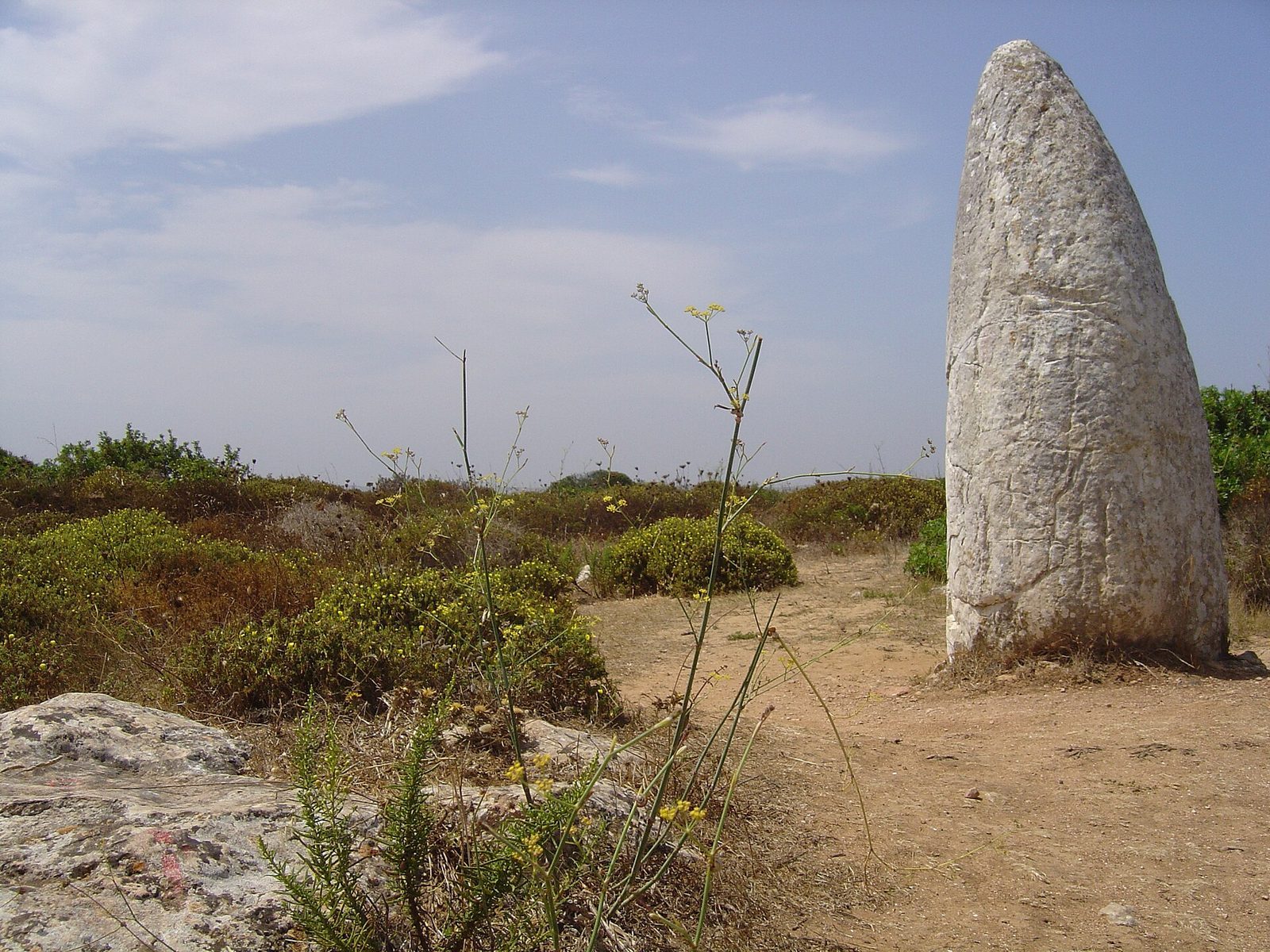
Carved from white limestone, the stones range from 0.65 to 3 metres high and have conical, roughly cylindrical, oval, or block-like forms. Some bear small cup-shaped hollows or raised, cord-like patterns. The stones are now fallen, with some in fragments, apart from Menhir 1.
The Padrão Menhir
Menhir 1, known as the Padrão Menhir, stands beside the road and is the only one of the fifteen stones still upright. A faint raised ring near its top resembles a motif found on other menhirs in the region and has been interpreted as phallic.
Excavated contexts
Excavations have revealed prehistoric features, later building materials, burials, and associated finds. Two of the menhirs, along with many objects recovered during the excavations, are held at the Vila do Bispo museum.
Menhir 9 and the stone structure
Fragmented Menhir 9 is associated with a roughly circular stone structure about 5 metres across. Its construction used blocks of limestone, sandstone, and greywacke, a sandstone containing mixed rock fragments. Finds from the area include parts of hand mills, percussion tools, flint flakes, and prehistoric pottery. A possible deliberately placed deposit contained a pottery vessel, two hand-mill components, and cockle and limpet shells.
The area near Menhirs 1 and 2
Near Menhirs 1 and 2, excavators found an early Neolithic fire-use feature and a paved surface, together with Roman and late Roman building materials and a burial area. Pottery fragments and animal remains came from this area. Women’s graves contained an earring and beads made from glass-based material.