Zavial Battery: A Coastal Artillery Defence in Portugal

Site at a Glance
- Rating
- 4.2
- Popularity
- Very Low
- Country
- Portugal
- Primary era
- Early Modern
- Eras represented
- Early Modern
- Civilizations
- Portuguese
- Site type
- Military
- Remains
- Fort
On this page8 sections
History
Zavial Battery is a ruined Portuguese coastal defence at Zavial in Raposeira, Portugal, built in the eighteenth century to protect Zavial beach and its anchorage. It succeeded the sixteenth-century Fort of San Ignacio of Zavial, which had defended a coastal tuna-fishing community and its fishing ground.
Fishing ground and early fortification
The earliest known activity at Zavial dates to 24 November 1569, when D. Sebastião, a sixteenth-century king of Portugal, appointed Pedro Dias as the official responsible for the Zavial fishing ground. During the Philippine Dynasty, the period from 1580 to 1640 when Portugal was ruled by Spanish Habsburg monarchs, a permit dated 2 January 1618 appointed the priest Vicente Freira to the chapel of the Zavial fishing establishment. He was required to celebrate Mass on Sundays and feast days, reflecting the growing importance of the settlement.
In 1630, Rodrigo Rebelo Falcão, the official responsible for the Algarve’s coastal tuna-fishing operations, requested defences for the exposed ports of Almádena and Azavial. By 20 October 1633, D. Luís de Sousa, governor and captain-general of the Algarve, had rebuilt the ruined and disused watchtowers of Aspa and Azavial and had begun constructing the Fort of San Ignacio of Zavial. Only its cistern, a water-storage structure, still required completion.
From fort to battery
An inspection in 1754 found the Fort of San Ignacio in good condition. The earthquake of 1755 then caused the fort to collapse, together with the walls of Lagos, the Governors’ Palace, and the fort’s chapel. Reconstruction at Lagos received priority, so the Marquês de Louriçal, governor of the Kingdom of Algarve, requested a new defence for the anchorage on 1 August 1763.
In a report dated 18 July 1765, Romão José do Rego, chief engineering sergeant, opposed rebuilding the ruined fort and recommended a battery, a fortified artillery position for defending a coast or anchorage. Zavial Battery was built on that basis, although it was already partly ruined by 1788.
Nineteenth-century decline and later transfer
During the Peninsular War, the Iberian campaign of the wider Napoleonic Wars fought mainly in Portugal and Spain between 1807 and 1814, the Prince Regent D. João placed the fortifications from Zavial Battery westward to Meia Praia Fort eastward under the authority of the Lagos garrison on 27 September 1805. Other fortifications outside this order were abolished because they had been destroyed or were considered unsuitable for retention.
A report of 18 April 1821 listed only three iron artillery pieces at Zavial Battery, all in very poor condition. The battery was abandoned in 1840. By an order dated 24 June 1938, its ruins, identified as Military Building No. 1 of the Lagos garrison, were transferred to the Ministry of Finance. The ruins were registered at the Urban Headquarters of Raposeira Parish on 21 April 1943 as belonging to José Miguel Belmonte Ribeiro Vaz Fragoso, and the property is also stated to have been acquired at public auction in 1964.
Remains
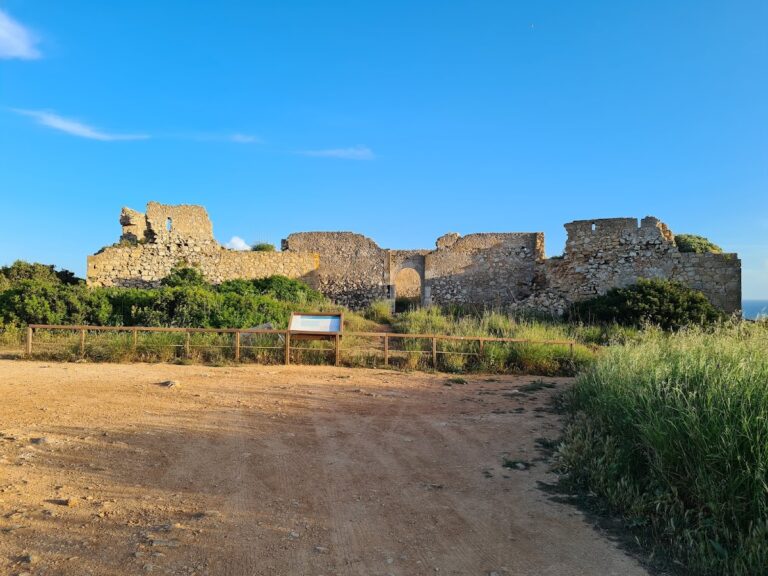
Zavial Battery and the earlier Fort of San Ignacio occupy the promontory called Ponta da Fisga, between Ingrina and Zavial beaches. The Fort of San Ignacio stands on an isolated rock, while the battery represents the later defensive installation associated with the same beach, anchorage, and fishing establishment. The surviving fabric is ruinous, and the battery’s documented armament in 1821 consisted of three iron artillery pieces in very poor condition.
Successive coastal defences
Fort of San Ignacio
The Fort of San Ignacio was built in the seventeenth century as part of the defence of Zavial. When construction was reported in 1633, its cistern remained unfinished. The fort later collapsed in the earthquake of 1755, leaving the battery to replace its defensive function after rebuilding the fort was rejected.
Zavial Battery
The battery was established on the Ponta da Fisga promontory to defend the anchorage. It was partly ruined by 1788 and later survived as ruins. Its remaining artillery in 1821 shows the reduced condition of the installation before its abandonment in 1840.
Nearby sites