Senftenberg Castle Ruin: A Medieval Hilltop Fortress in Austria


Site at a Glance
- Rating
- 4.8
- Popularity
- Low
- Country
- Austria
- Primary era
- Medieval
- External website
- Open
- Eras represented
- Medieval
- Civilizations
- Holy Roman Empire
- Site type
- Military
- Remains
- Castle
On this page7 sections
History
Senftenberg Castle Ruin is a medieval hilltop fortress in Austria, built by the free noble lords of Lengenbach and first documented on 26 April 1197. On that date, Rudegerus de Senftenberc appeared as a witness in a charter, providing the earliest recorded connection between the castle and the Senftenberg noble family. The Lengenbachs were also associated with castles at Rehberg before transferring Senftenberg to relatives who took the names Senftenberg and Minnenbach.
Medieval ownership
During the thirteenth century, the castle belonged to the Zebringer family, a medieval noble lineage connected with territorial lordship and castle ownership in the region. In the fourteenth and fifteenth centuries, it passed to the lords of Wallsee. The fortress was partly destroyed during guardianship conflicts between 1407 and 1409, after which it was rebuilt.
Refuge, attacks, and destruction
During the first Ottoman siege of Vienna in 1529, the castle provided refuge for the local population. Around 1520, robbers were also regularly present there. Repeated attacks followed during peasant uprisings toward the end of the sixteenth century, showing that the fortress remained exposed to regional unrest.
In 1645, during the Thirty Years’ War, the major European conflict fought from 1618 to 1648, Swedish troops under General Torstenson captured and destroyed the castle. General Torstenson was the Swedish field marshal Lennart Torstensson, who commanded forces in the war. After its destruction, Senftenberg fell into decay and survived as a ruin.
Preservation in the modern period
The Burgruinenverein Senftenberg has leased the ruin for 100 years and made its renovation a central goal. A fire on 14 April 2022, apparently following a break-in at an equipment shed, seriously damaged parts of the site managed by the association. The castle ruin itself was not affected, and the wooden castle bridge was saved.
Remains
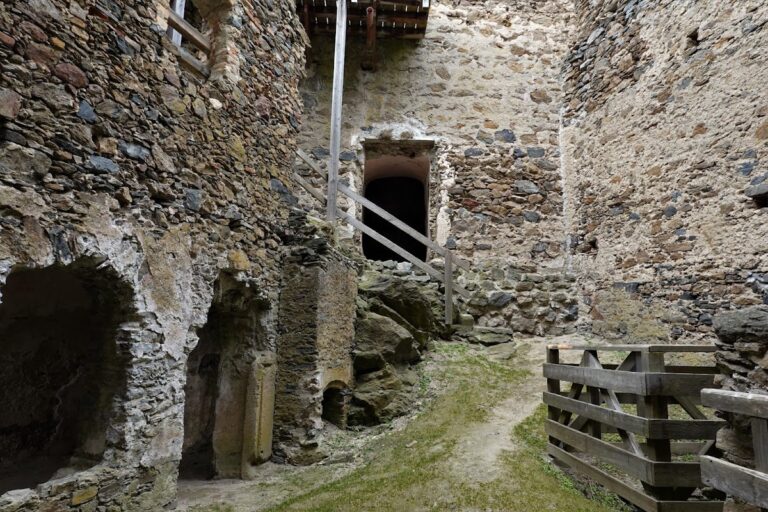
Senftenberg Castle Ruin occupies a hilltop at approximately 271 metres above sea level. The surviving fortress is preserved as a ruin and retains three gate complexes, a square bergfried, a shield wall, another tower, and a wooden castle bridge. A bergfried was the principal fortified tower of a medieval castle, commonly serving as a strong defensive refuge rather than as an ordinary residential tower.
Fortifications and towers
The shield wall is described as an unusual feature among Austrian castles. The surviving tower has a complex changing outline: its base is rectangular, its middle section is oval, and its upper quarter is hexagonal. Together with the square fortified tower and the three gate complexes, these elements preserve the defensive structure of the hilltop stronghold.
Castle bridge
A wooden castle bridge remains part of the surviving access arrangement. It was saved during the fire of 14 April 2022, while the ruin itself escaped damage from that event.