Greetsiel Castle: Ancestral Seat of the Cirksena Family


Site at a Glance
- Rating
- 4.7
- Popularity
- Medium
- Country
- Germany
- Primary era
- Medieval
- External website
- Open
- Eras represented
- Medieval
- Civilizations
- Unclassified
- Site type
- Military
- Remains
- Castle
On this page9 sections
History
Greetsiel Castle, also known as Ulrichsburg, was the ancestral castle of the Cirksena family in Greetsiel, Germany. The late medieval brick castle was developed between 1457 and 1460 and remained an important site in East Frisian history even after the government seat moved away.
From Appingen to Greetsiel
The Cirksena family had earlier been based at Appingen, about 2 kilometers south of Greetsiel. After the access there to the open sea silted up, Haro Edzardsna moved the family seat to the recently constructed sluice at Greetsiel. Between 1362 and 1388, the family built an earlier chieftain’s castle known as the old house.
As the Cirksena became the leading chieftain family in East Frisia, Ulrich Cirksena commissioned a larger four-wing castle with a defensive tower between 1457 and 1460. On 23 December 1464, Holy Roman Emperor Frederick III elevated Ulrich to the rank of Imperial Count and granted him East Frisia under imperial authority. This formal grant, known as an enfeoffment, confirmed the territory as a possession held through the emperor.
The Cirksena Seat
Edzard the Great, an East Frisian count whose rule brought the Cirksena territory to its greatest expansion, was born at the castle in 1462. The seat of government later moved first to Emden and then to Aurich, but Greetsiel Castle continued to hold an important place in the history of the family and of East Frisia.
The castle also became involved in regional conflicts. During the Guelders War, Balthasar of Esens, an East Frisian chieftain, captured it in 1534 and held it as a pledge until a peace settlement. Following the Emden Revolution, the Cirksena accepted in the Treaty of Greetsiel that only the Reformed religion, a Protestant tradition arising from the Reformation, could be taught in Emden.
Occupation, Siege, and Demolition
In 1609, troops from the city of Emden occupied Greetsiel and its castle after disputes between the provincial estates and Count Enno III of East Frisia. Further conflict arose in 1684 between Christine Charlotte of Württemberg, the regent of East Frisia, and the provincial estates. Foreign powers intervened, and after a six-day siege, 300 soldiers from regular Brandenburg regiments captured the castle on 6 November.
The Brandenburg troops were intended to form a permanent garrison of 200 men, funded by the estates and the town of Greetsiel. That plan was abandoned in 1692. After the East Frisian countly house became extinct and Prussia took power in 1744, the castle was converted into a penitentiary in 1755. It was sold for demolition in 1777.
Remains
Castle Layout and Construction
The developed castle was a four-sided brick complex with a defensive corner tower and a broad water-filled moat. The building measured 31.40 meters from northeast to southwest and rose 9.42 meters from the bottom of the moat to the roof. One corner tower reached 31.40 meters in height and had a diameter of 10 meters. A wooden bridge crossed the moat, which was 25 meters wide and more than 6 meters deep.
The earlier old house measured 12.60 by 11.50 meters. Its foundation walls were 2 meters thick, giving the building the character of a tower house, a fortified residence centered on a substantial tower-like structure. It probably first formed the east wing of the later castle before a subsequent eastward expansion probably led to its demolition.
Surviving Buildings
Schatthaus
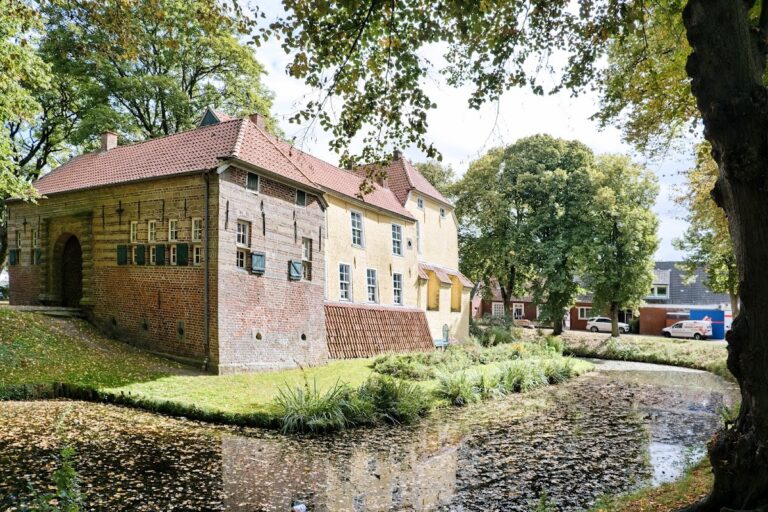
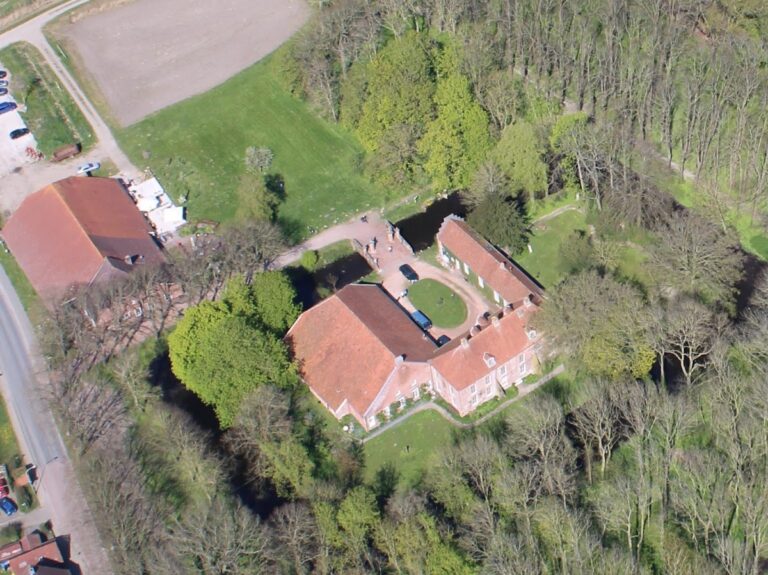
The Schatthaus survives as the former farmyard of Greetsiel Castle. It represents the part of the castle complex associated with agricultural and estate functions.
Old Stone House
The Cirksena family’s old stone house is also preserved among the remains of the former castle. Together with the Schatthaus, it forms the surviving physical evidence of the Cirksena seat after the main castle was sold for demolition.