Burg Marquartstein: A Medieval Hill Castle in Bavaria


Site at a Glance
- Rating
- 3.9
- Popularity
- Low
- Country
- Germany
- Primary era
- Medieval
- Eras represented
- Medieval
- Civilizations
- Holy Roman Empire
- Site type
- Military
- Remains
- Castle
On this page10 sections
History
Burg Marquartstein is a medieval hill castle in Germany, near Marquartstein in Upper Bavaria. Marquart, Count of Chiemgau, founded it in 1075 on a rocky site above the Tiroler Ache valley. The castle later became a centre of local government and justice, and its long history includes noble inheritance, literary connections, educational use, and modern private restoration.
From the Counts of Chiemgau to the Wittelsbachs
Marquart died shortly after marrying Adelheid of Lechsgemünd. His widow later married Ulrich of Passau, a member of the Diepolding family. After Ulrich died in 1099, the castle passed through the marriage of his daughter Uta to Engelbert II of the Spanheim family. It thereby entered the possessions of the Spanheims, a medieval noble dynasty.
After Engelbert II’s death, the County of Kraiburg–Marquartstein became part of the possessions of the Ortenburg family. When the palatine branch of that house ended with Rapoto III in 1248, its lands passed to his son-in-law Hartmann I of Werdenberg. Hartmann sold the county in 1259 to Henry XIII, the Wittelsbach duke of Lower Bavaria. The Wittelsbachs were the ruling dynasty of Bavaria.
An administrative and judicial centre
For centuries, Marquartstein served as the seat of a Pflegeamt, a Bavarian territorial office responsible for administration and justice. This role made the castle a local centre of government. The Marquartstein district court was abolished in 1803, and the area was incorporated into the Traunstein district court.
The Tautphoeus residence
In 1857, the English-Irish writer Jemima Montgomery and her husband, Cajetan von Tautphoeus, purchased the decaying castle and arranged its renovation. They probably intended it for their only son, Rudolf von Tautphoeus. Jemima von Tautphoeus drew inspiration from the castle for her novels, linking the residence to her literary work.
Rudolf later entered diplomacy and served as a ministerial counsellor, an extraordinary and plenipotentiary minister, and a Bavarian chamberlain. He lived with his wife, Alice Baroness Isocco Sonnino, at Marquartstein Castle, in Como, and in Rome. The later history of the residence after Rudolf’s death in 1885, or after Jemima’s death in 1893, is unclear.
The castle chapel acquired an additional historical association in the late nineteenth century. The German composer Richard Strauss married Pauline de Ahna, a soprano, there on 10 September 1894.
School and private ownership
From 1928 to 1958, the castle housed a Landschulheim, a residential rural school where pupils lived while attending classes. In 1987, the Munich art dealer and collector Konrad O. Bernheimer acquired the property and renovated it. After selling Bernheimer House in Munich, he intended to use Marquartstein for his family’s art and antiques collection. The castle remains privately owned and has been offered for sale since 2015.
Burg Marquartstein is protected as an architectural monument in Bavaria under designation D-1-89-129-5. Archaeological remains beneath and around the castle are separately protected as an archaeological monument under designation D-1-8240-0118. Rettenburg and Streichenburg were probably outlying fortifications connected with Marquartstein.
Remains
Burg Marquartstein occupies a projecting rock at approximately 575 metres above sea level, overlooking the valley of the Tiroler Ache in the Chiemgau, a historical region of southeastern Bavaria. It is a medieval hill castle, and substantial parts of the complex survive. The castle is described as containing 40 bedrooms, while archaeological layers beneath the site preserve evidence of earlier phases of occupation and construction.
Castle and chapel
Castle buildings
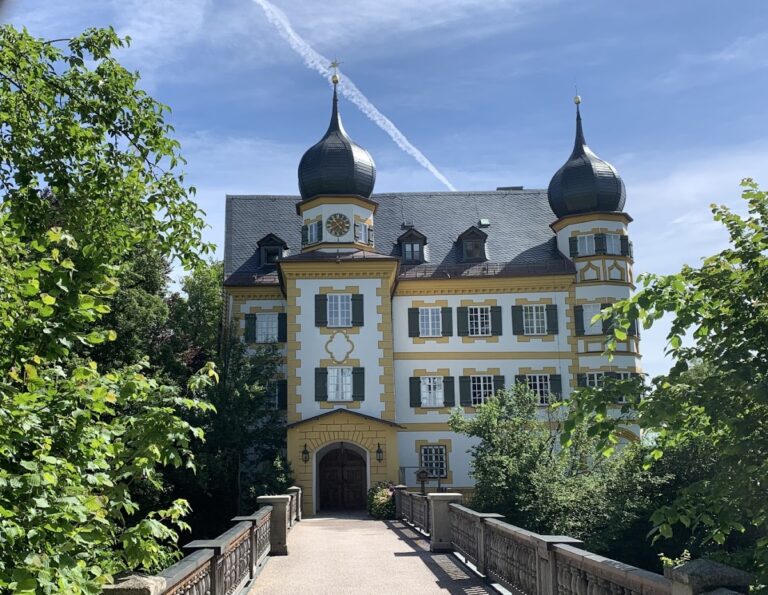
The surviving complex stands on the rocky height above the river valley and retains substantial medieval fabric. Its later history is also reflected in its continued residential use and in the renovation carried out after Konrad O. Bernheimer’s acquisition in 1987. The scale of the residence is indicated by its reported 40 bedrooms.
Chapel of St Bartholomew and St Vitus
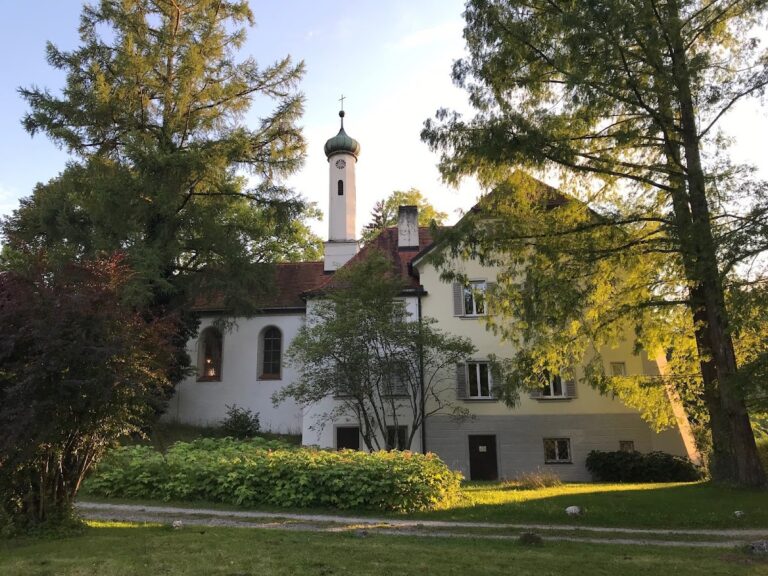
The chapel of St Bartholomew and St Vitus stands beside the castle. A fire on 13 February 1843 damaged the building, which was rebuilt in 1845. The chapel is also the setting of Richard Strauss’s marriage to Pauline de Ahna in 1894.
Archaeological remains
Subsurface deposits in the castle area belong to the medieval and early-modern periods. They include remains of predecessor structures, the former castle chapel, and the vanished outer bailey. These remains preserve evidence of earlier arrangements within the castle complex and of buildings that no longer survive above ground.