Manningaburg: Historic Lowland Castle in Germany


Site at a Glance
- Rating
- 4.4
- Popularity
- Low
- Country
- Germany
- Primary era
- Early Modern
- External website
- Open
- Eras represented
- Medieval, Early Modern
- Civilizations
- Holy Roman Empire
- Site type
- Military
- Remains
- Castle
On this page11 sections
History
Manningaburg is a lowland castle in Pewsum, Germany, built for the East Frisian Manninga family in the fifteenth century. A lowland castle was a fortified residence in flat terrain, commonly protected by surrounding waterworks. The castle became the family’s ancestral seat and later served as a residence for East Frisian rulers, noblewomen, and military commanders.
The Manninga seat
The Manninga family held several East Frisian estates, including Lütetsburg, Jennelt, and Westeel. The family is said to have emerged from the Beningamannen association of the Emsigerland, while Pewsum was probably its oldest ancestral seat. Local chiefs of the lineage had the castle built during the fifteenth century, although the identity of the original builder is uncertain. The first documented reference to a chief of Pewsum names Dedeke to Pewsum in 1404.
Poppo Manninga rebuilt the Pewsum castle in 1458. Around 1530, probably on the orders of Fokko Manninga, a richly furnished New Castle was erected beside it. The expanded complex included the old outer bailey and the new upper castle, surrounded by three moats. The towers of the New Castle later served as sea marks.
Expansion, sale, and princely residence
After Fokko Manninga died, his son Hoyko inherited the estate in 1540 and continued enlarging the castle. Debts passed down from his father, together with Hoyko’s extravagant spending, forced him to sell parts of the family’s holdings. He sold the lordship of Jennelt in 1540, the Asinga House at Warffum in 1560, and additional land at Visquard and Jennelt in 1560 and 1562.
In 1565, Hoyko sold the castle and lordship of Pewsum to Catherine of Sweden for 80,000 guilders. Catherine and her husband, Edzard II, the ruling count of East Frisia, acquired the castle and the Pewsumer mill. The couple frequently stayed at Manningaburg. From 1611, the castle became the residence of their daughters, Countesses Sophia and Maria. Maria later became Duchess of Brunswick-Lüneburg-Dannenberg.
Sophia and Maria established a practice of distributing “castle bread” to poor people in Pewsum and Woquard. This charitable tradition continued until the First World War. During the Thirty Years’ War, the major European conflict of 1618 to 1648, Manningaburg housed Count Peter Ernst II of Mansfeld, Dodo von Knyphausen in 1623, and the Hessian general von Eberstein in 1644. East Frisian princes also received guests there during the seventeenth century, including Frederick William of Brandenburg, known as the Great Elector, during his journey to the Netherlands in 1634.
Decline and changing uses
Extensive renovation took place in 1669, but the castle began to decay afterward. Financial problems in the Cirksena dynasty, which ruled East Frisia, prevented essential repairs, particularly to the upper castle. That part of the complex was demolished in 1716 after its fabric had seriously deteriorated. The sixteenth-century outer-bailey and upper-castle buildings, including the stable building, were demolished during the eighteenth century. The lower-castle section, with its fifteenth-century core, remained.
After the death of Carl Edzard, the last native East Frisian prince, the castle passed to Frederick II, the eighteenth-century king of Prussia. He considered selling it for demolition but abandoned the proposal when the bids were too low. Manningaburg entered private ownership in 1859.
Around 1920 to 1930, Cornelia, the sister of Hermine Heusler-Edenhuizen, operated a children’s home in the castle. During the Nazi period, it housed a Gau Leadership School, a Nazi institution for political and ideological training. Its first year-long leadership course began in March 1935 with 40 participants. During the Second World War, the building served as a military hospital, and it later housed expellees.
Restoration and present role
The Heimatverein Krummhörn purchased the castle in 1954 with assistance from the Norden district and the Ostfriesische Landschaft. The complex was then close to ruin, so the association carried out extensive repairs and began its restoration. The municipality of Krummhörn acquired Manningaburg in 1980.
Today, the castle accommodates a museum and the civil registry office, where approximately 100 couples are married each year. The museum explores castle construction in East Frisia and the Groningen region, the history of church building in East Frisia, and religious life. Temporary exhibitions complement its permanent displays.
Remains
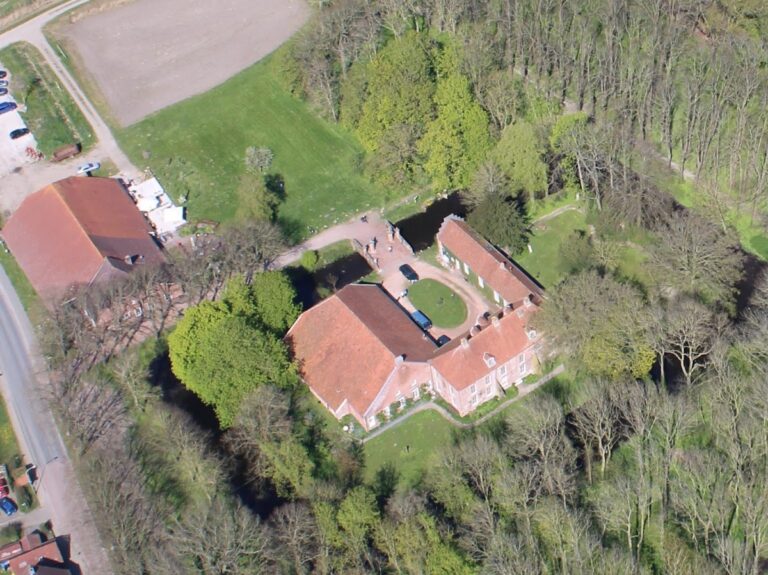
Manningaburg stands in the center of Pewsum as a lowland castle surrounded by a broad moat. The original complex was enclosed by three moats and combined a lower castle, an outer bailey, and an upper castle known as the New Castle. The surviving fabric brings together the remains of the fifteenth-century lower castle and later additions from the sixteenth century.
Lower castle and early foundations
Fifteenth-century castle core
The foundations of Poppo Manninga’s 1458 castle survive in the west and south wings. These foundations form part of the lower castle, the surviving outer-bailey section of the former complex. They preserve the physical remains of Manningaburg’s fifteenth-century phase within the later building.
Sixteenth-century additions
Gatehouse
The gatehouse dates from around 1550 and displays Dutch influence. It belongs to the later phase of construction that reshaped the surviving castle after the Manninga family’s earlier building work.
North wing
The north wing was built around 1550 on a Dutch model. Its facade uses alternating bands of sandstone and brick, a decorative brickwork technique known as Specklagen. These contrasting horizontal bands remain a distinctive feature of the surviving sixteenth-century fabric.
Nearby sites