Seitzenbuche Roman Fortlet: A Roman Frontier Installation in Germany
Site at a Glance
- Popularity
- Very Low
- Country
- Germany
- Primary era
- Classical
- Eras represented
- Classical
- Civilizations
- Roman
- Site type
- Military
- Remains
- Fort
On this page10 sections
History
Roman frontier and sanctuary
The Seitzenbuche Roman fortlet is a small Roman frontier installation at Mudau, Germany. Built by the Romans on the older Odenwald line of the Neckar-Odenwald Limes, a frontier system of military installations, it watched a pass on the shortest route between the Main and Neckar rivers. The fortlet stood between the Zwing fortlet to the northwest and the fort at Schloßau to the southeast.
The eastern stone tower at nearby watchpost Wp 10/37 later served as a sanctuary, but its original purpose and the order in which the two stone towers were built remain uncertain. It may first have served as a frontier watchtower or provided a design model for towers linked with the numeri Brittonum, Roman units designated as British contingents.
The sanctuary’s date is also debated. A Victoria shield fragment found at the Oberscheidental fort, considered alongside a building inscription, supports a date before the Roman auxiliary regiment cohors I Sequanorum et Rauracorum left for Miltenberg around AD 159. A later dating of the sword and belt fitting from the Mars statue to the late second century has prompted another possible connection: the sanctuary may have been established in relation to Emperor Caracalla’s AD 213 campaign against the Alamanni, a confederation of Germanic peoples. The grouping of deities may point to a military occasion, although these gods were also popular among soldiers more generally.
Nineteenth-century investigation
Johann Friedrich Knapp began research at the fortlet in the nineteenth century. Excavations by the Imperial Limes Commission, a German body that investigated Roman frontier sites, established the fortlet’s dimensions. Andreas Debon, a local historian and district court assessor, first drew attention to the area of Wp 10/37.
Wilhelm Conrady, a pioneer of frontier research, and Ernst Wagner, director of the Grand Ducal Collection of Antiquities, excavated at the watchpost in May 1884. A forester from Schloßau named Langer continued the investigations.
Remains
Fortlet and frontier route
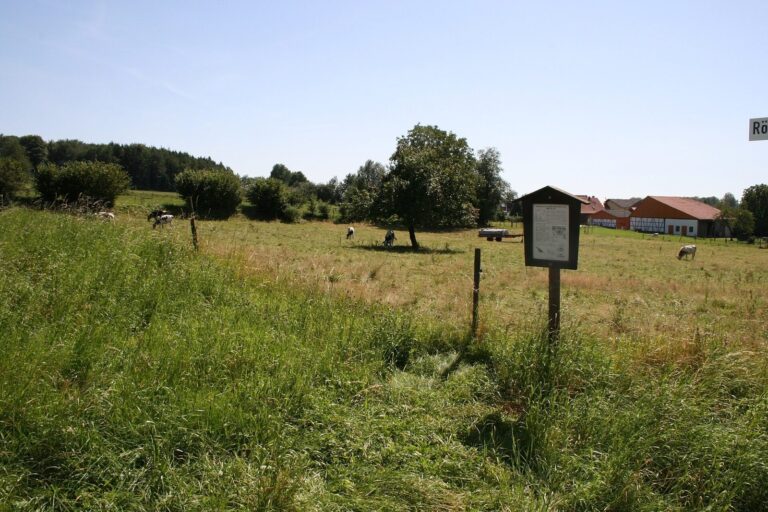
The remains comprise a square stone fortlet and a separate watchpost area with timber and stone tower sites. The fortlet stood on Heidenberg, at 460.7 metres, between roads toward Schloßau and Kailbach. It measured 20 by 20 metres and had a 2.30-metre-wide gate, inward-turning gate walls and a threshold. Its remains resemble those of the nearby Zwing fortlet. The site is heavily damaged, with slight depressions and a few stones from the wall’s projecting upper edge visible in the woodland. At the pass, the Limes route runs from west-northwest to east-southeast, bends again at Schloßau, and climbs east of the fortlet toward a high point near watchpost Wp 10/38.
Watchpost Wp 10/37
Timber and stone tower sites
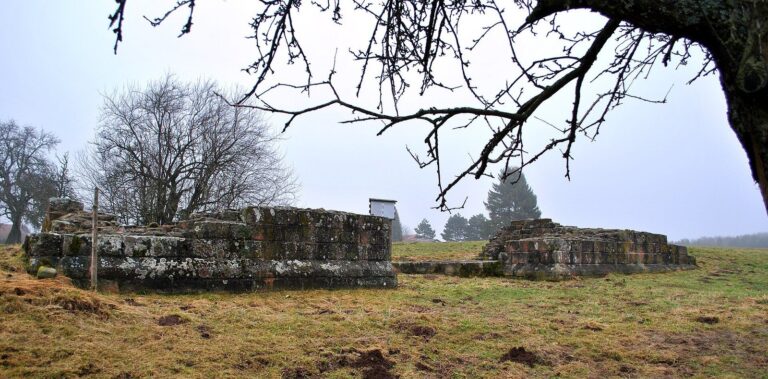
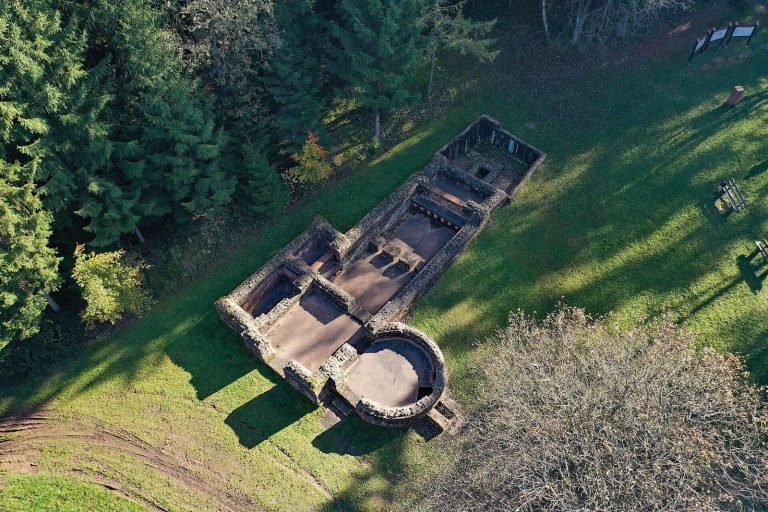
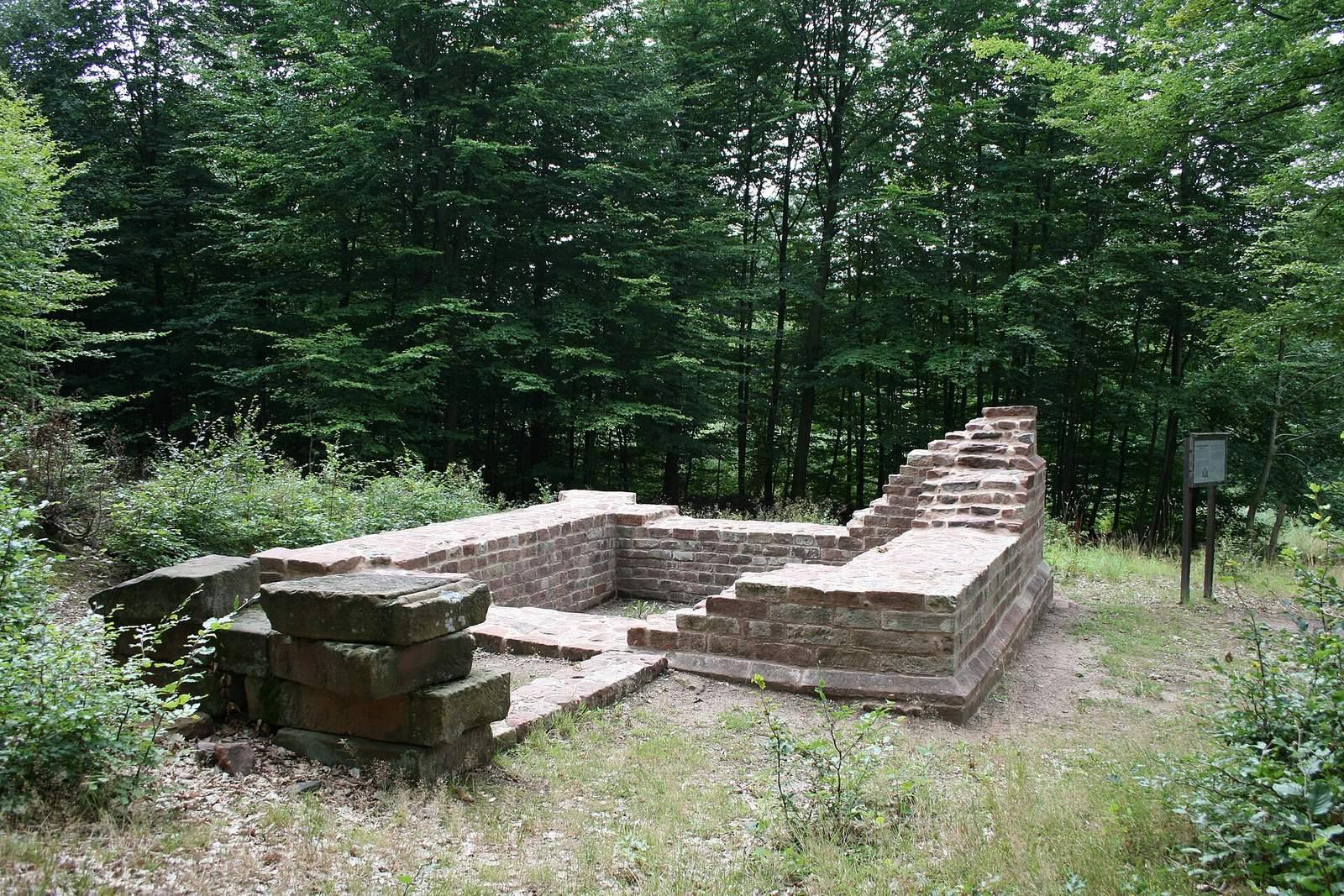
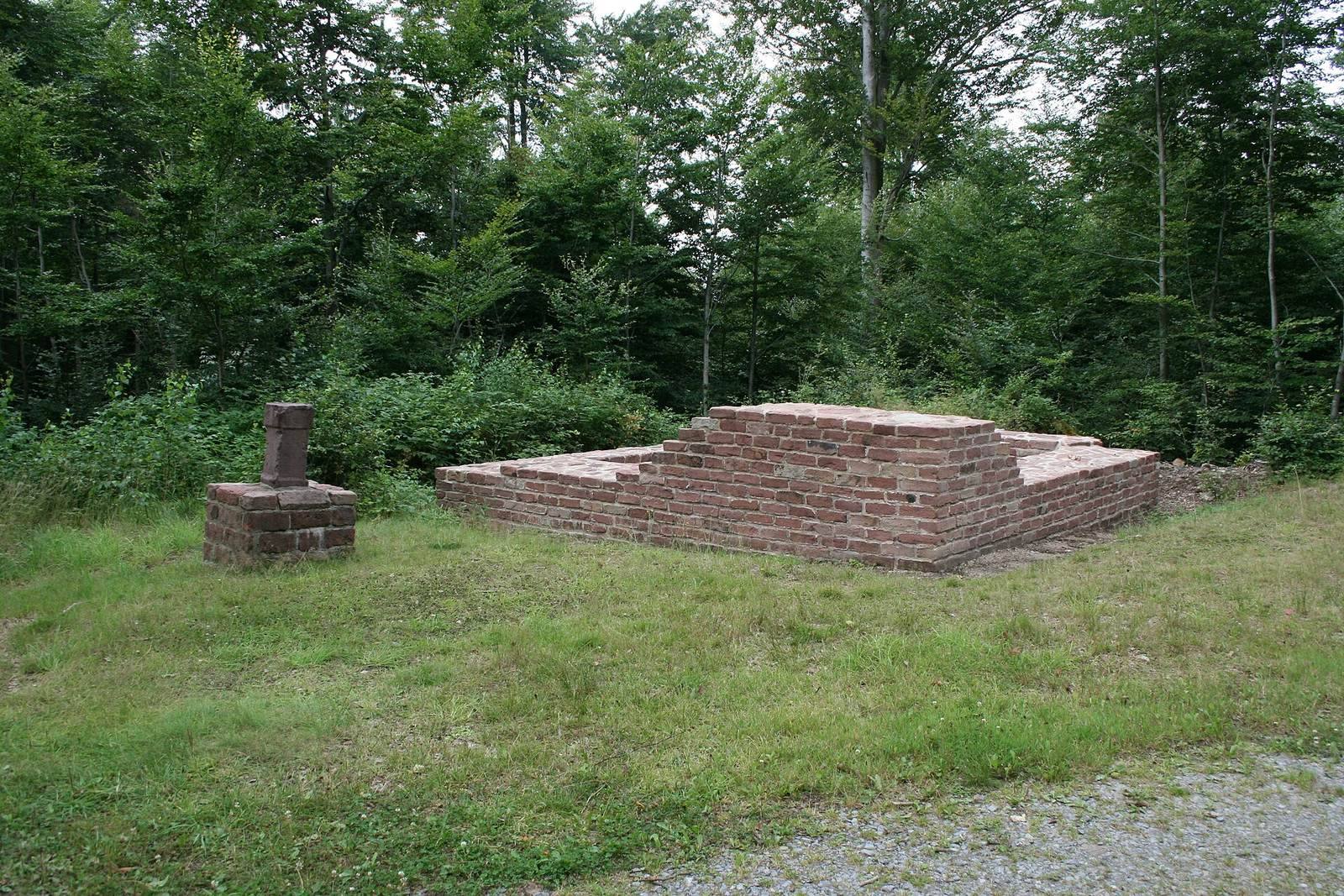
Excavations identified a timber-tower site with a total diameter of 20 metres, alongside two stone-tower sites. Both stone foundations have been reconstructed. The western tower measures 6 by 6 metres, while the eastern one measures 6.60 by 6.60 metres.
Eastern tower sanctuary
A staircase was added to the north side of the eastern tower. An inscription dedicated to Jupiter, a major Roman god, was built into its open steps. It records the fulfillment of a vow for the completion of a burgus, a small fortified frontier installation, and probably refers to the western tower. A replica of the inscription stands in front of that tower; the original is held at the Roman Museum in Osterburken.
Plaster and traces of strong red, yellow and green paint found in the eastern tower’s rubble probably came from its interior. Wedge-shaped stones suggest that the statues were displayed in an arched niche. The tower also provides the only evidence for a tiled roof at a tower site on the Odenwald Limes.
Statues and other finds
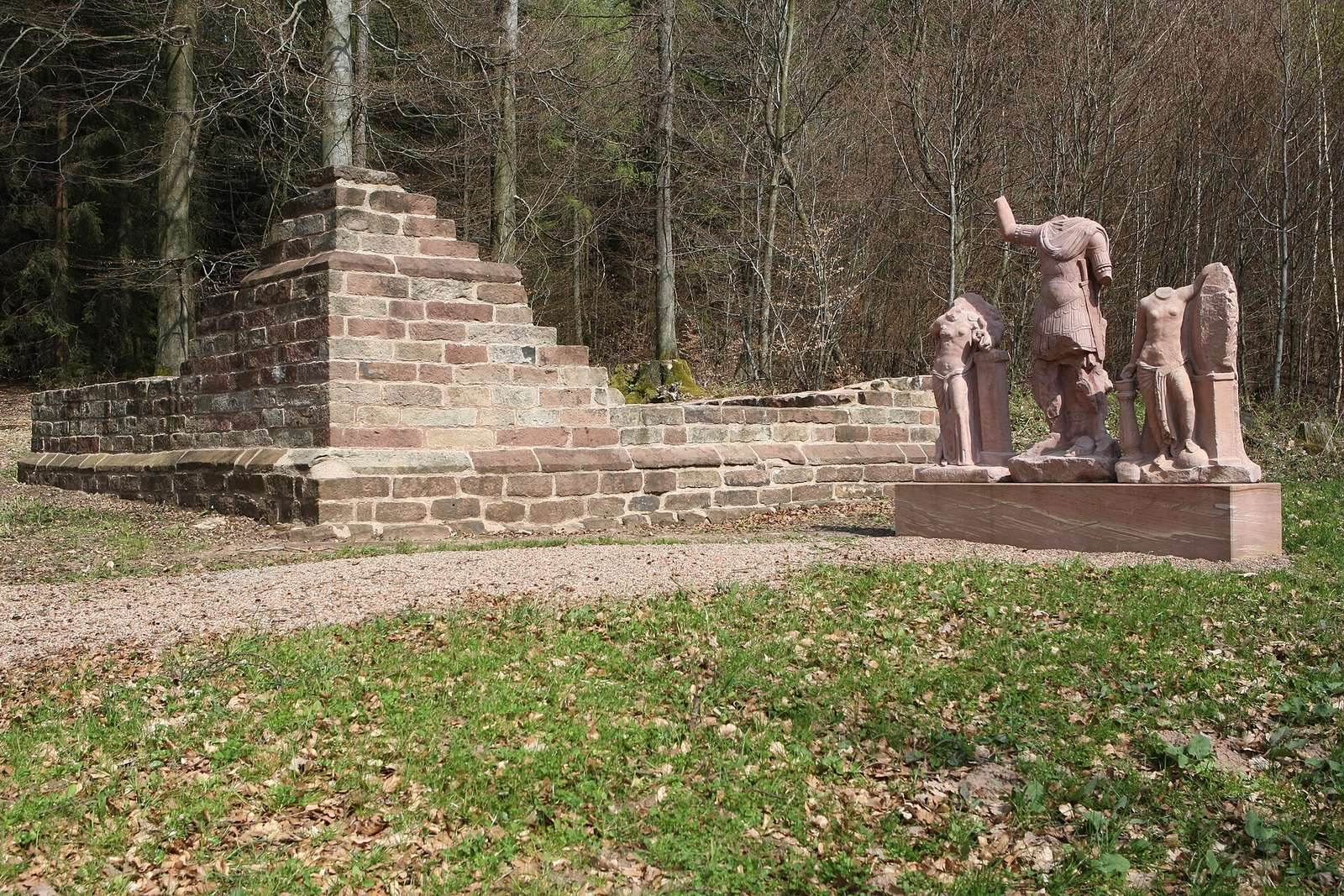
Three red sandstone statues, each more than a metre tall but smaller than life-size, depict Victoria, the personification of victory, Mars, god of war, and Salus, associated with health and well-being. They are the work of a local workshop and show fairly careful craftsmanship. The originals are held at the Roman Museum in Osterburken, while copies have stood at Wp 10/37 since 2009. Brick stamps and graffiti were also found in the watchpost area.
Conservation and reconstruction
The sanctuary’s present conserved and partly reconstructed appearance dates to the first survey, in March 1893. During that work, one corner was rebuilt beyond the surviving remains, though the sloping base course is original. Sloping stones recovered from the rubble were also used to reconstruct a second step in the tower’s profile.