Amorbach Abbey: A Benedictine Monastery and Princely Residence in Germany
Site at a Glance
- Rating
- 4.7
- Popularity
- Very Low
- Country
- Germany
- Primary era
- Early Modern
- External website
- Open
- Eras represented
- Medieval, Early Modern, Modern
- Civilizations
- Holy Roman Empire
- Site type
- Religious
- Remains
- Monastery
On this page15 sections
History
Amorbach Abbey is a former Benedictine monastery in Amorbach, Germany, whose origins lie in the early medieval Christianization and settlement of the Odenwald. Its foundation date is uncertain: a tradition celebrated in 1734 placed it in 734, the abbey’s necrology points to 767, and a broader scholarly dating places the foundation between 747 and 800. The monastery developed from a Carolingian foundation, meaning one established during the rule of the Carolingian dynasty as Frankish rulers promoted Christianity, administration, and settlement. It became one of the earliest monastic foundations in the Main-Franconian region.
Carolingian foundation and royal protection
An older tradition attributed the foundation to Saint Pirmin, but that association is not secure. Later interpretations favor Irish-Scottish or Irish-Frankish monks. Another tradition states that Saint Amor became the first abbot and moved the monastery to its present location in 734. Whatever the precise circumstances, Amorbach was one of four Carolingian monasteries assigned to develop and Christianize the Odenwald, alongside Lorsch, Fulda, and Mosbach.
The monks cleared forests, encouraged new settlements, strengthened Christianity in the eastern Frankish region, and helped extend Frankish royal authority. The abbey stood where an ancient route from the Main near Miltenberg toward Bad Wimpfen met a route running from Worms through the Odenwald to Würzburg. Before 800, it came under the direct protection of Charlemagne, the Carolingian ruler who expanded Frankish power and promoted Christian administration. Amorbach consequently became a royal or imperial abbey, a monastery subject directly to the ruler rather than to an intervening territorial lord or bishop. Around 882, it probably received royal immunity.
During the ninth century, Amorbach took part in the Carolingian mission to Saxony. Several of its abbots also served as bishops of Verden. Spatto, for example, was simultaneously abbot of Amorbach and Neustadt am Main from 810 to 823. These connections placed the monastery within the wider network through which Carolingian rulers organized religious foundations and extended their influence.
Reform and territorial development
By the tenth century, Amorbach had become a proprietary monastery of the Bishopric of Würzburg. After 950, it adopted the Gorze Reform, a Benedictine movement that sought stricter observance and more disciplined communal life, probably through contacts with Lorsch. In 993, King Otto III placed the abbey under Würzburg authority on the basis of forged documents. As a result, Amorbach lost extensive possessions in the Bauland to the bishops of Würzburg.
The abbey established some of the region’s earliest independent parishes, including Buchen, Walldürn, and Bödigheim. It later incorporated Bödigheim parish in 1256, Hollerbach in 1277, and Hausen parish, together with its branches at Oberscheringen and Einbach, in 1330. At various times, priests connected with Amorbach served as many as 40 parishes.
About 1010, the monk Theoderich of Fleury worked at Amorbach. His writings influenced Abbot Richard, who led Amorbach from 1012 to 1039 and also became abbot of Fulda in 1018. Richard created the Ordo Amerbacensis, a set of regulations for monastic life that became a model for renewal. Amorbach also supplied the first monks for the Benedictine monastery on Bamberg’s Michaelsberg, founded in 1015.
Abbot Ezzelin, who served from 1039 to 1091, acquired the Mudau Odenwald after 1050. This territory covered approximately 100 square kilometers. Through planned forest clearance, undertaken both with and against neighboring nobles, the abbey helped settle an area that had previously been sparsely inhabited. The territory was later organized as the Zent Mudau in 1271. Donations and purchases during the eleventh and twelfth centuries further enlarged the abbey’s possessions. The Amorbach tradition notes, compiled around 1100, list property in 52 regional settlements and provide an important record of the high medieval Odenwald.
Medieval reforms and changing lordship
From about 1130, Amorbach followed the Hirsau Reform, another Benedictine movement devoted to stricter observance and renewed communal discipline. King Conrad III visited the abbey in 1144 and assumed its higher advocacy after the death of Count Gotebold II of Henneberg. In 1168, Emperor Frederick Barbarossa transferred the advocacy to Rupert II of Frohburg. Rupert later took the name Rupert of Dürn and became the progenitor of the Lords of Dürn.
In 1272, Ulrich of Dürn sold the town of Amorbach and the advocacy over the abbey to Archbishop Werner of Mainz. Secular authority therefore passed to the Electorate of Mainz, while ecclesiastical authority remained with the Bishop of Würzburg. The abbot later authorized Weiprecht Rüdt of Rüdenau to build a castle above Bödigheim.
The monastic community gradually declined from the later twelfth century and had become an exclusively aristocratic monastery by the late Middle Ages. Abbots Dietrich II of Kuntich, who served from 1406 to 1428, and Heinrich II, who served from 1428 to 1456, reversed this decline. Dietrich restored discipline through renewed observance of the Benedictine Rule and reopened the community to people who were not of noble birth. Heinrich restored the abbey’s economic position.
Abbot Friedrich Feyser commissioned a register of land and rights in 1395. The resulting record described the abbey’s rights and the obligations of dependent peasants. Under Abbot Jakob Zweifel, who served from 1517 to 1532, the church was repaired. The abbey then received income from more than 100 places and exercised advocacy rights in 19 villages.
Reformation, war, and recovery
In 1525, during the German Peasants’ War, citizens of Amorbach joined insurgents led by Götz von Berlichingen, an imperial knight and military leader associated with the rebellion. They stormed and plundered the abbey. During the Reformation, several parishes under noble influence adopted Protestantism. Abbot Theobald Gramlich of Scheringen, who served from 1556 to 1584, used military pressure to keep or restore parishes within his sphere of influence to Catholicism after the Peace of Augsburg, the settlement that regulated religious divisions within the Holy Roman Empire.
The Thirty Years’ War brought further destruction. In 1631, troop movements, forced billeting, plundering, and extortion damaged the abbey and its surrounding economy. Amorbach was dissolved from 1632 to 1634, and its property was transferred to Count Ludwig I of Erbach. After the war, depopulated villages and lost economic resources left the institution severely weakened. Only 11 monks remained in 1651.
An agreement between Mainz and Würzburg in 1656 transferred Amorbach, which had already been under Mainz’s secular authority, into the ecclesiastical jurisdiction of the Archbishopric of Mainz. The abbey’s rights were restricted in favor of the princely episcopal government. It nevertheless recovered, and the community had grown to 41 monks by the death of Abbot Cölestin Mann in 1713.
Baroque rebuilding and secularization
Under Abbot Engelbert Kinbacher, the abbey celebrated its supposed thousandth anniversary for eight days in 1734. Between 1742 and 1747, the abbey church was extensively remodeled in the Baroque and Rococo styles. Maximilian von Welsch and Johann Valentin Thoman directed the work, with Alexander Jakob Schmitt and Franz Häffele involved in carrying out the plans. Abbot Hyazinth Breuer served from 1753 to 1778, and Benedikt Külsheimer was the final abbot, serving from 1778 until 1803.
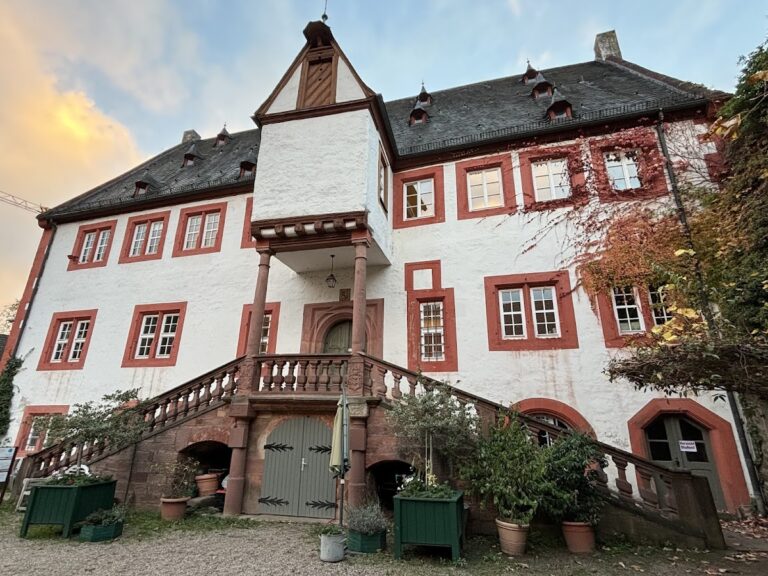
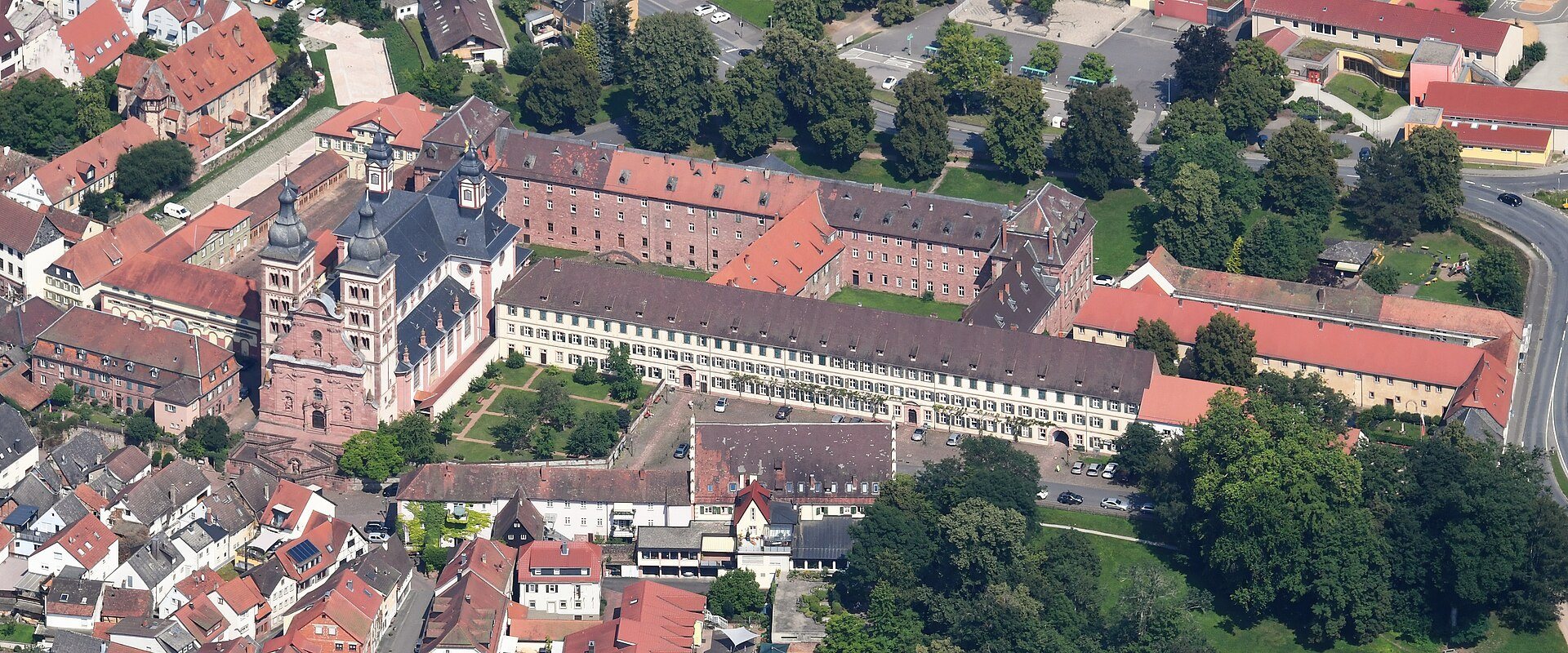
From 1783 to 1787, the Benedictines built a new convent building and prelature, as well as a library and the Green Hall. These buildings used the Amorbach Zopfstil, a late eighteenth-century German style that formed a restrained transition from Baroque and Rococo decoration toward early Neoclassicism. The projects were completed only a few years before the end of the Holy Roman Empire.
Amorbach Abbey was secularized in 1803. Its 24 Benedictine monks were expelled, and the buildings and lands passed to the Princes of Leiningen as compensation for territories they had lost on the left bank of the Rhine to French revolutionary forces. The extensive former monastery buildings led to Amorbach’s selection as the residence of the new Principality of Leiningen.
From 1803, the former Catholic abbey church served as the Lutheran court church of the princely house, and it has been an Evangelical Lutheran church since 1861. The former monastery buildings became a princely residence. The Principality of Leiningen was mediatised by Baden in 1806, the Amorbach area passed to Hesse in 1810, and it became part of the Kingdom of Bavaria in 1816.
The former monastery garden was transformed by Friedrich Ludwig von Sckell between 1805 and 1817 into an English-style landscape park known as the Seegarten. The former abbey library was auctioned in 1851, dispersing manuscripts as far as Cape Town, Moscow, and New York. The library rooms now hold approximately 35,000 volumes belonging to the Princes of Leiningen. The buildings and lands remain associated with the princely family. The abbey’s principal patron was the Virgin Mary, while its secondary patrons were the Roman martyrs Simplicius, Faustinus, and Beatrix.
Remains
Abbey church
Romanesque foundations and Baroque exterior
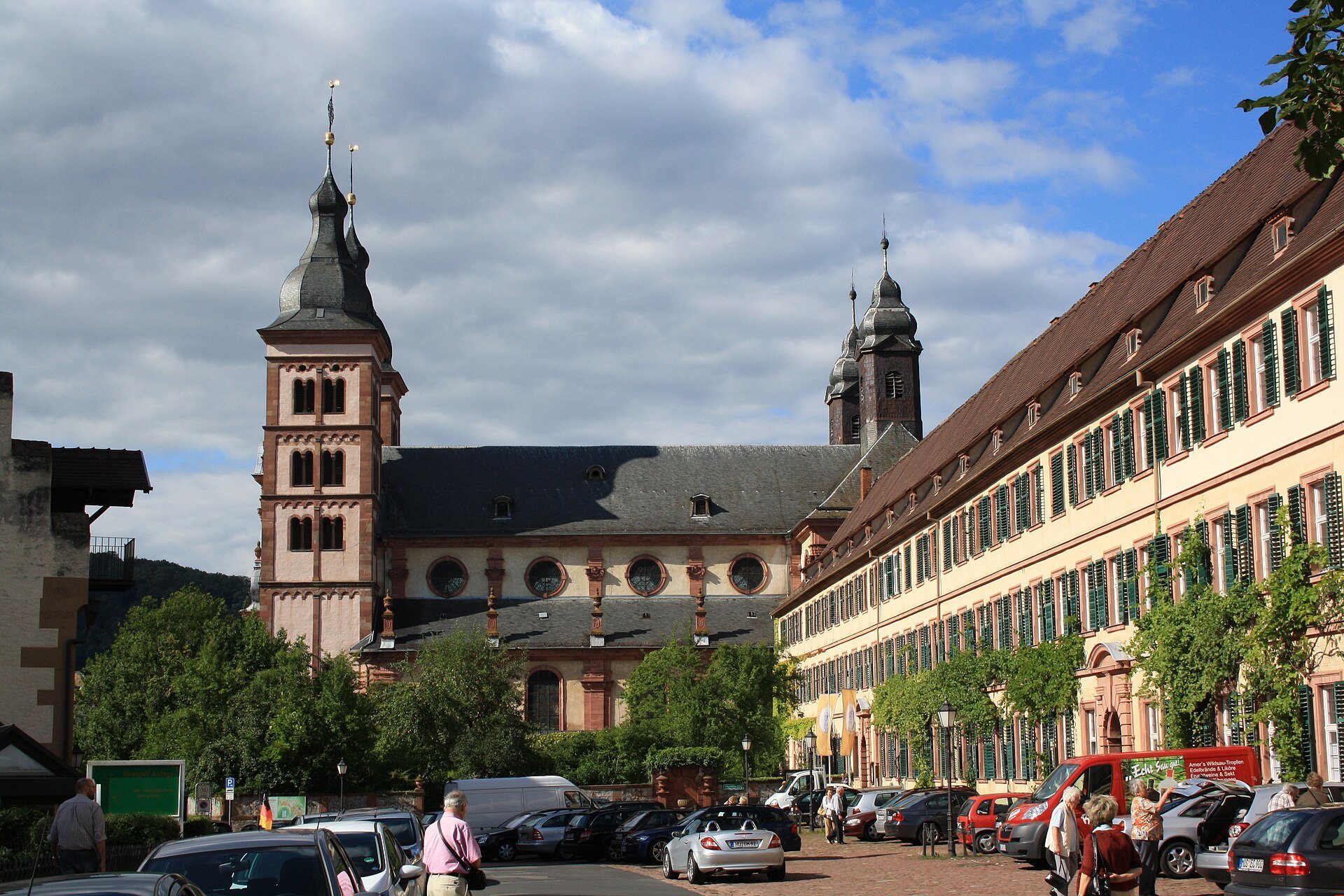
The abbey complex developed from a Carolingian basilica. A Romanesque tower front was added in the early twelfth century, and the two western towers survived the eighteenth-century rebuilding. The present church incorporates these six-storey towers behind a monumental sandstone facade. The later rebuilding retained the cruciform ground plan. The three-aisled nave was widened beyond the line of the towers, the towers received domed caps, the choir was lengthened, and the building was raised. Larger windows increased the light within the church, while two bell towers were added to the transept.
The facade has an elevated main portal reached by two large stairways. Statues of Jesus, Mary, Zechariah, Elisabeth, Joachim, and Anne decorate the stair railings. A wall niche contains a figure of Saint Beatrix, and Saint Benedict stands on the pediment.
Interior decoration and furnishings
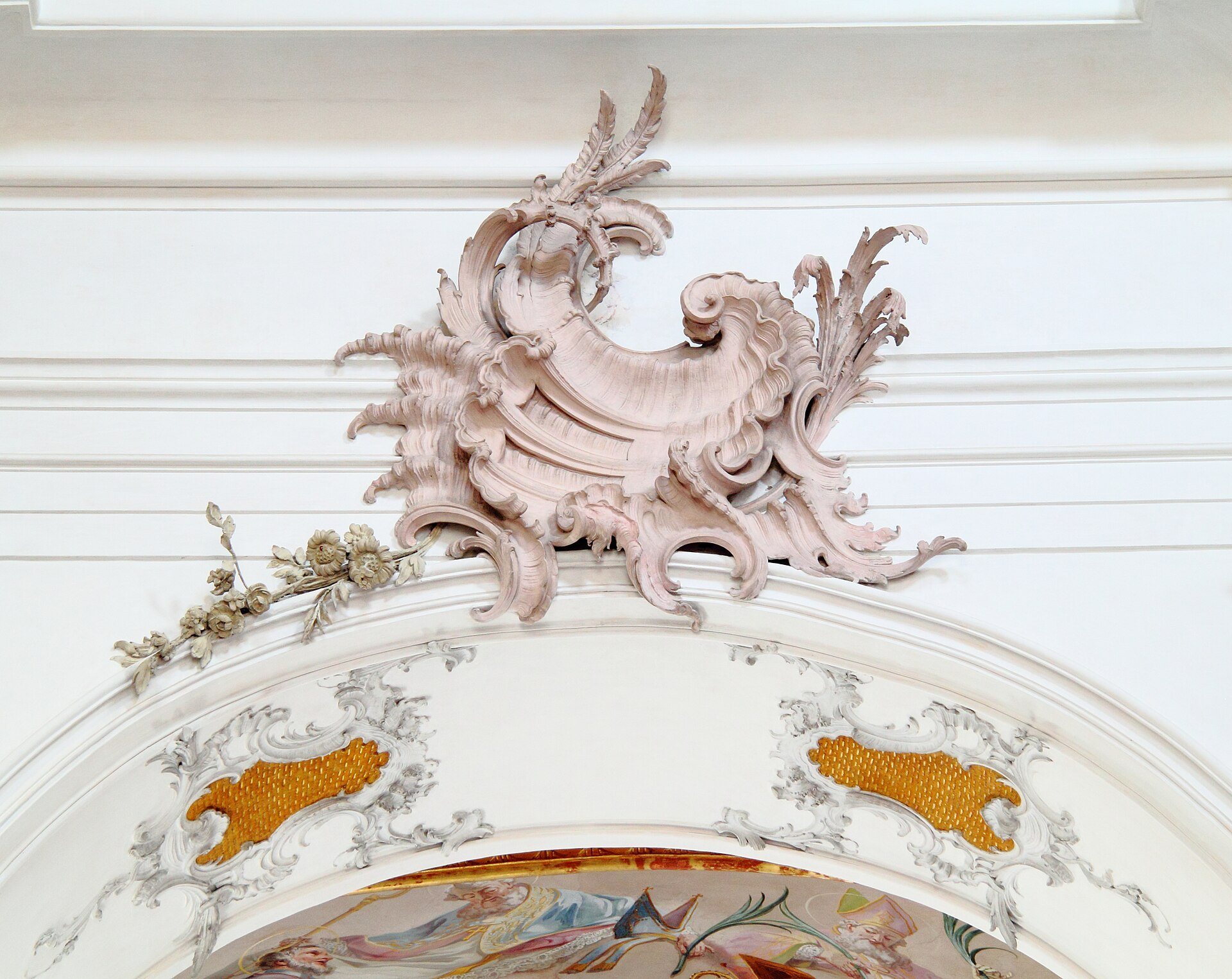
The interior contains late Baroque and Rococo stucco by the Wessobrunn artists Johann Michael Feichtmayr and Johann Georg Üblhör. The Wessobrunner School was a group of southern German stucco artists known for elaborate ornamental plasterwork. Matthäus Günther created 23 bright frescoes, including scenes from the life of Saint Benedict. His large nave fresco also shows Franz Häffele, the building supervisor, holding a measuring instrument and wearing a tricorne hat.
The high altar has six red or colored marble columns that support dark beams and a representation of the Holy Trinity. Matthäus Günther’s altarpiece depicts the Assumption of Mary and is flanked by life-sized statues of Joachim and Anne. Side-aisle altars are dedicated to saints including Joseph, Magdalene, and Agnes. One altar commemorates the Verden bishops Suitbert, Patto, and Issinger, who had been associated with Amorbach as monks.
Marx Gattinger of Würzburg made the wrought-iron choir screen between 1748 and 1750. It formerly separated the monks from lay worshippers. The double-flight, gilded Rococo pulpit was made in 1749 by the Würzburg woodcarver Johann Wolfgang van der Auvera.
Bells and organ
The church retains an eight-bell historic peal. Two sugarloaf bells hang in the northwest tower, three Gothic bells in the southwest tower, and three Baroque bells in the southern transept tower.
The Stumm organ was completed in 1782 after eight years of construction by Johann Philipp and Johann Heinrich Stumm. Its original arrangement comprised 45 stops on three manuals and a pedal, and its case was made by the Schäfer brothers of Karlstadt am Main. It was the largest work produced during the approximately 200-year history of the Stumm organ-building dynasty.
Georg Friedrich Steinmeyer rebuilt the organ in 1868, replacing its slider chests with cone chests. Steinmeyer restored it in 1936, when several stops were replaced and some historic material was lost. Partial restoration followed in 1964, and Steinmeyer and Klais enlarged the instrument in 1982.
Behind the 16-field facade are 124 sounding pipes, some several metres long, together with the Hauptwerk, Positiv, and Echo divisions. Their original arrangement is mounted on reconstructed slider chests. The pedal division stands freely behind them. The swell division added in 1982 occupies three levels and includes stops made after 1868 with a French Romantic tonal character. The organ now has 66 stops, 5,116 pipes, a carillon or bell mechanism, four manuals, and a pedal. Sixteen of the original 45 Stumm stops survive completely, while six others remain largely intact.
Convent buildings and garden
Green Hall
The convent building contains the Green Hall, a Neoclassical concert hall belonging to the group of late eighteenth-century buildings constructed in the Amorbach Zopfstil. Johann Sebastian Barnabas Pfaff made its stucco in 1792, and Andreas Dittmann continued the work in 1793.
Former monastery library
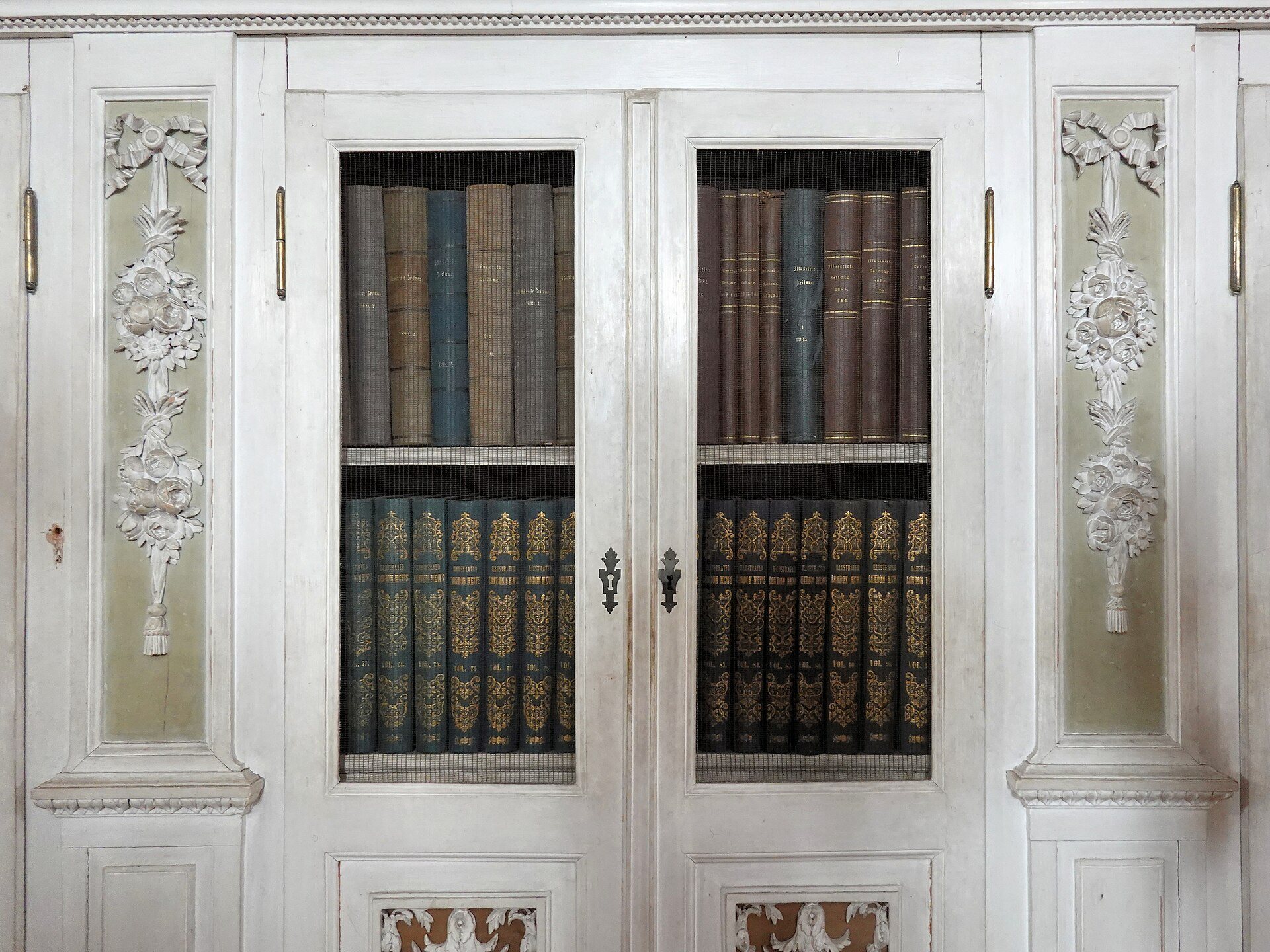
The princely Leiningen library occupies a two-storey former monastery library with a gallery. Its approximately 35,000 volumes are arranged in 100 bookcases. A ceiling fresco by Conrad Huber, dated 1798, represents wisdom, virtue, and the sciences as allegorical female figures. J. B. Berg made the gallery and stair railings in 1797 and 1798.
Seegarten
The former Baroque monastery garden is now the Seegarten, an English-style landscape garden created by Friedrich Ludwig von Sckell between 1805 and 1817. The garden forms part of the post-monastic transformation of the abbey complex after the buildings became a princely residence.